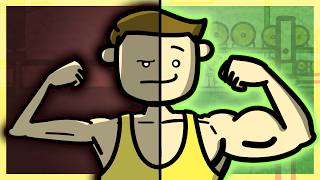

Why extroverts never miss the gym
34sRelates social motivation to exercise frequency, making viewers identify with or contrast their own traits.
▶ Play Clip"Title is slightly exaggerated but mostly accurate; conscientiousness is highlighted as key, but the video covers all traits."
This video explores how the Big Five personality traits—extraversion, openness, conscientiousness, neuroticism, and agreeableness—influence exercise behavior and gym success. It explains why some people are naturally motivated to work out while others struggle, based on scientific research.
Personality influences all behaviors, including exercise, which affects fitness goal achievement.
The model uses five traits: extraversion, openness, conscientiousness, neuroticism, and agreeableness.
High extraversion individuals are motivated by social engagement, leading to higher exercise frequency.
High openness is linked to motivation for mental health and stress relief, but not necessarily increased exercise behavior.
Conscientiousness is the most positively influential trait, associated with intrinsic motivation and follow-through.
High neuroticism leads to exercise to avoid guilt or social pressure, often resulting in lower overall exercise behavior.
High agreeableness may reduce exercise because working out is seen as a selfish behavior, though research is limited.
Understanding your personality can help tailor exercise strategies to improve consistency and success. Future content will explore deeper facet traits and practical applications.
What are the five personality traits in the Five Factor Model?
Extraversion, openness, conscientiousness, neuroticism, and agreeableness.
00:40
How does extraversion influence exercise behavior?
High extraversion individuals are motivated by social engagement, leading to higher exercise frequency.
01:06
What is the relationship between openness and exercise?
High openness is linked to motivation for mental health and stress relief, but not necessarily increased exercise behavior.
01:40
Which personality trait is most positively influential for exercise?
Conscientiousness.
02:19
What motivates people with high neuroticism to exercise?
They exercise to avoid guilt, embarrassment, or social pressure regarding body appearance and weight.
03:03
Why might high agreeableness reduce exercise behavior?
Because working out is seen as a selfish behavior, and agreeable people prioritize maintaining positive relationships over selfish acts.
03:29
Personality Influences Exercise
Establishes the core premise that personality affects gym success.
Five Factor Model Introduction
Provides the scientific framework used to analyze personality traits.
00:40Conscientiousness as Key Trait
Identifies conscientiousness as the most influential trait for exercise consistency.
02:19Neuroticism and Avoidance Motivation
Highlights how negative emotions can drive exercise but lead to lower overall activity.
03:03Agreeableness and Selfishness Paradox
Presents a counterintuitive finding that being agreeable may hinder exercise.
03:29[00:00] Your personality can influence your chances of success at the gym. In this video, we’re gonna look at what different personality traits say about our relationship with exercise. We generally understand
[00:13] that our personality influences basically all our behaviors that means our personality can impact how likely we are to exercise we want to exercise in the first place, which in turn, can impact our ability
[00:28] to achieve our fitness goals. So, by using a bit of science, let’s get to understanding why that one friend is always happy to go to the gym while you’re physically and emotionally struggling with your warm-up.
[00:40] the five factor model to evaluate personality. This model, which is based on decades of empirical research, attributes personality to how much one aligns with five broad but distinct personality
[00:54] traits. These traits are extraversion, openness, conscientiousness, neuroticism, things down one personality trait at a time. First up is extraversion,
[01:06] and enthusiasm for stimulation through social interactions. So, how does extraversion influence exercise? For the most part, Unsurprisingly, people with high extraversion are largely motivated
[01:24] by social engagement. So, places with a lot of people, especially people with a shared interest, like a gym, is perfect for them. That’s between extraversion and increased exercise frequency and physical activity.
[01:40] The next personality trait is openness, which is characterized by high curiosity, creativity, and willingness to try new experiences. Now, high openness is associated with greater motivations to improve mental
[01:53] health and stress through exercise, but it wasn’t related to increased exercise behavior itself. They’re also motivated to engage in more fun and enjoyable activities, which I would assume only masochists
[02:05] maybe it has to do with open people being more easily content with how things are. But, overall, despite the exercise motivations, openness does not strongly influence exercise behavior. Next up,
[02:19] with organization, dependability, and goal-directed behavior. that conscientiousness can positively influence
[02:32] motivations tend to be more intrinsically driven. to exercise simply because they perceive exercise as good
[02:45] is also associated with greater follow-through and consistency. Overall, conscientiousness is perhaps the most positively influential The fourth personality is neuroticism, classified as having emotional
[03:03] instability, anxiety, and negative emotional experiences. traits, people with high neuroticism tend to exercise not to achieve, but to avoid things, like feeling guilty or embarrassed.
[03:17] to improve things like body appearance and weight to avoid social pressure. All in all, high neuroticism tends to lead to lower exercise behaviors.
[03:29] or the tendency to be kind, considerate, and cooperative. Now, the research here isn’t as in-depth as we see with other personality traits. But, surprisingly, what we do have suggests that agreeableness
[03:43] Now the reason isn’t fully clear, high agreeableness are motivated to maintain positive relationships, and engage in fewer selfish behaviors. And going to the gym to work on yourself,
[04:02] although a good behavior, is ultimately a selfish behavior. so we can use a bit more to draw better conclusions. As we can see,
[04:14] there are some clear relationships between exercise and your personality. There’s actually more traits, known as lower-level facet traits, that dig further into the five factor model. And to be completely transparent,
[04:29] although generally well perceived, isn’t completely free of criticism. think about how our personalities can affect our motivations, which we can
[04:41] then use to strategize the best approach for our training. Keep an eye out for more content on this in the future.



⚡ Saved you 0h 05m reading this? Transcribe any YouTube video for free — no signup needed.