
Words have rhythm even when you speak them
56sThe weird robot voice example makes a linguistics concept instantly funny and relatable.
▶ Play Clip"Delivers exactly what it promises: a clear two-step method with real examples; 'secret' is just a hook."
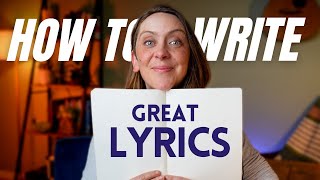
This video offers a practical two-step method for songwriters who have a melody but struggle to write lyrics that fit it. The core insight is that both language and melody have natural rhythms, and the key is to align stressed syllables with the melody's strongest beats rather than starting at the first note.
Lee from the songwriter community asks: 'I create melodies but get stuck with putting lyrics to them or vice versa.' This frames the exact challenge the video solves.
The key mistake is trying to start the lyric writing process at the beginning of the melody. Instead, focus on where the melody's strong accents fall.
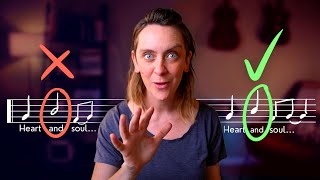
Words and sentences have patterns of accented and unaccented syllables. For example, in 'language has rhythm', the strong syllables are 'lang' and 'rhyth'; changing that stress sounds weird and robotic.
Melodies contain strong notes due to their position in the bar and their relationship to neighboring notes, similar to the strong and weak syllables in language.
A four-note melody and a four-syllable phrase like 'tonight we're here' can still feel odd if the accents don't align with the melody's strong beats.
Take one melodic phrase and identify its most accented or emphasized part. The accent may be at the beginning, middle, or end of the phrase — not always where you expect.
In a song co-written with Benny, the word 'satellites' clicked into the melody's most important beat, and the rest of the lyric syntax immediately fell into place around that key word.
Create a list of lines, images, or phrases that show rather than tell, full of specific details and objects, so you have plenty of rhythm-matched options to draw from.
For a song about nature and technology, the list included satellites, space travel, rocket ships, AI language bots, solar panels, Hubble/James Webb telescope, driverless cars, tablets, streaming services, smart fridges, skyscrapers, pig-grown kidneys, and 3D printers.
Using a longer melody with multiple strong moments, the speaker picks 'ripples' and 'stream' from the word bank and builds a line around those strong beats: 'ripples across my stream / surf all my dreams.'
Placing an empty grammatical word on a strong melodic beat is 'lazy songwriting.' The spotlighted melodic moment deserves a word that carries meaning.
Viewers are invited to join the songwriter community by clicking the link below and can submit their own songwriting questions for future videos.
By identifying the strongest accent in a melody and building a bank of concrete, rhythm-matched words, songwriters can turn the frustrating problem of fitting lyrics to a melody into a repeatable, creative process.
What common problem did Lee describe in his message?
"I create melodies but get stuck with putting lyrics to them or vice versa."
00:16
What is the key mistake to avoid when writing lyrics to a melody?
Trying to start at the beginning of the melody; instead, start at the strongest accented part.
00:30
What does the phrase 'language has rhythm' demonstrate?
Words have accented and unaccented syllables; 'language' always stresses 'lang' and 'rhythm' always stresses 'rhyth.'
01:26
What two components need to align when fitting lyrics to melody?
The stressed/unstressed syllables of language and the stressed/unstressed beats of the melody.
02:39
What is Step 1 of the two-step process?
Take one melodic phrase and identify its strongest/most accented part.
04:48
What word unlocked the lyric in the co-written song with Benny?
"Satellites."
06:59
What kind of list should you create in Step 2?
A list of lines, images, or phrases that show rather than tell, full of specific details and objects.
09:07
Why is placing a meaningless word on a strong melodic beat considered lazy songwriting?
Because the spotlighted melodic moment deserves a meaningful word, not grammatical glue.
12:32
Language carries its own rhythm
Understanding that everyday speech has strong and weak syllables is foundational to matching lyrics with melody.
01:26Start from the strongest accent, not the beginning
This reframes the entire lyric-writing approach and is the core actionable technique of the video.
04:48A single well-placed word can unlock a lyric
The 'satellites' example shows how one rhythm-matched word can generate the entire surrounding syntax.
06:59Show, don't tell: build a concrete word bank
Specific images and objects provide far better raw material for rhythm-matching than abstract statements.
09:07Respect the melodic spotlight with meaningful words
Avoid wasting the melody's strongest beat on empty grammatical words — meaning and rhythm must work together.
12:32[00:04] service I could do that but to me that's lazy songwriters in our songwriter Community what their current challenges or
[00:16] problems were with songwriting anything that I could help them with and I got that I could help them with and I got this message from Lee an baloi Lee says I create Melodies but get stuck with putting lyrics to them or vice versa I'm
[00:30] going to share with you a very practical tip and some may call it a secret but not really a secret it's just a thing the key here is the mistake to avoid is trying to start at the beginning of the melody so this tip is really going to
[00:45] help you identify where you need to start the lyric writing process with the melody that you have Okay so let's dive in there are two things that we need to understand one about lyrics and one about Melody
[01:00] that are really at the heart of this problem okay and once we understand what they are we can start to create a pathway to joining those two things together in a little bit more of a natural and fluid way the first thing to
[01:13] understand is that words and sentences and lines have a pattern of accented and unaccented syllables strong and weak syllables which is to say that language
[01:26] has Rhythm even when we're not singing it when I say language has Rhythm you can hear that there are accented syllables on the syllable Lang and rhyth those are the two strong syllables in that sentence if I change the natural
[01:43] that sentence if I change the natural Rhythm inside words really wonky stuff starts to happen so I could change that rhythmic pattern and say something like this language has Rhythm and it's very weird it sounds
[01:56] Rhythm and it's very weird it sounds like a weird robot gone wrong okay so it turns out that language has this inherent pattern of stressed and unstressed syllables it is true to say that there are some circumstances where
[02:09] those things will change for example in that same phrase if I really want to emphasize that language has Rhythm I've put a little bit of extra Accent on the word has but you know what can't change the word language it is always language
[02:26] it's never language also the word rhythm is always Rhythm it is never Rhythm here in lies the problem when we're trying to bring lyrics and Melody together because
[02:39] the second component is that Melody has stressed and unstressed beats or we could even call them syllables as well I'm going to sing a Melody to you in a really simple 44 meta and demonstrate to you how in this very simple Melody we
[02:53] have the same thing we have some of the notes that because of their position in the bar and position relative to each other are going to be stronger notes into the technical component of this you can feel it in your body 1 2 3
[03:18] melodic Rhythm and the key to everything is actually getting those things essentially to be the same or as close to same as we can so let's take this same m and I'll show you by demonstration so this little Melody that
[03:34] demonstration so this little Melody that goes 1 2 3 4 has essentially four notes if all I'm thinking about is that there are four notes in that Melody and I just need to find a phrase that has four syllables I might just on the page come
[03:49] up with something like tonight we here tonight where here that's four syllables surely that'll match the melody but let's hear what that sounds like 1 2 3 four T
[04:03] tonight you can feel that it feels a little odd and it's true that your problem as a songwriter might not be as Extreme as this you might not be writing things that don't fit together like this but the Insight that Melody has inherent
[04:19] but the Insight that Melody has inherent strong stressed parts of it is really our key into the solution it's the key into finding lyrics that do flow into that Melody without a sense of jarring and also provide us a pathway for
[04:34] generating a lot of lyric ideas that give us options that totally flow with the melody that we have I'm going to break this down into a two-step process break this down into a two-step process for us so the first step of the two-step
[04:48] process is to take one melodic phrase let's just start with one melodic phrase okay the key here is to identify what is the Str strongest part
[05:00] of that Melody what is the most accented or emphasized part of that Melody so is it at the beginning of the melodic phrase in this case it absolutely is
[05:12] phrase in this case it absolutely is when I sing 1 2 3 beginning there's another strong accent but it's not actually as strong as that
[05:27] very first syllable so in that phrase yes the accent is right at the beginning of the phrase but that is not always the case so let me give you a real life songwriting example from a song that Benny and I recently co-wrote so Benny
[05:41] Benny and I recently co-wrote so Benny brought this song idea that had a very specific Melody and I will send you the melody to the first two phrases CU it's melody to the first two phrases CU it's a great example of a Melody where the
[05:53] phrase but at the end of the phrase all right so here is this little Melody so it goes [Music]
[06:10] really hear where the emphasis [Music]
[06:25] to be essentially about technology we wanted it to have lots of images of sophisticated human innovation in a technology space so we kind of knew that technology space so we kind of knew that and with that
[06:44] were trying to find words that fit into that space and as we were singing and holding the imagery in our mind one of us and I can't remember which one said something about satellites satellites and because we'd been singing the melody
[06:59] we both knew that that clicked into the melody into that most important bit of [Music] melody satellites and then what happened melody satellites and then what happened is once we had the
[07:16] satellites It just fits suddenly the rest of the syntax fell into place rest of the syntax fell into place around that key word right now I challenge you to come up with five other words words or short phrases that you
[07:32] could replace satellite with so what else we got B it has to be something that complies to that same little rhythmic unit the key tip here is to
[07:44] rhythmic unit the key tip here is to tune in to where the strong accented parts of the melody are and start finding lyrics there so we're not going to start the lyric writing process at the beginning of the phrase we're really
[07:58] the beginning of the phrase we're really going to focus on finding a word a small phrase that really falls into that strongest moment of the melody another way to think about this is we're really focusing our lyric writing attention on
[08:12] the most important or spotlighted part in the melody not just the beginning of the melody this is really going to come to life in your songwriting when you actually have an idea for a song so it doesn't need to be a fleshed out idea
[08:26] but having a title or having a memory or having an experience or having a story a having an experience or having a story a scene a situation or even just an image or a metaphor that you find compelling can be a great place to start and
[08:40] sitting inside that image in your mind playing that Melody but focusing on the strong part of the melody and trying to find a single word that flows naturally
[08:52] into that space the second step in this little process of bringing lyrics and Melody together is to sit down and create a list of raw material for your create a list of raw material for your lyrics give yourself a lot to draw from
[09:07] now that you are tuned in to the rhythm of the melody now that you're tuned in to where those strong beats are and you're actively looking for words or phrases that have a rhythmic match to the rhythm of your Melody a great way to
[09:23] do this is to start by creating a list of lines images or frame phrases that of lines images or frame phrases that are examples that do showing rather than telling so really trying to include a lot of specific details objects things
[09:41] out there in the world things that show rather than just tell about the idea that you have for your song let me show you the list that Benny and I then sat down and created for this song so we knew that this song was going to be
[09:55] knew that this song was going to be about nature and relationship to Nature but what we were going to do is contrast that with technology so we sat down and we wrote a huge list of as many aspects
[10:08] of human technology and Innovation as we could think of satellit space travel rocket ships AI language Bots solar panels Hubble James web telescope we can see the universe's Beginnings the Inception the nursery driverless cars
[10:23] tablets streaming services smart fridges skyscrapers buildings as tall as mountains kidney grown from a pig 3D printers etc etc I'm going to practice this again and I haven't written anything I haven't pre-prepared anything
[10:37] I'm going to come up with a slightly longer Melody right something that has a few moments of strong stress not just one and I'm going to look back into that same set of lyrics and I'm going to start to find things that going to fit a
[10:51] start to find things that going to fit a slightly longer Melody
[11:06] lines and find some other words that fit those key moments and see if a line starts to flow around those strong points of the [Music] melody so to me it's really the middle
[11:22] and the beginning that are the strongest bits so that's where I'm going to start ripples in space ripples in I like Ripple Ripple I've got the word Ripple
[11:37] Ripple Ripple I've got the word Ripple right there right above it okay so I love that there is a connection here between Ripple which we often associate between Ripple which we often associate with water and streaming which is also
[11:51] water related but streaming service okay we getting somewhere so I like the idea of um surface as a counterpart to Sur this and also surface of water and again with attention to the Rhythm surface K so
[12:07] next half of the melody where I can fit that ripples across my stream
[12:19] and so either surface that something surfacing ripples across my stream
[12:32] my stream Ser so are now this is a great moment because I could do that but to me that's lazy songwriting CU I'm putting all this emphasis on the word r which is to say I'm putting this giant Spotlight on the
[12:46] word r but that doesn't carry any meaning it's kind of grammatical glue there's actually a syllable or a word in that space that deserves that melodic
[12:58] attention so I'm going to keep work work ripples across my streaming Ser surf all my dreams the context here is that the song idea underlying this process is all about technology right so I want to
[13:12] create a section I'm looking at lyrics that are really designed to bring out this idea of technology and my interaction with technology and the ways in which technology manipulates me or influences me or just changes or
[13:29] transforms my experience of reality so this could go anywhere but what we've done immediately is found words and images from the image Bank of technology
[13:42] and started to be really sensitive to how those words actually relate to the melody and you can hear that not only is there a really intimate rhythmic relationship between the lyric and the melody but I'm also drawing from the
[13:57] melody but I'm also drawing from the pool of lyrics that are actually about there are some really nice aspects to this right there's the connection between Ripples and streaming and surface and I also have a nice rhyme
[14:10] between stream and dream so there's a lot of things going on here that are really cool and at the very least are Far Cry from something generic or cliched so Lee I hope that this was helpful to you it's a small but very
[14:25] helpful to you it's a small but very very powerful tip one way in to crack open this puzzle and this problem of finding a way to create lyrics When you have already written a melody and if you are a songwriter who would also love to
[14:40] send us your questions your problems your challenges have us create videos specifically for you as well to help you in anything that you're struggling with songwriting click on the link below to check out all the information about our
[14:55] songwriter community and we hope to see you there happy songwriting you there happy songwriting [Music]

⚡ Saved you 0h 15m reading this? Transcribe any YouTube video for free — no signup needed.