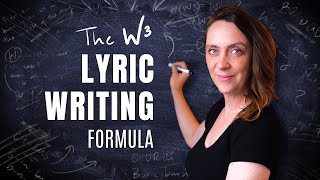

The W3 Formula: Fix Vague Song Lyrics Fast
54sSongwriters instantly recognize their own vague lyrics and want the simple fix.
▶ Play Clip"Title promises a simple formula and actually delivers one — but a mid-video sponsor break and some repetition keep it from being exceptional."
This video presents the W3 formula — a simple three-question framework (Who is talking? To whom are they talking? Why are they talking?) designed to help songwriters write clearer, more focused lyrics. Through real song examples and a common pronoun mistake, the host demonstrates how to establish perspective and intention in any song.
The W3 formula consists of three questions to ask of any song idea: Who is talking? To whom are they talking? And why are they talking? It helps make lyrics clear and focused.
Establish the perspective quickly by using specific pronouns like I, me, my, and mine. This attaches the idea or emotion to a real human being, helping listeners connect emotionally.
A line like 'Across the barren earth, the sunset turns from tea to wine' is evocative but lacks a person. Adding a pronoun — 'He looks across the barren earth' — instantly creates a character and raises questions about who they are.
The famous first line 'cool wind in my hair' uses first-person perspective. The alternative 'cool wind in the air' lacks that sense of who is experiencing the scene.
The second question is about the addressee. In 'Texas Sun' by Leon Bridges, the narrator speaks to a specific 'you', and we as listeners listen in on that conversation.
In 'What's He Building in There', the narrator uses 'he' and 'him' and addresses the listener directly, creating a gossipy complicity. This shows how point-of-view structure can serve the song's intention.
The 'why' is the trickiest but most important part. A song coalesces once the writer crystallizes the intention behind it. Asking 'Why does this song exist?' clarifies the message and helps finish the song.
Switching between pronouns like 'she' and 'you' when referring to the same character can confuse listeners. The Eleanor Rigby example shows how changing one word makes the lyric feel off, even if listeners can't pinpoint why.
The W3 formula — Who, To Whom, Why — gives songwriters a simple but powerful way to keep lyrics focused and emotionally clear. By consistently maintaining perspective and avoiding pronoun switches, writers can ensure their songs connect with listeners.
What are the three questions in the W3 formula?
Who is talking? To whom are they talking? Why are they talking?
00:30
How can you quickly establish perspective in a song lyric?
Use specific pronouns like I, me, my, and mine as early as possible to attach the emotion to a person.
01:11
What is the effect of adding a pronoun to a descriptive line?
It puts a person in the scene, making the listener wonder who they are and connecting emotionally to the imagery.
02:17
Which song contains the line 'cool wind in my hair' and why is it effective?
Hotel California. It uses first-person perspective ('my hair') rather than 'the air', creating a sense of who is experiencing the scene.
03:11
In 'Texas Sun' by Leon Bridges, who is the narrator speaking to?
A specific 'you' — the songwriter is singing to a particular person, and the listener listens in on that conversation.
04:05
How does Tom Waits use point of view in 'What's He Building in There'?
The narrator talks about a neighbor ('he') to the listener, creating a gossipy, complicit tone rather than addressing the neighbor directly.
07:48
What is the most common lyric mistake discussed in the video?
Switching between different pronouns (e.g., 'she' to 'you') when referring to the same character, which confuses listeners.
12:25
Why does a song truly coalesce according to the video?
When the songwriter crystallizes the intention behind the song — when they can answer why the song exists.
10:11
W3 Formula: A Three-Question Framework
Provides a simple, memorable structure that songwriters can apply to any lyric to gain clarity and focus.
00:30Pronouns Attach Emotion to a Person
Shows that using 'I/me/my' early humanizes the song and forges an emotional connection with the listener.
01:11Point of View Can Serve the Song's Intention
Tom Waits' example demonstrates how talking about someone rather than to them creates a unique complicity with the listener.
07:48Intention Is What Makes a Song Coalesce
Highlights that clarity about a song's purpose is the key to finishing it and making it emotionally focused.
10:11Pronoun Switching Is a Subtle but Common Mistake
Warns against a tiny change that can quietly disconnect listeners from the story, without them knowing why.
12:25[00:02] recording app made for musicians by musicians. There's no question that songs are one of the most effective and emotionally rich forms of communication. But squeezing our heartfelt stories into song form is rarely easy, and we often
[00:15] find ourselves lost, confused, and overloading our songs with multiple messages and perspectives. So, in this video, we're going to show you the W3 formula for making your songs as clear, focused, and lyrically strong as they
[00:30] we're going to show you one of the most common mistakes that songwriters make in their lyrics, and also show you how easy it is to it is to avoid. The W3 formula is simple. Each W
[00:43] stands for a single question to ask of any song idea you're working on. The first W question, who is talking? Being clear on who is telling the story helps us as songwriters maintain focus on what story we're
[00:58] practice as songwriters, when we start the songwriting process, it's very common that we're mining our own emotion and experience or ideas, concepts, thoughts about the world for the purposes of songwriting. But the idea
[01:11] here is as quickly in our lyrics as we can to establish the perspective in a really practical sense by using a specific pronoun. If it is us telling the story and we're telling it from our perspective, getting the pronouns I, me,
[01:25] my, and mine in as quickly as possible attaches an idea or an emotion to a person, to a human, to an actual individual's experience. And as soon as
[01:37] a listener can see a human being in their mind's eye telling this story, they connect emotionally to the ideas, the imagery, the emotions, or the concepts that we're writing about in our song lyrics. So, let's take a line like
[01:52] this. Across the barren earth, the sunset turns from tea to wine. Sounds beautiful, poetic, lovely imagery. What's the problem? The problem
[02:04] imagery. What's the problem? The problem is that there's no person in this scene. It's nice imagery. It's evocative. But watch the shift that happens by simply watch the shift that happens by simply adding in a specific pronoun that puts a
[02:17] person in this scene. He looks across the barren earth as sunset turns from tea to wine. And the shift for me was really one of now observing someone
[02:29] observing this sunset. I also started wondering who is this person? So adding that pronoun actually creates a lot of questions for us as the listener because we've been introduced to a character that we know nothing about yet. So we
[02:41] pronoun in early. But we can also have the description come in and then delay the introduction of the pronoun. So we could have across the barren earth the sunset turns from tea to wine and I wondered if I'd ever see her again.
[02:57] In either of these examples, there is very quickly the introduction of the specific point of view of the lyric. We're not waiting around as listeners to We're not waiting around as listeners to find out whose perspective is this song
[03:11] from. So if we think of a song like Hotel California, that first line is on a dark desert highway, cool wind in my hair. And there's an alternate universe in which that lyric is on a dark desert highway, cool wind in the air, which
[03:26] completely lacks a sense of perspective. In the examples we've just seen, we've actually used two different pronouns. So, we've heard the sort of I, me, mine, So, we've heard the sort of I, me, mine, first person, but we also heard he looks
[03:38] opens things up creatively. We can absolutely write songs in the third person where we as the songwriters are not active participants in the story. We are the storytellers. Which leads us
[03:51] nicely to our second W in the formula. Because if the first W is who is Because if the first W is who is talking? The second W is to whom are they talking? Let's use a quick snippet of a contemporary example. Here is the
[04:05] opening lyric to the song Texas Sun by Leon Bridges. You say you like the wind blowing through your hair. Come on, roll with me till the sun goes down. Texas
[04:17] with me till the sun goes down. Texas sun. The very first word in this song is you. But there's also me in this song. So in this song, it's very clearly that So in this song, it's very clearly that I, the songwriter, am speaking to you.
[04:32] But when we as listeners listen to this song, we don't assume that Leon Bridges is kind of like reaching through the speaker and talking to us, he's writing speaker and talking to us, he's writing a song to a specific person. And we as
[04:46] listeners are identifying with the sentiment, the emotion, the singer of identifying with the person he's singing to. But it's clear that Leon Bridges has to. But it's clear that Leon Bridges has a singular person in his mind to whom he
[05:01] is singing this song. So if we were to represent the point of view that Leon Bridges is using in this song, it would look like this. We have the storyteller, the songwriter speaking to this other person
[05:14] in the song. We as the listeners are listening in on this conversation. This tested way of writing songs. This is what you hear in a lot of love songs where the storyteller or the songwriter is talking to this other person. They're
[05:29] reaching out to this other person to express their feelings of love and gratitude. Whatever the message might be, we as the listeners are listening to this conversation take place. But it's important to recognize that there's a
[05:42] there is no you. There is I, me, my mind. It's the songwriter, narrator speaking and singing about their experience, their emotion, their ideas. Often that's what we do when we sit down to write a song. We're trying to work
[05:56] through an idea or an emotion and there's not necessarily a specific you to whom we are speaking. Graphically, the way that we can see that visually is simply that the singer narrator is singing a song and it's reaching towards
[06:10] the listener. The listener is the intended audience without there being a specific you. There's no other individual on the stage of this song in the theater of this song world. There's not another character. There's just the
[06:24] singer on stage solo singing about their experience. But being really clear about experience. But being really clear about that is helpful because songs that start that way but introduce a U at the very end of the song can suddenly feel like,
[06:37] in the song? And that's really what we're getting at here. Being clear about to whom we are singing this song is really important. This idea of talking to yourself or processing a theme or a concept and letting the idea go out
[06:54] target, but without talking to the listener is also very common for songwriters. Time to have a quick look at Tape. It a pro audio recording app perfect for songwriters and musicians who are looking for a better way to
[07:07] capture and organize their original ideas. Tape it allows you to record in stereo, set markers on your audio files, and importantly has been designed in such a way that you can easily organize and group your recorded ideas, share
[07:19] them privately with other people, and even add photos and additional text. You can download it for free from the app store and for a 20% discount on Tape It Pro, you'll find a link in the show notes. Given that that is common for a
[07:32] songwriter to be talking from their perspective but not to a specific you. Let's build on that to explore some other points of view that still have a very clear sense of who is speaking and to whom they are speaking. A song that
[07:48] kind of point of view is the song what's he building in there by Tom Weights. What's he building in there? What the hell is he building in there? He has subscriptions to those magazines. He never waves when he goes by. He's hiding
[08:02] something from the rest of us. He's all to himself. I think I know why. From a point of view perspective, we have the presence of an I pronoun. So, we know that the songwriter narrator is a character on the stage of this song.
[08:18] But we also have he and him. We also have this other person on stage and he's is the really interesting part about this song. He's not talking to this
[08:31] other person. He's talking about this other person. He's really talking to us, the listener. When he says, "What's he building in there?" He's saying it out loud. He could be saying it to himself, but it feels like he's including us in
[08:45] the conversation in a gossipy kind of tone that makes this structure so talking about or the person Tom Weights is talking about has no idea he's being talked about. This Tom Weights lyric actually brings us really beautifully to
[09:00] actually brings us really beautifully to the final W in the W3 formula. And that the final W in the W3 formula. And that final W is why. So we have who is final W is why. So we have who is talking to whom are they talking and why
[09:12] are they talking? So why did Tom Weights write this song? Why did he use this point of view structure? Well, it seems like the whole point of that song, what's he building in there, is to kind of make us
[09:25] complicit in this gossipy rant about a neighbor. That's the whole structure. And that song goes on for quite some time where he repeats that structure and never addresses the neighbor himself. It's always talking to us. So Tom
[09:40] Weights is deliberately using that point of view structure to serve the intent behind that song. The why of a song is actually the trickiest part and probably the most important part of a song. It's tricky because so often when we sit down
[09:55] writing a song. We're just songwriting to write songs. Often we write to figure out why we're writing to figure out what exactly we're writing about. But a song really becomes a song and coaleses around idea at the moment where we
[10:11] crystallize on that intention for a song. And that's really when we achieve this focus and clarity in our lyric writing, when we can connect with a writing, when we can connect with a sense of what is the intention behind
[10:24] this song. But let's turn this abstract idea into something really practical and really usable. So here is a list of questions you can ask yourself during the songwriting process. And this is often most helpful when you're halfway
[10:37] through a song and you're stuck. you're not sure how to move forward with the song because you're not really sure what you're trying to say in the song. You can also download a free PDF that we've put together of these questions and more
[10:50] that you can use as a checklist for any song that you're writing. So, a question you can ask is why does this song exist? Are you processing an experience? Are you trying to persuade? What is the motivation for writing the song? What do
[11:06] you as the songwriter need to say or express? What is the feeling you want a listener to walk away with? That last one is such a big one because really trying to finish the song, trying to get that last piece of
[11:21] the puzzle in place can sometimes all be about answering that question, how do we want people to feel at the end of this story? And that forces us to really question what kind of story we're trying to create. And it's not just the end of
[11:33] the song. Sometimes it can be the heart of the song, which is to say the chorus or the refrain line can really come about when we get clarity around what is it that I want someone to walk away feeling from this song. It's not
[11:46] necessarily enough to just have a theme. For example, you might want to write a love song, but there are so many different types of love songs. And so people are really in love with each other and want to express that
[11:58] gratitude, but at the end they realize it just can't be. They can't be love song than two people reflecting on a relationship that's still going strong after 30 years. So the idea of love as a theme gets us in the ballpark. But
[12:12] really answering this question of why does this song exist? What do I want to say is the thing that helps you get specific and get to the end of the song. So here we are at the most common mistake we often see in songwriter
[12:25] songs. It's a mistake that's easy to make, but it's also very easy to avoid. So, the mistake is switching between different pronouns when you're talking about the same character. Let's look at the lyrics to a very familiar song to
[12:38] see how easy it is to get this wrong. The original lyrics go, "Elanory picks up the rice in the church where the wedding has been. Lives in a dream. Waits at the window wearing the face that she keeps in a jar by the door. Who
[12:52] is it for?" Now, here's the same lyric with one word changed. Eleanor Rigby picks up the rice in the church where the wedding has been, lives in a dream, waits at the window wearing the face that you keep in a jar by the door. Who
[13:07] is it for? Now, it might sound a bit ridiculous because we're familiar with the actual lyric of Eleanor Riby, but this is something that we see all the time in songwriter songs. And it's a really natural thing to do because often
[13:22] of seeing a scene and we're seeing some characters, particularly if we're writing about someone. And it's actually a very natural and intuitive thing to want to zoom the camera lens in as the song becomes more emotional or more
[13:38] intimate. And often the way that we might unconsciously do that is by switching from he, she, or they to you because you feels a lot more intimate. But the real problem is that this is such a subtle issue that it often goes
[13:55] overlooked. And we find that when we're doing feedback sessions, the songwriter hasn't picked up on it because they're immersed in trying to bring this theme and this story to life. But that one word, that switching between she and you
[14:08] can be enough to just confuse the listener. And they might not even know why they're confused. They might just disconnect with the song and the story, but not really be able to pinpoint that that is the reason. So this is why we
[14:20] need to be so mindful of sticking with the perspective we start with so as not to confuse the listener. One caveat to that Benny I think is important because true. It is true that there are some
[14:34] very well-known, very beautiful, very emotional songs that absolutely do this pronoun switching. And often there are other things going on in the song that help carry us through with an emotional logic that is not confusing. But those
[14:48] songs are few and far between. So if you're struggling with a song, just pause for a moment and ask these three questions and feel the impact of the clarity and the focus that comes into your thinking and your intent as you
[15:02] you're interested in more help and guidance with lyric writing, check out this video right here. Happy songwriting. Bye.


⚡ Saved you 0h 15m reading this? Transcribe any YouTube video for free — no signup needed.