
How Many A+ Trades Do Top Traders Really Take?
42sThe shocking revelation that top traders take only one A+ trade per month (or less) sparks curiosity and challenges common trading advice.
▶ Play Clip"Delivers on the promise of an unfiltered dinner with top traders, but the heavy promotional segment at the end and some filler questions dilute the value."
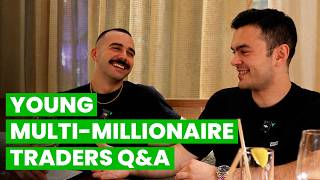
This video offers an unfiltered, behind-the-scenes look at a private dinner with two top traders from SMB Capital, Nano and Max, who generated nearly $50 million in yearly trading profits. They answer hard-hitting questions from the trading community about grading setups, dynamic risk management, protecting mental capital, scaling risk, and leveraging modern tools. The conversation provides rare insights into the mindset and strategies of elite traders, emphasizing extreme selectivity and the importance of psychological resilience.
The video is set at Uchi, a high-end Japanese restaurant in Miami's Wynwood District, featuring Nano and Max from SMB Capital, a team that generated nearly $50 million in yearly trading profits. They answer questions submitted by the Twitter trading community.
Nano explains that B trades can occur as often as 4-5 times a week, but A+ trades are rare, with more than one per month being too loose. The risk differential between B and A+ trades is drastic, with A+ trades risking five times more than B trades.
Reflecting on the past 4-5 months, Nano recalls only a few A+ trades, such as silver and gold in January, with the previous ones occurring in October or November. The extreme selectivity is crucial for avoiding pitfalls and drawdowns.
Max states that A+ setups need a hit rate of 90% plus. If you get an A+ trade dead wrong, it can screw you up, but if you don't size up enough, you're doing something wrong. This is a performance-based job, and not putting on as much risk as responsibly possible in A+ trades is a mistake.
The team focuses on bigger opportunities with higher expected value (EV) but less certainty, applying a 'less is more' theory. By focusing on their absolute best and biggest trades, they can nail A+ trades and put up six or seven-figure results.
Even on big days, Max might scalp smaller plays for a few thousand dollars while also trading for a seven-figure trade. This is possible because they have the bandwidth and training to handle multiple symbols, and sometimes 15 seconds can feel like an eternity, allowing them to capture extra edge.
The team's mindset varies daily. On some days, focusing on squeezing out an extra $5-15k is not a good use of mental capital, while on slow days, making $4k is appreciated. It's a professional evaluation of the best use of mental and physical capital.
Nano mentions an internal body mechanism that signals when he's putting on poor quality trades. By differentiating risk levels, mistakes are kept to a point where they don't impact the week or month. The separation between risking $20-30k on lower-quality trades and $500-600k on A+ trades is massive.
Making mistakes over and over can be okay as long as they aren't applied to B+ or A+ trades. You can make a bunch of starting mistakes, but understanding what your A+ trades are requires grinding through lower-quality trades to find the best nuances.
You can't develop a great trading model without seeing what goes wrong first. This is a key part of the iterative process of refining strategies.
Nano explains that each of his biggest trades has led to the next stage of risk. You want to responsibly increase risk as much as possible without long-term harm. For example, if you risk $1,000 and have a $3k win, don't increase risk to $2,500 where two bad trades give it all back. Increase to a point where max risk on the next great trade keeps you growing without harming yourself long-term.
Max emphasizes that any size-up should come from true consistency, not just one win. You need a lot of consistency before sizing up a strategy, and it's important to outline what that strategy makes P&L-wise and risk-reward-wise. Avoid sizing up a strategy you're not good at.
The job is very mental, especially when starting out. Going from risking $1,000 to $5,000, $10,000, or more can impact you psychologically. It's important to grow risk at the same level as your human psychology can handle.
Having colleagues like Raph on the call helps keep numbers in perspective. Separating what dollar values can accrue in life versus the trading account is crucial. When starting out, the account might represent months of survival, but at a firm, growth is capped by firm resources, which is effectively infinite, allowing you to think of money as points in the game.
One of the biggest stresses of the job is not the skill itself. Day trading skills can be taught to many people, but incorporating human psychology and the human toll is the hard part. Executing correctly and putting on A+ risk without stressing out is a key differentiator.
On A+ trades, if you only make 4x instead of 8x, that extra 4x could be the entire difference and could be your entire capital for the next 20 years. This is why sizing is so different for A+ trades, and it's the reason why you might not grow as fast next year if you don't execute them well.
During the 2022 drawdown, the team didn't make as much on the incredible trades of 2023 with regional banks because they were down. Getting out of the hole and starting green pushes how much more you would have made in 2024 and 2025. Everything cascades.
Alex asks how to best determine if you truly have edge and if refining one or two core setups is the way to become profitable. Nano's first instinct is to use AI for backtesting, but there's a more practical answer for those not interested in programming.
Having edge in a trading system aligned for a starter trade versus a B trade versus an A+ trade is vastly different. Losing once on a strategy doesn't mean it doesn't have edge; it might be a higher-variance strategy, hence risking less on it.
If you're just starting out, you don't know what your one or two A+ trades are. You have to go through the B's, B+es, and starters to refine your trades and truly craft your A+ trade. It's part of any trader's journey.
It can be naive for a trader to think they've found their core strategies after a good first year. Markets change significantly per year, and being humble is crucial. The team lost seven figures in 2022 and had to refine their strategies. They used lessons from 2022 to slow down strategies during a similar slow period, avoiding the same drawdown.
You have to be active in analyzing what works and what doesn't to keep refining A+ trades. Understanding what made an A+ trade and the environment is essential. If you become oblivious to everything else, you'll miss out on information that could refine your craft.
Anytime you feel like you should only focus on one or two things, the market will do an incredible job of humbling you. A big loss will always hit you, and you'll have to look back and realize how to fix it. Finding ways to grow from those moments is critical.
A study by researchers at UC Davis found that 99% of active retail traders never reach long-term consistent profitability, far worse than the generally quoted 90%. At SMB Capital, new stock traders reach sustaining, consistently profitable status at roughly 20 to 40 times the rate of independent retail traders.
The video promotes a detailed video dissecting why SMB Capital has a higher success rate and offers three cheat sheets with exact entry, stop, exit, and execution rules for three top-performing stock trading strategies.
How often do A+ trades occur according to Nano?
More than one A+ trade per month is probably too loose.
03:34
What is the risk differential between A+ and B trades?
A+ trades risk five times more than B trades.
04:03
What hit rate do A+ setups need according to Max?
A+ setups need a hit rate of 90% plus.
05:25
What is the 'less is more' theory in trading?
Focusing on the absolute best and biggest trades is how you truly nail A+ trades, rather than trying to capture every small scalp.
06:35
How does the team keep mistakes from impacting their week or month?
By differentiating risk levels, mistakes are kept to a point where they don't impact the week or month.
09:59
What is the recommended approach to increasing risk after a big win?
Increase risk to a point where if you use max risk on the next great trade, you can keep growing without harming yourself long-term.
12:25
What is the key to sizing up a strategy?
Any size-up should come from true consistency, not just one win. You need a lot of consistency before sizing up a strategy.
13:37
What is the biggest stress of the trading job according to the speakers?
The biggest stress is not the skill, but incorporating human psychology and the human toll into the job.
17:08
What percentage of active retail traders never reach long-term consistent profitability?
99% of active retail traders never reach long-term consistent profitability.
26:15
How much more likely are SMB Capital traders to become consistently profitable compared to independent retail traders?
SMB Capital traders reach consistent profitability at roughly 20 to 40 times the rate of independent retail traders.
26:29
Extreme Selectivity of A+ Trades
Reveals that top traders only see a few A+ trades per month, emphasizing the importance of patience and selectivity.
03:34A+ Trade Hit Rate and Sizing
Highlights the high hit rate required for A+ trades and the necessity of aggressive sizing to maximize performance.
05:25Mental Capital Management
Emphasizes that managing mental capital is as important as financial capital, a key principle for sustainable trading.
08:14Risk Scaling Method
Provides a concrete approach to increasing risk responsibly, avoiding long-term harm while growing.
11:58Psychology Over Skill
Challenges the common belief that trading skill is the main barrier, pointing to psychology as the true differentiator.
17:08Humility and Market Adaptation
Stresses the need for humility and continuous adaptation as markets change, using past losses as learning opportunities.
23:31Retail Trader Success Rate
Cites a staggering statistic that 99% of retail traders never achieve consistent profitability, highlighting the difficulty.
26:15[00:01] get an invite to this table. Tonight, we're pulling up a chair. We're at Uchi, a high-end contemporary Japanese restaurant in Miami's Winwood District for a raw, unfiltered look at an SN trading team that generated nearly 50
[00:17] million in yearly trading profits. This isn't a polished interview. It's a behindthescenes dive into the minds of Nano Midseigure Pro and Max 8 figure producer as they answer the hardest question submitted by you, the trading
[00:32] community. Now, previously we'd asked our Twitter trading community to submit our Twitter trading community to submit questions for this top team. Nano and Max at this dinner step forward to answer those questions for you at this
[00:46] private dinner. Here's what you're going to learn tonight. One, the importance of grading setups. The most prominent lesson is the extreme selectivity required for top tier performance. Number two, dynamic risk management.
[01:02] Highle traders do not risk the same amount on every trade. They leverage their best ideas with significant size. As Max says in this video, if you're not putting on as much risk as you responsibly can in those A+ trades, then
[01:17] responsibly can in those A+ trades, then you're doing something wrong. Three, protecting your mental capital. Managing your mental capital is as important as managing your financial capital. For this team, focusing on a few massive six
[01:31] or seven figure opportunities pays out more in the long run than trying to capture every small scalp. for responsible risk growth. Scaling a trading career requires a systematic approach to increasing risk without
[01:47] dampening your career. Nano and Max discuss how they scale. Five. Leveraging modern tools and adapting to markets. The journey to becoming a master trader
[01:59] is iterative and increasingly aided by technology. Traders must remain humble as markets change. Lessons learned in difficult years like they talk about quite openly like in 2022 provide the blueprint for staying safe during future
[02:15] slow periods. Okay, this is going to be fun. Take out your notebook and get ready for two traders who will inspire you to be great. Hey, if you find this interesting, we've put together a special video, a day in the life of a
[02:30] top trading team with these guys and their team. Subscribe so you don't miss their team. Subscribe so you don't miss it.
[03:01] shorting puts probably works. That doesn't make sense. premarket already? The video is starting to go back up.
[03:20] Hello. A question from Germany. How many trades do you make on an average day? trades do you make on an average day? How many B and A plus setups per year? videos. That's for you, Ker. I like your videos.
[03:34] Um, okay. So, I mean, I'll start off. I mean, terms of B trades, I mean, those can come as often as five times a week, four times a week. But a A+ I think definitively I can tell you if you're getting more than one A+ a month.
[03:50] >> If that, yeah, >> if that, you're probably too loose with >> Would you say that's right? >> Yeah. I think that what's very like critical is that the risk differential between our B's
[04:03] and our A's is drastic. So for example, I think that we risk what five times on our A's that we do on our B's. >> So for us to level up that much, it has
[04:16] to essentially hit every single nuance. >> If I think back right, this is February 2026. How many a trades over the last four or
[04:29] five months? I can think about silver and gold in January and then I think that we have to go back until probably October or November until we had truly a a trade >> when things actually popped before
[04:44] things popped. Um, and like the reason for that is because we're going to put so much more risk on those because stats and we have so many trades. We know that in the long run, us putting so
[05:00] much extra risk on these, it's going to work. So whether or not that this particular trade wins or loses, it's going to work in the long run. Um, and that's why we put on so much more significant risk. That's also why we're
[05:13] not taking as many of these. Uh, and being super critical with how we grade these trades is how we kind of like stay away from pitfalls and draw downs,
[05:25] honestly. >> Yeah, sounds about right. I think um, you know, a A+ setups, they need to be probably a hit rate of 90% plus >> because it's not often that they're actually the best for score trades. A+.
[05:40] I mean, if there's a a A+ trade and you get it dead wrong, you will screw up >> Yeah. Absolutely. Yeah. And if you don't, then you're not sizing up enough. don't, then you're not sizing up enough. >> Yeah. And I think that with this job, if
[05:52] you're not sizing up those those best trades, then you're doing something wrong. Like like this is ultimately a performance-based job. And if you're not putting on as much risk as you can responsibly do in those A+ trades,
[06:06] then you're doing something wrong. I agree. Cool. >> Yeah. >> How do you decide to forego your daily easy money trades? >> Wow, Lance is really just spreading
[06:19] across the whole community. And focus on a bigger opportunity with bigger EV but a bigger opportunity with bigger EV but less certainty. scalability is so important. you have to just like think about
[06:35] what is going to really pay you out in the long run. And I think that this is kind of the like less is more theory. The sense that us focusing on our
[06:47] The sense that us focusing on our absolute best and biggest trades is absolute best and biggest trades is how we truly nail those A+ um there's only so much bandwidth that
[07:00] there is and if you go in uh every day and try and capture each little scalp, you know, there's just so much that that um we can do. But on those biggest opportunities truly laser focusing on those, I mean, that's how we put up some
[07:16] of our best six, seven figure trades. >> Yeah. And I mean, I think at the end of exclusive. Like on the big days, I still look over and Max is still scalping stands out to me is like even the Beyond day. We'll be hitting sympathy plays of
[07:33] be trading for a seven figure trade on Beyond, but you'll look over at some bid that I really want to hit here." And you're going to make 2 or 3K on the to something else. >> Well, sometimes I do that just like you.
[07:48] "Why is he wasting his time on this?" But >> we have bandwidth. We're trained to handle more than one symbol. >> And 15 seconds sometimes feels like an eternity in trading when something is
[08:01] halted, for example, and you'll switch over, hit another symbol because you have edge there and you know, maybe you make an extra five or 20 grand and >> Yeah. I mean, also I'd say that our mindsets
[08:14] each day is totally different. One day you could be thinking, "Okay, I'm sitting here and like we're moving hundreds of thousands of dollars per day hundreds of thousands of dollars per day trying to like focus and squeeze out an
[08:28] trying to like focus and squeeze out an extra 5 10 15k. It's not a good use of our like mental capital." And then there are days where things are so slow and we're sitting there and we're like, "Damn, you made four grand on that."
[08:42] "Damn, you made four grand on that." Right? add it really just is a question about evaluating that day. You know, it's not really a question about losing touch with what the value of making the money is. It's more a professional
[08:57] evaluation of what is the best use of our mental and honestly in this job physical capital. >> Yeah, absolutely. >> What's the solution when you find yourself repeating the same mistakes?
[09:15] that anytime that I know that I'm putting on kind of poor quality trades, one I get that internal body like mechanism where I'm like, I know I'm doing something stupid. It's kind of like those those like moments when we
[09:31] put on a trade and we talk to each other on call and then 4:05 p.m. hits and then done that. >> Why are we so many contracts? >> Yeah. like like I know that like we'll be on call and be 355 and like I know
[09:46] are. >> Um >> Um I think that sometimes at least for us by really differentiating I think how
[09:59] much we're like risking on trades. We keep like the mistakes to a point where it's not actually impacting our week or our month. Like for example, we put on a stupid, but like we're like, "All right, we probably shouldn't have done that."
[10:14] We're not looking back on last year and being like, "Oh, it was the stupid trades that is difference between what we made and what we could have made." I think that by further differentiating the risk separation and by consistently
[10:30] grown. I mean, you're talking about we talk about risking let's say 20 30 grand on stuff. We were still talking about risking 20 30 grand and only risking two 300k on our A's and now they're I mean like we're moving 500K 600K on those
[10:46] A's. That is a massive separation in those A's that we're doing without also those A's that we're doing without also increasing our lower quality trades. So it might be a situation where it's a like a necessary evil, but at least
[11:01] we're not we are improving our separation between what actually matters and what doesn't in terms of our, you know, stats and stuff. >> Yeah. I mean, I think I think because of our grading system,
[11:14] making mistakes over and over again can be okay so long as those mistakes aren't applied to B's in the plus. >> Yeah. You know, you can make a bunch of starting mistakes and that's okay. >> It's also like how do you know what your
[11:27] A's are without understanding what like the lower quality trades were? Like we wouldn't have determined what our best trades are without grinding through all the BS of like the lower quality trades >> and finding the best nuances.
[11:42] >> How you develop a model, right? You can't develop a great trading model without seeing what goes wrong first. >> Yeah. Fabio's question. Can you explain a clear method to increase the risk unit? For example, if I risk $200 per
[11:58] trade when I get three R of net profit 600 over a cluster of 10 trades, rise the risk by $250. So, I think that we're all the same in the way in which we
[12:11] way in which we grew our risk. In my eyes, each one of like my biggest trades has kind of led to the next stage of my risk. I think that you want to responsibly increase your risk as much as possible
[12:25] without putting yourself in any long-term harm. So, for example, long-term harm. So, for example, let's say that your risk is $1,000 and you put up a 3K trade. Okay, fine. Massive win. Don't increase your risk to
[12:43] 2500 where you have two bad trades and then you like give it all back. RI increase it to a point in which if you use max risk on the next really great
[12:55] trade, you can keep yourself in that line where you are growing without harming yourself long term. You know, like for example, when we were really in that sizing up portion of our career, I was always like, man, we're we're like
[13:12] four daily stops away from giving everything back. But the way it's structured is that, you know, one, if you were to lose that, then you wouldn't you were to lose that, then you wouldn't still have that same risk, but two,
[13:25] still have that same risk, but two, it's it's so important to like understand the risk of every single trade and make sure that no particular
[13:37] moment dampens your entire like trading career. Yeah, I think we've done a really good job, I mean, at at making sure that any size up we've had has come from true consistency. And I think that um you know, you can't just take one
[13:51] win. I mean, here you mentioned that you'd want, you know, 10 trades, right, before you increase by 25%. It's probably a bit conservative, but want to look for. You you want a lot of consistency
[14:05] before you find yourself sizing up a certain strategy. And I think just outlining what that strategy makes P&L-wise and, you know, riskreward-wise makes the most sense. And remember, just because you size up that strategy
[14:20] sized up. And we've made that mistake before where size up as traders in sized up in a strategy that I'm not that good in. Um, >> I would also like just say this on like
[14:34] a more like serious note is that I think that in this job so much of it I think that in this job so much of it is mental and especially when we're starting out. We both came from like similar backgrounds. You go from a point
[14:49] in which you're risking $1,000 to like 5,000, 10, 20, 50, whatever. the money seems extremely real like when you're doing that and it still is very real. But I think it's so important to understand that this is still a very
[15:05] understand that this is still a very human job and you can't just go from human job and you can't just go from risking $1,000 to five or 10 or 25 and not understand that seeing those dollar values are going to impact you
[15:18] psychologically. And it's very important that you grow in your risk at the same level in which you can with your own human psychology grow >> I think we've done a good job though of having like guys like Raph for example
[15:34] on the call who won't he who'll be like oh what are you talking about when they mention when you mention a number like you know just arbitrary numbers here but about? Yeah >> that doesn't matter. That's totally
[15:47] >> Um, >> of course I I I just think separating ourselves of what those dollar values can actually acrue you in life versus >> That's one of the benefits obviously that we've had being on the call and
[16:00] then all but I'm saying is that in theory for for your average like person >> and that's the benefit of finding a somewhere that you can trade that has >> you know you're not thinking about your your trading account as your next rent
[16:14] payment. That's a problem. When me and our mom first started out, we were >> And all of a sudden, the the money that you see in that account is like how many months you have left to survive, right, before you have to go like in debt or
[16:29] something. Uh, you know, as opposed to when you're working at a firm where your growth is capped by the firm's resources, which is for most people effectively infinite. um you're actually in a different
[16:42] position where you're you're you're just thinking about the money quote unquote as as points in the game >> and you just want to get as good of you know at the game as possible. >> And it's it's not it's not a matter of
[16:55] what the points, >> you know, how much how much you can acrew in points without losing too many. >> Yeah. P&L, right? >> Oh, that's fair. You know, I think that
[17:08] much stress on themselves in these situations because it's so much easier account. >> Well, yeah, but like >> Yeah. >> I mean, growing a 25K account with a PD
[17:22] rules is >> Well, even if let's say you have a six pay bills. >> Yeah, of course. I do think that one of the biggest stresses of this job is not the skill. I
[17:38] honestly think that you could probably teach day trading skills to many people >> Really? >> It Yeah. It's it's how do you incorporate the human psychology and the human toll into this job and then can
[17:53] >> Yeah. >> Right. Like >> could you execute correctly and actually in those moments put on A+ risk? Like >> without stressing out over the over >> could you for example know damn I really
[18:09] >> Yeah. >> Could you do that but like mentally know >> And when you see an A+ trade and you're up 5R you're like oh I got to take that. up 5R you're like oh I got to take that. >> Yeah. Because that's that's lifeanging
[18:23] reach the actual target yet." >> Those are all extremely hard things. And that's kind of what really differentiates your success cuz like you think about those those best trades, you put on A+ risk, quiet.
[18:54] only make 4x instead of eight. That extra 4x could be the entire difference. And that could be your entire capital that you are risking for the next 20 >> And that's the whole reason that you're sizing things so differently. Yeah. For
[19:07] those A+ that sizing is a reason why you're not growing as fast next year. fight. It's a whole parabolic curve. Like that's the exact same reason or that is the exact reason why when we were in a draw down 22 we had those
[19:22] incredible trades of 23 with the whole regional banks we didn't make as much because we were down. So then you get out of the hole and you start doing green >> going to push how much more you would
[19:35] have made how much more you made 24 how much more you made 25 everything leads >> it cascades. >> Yeah. Alex asked us how to best determine whether you truly have edge and if they would suggest refining one
[19:49] or two core setups and becoming a master at them in order to become profitable. >> Initially when I first heard the question my first instinct was use quad, right? Because like now we're in the day and age where
[20:02] and age where it makes sense to use AI because it takes such little effort to figure out if a strategy is actually profitable from a standpoint of back tests instead of putting in the effort yourself of
[20:14] manually testing this thing whether it's using the pine editor and trading view using the pine editor and trading view or claude or whatever it might be. um there are real real ways, you know, uh to without being a coder to figure out
[20:27] if your strategy is profitable. Now, all that said, there is a more practical answer to this if you're not someone who's interested in chasing AI and who's interested in chasing AI and chasing actual um programming as a way
[20:39] of of approaching your trading. If you just want to be an actual trader, um uh >> What do you guys want for dessert? >> Fried ice cream. Fried milk. Yes.
[20:52] >> And then also another vodka soda. >> A vodka soda and then the fried ice cream. Yeah. >> Um as many as at least one ball person and one banana bread. >> Thank you.
[21:07] >> Yeah. So I mean at at the end of the day you know determining if you have edge uh you see the issue with that question is you know I mean having edge in a trading system that's aligned for a starter trade or versus a B trade versus an A+
[21:23] trade is vastly different. You know I mean just because you lose once on a doesn't have edge. It just mean that it might it might be a higher bearing strategy hence why you're risking so little on it. But, you know, as to
[21:37] little on it. But, you know, as to whether you have edge on your one or two core setups, then it must be the case by calling them core setups that that these are inherently higher graded trades. You're not going to call it a core
[21:50] right? >> Yeah. So, let me offer you one thing. If you're someone, right, and I'm not trying to like speak
[22:02] right, and I'm not trying to like speak us up or right, but we have established us and we know what our best like trades are. If someone were to like tell us just stay like patient, wait for those best trades, don't do anything else,
[22:18] that'd be fine. If you are just starting out trading, you don't necessarily know what that one or two A+ trades are. You may think that you do, but without going through the B's, the B+es, and the starters, how do
[22:33] you actually refine your trades to the point in which you you have truly point in which you you have truly crafted and said this is our A+ trade. So yes, you have to go through those trades. It's part of any trader's
[22:48] journey. And by by letting me say that we're still so far from being able to say that we can only do one or two trades. I mean, frankly, where we are in
[23:00] our journey, I think that we we are just starting to get to a point. Absolutely. starting to get to a point. Absolutely. >> In which we would say we are, >> Oh, hands down. And while I still think in a few years we'll look back and say
[23:17] are A+es, which I'm know I'm sure you know what I'm talking about, will still >> I would be surprised to look back and say that those are our only one or two >> But like >> that are our core A+ strategies.
[23:31] >> that are our core A+ strategies. >> But I think that is it. It can be very >> naive for a trader to think, oh, I made really good money in my first year doing this. I'm only going to do this now. being humble as a trader and
[23:44] understanding that the markets significantly change per year. I mean, God knows that markets have humbled us. I mean, we both were doing great in 21 22 >> and 22 that what we lost seven figures
[23:59] 21. >> So, we had to uh refine >> dial dial that strategy back, refine it. And even so, like for example, I think that one of the great things that we've done of late, um, is we've had a similar
[24:16] slow period in the market, very similar to the style of 22, except we use what we learned in 22 to slow down a lot of our strategies now, right? We're not going through that that same draw down. Uh, being very active and and analyzing
[24:32] what works, what doesn't. You have to do that in order to keep refining those a trades like you have to understand okay what made that a trade what environment all those sorts of things if you just become oblivious to
[24:48] to everything else and only focus then you're going to miss out on so much information that could allow you to further refine your craft. Um, I think that anytime that you feel like you should only focus on one or two things,
[25:04] the marketer will do an incredible job of humbling you. And you know this uh especially uh but uh but a big loss will always hit you and
[25:21] a big loss will always hit you and you'll have to look back and realize how do you fix it and >> reflect on it. you know, it can be very >> reflect on it. you know, it can be very tough and I think that finding ways to
[25:34] grow from those moments is what's critical and being active and understanding how do you adjust is going to be the actual key for you to succeed >> think it's well put. If you don't actively trade US stocks, skip this
[25:50] video. It's not for you. If you do, we're betting you've tried every trading strategy, followed every advice available, and bought every course, but nothing seems to work consistently. We're betting that you always feel like
[26:03] you're so close to consistent profitability, but it's like there's an invisible wall that keeps you stuck and unable to break through no matter how hard you try. You're not alone. That's because a study of tens of millions of
[26:15] trades spanning 15 years done by a group of researchers at the University of California, Davis has shown that a staggering 99% of active retail traders never reach long-term consistent profitability. That is far far worse
[26:29] than the generally quoted number of 90%. Which makes this next stat even more interesting. At our firm SMB Capital, our new stock traders reach the status of sustaining, consistently profitable trader at roughly 20 to 40 times the
[26:46] rate of independent retail traders. That is an absolutely staggering difference in success rate. But why is this the case? We've put together a detailed video dissecting why that is and how you can finally break through to the
[27:00] consistently profitable side. So, click the link on your screen now to watch this eyeopening video. When you watch the video, you'll also be getting three cheat sheets with the exact entry, stop, exit, and other precise execution rules
[27:15] for three of our top performing stock trading strategies that have made our firms tens of millions of dollars collectively. This gift alone is worth far more than the few minutes of your time watching the video. And if you
[27:28] haven't heard of us, we're not some funding company calling itself a prop firm. We're one of the world's most elite and respected proprietary trading throughout all types of market
[27:40] conditions since 2005. We have over 50 professional traders on our floor, including multiple sevenfigure and even 8 figure per year traders. In fact, our top traders have each made nearly 20 million in net trading profits in a
[27:55] single year multiple times. So, click the link on your screen to watch the potentially game-changing video we've put together for you and get the exact entry, stop, and exit rules of three of our top performing stock trading
[28:08] our top performing stock trading strategies, all for free.
⚡ Saved you 0h 28m reading this? Transcribe any YouTube video for free — no signup needed.