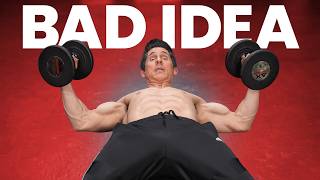

The Upright Row Will Destroy Your Shoulders
42sControversial claim that a common exercise is dangerous, with a dramatic visual of potential injury, sparks debate and curiosity.
▶ Play Clip"The title accurately promises a list of eight risky exercises, and the video delivers exactly that with clear explanations and safer alternatives."
This video, hosted by Jeff Cavaliere, critiques eight common exercises that pose injury risks, offering safer, more effective alternatives. Each exercise is analyzed for its biomechanical flaws, with demonstrations of better options to achieve similar muscle-building results without compromising joint health.
The upright row forces the shoulder into internal rotation under load, increasing impingement risk. The high pull is a safer alternative, keeping elbows lower and avoiding internal rotation.
The unsupported fly places the anterior shoulder capsule in a vulnerable, stretched position. Cable crossovers provide a safer, more overloadable alternative with a safety net.
The Cuban press combines an overhead press with a corrective exercise, but neither is done optimally. Better to do face pulls for external rotation and overhead press separately for heavier loading.
Anchoring feet engages hip flexors, pulling on the lumbar spine and reducing ab work. Unanchored sit-ups with hamstring engagement protect the back and target abs better.
Rack pulls above the knee cause thoracic forward flexion, compressing the thoracic outlet. Lowering the bar below the knee or performing regular deadlifts reduces risk.
The one-arm row with one leg on the bench loads the inguinal canal, increasing hernia risk. A tripod row with both feet on the floor eliminates this risk.
Static stretching before running is ineffective; dynamic leg swings are better for warming up. If static stretching is done, proper form (anterior pelvic tilt) is crucial.
Side bends with dumbbells can aggravate the low back. Side planks or Russian twists are safer, more effective oblique exercises.
Many popular exercises carry hidden risks that can lead to injury over time. By substituting safer alternatives, you can achieve the same or better muscle growth while protecting your joints and long-term health.
What is the main risk of the upright row?
It forces the shoulder into internal rotation under load, increasing impingement risk.
00:46
What is the safer alternative to the upright row?
The high pull, which keeps elbows lower and avoids internal rotation.
00:59
Why is the unsupported dumbbell bench fly risky?
It places the anterior shoulder capsule in a vulnerable, stretched position, especially with heavy weights.
02:19
What exercise is recommended instead of the unsupported dumbbell fly?
Cable crossovers, which provide a safety net and allow heavier loading.
02:45
Why is the Cuban press considered inefficient?
It combines an overhead press with a corrective exercise, but neither is done optimally; better to do face pulls and overhead press separately.
04:03
What is the problem with anchored sit-ups?
Anchoring feet engages hip flexors, which pull on the lumbar spine and reduce ab work.
05:33
How can you make sit-ups safer and more effective?
Do them unanchored, engaging hamstrings to reciprocally inhibit hip flexors.
06:12
What risk do rack pulls above the knee pose?
They cause thoracic forward flexion, compressing the thoracic outlet (nerves and blood supply under the clavicle).
06:54
How can you reduce the risk of rack pulls?
Lower the bar below the knee or perform regular deadlifts to introduce a hip hinge and prevent shoulder blade protraction.
07:34
What is the hernia risk with one-arm dumbbell rows on a bench?
The asymmetrical loading on the inguinal canal can widen the hole and create an inguinal hernia.
08:29
What is the safer alternative to the one-arm row on a bench?
The tripod row, with both feet on the floor and the bench raised, eliminating asymmetrical loading on the inguinal canal.
08:54
Why is static stretching before running not recommended?
It is less effective than dynamic warm-ups; dynamic leg swings are better for preparing for activity.
09:38
What is the correct form for a standing hamstring stretch?
Get into anterior pelvic tilt, shoot your pelvis back, keep leg up, and chest straight out, not down.
10:19
Why are side bends with dumbbells problematic?
They can aggravate the low back, which should be a stable joint, not overly mobile.
11:16
What are safer alternatives to side bends for obliques?
Side planks or Russian twists (with back behind body to ensure rotation).
11:31
Upright Row Impingement Risk
Highlights a common exercise's hidden risk of shoulder impingement due to internal rotation under load.
00:46Unsupported Fly Vulnerability
Explains why the unsupported dumbbell fly can stress the anterior shoulder capsule, especially with heavy weights.
02:19Sit-Up Back Strain Mechanism
Reveals how anchored sit-ups engage hip flexors, pulling on the lumbar spine and reducing ab activation.
05:33Rack Pull Thoracic Outlet Compression
Identifies a specific risk of nerve and blood supply compression from rack pulls above the knee.
06:54One-Arm Row Hernia Risk
Points out a rarely discussed risk of inguinal hernia from asymmetrical loading in the one-arm row.
08:29[00:04] Jesse. I'm going to show you how Jesse got in this position. It's actually from about today that I really [music] wish that you'd stop doing. And I'm not going you why I don't like the exercise and more importantly what you can do instead
[00:17] so you don't wind up like Jesse. >> I'm not dead yet. >> I've been doing upright rows for years. Never once had an issue. In fact, it's a great builder for my shoulders and my traps. And again, never had one single
[00:31] adri. A Now, I'm not saying that your shoulders about to detonate like a claymore in Call of Duty on a single repetition, but the accumulation of shoulders or every time you do that exercise leads to a compounding risk
[00:46] especially because you have a better option. And that's the case with all these exercises. [music] This is a different exercise altogether does to your shoulder joints. And this is a high pull. And the main difference
[00:59] between the high pull and the upright row is the position of the elbow and the wrist in relation to each other. During that upright row, as you can see here, Jesse's elbows are way higher than the wrist, which drives his shoulder into
[01:12] internal rotation under load. By the way, with that weight in his hands at elevated above his shoulder, which can [music] lead to increased risk of impingement and feelings of discomfort if you have any impingement already.
[01:24] However, on the high pull, you can see that the elbow is now down lower than shoulder rotation, not internal rotation, even though you can still handle the same load, and you can still get that same impact and growth on the
[01:37] delts and on the traps. Now, a lot of people tell you, you can do the upright row, stop listening to Jeff, because you can stop it at your chest or you can let your elbows kind of hang back a little bit and don't go so high, right? So,
[01:49] you're telling them to do the high pull. The essence is an upright row done like a classic upright row is not an exercise that you should do and is one that you gains with something like this. The high pull the chest fly. Come on. If it's
[02:04] for me. How else am I going to build those tigle bitties JUST LIKE MY BOY? OH GOD, GET ME TO THE MEDICAL CHOPPER. >> I guess you could say aasta vista to that shoulder, Jesse. Look, all kidding aside, guys, as a physical therapist, my
[02:19] issue here with the unsupported dumbbell bench fly is that itself is that it's placed in a much more vulnerable position, particularly the anterior shoulder capsule because of the unsupported nature of those dumbbells
[02:32] stretched position. Again, you're doing the exercise likely to get a greater stretch on the pecs, but in that especially if you start to use heavier and heavier weights. I know the
[02:45] what if I told you you could stand up, do a cable crossover, actually use much more weight, provide more overload in that stress position, but do it much the cable crossover does. Depending upon where you position your body in relation
[03:00] to the machine, you can set a safer safety net so that that bottom [music] range of motion, all you have to do is slightly turn to one side or the other Again, without any vulnerability to the anterior shoulder capsule. And again, we
[03:13] get a lot more opportunity to load the exercise more heavily. So you can combine that stretch tension with just the overall tension we get from using stimulus for growth. Not to mention, of course, we can get that adduction fully
[03:26] on the fly cuz it pretty much stops at midline, making it a much better we're showing here. So therefore, why not do it? Especially if the gains can be better. As a world traveler, who am I to turn down an exercise with a foreign
[03:39] flare like the Bulgarian split squat or a Russian twist? But there's no better press, which I don't know what I like better, the Cuban press or Cuban cigars. down in Cuba with my buddy Carlos smoking goibas underneath a palm tree.
[04:03] I don't know. Doesn't seem as smooth as that Cuban cigar there, Jesse. Although same way. I don't know who thought it was a good idea to combine a basic compound lift like an overhead press with a corrective exercise because it's
[04:17] just not necessary. As a matter of fact, you're better off doing just a regular something like this, which is just a basic external rotation with a band, right? we can isolate one function from the other because when we're doing that
[04:30] cub and press anyway, you're getting just a little bit of resistance or stimulation of the rotator cuff into external rotation just in the very very beginning of the exercise. Whereas if we do something like my favorite exercise,
[04:42] a face pull, you can see that we get resisted external rotation not just in the range of motion. And we could actually add an overhead press of trying to build bigger shoulders because again, you can handle that with
[04:55] heavier weight on its own. This overhead portion of this actually stimulates the to stabilizing your shoulders and making it a more corrective or protective exercise long term. But you certainly don't need the Cuban press, no matter
[05:08] how you feel when you smoke them. Jesse, nothing gets you to rock hardcore like doing a properly performed military situp. As a matter of fact, my dad, an old Navy drill instructor, taught me a good trick. Keep your feet anchored
[05:21] underneath something to help you get those thousand reps real easy. 978. those thousand reps real easy. 978. 97. Oh, God. My back. Oh, what a idiot.
[05:33] dad, thank you for your service, just not for the advice you gave Jesse. something does two things you don't want takes away a lot of the work from the abs because you're getting a good
[05:47] isometric engagement of the hip flexor that your body can almost post [music] Jesse said for 1,000 reps. The second thing it's doing is that when you do engage the hip flexors like this, they have a tendency to become overactive and
[06:00] start to pull on the lumbar spine, yanking your back into positions that [music] lead to low back pain. So to get the exercise to do more work for your abs, number one, and save your low back in the process, you want to anchor your
[06:12] you want to be pulling against something in order to pull your body up. This you'll start to feel in the hamstrings instead. And by engaging the hamstrings, you reciprocally start to take away some of the contribution or overcontribution
[06:26] of those hip flexors, which is going to allow you to have that core do more of number of repetitions that you do, but in the end making them a hell of a lot more effective. You know, nothing builds my traps, my deadlifts, or my Instagram
[06:42] followers like a nice heavy set of rack pulls. much weight you can load up on this freaking thing? I can't feel my fingers. How am I going to click like on my own Instagram reel?
[06:54] Well, yeah, sure, the exercise allows for a lot more weight. However, at what you should be concerned about when you do a rack pull, specifically at a height above the knee. Cuz what you're going to get is a lot of thoracic forward [music]
[07:07] shoulder blades of yours are going to come up and around your body. And what that does is places some stress on a structure called the thoracic outlet, which is a series of nerves and blood supply that runs underneath the clavicle
[07:21] here that can become compressed as that shoulder moves down and forward when the weight is so excessive. So, what would you do instead? Just simply either lower the weight by lowering the bar, [music] actually preferably performing a regular
[07:34] trying to use this as an accessory movement to improve your lockout on the lowering it down a little bit more, like below the knee, cuz that's going to introduce a necessity of a hinge at your pelvis. And when you hinge, all of a
[07:48] sudden, the mechanics up and down the spine will change, preventing all that of the shoulder blade, which will protect that thoracic outlet. take away a good loading option to get a lot of those followers on Instagram without
[08:02] itself. Nothing cranks my wanker like a Nothing better for building the lats one side at a time. Plus, I'm nice and stable on the bench like this and no wrist to my lower back. Oh, my balls. My
[08:16] wrist to my lower back. Oh, my balls. My balls. Oh. The issue with this exercise is the setup. It's the fact that you do have a lot of weight that you do the exercise with. When you drop one leg back and have one on the bench and pull
[08:29] the weight from this off leg, right, you're basically loading down into this area, putting pressure on an already weakened structure in the inguinal canal where we have a hole in the tissues down there to allow other structures to pass
[08:42] through. That hole can easily widen and create an inguinal hernia when you're in one- arm row, especially again as you increase that weight. But the fix is simple. All you have to do is just
[08:54] simply raise the bench up to this position here and perform it with both feet on the floor in this tripod row position. So I can still do one arm at a time. I let it hang in front of me in a balanced position here and I allow
[09:08] myself to pull up in the same exact way driving up and getting a good lat contraction one side at a time. But I don't have to put that asymmetrical loading and stress onto that inguinal canal to decrease any risk there is from
[09:21] a hernia on the exercise and instead get all the benefits in a much more Nothing gets me loosey goosey before a run like a nice stretch. And man, I'm [music] And don't worry, Jeff, I'm not getting hurt doing this one.
[09:38] No, Jesse, you shouldn't get hurt doing that stretch, but at the same time, you probably shouldn't be doing it either because doing a static stretch before you go out for a run is not necessarily the best way to warm up for an activity.
[09:50] in that case, you would do something like a leg swing rather than a static hold. And a leg swing gives you the opportunity to not just get your dynamic flexibility through your hamstring, but you could also rotate your toe in space
[10:04] from out in so that you're basically getting external and internal hip more functional. As far as that static stretch, whether you do it standing here probably doing it wrong anyway because you're not stretching your hamstring at
[10:19] all if you just allow yourself to slump. This is just working on your low back preparing your hamstring at all. If you really want to do that, you have to get into anterior pelvic tilt where you shoot your pelvis back, get your leg up,
[10:32] and then get your chest straight out, not down. And just reaching out in this and maybe for the first time ever, help you actually feel the stretch. Again, doing before you go out for a run. Save those static stretches for the right
[10:48] swing when you actually want to warm up. >> I don't care what anyone says, I love side bends. And dare I say, they're almost fun. And what better way to carve out that midsection, burn those love handles, and get 5 to 6 minutes of just
[11:03] feeling like a million bucks. So, if you're obsessed with the exercise and think it's fun like Jesse, there's probably a reason for it, cuz you're playground by yourself. Cuz you don't need to have a dumbbell in each side. If
[11:16] you're going to do this variation, at least drop one dumbbell and work on one pulling back against the weight of that dumbbell and working the opposite side. instead that don't aggravate your low back. Remember, the low back should be a
[11:31] stable joint, not necessarily an overly mobile one. So do something like this side plank or any variation of a side plank. Or if you have to, you want to capabilities of the obliques because that's what they do better anyway,
[11:44] [music] then do something like this Russian row. It's not just a Russian back behind your body to ensure that you're rotating enough. But simply doing this silly exercise is not the way to build up your obliques. And there's no
[11:57] handles. If you want to see a way to do that the right way, make sure you check out this video over here. If you're looking for how to do those Bulgarian split squats, you know, Jesse the World Traveler, you can find that video over
[12:09] turn on your notifications. >> Jeff, Jeff, my body's hurting bad. I not come to work tomorrow? >> We all thank you, Jesse. [music] See >> We all thank you, Jesse. [music] See you.
⚡ Saved you 0h 12m reading this? Transcribe any YouTube video for free — no signup needed.