
Destructive Capacity vs Attack Potency
48sThis segment clarifies a common point of confusion in power scaling with a simple grenade vs sniper rifle analogy, making it highly educational and shareable.
▶ Play Clip"The title accurately reflects the content, which is a thorough introduction to power scaling basics."
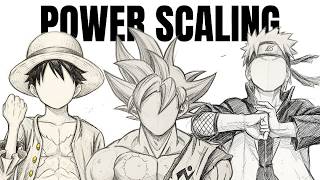
Power scaling is a method used by fans and creators to determine the relative strength of fictional characters by analyzing their feats and placing them into power tiers. This video explains key concepts like destructive capacity vs. attack potency, durability, speed categories, the scaling hierarchy, hacks, and chain scaling.
Power scaling is a structured way to analyze who would win in a fight by examining a character's feats and placing them into power tiers.
Destructive capacity (DC) measures the total area a character can destroy, while attack potency (AP) measures the force concentrated in a single strike, regardless of area affected.
Durability is how much force a character can withstand, often linked to AP via Newton's third law. Endurance is stamina to keep fighting after injury.
Speed is divided into combat speed, reaction speed, travel speed, and attack speed. These are not automatically equal.
Characters are ranked from street level to outer versal based on the scope of their power. Each tier represents a massive qualitative jump.
Hacks are special abilities that bypass conventional stats like AP or durability, such as reality warping or existence erasure.
Chain scaling determines a character's level by comparing them to someone they have defeated or fought on equal footing, using established benchmarks.
Power scaling relies on understanding key distinctions like DC vs. AP, durability vs. endurance, and speed categories, along with the scaling hierarchy and chain scaling, to accurately compare fictional characters.
What is the difference between destructive capacity and attack potency?
Destructive capacity measures the total area destroyed; attack potency measures the force concentrated in a single strike.
0:22
What is durability in power scaling?
Durability measures how much force a character can withstand before taking damage.
2:14
What are the four subcategories of speed in power scaling?
Combat speed, reaction speed, travel speed, and attack speed.
3:58
What is chain scaling?
Chain scaling determines a character's level by comparing them to someone they have defeated or fought on equal footing.
9:38
What are hacks in power scaling?
Hacks are special abilities that bypass conventional stats like attack potency or durability, such as reality warping or existence erasure.
7:46
What is the difference between durability and endurance?
Durability is how much damage a character can withstand; endurance is stamina to keep fighting after injury.
2:48
What does 'outer versal' mean in the scaling hierarchy?
A character that exists beyond conventional space, time, and dimensional frameworks, treating a multiverse as trivial.
6:56
DC vs. AP Distinction
Clarifies a common confusion in power scaling, essential for accurate analysis.
0:22Durability and Newton's Third Law
Explains the logical connection between a character's attack potency and their durability.
2:14Speed Subcategories
Highlights that different speed types are not interchangeable, preventing misinterpretation of feats.
3:58Scaling Hierarchy
Provides a structured framework for ranking characters from street level to outer versal.
5:16Hacks as Rule-Breakers
Explains how special abilities can override raw power, a key concept in vs. debates.
7:46Chain Scaling Logic
Demonstrates a practical method to scale characters without direct feats.
9:38[00:00] Power scaling is a method fans and
[00:02] creators use to determine how strong
[00:04] fictional characters are compared to one
[00:06] another. It's a structured way of
[00:07] analyzing who would win in a fight,
[00:09] whether the characters are from the same
[00:11] series or completely different
[00:12] universes. To do this, people examine a
[00:15] character's feats, things the character
[00:17] has clearly done, and place them into
[00:19] power tiers based on those
[00:20] accomplishments. One of the most
[00:22] important ideas in power scaling is
[00:24] understanding the difference between
[00:25] destructive capacity and attack potency.
[00:28] This is also where most confusion
[00:30] happens, so it helps to break it down
[00:32] simply. Think of it like this, a grenade
[00:34] versus a sniper rifle. A grenade causes
[00:37] massive area damage. It blows up
[00:39] everything around it. A sniper rifle, on
[00:41] the other hand, focuses all its force
[00:43] into a single precise point. Both can be
[00:46] deadly, but they function very
[00:48] differently. That's essentially the
[00:50] difference between destructive capacity
[00:52] and attack potency. Destructive capacity
[00:54] refers to how much total area a
[00:56] character can destroy with a single
[00:58] attack. If a character fires an energy
[01:00] blast and wipes out an entire mountain,
[01:03] that would be considered mountain level
[01:05] DC. It's about visible largecale
[01:07] destruction. A clear example is when
[01:09] Frieza destroyed planet Vegeta in Dragon
[01:12] Ball Z. That feat shows planetary level
[01:14] destructive capacity because the entire
[01:17] planet was destroyed. Attack potency,
[01:20] however, measures how much force or
[01:21] damage is concentrated into a single
[01:24] strike, regardless of how much area is
[01:26] affected. This is where people often get
[01:29] confused. Imagine a fighter punches a
[01:31] villain. The punch doesn't create a huge
[01:33] explosion or crater, but it breaks armor
[01:36] that was previously shown to withstand a
[01:38] nuclear blast. Even though the damage
[01:40] was focused on a small area, that punch
[01:43] would have nuclear level attack potency.
[01:45] This distinction explains how characters
[01:47] can defeat extremely durable opponents
[01:50] without destroying everything around
[01:52] them. For example, in Narut, when Naruto
[01:54] Uzzumaki destroyed the 10 Saigon, an
[01:57] object durable enough to survive
[01:59] planetary destruction, he did so without
[02:01] obliterating the surrounding area. That
[02:03] means his attack potency was high enough
[02:06] to overcome that level of durability,
[02:08] even though the overall destructive
[02:10] capacity of the attack did not destroy
[02:12] the planet itself. It's also important
[02:14] to understand durability, which measures
[02:16] how much force a character can withstand
[02:19] before taking damage. In many power
[02:21] scaling frameworks, durability is
[02:23] directly connected to attack potency
[02:25] through Newton's third law. The
[02:27] principle states that for every action,
[02:29] there is an equal and opposite reaction.
[02:32] Applied to scaling, if a character can
[02:34] strike with a certain level of force,
[02:36] their body must be durable enough to
[02:38] handle the recoil or stress generated by
[02:41] that same level of force. otherwise they
[02:43] would injure themselves when attacking.
[02:45] Durability is not the same as endurance.
[02:48] Durability refers to how much damage a
[02:50] character can physically withstand.
[02:53] Endurance, on the other hand, is about
[02:55] stamina, how long a character can keep
[02:57] fighting after they've been injured or
[02:59] exhausted. A character might have high
[03:01] endurance but low durability, meaning
[03:03] they can push through pain, but still
[03:05] take heavy damage from strong attacks.
[03:08] Understanding the difference between
[03:09] attack potency and destructive capacity
[03:12] becomes especially important in
[03:14] fictional battles. For example, consider
[03:16] Future Trunks fighting Frieza in Dragon
[03:18] Ball Z. Frieza has planetary level
[03:21] destructive capacity. He can destroy
[03:24] entire planets. However, Future Trunks
[03:26] demonstrates higher concentrated attack
[03:29] potency. His sword strikes carry enough
[03:31] focused energy to cut Frieza in half. If
[03:34] you judge the fight based only on
[03:36] destructive capacity, you might assume
[03:38] Frieza would automatically win because
[03:40] he can destroy a planet. But that
[03:43] overlooks a key factor. Trunks's attack
[03:45] potency exceeds Frieza's durability.
[03:48] Since AP must surpass durability to
[03:51] cause lethal damage, Trunks is able to
[03:53] overpower him despite the gap in
[03:55] large-scale destructive output. Speed
[03:58] and power scaling is not a monolithic
[04:00] statistic. Rather, it is divided into
[04:02] several subcategories to reflect the
[04:04] nuanced ways fictional characters move.
[04:06] The primary categories include combat
[04:09] speed, reaction speed, and travel speed.
[04:11] Combat speed is the speed at which a
[04:13] character can fight, encompassing the
[04:15] movement of limbs and the execution of
[04:17] techniques in a localized engagement.
[04:19] Reaction speed is the speed at which a
[04:21] character can perceive and respond to an
[04:23] action. This often grants a short range
[04:25] movement, but does not necessarily
[04:27] translate to long-d distanceance speed.
[04:29] Travel speed is the velocity at which a
[04:31] character moves over long distances,
[04:33] often through running, flying, or other
[04:35] continuous means. Attack speed is the
[04:37] speed of a specific attack or projectile
[04:40] launched by a character, which may be
[04:42] significantly faster than the
[04:43] character's own movement. It is
[04:45] important to note that combat speed and
[04:47] reaction speed are not automatically
[04:49] equal to travel speed. Fictional
[04:50] characters are often portrayed as being
[04:52] fast enough to react to or dodge
[04:55] light-based attacks, yet they may still
[04:56] take hours to travel across large
[04:58] geographical areas. The two are
[05:01] functionally different measurements. A
[05:03] realworld comparison makes this clearer.
[05:05] A professional boxer may throw punches
[05:07] at around 45 mph, but their running
[05:10] speed might only reach 15 mph. The speed
[05:13] of their strikes does not equal their
[05:14] long-distance movement speed. The
[05:16] scaling hierarchy is the framework used
[05:18] to rank characters based on the maximum
[05:21] amount of matter or energy they can
[05:23] affect. You can think of it as a ladder.
[05:25] Each rung represents a higher
[05:27] quantitative scale of destruction,
[05:29] creation, or influence. In fiction,
[05:31] characters are not simply described as
[05:33] strong. They are categorized by the
[05:35] scope of their power. Starting from the
[05:37] bottom are the low tiers where most
[05:39] grounded action heroes exist. Street
[05:41] level are characters capable of
[05:43] defeating groups of trained fighters or
[05:45] criminals. Wall/room level are
[05:48] characters who can punch through brick
[05:49] walls or destroy small structures.
[05:52] Building level are characters capable of
[05:54] collapsing large buildings or
[05:56] skyscrapers. Above that are the mid
[05:58] tiers where many superheroes and shownen
[06:00] protagonists begin. City level are
[06:03] characters who can destroy or severely
[06:05] damage an entire city. Mountain level
[06:08] are characters with enough energy output
[06:10] to vaporize or obliterate a massive
[06:12] natural formation. Island level are
[06:15] characters capable of destroying or
[06:17] affecting an entire island or comparable
[06:19] land mass. Next are the high tiers,
[06:22] often considered god level beings. These
[06:24] characters can destroy, create, or
[06:27] significantly affect celestial bodies
[06:29] such as moons, planets, stars, or even
[06:32] galaxies. Beyond that are the cosmic
[06:35] tiers which include universal and
[06:37] multiversal levels. At this stage, power
[06:39] is no longer about physical size alone,
[06:42] but about influence over space-time
[06:44] structures. Universal characters can
[06:46] affect or destroy an entire universe,
[06:49] while multiversal characters can impact
[06:51] multiple universes or higher dimensional
[06:54] systems. The outer tiers are typically
[06:56] the most difficult for beginners to
[06:58] grasp. A character described as outer
[07:00] versal is not merely stronger than a
[07:02] universe. They exist beyond conventional
[07:05] space, time, and dimensional frameworks.
[07:07] To such beings, a multiverse could be
[07:10] treated as something conceptually
[07:11] trivial, like an illustration that can
[07:13] be erased. A critical principle of the
[07:16] hierarchy is that each tier represents a
[07:18] massive qualitative jump over the
[07:20] previous one. A planet level character
[07:22] is vastly beyond a city-le character in
[07:25] raw destructive scope. However, raw
[07:28] scale is not the only deciding factor in
[07:30] battles. A lower tier character can
[07:32] still compete if their attack potency
[07:35] exceeds the higher tier opponent's
[07:37] durability or if they possess
[07:38] specialized abilities commonly referred
[07:40] to as hacks that bypass conventional
[07:43] durability or scaling advantages. In
[07:46] power scaling, hacks is a slang term for
[07:48] special abilities that allow a character
[07:50] to win without relying on raw physical
[07:53] power or destructive output. Instead of
[07:55] overpowering an opponent numerically, a
[07:58] hacks ability bypasses conventional
[08:00] stats like attack potency or durability.
[08:03] A simple way to understand it is to
[08:04] compare it to a cheat code in a video
[08:06] game. A standard character wins because
[08:09] their attack value is higher. A hacks
[08:11] based character wins by ignoring the
[08:13] numbers altogether. The term comes from
[08:15] hacking, altering the rules of a system.
[08:18] In fictional battles, hacks abilities
[08:20] function the same way. They override or
[08:22] circumvent the normal rules of combat.
[08:25] For example, imagine character A can
[08:27] destroy a galaxy with a punch that
[08:29] demonstrates immense destructive
[08:31] capacity and attack potency. However, if
[08:34] character B has the ability to turn
[08:36] anyone they touch into a harmless toy,
[08:39] character B wins instantly. It does not
[08:41] matter how much force character A can
[08:43] output if their abilities are nullified
[08:46] through a rule-breaking effect. Some of
[08:48] the most well-known hacks abilities
[08:50] include reality warping, often
[08:52] considered one of the highest forms of
[08:54] hacks. The user can alter the laws of
[08:56] physics, rewrite environmental
[08:58] conditions, or redefine how powers
[09:00] function. Characters like Scarlet Witch
[09:02] demonstrate this ability, as do many
[09:05] cartoon entities from Looney Tunes,
[09:06] where logic itself is flexible.
[09:09] Existence eraser, the complete removal
[09:11] of a being from reality. This goes
[09:14] beyond physical destruction. the target
[09:16] may leave nobody behind and in some
[09:18] cases no memory of their existence. A
[09:21] well-known example is Thanos using the
[09:23] Infinity Gauntlet in Avengers Infinity
[09:25] War. Another example is Beerus using
[09:28] Hkai in Dragon Ball Super. Beyond these,
[09:31] there are numerous other forms of hacks,
[09:33] conceptual manipulation, mind control,
[09:35] soul manipulation, and more. The final
[09:38] foundational concept in power scaling is
[09:41] chain scaling. This is one of the most
[09:43] commonly used forms of reasoning in
[09:45] scaling discussions. Chain scaling
[09:47] determines a character's level by
[09:49] comparing them to someone they have
[09:51] defeated, harmed, or fought on equal
[09:53] footing. The logic is straightforward.
[09:55] If character A is stronger than
[09:57] character B, and character B has
[10:00] demonstrated a specific level of power,
[10:02] then character A must scale to that
[10:04] level or higher. For example, imagine
[10:07] three characters, Joe, Stark, and Jeff.
[10:10] We do not know how strong Joe is, but we
[10:13] have seen the others fight. Stark
[10:15] destroys a mountain with a single punch.
[10:18] That feat establishes Stark as mountain
[10:20] level in destructive capacity. Later,
[10:23] Joe fights Stark and wins decisively,
[10:25] even if Joe has never personally
[10:27] destroyed a mountain. Chain scaling
[10:29] allows us to conclude that Joe is at
[10:32] least mountain level because he
[10:34] overpowered someone who demonstrably is.
[10:37] This method is widely used because
[10:39] authors rarely give every character a
[10:41] large-scale destruction feat. Constantly
[10:44] showing planet level explosions just to
[10:46] prove strength would disrupt pacing and
[10:48] narrative structure. Instead, writers
[10:51] often establish power progression by
[10:53] having a new antagonist defeat a
[10:55] previously established strong character.
[10:58] The defeated character acts as a
[10:59] benchmark or measuring stick. Chain
[11:02] scaling relies on consistent portrayal
[11:04] and clear outcomes. If the victory is
[11:07] decisive and not based on external
[11:09] factors such as exhaustion, hacks, or
[11:12] situational advantages, the upscale is
[11:15] considered valid. When applied
[11:16] carefully, chain scaling allows analysts
[11:19] to determine relative power levels even
[11:21] when direct feats are limited. Thanks
[11:24] for watching, and if you enjoyed this
[11:26] video, please like and subscribe for
[11:28] more.
⚡ Saved you 0h 11m reading this? Transcribe any YouTube video for free — no signup needed.