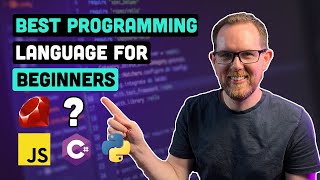

Which Programming Language Should You Learn?
45sThe overwhelming list of languages and the decision paralysis resonates with beginners, sparking curiosity.
▶ Play Clip"Delivers on the promise of recommending a beginner language, but lacks depth and is padded with personal anecdotes."
This video guides complete beginners on choosing their first programming language. It recommends starting with Python for its simplicity and versatility, then progressing to JavaScript for web development, and optionally TypeScript for type safety. The video also provides resources for learning and emphasizes practical application.
The video begins by addressing the overwhelming choice of programming languages (Rust, C++, C#, F#, Ruby, Dart, Kotlin, Solidity, etc.) and explains that the choice depends on your goals, such as web3 (Solidity), game development (C++), or frontend (JavaScript).
For complete beginners, Python is recommended because it is the easiest language to learn, has a large library selection, and a massive community. It was created by Guido van Rossum in 1991 and runs on all major OSes, even pre-installed on Mac.
Python can be used for batch renaming files, concatenating videos, creating NFT collections, building APIs, and automating tasks like sorting photos by date. It is also widely used in data science and machine learning.
Once basics are mastered, JavaScript is the next step for web development (frontend and backend). It was developed in 1995 by Brendan Eich and is embedded in every web browser. It is also used for mobile development.
TypeScript, maintained by Microsoft, introduces static types, preventing type-related bugs. It is a requirement for many jobs and a good stepping stone to C# or Java.
FreeCodeCamp offers free courses for Python and JavaScript. The Head First series (e.g., Head First JavaScript, Head First Python) is recommended for its engaging style.
The video concludes that Python is the best starting point for beginners due to its simplicity and broad applicability, with JavaScript and TypeScript as logical next steps for web development. It encourages practical use and provides resources for continued learning.
What is the recommended first programming language for beginners?
Python
00:54
Who developed Python and in what year?
Guido van Rossum in 1991
01:08
What language is essential for frontend development?
JavaScript
02:26
What is the main benefit of TypeScript?
It introduces static types, preventing type-related bugs.
02:58
Name two resources recommended for learning Python and JavaScript.
freeCodeCamp and the Head First series (e.g., Head First Python, Head First JavaScript).
03:26
Python as the beginner's choice
Provides a clear, actionable recommendation for beginners overwhelmed by language options.
00:54Python's versatility
Illustrates Python's broad utility with concrete examples, making the case for learning it.
01:23JavaScript's ubiquity
Highlights JavaScript's near-universal presence on the web, justifying its importance.
02:08TypeScript for type safety
Explains a key advantage of TypeScript that helps prevent bugs, valuable for professional development.
02:58[00:00] stuck in learning a language and writing your first program. Great, so you look up different programming languages. So where on Earth do you start? There's Rust, C++, C#,
[00:12] F#, Ruby, Dart, Kotlin, Solidity to name but a few. If you look on Wikipedia you'll find many many more. Each programming language generally has kind of program language you use. For example, if you want to be a web3
[00:27] developer you're going to need to know how to use solidity, which is the professional game developer for example, you need to know C++ as that's what all the major games are developed in. Or if you want to be an indie game developer
[00:41] become a frontend developer then learning JavaScript is a must and at complete beginner and you don't know the difference between a function and a loop,
[00:54] an array or a hash map. Then there is no point starting with one of the more language that you can use to create a large variety of things. For beginners you should start with Python. Python was developed by this guy, Guido van Rossum
[01:08] back in 1991. It's the easiest language to get your head around and has a large selection of libraries and a massive community behind it. There are so many learn the basics, such IF statements, variables, loops, functions and more. Python
[01:23] runs on all major operating systems and even comes pre-installed on Mac and but there's a link in the description below for anyone that wants it. When I start all over again I'd definitely use Python. Need to batch rename a whole load
[01:39] of files, use Python. Need to concatenate a whole load of videos together, you can do that with Python too or say you want to create an NFT collection of 10,000 even create APIs with Python and it's also one of the languages that are
[01:54] another video. For example, one of the Python scripts I have running on my machine moves my photos from my camera uploads folder on Dropbox and moves them over to my photos folder, and sorts them by year and month based on the date
[02:08] that they were taken. Python is also used in data science and machine learning. So toolbelt. Once you have the basics mastered, it's worth moving on to a more into Web Development for example for both frontend and backend, you're
[02:26] and is a requirement for frontend development. JavaScript was developed in 1995 by Brendan Eich and is embedded into every web browser you use. Pretty much every website you use has some form of JavaScript on it. It's used for
[02:40] the backend servers. Don't believe me try disabling JavaScript in your browser and see how many websites still work the same! JavaScript is also used for backend nothing but JavaScript. JavaScript can also be used for mobile development
[02:58] have as many uses as JavaScript and once you've learned JavaScript it's worth having a look at TypeScript as well. TypeScript's maintained by Microsoft and it introduces static types which means that you can't change the type of a
[03:13] helps resolve a lot of bugs before they even happen. If you want to be a be a requirement for most of the jobs that you apply for. TypeScript is also a
[03:26] great stepping stone for learning other languages such as C# or Java, which for learning both Python and JavaScript. Over on the freecodecamp YouTube at. This will cover the basics such as variables, functions, IF statements, arrays,
[03:44] and a few games as well. For JavaScript there is a great free full-stack course learn at your own pace by reading, the Head First series of books are really
[03:58] good. So Head First JavaScript and Head First Python. They're quite funny, at struggling with programming you might like my next video where I cover all the in the next video.


⚡ Saved you 0h 04m reading this? Transcribe any YouTube video for free — no signup needed.