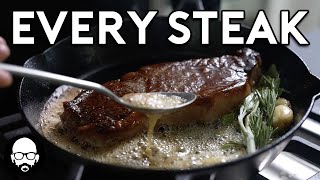

Best Way to Cook Every Steak?
45sThe introduction sets up a high-anticipation 'you can make steak at home' challenge, perfect for grabbing attention.
▶ Play Clip"Title delivers exactly what it promises: a comprehensive guide to cooking every major steak cut."
This video from Babish provides a comprehensive guide to preparing various cuts of steak, from New York strip to ribeye, using techniques like pan-searing, grilling, and smoking. Each cut is paired with a specific cooking method and recipe to highlight its best qualities.
Babish argues that porterhouse steaks are overpriced and impractical for home cooking because they combine two different steaks (filet mignon and New York strip) that require different cooking methods.
The best way to cook a New York strip is to pan-sear it in a hot cast iron pan, then lower the heat, add butter and garlic, and baste the steak. Rest for 10 minutes before serving.
Due to its leanness, filet mignon is ideal for steak tartare. The beef is trimmed, finely chopped, and mixed with a dressing of parsley, capers, shallot, garlic, Worcestershire, Dijon mustard, caper oil, apple cider vinegar, and anchovy paste.
Sirloin is best used in beef stroganoff. The technique of velveting (marinating in baking soda) tenderizes the meat and promotes browning. The beef is seared, then finished in a sauce with mushrooms, sour cream, and served over noodles.
Flank steak is ideal for pinwheels. The steak is butterflied, pounded thin, stuffed with cheese and sautéed peppers and onions, rolled, tied, seared, and finished in the oven.
Skirt steak benefits from a marinade reminiscent of carne asada (olive oil, soy sauce, lime juice, spices). It's grilled over a two-zone fire to medium, sliced thin, and used in a burrito.
Delmonico steak, similar to ribeye but less expensive, is perfect for cheesesteaks. The steak is partially frozen, shaved thin, seared, topped with cheese, and served on a roll.
Chuck steak is tough but flavorful. It's ground into steak hash, formed into patties, and cooked like a steak to medium-rare, served with mustard and parsley.
Boneless short ribs are grilled medium-rare, sliced thin against the grain, piled on a roll with cheese, and served with a beef stock dip.
London broil is marinated in a soy sauce-based mixture, grilled medium-rare, and sliced thin against the grain. Leftover slices can be used as homemade roast beef cold cuts.
Hanger steak is flavorful and tender, best cooked over indirect heat on a grill to medium-rare and served with French fries for steak frites.
Bone-in ribeye is reverse seared by smoking at low temperature until internal temp reaches 110-115°F, then seared over high heat. This yields a perfectly cooked, juicy steak.
Babish demonstrates that the best way to cook a steak depends on the cut, with techniques ranging from pan-searing and butter basting to grilling, smoking, and even raw preparations like steak tartare. The key is to match the cooking method to the steak's characteristics to maximize flavor and tenderness.
What is the best way to cook a New York strip according to Babish?
Pan-sear in a hot cast iron pan, then lower heat and butter baste with garlic.
02:36
Why does Babish recommend using filet mignon for steak tartare?
Because filet mignon is almost devoid of fat, making it ideal for raw preparations.
04:24
What is the velveting technique and why is it used for sirloin?
Velveting is marinating beef in baking soda to tenderize it and lower the temperature for Maillard reaction, promoting browning.
08:34
How is flank steak prepared for pinwheels?
Butterfly the steak, pound thin, stuff with cheese and sautéed peppers and onions, roll, tie, sear, and finish in the oven.
11:54
What is the key to making a good cheesesteak with Delmonico steak?
Partially freeze the steak to slice it very thin, then sear quickly.
18:30
What is steak hash and how is it made from chuck steak?
Steak hash is ground beef formed into patties and cooked like a steak. Chuck steak is cut into chunks, frozen, then pulsed in a food processor to grind.
20:59
How should boneless short ribs be sliced for a French dip?
Slice with the grain to maintain tenderness, then shave thin.
24:06
What is the recommended internal temperature for a reverse smoked ribeye before searing?
110-115°F.
28:53
Why does Babish recommend cooking skirt steak to medium rather than medium-rare?
Because skirt steak is fibrous and fatty, making it more tender and juicy at medium.
16:38
What is the purpose of resting a steak uncovered in the fridge overnight?
To deeply flavor, tenderize, and help the steak brown better.
23:40
Porterhouse is overrated
Babish challenges the popularity of porterhouse, arguing it's impractical for home cooking.
01:41Velveting technique
Introduces a scientific technique (baking soda marinade) to tenderize meat and enhance browning.
08:34Reverse smoke sear for ribeye
Combines smoking and searing for optimal flavor and texture, a pro-level technique.
28:27Steak tartare from filet mignon
Showcases a classic, high-end preparation that highlights the cut's leanness.
04:24Skirt steak at medium doneness
Challenges the common preference for medium-rare, explaining why medium works better for certain cuts.
16:38[00:04] strip, and then for dessert, the filet mignon. Thank you so much. Steak houses, we all love them. But did you know that you can make steak at home? It's true. I'm here to show you
[00:17] the best way to prepare every cut of steak. So, shake up a rock hard filthy martini, fire up the grill, cuz we're about to make some steak, if that wasn't [Music]
[00:30] Dirty. [Music]
[00:49] Squarespace. They've supported this channel for over 7 years. In fact, they were my first ever sponsor. Squarespace is the perfect platform to create your online. Whether you're building a digital empire or just want people to
[01:01] Squarespace has you covered. I'm having a lot of fun making food ranking videos, and my favorite part is seeing what you guys suggest. So, I built a site where you can submit your episode ideas. Go to rankedwithbabish.com and submit yours,
[01:14] and coming soon, you can see all my ranked lists. Squarespace's brand new designer templates make it so easy to set up exactly what you need. To create one of your own, head to squarespace.com for a free trial, and use code Babish
[01:26] website or domain. [Music] The porterhouse steak, maybe the most instantly recognizable steak. Basically, just a bone connecting a New York strip and a filet mignon. And I think the best
[01:41] way to cook porterhouse is to not at all. What? Porterhouses are dumb. They're overpriced, and they connect two very different steaks, a filet mignon and a New York strip. So, it's pretty
[01:54] these correctly. Leave that for the steak houses. At home, bone. Bone's free. porterhouse, which we've made plenty of videos on, I'm going to show you the
[02:09] best ways to make a New York strip and a filet separately. New York strip? I'm asking.
[02:22] look it up. I left my phone upstairs. Or I mean in the back in the in the Uber to come here to steak house. What I do know is that they have a lovely sort of grassy flavor, a firm texture, and they are the quintessential
[02:36] steak house experience. This is my favorite one to just pan sear and butter baste. So, I'm going to start by generously oiling a cast iron pan. Then it is absolutely smoking. We want to sear this guy hot and fast, especially
[02:51] Once it's got a great crust on it, we're going to lower the heat, add a big old hunk of butter, a few cloves of garlic, and we're going to mop down the steak going to move the steak onto a plate, pour the hot butter over top, and let it
[03:05] rest for 10 minutes. Our steak is rested. Before we serve, garlic, and I'm going to treat the top of the steak almost like a cheese grater. The rough texture just kind of shaved off a good amount of that fried
[03:19] garlic. Slice it on the bias. Doesn't come more Slice it on the bias. Doesn't come more perfectly cooked than that. little bit of freshly ground pepper. And
[03:33] oil, but we have all this beautiful butter here. butter here. All right. A pan seared butter basted medium rare. [Music]
[03:46] It's the combination of the savory toasty notes of the brown butter, the richness of the steak. New York strip has a slight grassy note, which the butter just rounds out beautifully. Now, if you ask me,
[03:59] that is the very best way to make a New York strip. So, next up we have beef tenderloin, or as the French like to call it, filet It's filet mignon, but I love you, and you're doing great.
[04:12] I'm being told it's pronounced filet mignon. Now, the best ways to make this usually involve searing it super hot, finishing it low, and getting it a nice rosy medium rare as edge to edge as possible. And that's a lovely enough way
[04:24] to consume a filet mignon. But they're almost devoid of fat, which is why you favorite way to utilize this steak is with a preparation as classy as filet mignon itself. That is steak tartare,
[04:38] mignon itself. That is steak tartare, the one raw entrant in our steak First thing we have to do is trim off all the fat and connective tissue. There we go. An almost entirely lean piece of beef. I'm going to thinly slice it into
[04:53] beef. I'm going to thinly slice it into planks. Now, I can cut these pieces into little strips, and chop those strips into little tiny Just to make sure there aren't any bits that we missed, I'm just going to give
[05:05] a couple once overs. For the tartare, we need to build a dressing. Often, tartare is served with parsley and capers and some finely chopped onion
[05:18] on the side, almost like with you would with caviar, and then you make your own little bites. But I like to make a dressing with all those things, mix it into the beef, and then garnish. So, I'm going to finely chop this parsley.
[05:31] About a tablespoon of parsley, a tablespoon of drained and dried capers. want whole capers in there. I've got about a teaspoon of finely minced shallot. I've got a quarter of a clove of garlic. You don't want to overdo this
[05:46] because it is raw garlic. Little splash of Worcestershire sauce, about a half a teaspoon of Dijon mustard. Now, earlier I fried some capers, and what I was left with is this lovely caper oil. So, I'm going to add just a little little bit of
[06:00] shiny. And I'm also going to hit it with just a tiny splash of apple cider just a tiny splash of apple cider vinegar and 1/4 tsp of anchovy paste. I have here and look at it and see like how much salt would I want on that, and
[06:14] just add that to the dressing. Some freshly ground black pepper. And just because we're a little shy on tools, I'm just going to do this in the deli container to try and mold it into a sort of puck
[06:27] for presentation. I'm going to press it evenly down into this deli container. our prayers, and hope that this thing comes out.
[06:42] Well, we can't do that. Start fresh. Move to a new city. Leave your husband. Really press it down in there to try and get a clean sharp little puck. You want
[06:54] your beef clean and sharp. Beautiful. If you really want to class things up to 11, gently top with a raw egg yolk. And then we're going to garnish with these crispy fried capers. This little pop of parsley. Surround
[07:09] with some definitely homemade bruschetta, and there you have it. Just about the classiest way to consume steak that's ever been conceived by a Let's give it a shot. Let's bust that egg yolk open.
[07:23] [Music] Let's class things up there. The best steak experiences are those that do not try to cover up or overwhelm
[07:37] the beef, but rather those that highlight and accent the beef. And that's exactly what this is. This tastes distinctly steak-like, but it has this lovely funky note coming in from the anchovy and the capers. It has this
[07:51] almost excess richness from the egg yolk. And then it's got this lovely well-rounded flavor from the shallot and the garlic and the caper oil. It's a really lovely way to experience steak. If you haven't tried raw beef before,
[08:05] careful out there. It's a lot of weirdos selling beef out of their car.
[08:19] very inexpensive, pretty tasty piece of beef. You could absolutely salt this, rare, slice it thin, and have a grand old time. But I think the best way to is a different way. What I'm going to do is I'm going to slice this guy into
[08:34] bite-size pieces for beef stroganoff. But I'm also going to utilize the technique of velveting. This is basically marinating the beef in baking soda. This both tenderizes it and lowers the temperature at which the Maillard
[08:46] reaction occurs, so it browns more quickly and readily. Now, this guy is minutes. You don't want to go any longer going to turn it to mush. And it's going to taste weird. So, we've thoroughly
[08:58] rinsed off the beef, and now I'm thoroughly patting it dry because I want to sear it hot and fast, and we want as little moisture as possible in order to do that. Now, you might notice I'm using a wok, and that's
[09:10] not just because I velveted the beef. Well, it is. this seems like it'd be a great pan to build the sauce in. So, questions. Got a nice little bit of smoke there.
[09:23] sear. Yeah. Yeah, we got color. We got some nice color. I'm just going to brown it on one side and then finish cooking it in the sauce. We've got here some shallot. I'm going to grate in some
[09:37] of heat, and then we're deglazing with a cup of beef stock. Scraping all that good stuff off the bottom of the pot. Now, in a separate pan, I'm going to sauté some lovely
[09:51] Water's boiling, so we can add our pasta. cooking. I'm to hit them with a little bit of dried thyme because I forgot to buy fresh. Then over here I have our reducing cooking liquid which I'm going
[10:04] to pour a little bit of over some sour cream. This is going to help temper the splitting when we add it back to the sauce. Our mushrooms and thyme are ready to go. So it's time to mushroom them into thyme. Let's add our beef back to
[10:19] the situation. Glug of soy sauce in there. Worcestershire sauce. Stir this up. Let the beef finish cooking. Let's throw a lid on this guy and let the residual heat help finish cooking the beef. Our beef has finished cooking
[10:31] through. I've killed the heat and now only now am I going to add the tempered sour cream. Hit it with a cornstarch slurry which should help thicken things. Okay, we got our buttered and salted noodles here. All right, we have our
[10:47] little bit of parsley, few twists of freshly ground black pepper. And just like that you've got my favorite way to prepare sirloin steak. The velveting makes it so tender. It can produce some strange off flavors. You
[11:02] got to make sure that you rinse it. And it doesn't hurt to have a really strong savory sauce like this to cover up any strange bitterness that might come from the baking powder. If sirloin's on sale, this is how big boys do it. I got a
[11:14] hamburger you can help right here. Hamburger Helper. Flank steak. The steak that sneaks up on you from the side.
[11:26] purposes interchangeable with hanger and skirt. These are fibrous, fatty steaks that need to be cooked hot, fast, and to medium rather than medium rare. So you can marinate this, you can grill it, you can slice it thinly on the bias across
[11:39] the fibers. But I think the best use for flank steak is pinwheels. Why pinwheels? Because it is an ingenious use of the form factor. You can see more than any other steak this has very specific, very directional grain. It's also an
[11:54] vegetables and all them kinds of fun stuff inside of your steak. To butterfly so it's going to be a little tricky. What we want to first do is trim it so
[12:06] that it is a more perfect rectangle. This side is a little thicker than this side. So I'm going to start cutting in through this side, work my way this way so that we can open it up. This can be our seam
[12:18] of the beef book that we're about to write. Okay, Daddy did his job. So now we get to eat. I'm laying down some plastic wrap on top of the steak. thin parts. The idea here is I just want to make it even. Now it's time to stuff.
[12:35] So first we need to season the meat with kosher salt, Muenster cheese here that I'm just going to shingle on. And now I've just got some peppers and onions that I've briefly sautéed and lightly seasoned. We want to leave a 1-in gap at
[12:49] seasoned. We want to leave a 1-in gap at the end. Now let's roll it up tight. It's like a big beefy cinnamon roll. Make sure that stuff's good and tucked in there. Roll it up. Now
[13:01] I have some lengths of twine to secure each individual pinwheel. Our flank is all tied up. So now all we need is a off the ends. Get those nice and flat. I think these
[13:15] are just about right in terms of thickness. You don't want to have these really long time. And there you have it folks, some frankly storybook steak pinwheels. Next up, can I sear these without all the stuff falling out of
[13:28] them? Find out after this. [Music]
[13:44] [Music] Babish cookware. Checkmate atheists. We'll find out now. So normally you want to sear these on a super hot grill to
[13:57] seal the cheese inside so it doesn't all melt out. But I like to get a nonstick skillet nice and hot and drop them straight in there. surface and it's going to almost immediately caramelize like a cheese
[14:11] frico and it's going to seal all that cheese inside. Now that we've got the put these guys in the oven to finish cooking through. All right. Our pinwheels have been cooked to a rosy
[14:23] medium. They've experienced minimal cheese loss. So there you have it folks, the best way to prepare flank steak. It's like a self-contained Philly cheesesteak without the fussy bread. Perfectly cooked all the way through.
[14:37] Peppery. The the best way to prepare flank steak. shaped, fibrous, super fatty cut of beef which makes it perfect for marination.
[14:53] want to tenderize it. So we're going to put together a marinade that is reminiscent of carne asada. Like most skirt steaks there is a huge difference in thicknesses throughout. So cutting it down into pieces makes it easier to cook
[15:07] each piece properly. So now onto the marinade. Marinades are really something you can just eyeball. I'm going to do about a half cup of olive oil, half cup of soy sauce, the juice of two limes, maybe a teaspoon of cumin, about a
[15:20] teaspoon and a half of dried oregano, half teaspoon each garlic and onion powder, paprika mostly for color, a little sprinkle cayenne pepper, teaspoon and a half of freshly ground black pepper, and two teaspoons of kosher
[15:34] salt. Whisk to combine. Now as you can see for marination I have folded down the top of my Ziploc bag. That's going to ensure that we don't get meat around the outside edge, prevent cross-contamination. Pour the marinade
[15:47] over top. Close things down. And give it a little massage to make sure that every piece is getting evenly coated in the marinade. Now if you want to be extra safe, place this in a bowl, put it in the fridge for at least 45 minutes up
[16:01] to three-ish hours. You don't want to over-marinate this cuz it'll start making it mushy, all that acid. So now it's time to grill our steaks using a two-zone fire. That means having a really hot side of the grill and a cool
[16:13] side of the grill. On a charcoal grill that just means piling all the charcoal going to do is we're going to sear the steak on both sides on the hot side of the grill and then put it on the cool side of the grill, cover things up, and
[16:25] let them gently come up to temperature. All right, so now it's time to slice and serve and it's essential with skirt steak that you slice it across the grain into thin slices. This is a very tough, very chewy steak if you don't do that. I
[16:38] wanted to cook this to medium because it is such a fibrous and fat and connective tissue-laden steak that I think it's more tender, more juicy at medium than it is at medium rare. So now you can just stop here and just serve this in
[16:52] slices as is. But I want to make a burrito. So I'm going to cut this into bite-size pieces. We have our grilled tortillas. I'm going to start with a the place. Now I'm going to load it up with some Mexican rice. Then I have
[17:06] these lovely roasted red peppers and poblanos. And of course we have our poblanos. And of course we have our steak. Wham So one of the reasons that burritos are so great from restaurants and
[17:20] takeout is because they wrap them. This steams the inside, gets everything melting. More importantly it steams the tortilla so it's not rigid or crumbly or this guy up. So now also just to really kick things
[17:34] up a notch, I'm going to put it on the grill. burrito. [Music]
[17:50] use ground beef, absolutely, but this has so much flavor to it both from the marinade but also from flame grilling it. Like this tastes flame grilled. I don't say this word
[18:02] often, I don't use it lightly. That's burritotastic. [Music] Next up we have the Delmonico steak. This is often thought of as a less expensive ribeye. It's similarly sort of
[18:16] bits, and it's got a similar fat content, almost a similar appearance. So for all intents and purposes it can be used interchangeably with ribeye. Now I think the best use for Delmonico is in a cheesesteak. In Philadelphia they
[18:30] actually thinly slice real ribeye, which is both expensive and very, very difficult to do. This is less expensive, has similar qualities, and it's going to be easier to slice thinly. First thing we got to do, place these guys on a
[18:43] sheet of parchment paper and put them in the freezer for 30 to 40 minutes depending on the power of your freezer. Uh the idea here is we want to get it extremely firm so that we can slice it very, very thinly.
[18:56] Uh and it needs to be not frozen through but maybe the first centimeter or two needs to be damn near frozen. So into the freezer it goes. Now this guy's not fully frozen through but good and hard so that we can shave it
[19:11] One of the keys to a good cheesesteak is very, very thin pieces of beef. This is cook very quickly. We're going to be able to get some nice browning on it.
[19:23] It'll make for a great sandwich. So I want to cook our shaved steak hot and just a little bit of fat in it. This is Babish nonstick which is safe to 550° F. So it's perfect for searing. All right, so once we got some really
[19:37] nice color on the first side, it's time to flip either with a spatula or by to flip either with a spatula or by going like this.
[19:49] just to make things steamy. Letting the cheese melt. I'm also going to dress this with mayo. So, some folks do it. Now, all we got to do is shimmy it right into our sandwich. There you have it.
[20:04] The best way to enjoy a Delmonico steak. This steak is nice and tender, super flavorful.
[20:16] Great and fatty. This is definitely a ribeye standing and you could treat it as a ribeye, but few ways finer to enjoy steak That was a big piece of fat. Let me just get that
[20:29] get that Oh, no, it's cheese. Stars. They're inexpensive and hard to eat. steaks that you can buy and with good reason. It's not particularly tender.
[20:43] bits, you're going to have a lot of sinew and connective tissue you're going wouldn't recommend cooking this as a straight-up steak, but we can make one of my very favorite steak analogs, steak hash, which is a French dish. It's
[20:59] basically just a burger without a bun, but you prepare it same way you would a steak, treat it same way you would a steak and eat it the same way you would A steak. So, what we're going to do is basically
[21:11] just turn this into ground beef. Now, to grind it, I'm going to cut it into 1-in chunks roughly. Then I'm going to freeze those chunks for about 20 minutes until I want to be on the lookout for any of this stuff, this very thin membrane,
[21:25] silver skin. This does not break down easily. Fat cuts very, very easily. Silver skin, even if you have a wicked sharp knife like this Babish 8-in chef's knife, it's going to slip across it almost because it's so tough. So, now
[21:40] about 20 minutes until firm around the edges, but nice and soft in the middle. So, in lieu of a meat grinder, we have a food processor. I put the blade in the freezer for at least 30 minutes to prevent smearing. Grab our semi-frozen
[21:54] beef. Should be firm, but not completely frozen. Now, we're just going to pulse this guy until we got a nice heavily ground beef. Absolutely beautiful ground beef. So, now
[22:07] we're going to form these into steaks. I'm going to grab about 6 oz per serving, basically like a medium-sized filet mignon. And I'm going to press it trying to make it nice and thick because this is going to be pretty easy to
[22:22] overcook. And you really want this to be like medium-rare, just like the juiciest, fanciest burger you ever had. It's a fork and knife burger. Just a little bit of salt on one side and these guys are ready for
[22:35] guy down with beef fat both to help prevent him from sticking and add all prevent him from sticking and add all the beefy flavor. super simple with some whole grain mustard, parsley, freshly ground black
[22:50] pepper. And there you have it, steak hash, one of my very favorite beef preparations. It's simple, it's easy, it's inexpensive, and it's delicious. Oh, yeah. This has got to be like the fanciest burger you've ever had. So, you
[23:03] got to make it nice and medium-rare at least, if not rare. Oh, yeah. Yeah, buddy. nothing but a fork. We'll be right back.
[23:27] clear-cut. Boneless short ribs, a cut normally relegated to the slow and low camp, but it's super flavorful, really well marbled, and actually takes very well to the grill. And I think the best way to
[23:40] prepare short ribs is in a French dip. Like most steaks grilled medium-rare, we are salting and resting this uncovered overnight in the fridge. That's going to help it retain moisture and brown up better. We got our grill set up to a
[23:53] going to sear it and then move it over to the cool side of the grill until it's a rosy medium-rare. All right. So, with short rib there's way, I'll be slicing with the grain. If
[24:06] grain. Now, we're going to shave it really thin, pile it tall and proud, top it with the cheese of your choosing. Still got some monster here. Now, we're broiler until the cheese is melted and bubbly.
[24:24] Just a little bit of beef stock that has been thickened with a very light roux and flavored with soy sauce and Worcestershire. There you have it, the best way to enjoy short ribs, a short rib French dip.
[24:39] Otherwise, you're going to be pulling out strips. Cutting it this way makes it tender, fall apart, juicy, and the dip, forget about it. If you ask me, if you're not braising or slow cooking it, this is the very best
[24:52] slow cooking it, this is the very best way to prepare short rib.
[25:06] that you can buy and it performs as such. It's extremely lean and tough. So, the best way to prepare it is to marinate it and cook it medium-rare. So, the classic London broil marinade usually starts with a bunch of soy
[25:19] sauce, about a half cups worth. I'm just going to add a little bit of balsamic, some Worcestershire for that old world solid-state machinery flavor, bit of ketchup. This is going to bring flavor, sugar, and acid, two tablespoons worth.
[25:32] Onion powder, about a half teaspoons worth, half teaspoon of garlic powder, teaspoon of paprika, about a quarter of teaspoon of cayenne for some nice heat, and maybe like a half teaspoon of ground sage. There's plenty of salt in soy
[25:45] much salt, about a half teaspoons worth, and some coarsely ground black pepper. I'm just going to throw in the bag to ensure nice even coverage and massage.
[25:58] fridge for 8 hours or at room temperature for 2 hours. Our London broil has been marinating for about 4 hours now. Blot off the excess marinade because it will burn. And this
[26:10] big bad boy is headed straight out onto the grill.
[26:23] very strong grain structure and especially when you have a steak this lean, you need to cut it against the grain to keep it tender. You see it's lovely and juicy and between the marinade and cutting across the grain,
[26:35] it's going to be quite tender. Perfectly lovely as is, especially if almost like a Yorkshire pudding situation, but I think the best way to enjoy this London broil is to let it cool completely, put it in the fridge,
[26:49] solidify, cut it into super thin sheets, and then you're going to have the best homemade roast beef cold cuts you've ever had.
[27:05] Is that where meat hangers come from? >> No. Uh meat hanger No. butcher's cut because it was inexpensive and only butchers knew how to cook them. My, how the times have turned. Now, they're expensive and very hard to find.
[27:20] they're expensive and very hard to find. So, It's one of my favorite cuts. It's usually oblong, so you can cook it to different donenesses for different guests. One of the most flavorful,
[27:33] tender, juiciest cuts and I think it's absolutely perfect for steak frites. finish them in the oven, but I like to do an indirect grilling situation. So, and then move them over to the cool side of the grill to finish cooking.
[27:48] Our hanger steak has rested for 10 minutes. It looks gorgeous. minutes. It looks gorgeous. Let's see if it's cooked properly. Oh. Big old pile of French fries.
[28:02] And there you have it, a perfect hanger steak frite. I think the best way to steak frite. I think the best way to enjoy a hanger steak. One of my very favorite dishes of all time and unquestionably the best way to
[28:15] prepare a hanger steak. Ribeye. Now, this is a steak guy's kind Ribeye. Now, this is a steak guy's kind of steak.
[28:27] laden with fat. It's full of different flavors and textures throughout. And I think the very best way to cook it is to reverse sear it, but not just any smoke it. Well, we're going to reverse smoke sear it.
[28:41] going to sear it. These guys have been generously salted and then rested uncovered in the fridge overnight. It's going to deeply flavor them, tenderize them, and help them brown better. Now, the reverse sear is dependent on getting
[28:53] the steaks' internal temperature to about 110-115° F tops. Very difficult to feel and intuit. So, if you have a temperature probe, now's the time to bust it out. [Music]
[29:13] And there you have it, a reverse smoked ribeye. You can see it is rosy red from Traeger. It's hard to tell that it is cooked to medium. Let's see it once we get to the eye. And there you have it, a reverse smoked ribeye, giving a whole
[29:28] new meaning to cowboy steak. You can see it's crazy tender and it's You can see it's crazy tender and it's crazy juicy. Just buttered beef. Normally, I like to finish steaks with butter. You'd be
[29:43] butter. You would be hard-pressed to find a better beef experience than this one. And that is the very best way to make a bone-in ribeye.
[29:55] Well, that was a whole bunch of fun. I hope you enjoyed seeing all my steak. But they're just my favorites. What are that I'm correct. [Music]
[30:09] You know, I've been here for about 3 hours and no one has hours and no one has brought There's nobody here.
[30:27] Squarespace for sponsoring this episode. Be sure to head to rankedwithbabish.com I should rank next or who you want to see as a guest. While you're there, Squarespace. If you feel stuck creating your website, Squarespace can definitely
[30:41] help. In just one click, you can choose from curated color palettes and fonts can create an entire site in just a few minutes. Their SEO tools help your site reach its audience, and you can use Squarespace to help manage your invoices
[30:54] business name. The tools are all easy to use and at your fingertips. To create a squarespace.com for a free trial and use code Babish for 10% off your first purchase of a website or domain.
[31:08] purchase of a website or domain. [Music]



⚡ Saved you 0h 31m reading this? Transcribe any YouTube video for free — no signup needed.