
Unlocking a 400-year-old chain
41sDemonstrating the original locking mechanism reveals the intricate security system behind priceless books.
▶ Play Clip"Title is playful, but the video delivers genuine content about chained libraries and the ampersand."
A visit to Hereford Cathedral's Chained Library reveals a collection of medieval manuscripts and early printed books. The video explores the practicalities of a chained library, the evolution from handwritten to printed books, and the historical significance of these priceless artifacts.
The chains and furniture are from the 17th century, but the earliest book dates back to around 800 AD.
The library holds 229 medieval manuscripts (handwritten) and about 1,200 printed books in the Chained Library.
Books are organized by section: manuscripts (M) and printed books (E), with sections for theology, canon law, history, geography, etc.
A codex describes the physical structure of a bound book with pages, as opposed to a scroll.
The library holds a first edition of Samuel Johnson's Dictionary of the English Language, an influential early dictionary.
To remove a book, you unlock the hasp, slide the rod, remove all chains one at a time, take the book, and rechain everything.
A handwritten Wycliffite Bible from 1420, an unauthorized translation into English, with gold leaf decoration on some pages.
A printed book using movable type, only 56 years after the handwritten Bible, showing the rapid technological shift.
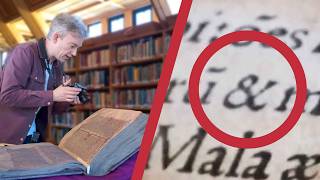
Early printed books used ligatures and abbreviations like 'ct' and 'quod' (Q with slash) that have mostly disappeared.
New technologies like the printing press feel slow at first but quickly transform society, similar to modern digital revolutions.
The Hereford Chained Library offers a unique window into the history of the book, from handwritten manuscripts to early printing, demonstrating how technological shifts can rapidly change the world.
What is a chained library?
A library where books are physically chained to the shelves to prevent theft.
01:40
How many medieval manuscripts are in the Hereford Chained Library?
229 handwritten manuscripts.
02:09
What is a codex?
A physical structure of a book with pages bound together, as opposed to a scroll.
05:43
What is the ampersand?
A symbol representing the word 'and', used to save time and space in writing.
16:15
What was the Wycliffite Bible?
The first translation of the Bible into English, considered unauthorized at the time.
16:44
How many years separate the handwritten Bible (1420) and the printed book (1476) in the video?
56 years.
19:34
What does the abbreviation 'quod' mean in Latin?
Because, that, or which.
22:11
What did Gutenberg invent that revolutionized book production?
The movable type printing press, using individual metal letters.
20:34
What is the earliest item in the Hereford Chained Library?
A book dating back to around 800 AD.
01:52
What is a ligature in typography?
Two or more letters joined together as a single glyph, like 'fi' or 'ct'.
21:46
Age of Chains
Shows that the physical infrastructure of the library has remained intact for centuries.
01:40Collection Numbers
Quantifies the scale of surviving manuscripts and early printed books.
02:0956-Year Leap
Dramatically illustrates how quickly printing technology transformed book production.
13:48The Ampersand
Highlights a simple typographic innovation that persists today.
16:15Illuminated Printed Books
Shows the transitional period where printed books mimicked manuscripts with hand-applied decoration.
20:47Technological Revolution Pattern
Draws a parallel between historical and modern technological adoption curves.
22:57[00:00] A chained library where the books are physically connected to the shelves And then, I looked at two books from that library can change the world so much in a very short time.
[00:17] just as a side note, because the cathedral has so much history: the largest surviving mediaeval map, in the 14th century,
[00:31] not accurately, but as art and religious propaganda. but I’m there to visit the Chained Library So, I went through the cathedral itself,
[00:44] or bays, of the Chained Library It’s designed to look and replicate the sort of proportions which is where it lived for about 250 years from 1540 to 1840.
[00:59] These are the original bays that were in the Lady Chapel, built in 1611. Hard to fathom, isn’t it? -Yeah.
[01:11] -Yeah. -Right, intact in one piece? So, you can see there’s still boards here and things like that.
[01:23] (laughter) So, how far back does this go? Well, it depends on whether you’re talking about the books or the space,
[01:40] So, the furniture and these chains are 17th century. They go back to about 800, well, yeah, around 800 is our earliest item.
[01:52] but it is the largest one to survive to the present day. moved and renovated, and the collection will have been built up over centuries… nebulous a definition, is always going to be tricky.
[02:09] We’ve got 229 mediaeval manuscripts, so written by hand, ink, some illumination, definitely lots of decoration. And then we have about 1,200 printed books in the Chained Library as well.
[02:23] So, do scholars still come in here and sit down at the pews? -It’s historical now. -Okay. as you’re trying to very carefully... -Yep.
[02:37] -...turn a page in a, you know, a thousand-year-old manuscript. Absolutely, people do still have access. When we look at one of our books, they can...
[02:49] well, actually, you can see here, some of our books are really, really big. So, thinking about reading that on that shelf is quite a challenge. but it’s not great for the book, really.
[03:05] So, do we know what book that is? Do we have an index for it? -We do have a list of items at the end. -Oh, yeah.
[03:18] so, it’s not an entirely place-accurate list, -...when this was created, sort of 18th century. So, you would have gone to that section, so, you’ve got section three, book five.
[03:32] Well, I think, but you also just knew where they were, ’cos, well, they were chained, weren’t they? -Okay, yes. No, sorry. Yes, of course you know where they were. They’re chained.
[03:47] the people in charge of the cathedral, -Can we have a tour down? Is that alright? -Yeah, yeah. So, these are our manuscripts and those are mainly theology,
[04:00] There’s a few exceptions in there. E is our printed books and canon law. and church fathers on the other.
[04:14] We’ve also got some history books, some geography books. We’ve got a first... -Wait, whereabouts? It’s one of these two. I think it’s this one.
[04:26] Now, in theory, I realise that no random member of the public but if there were a scholar with a thesis that required that specific copy, We’ve got a couple of scholars in next week, I think, to look at some things,
[04:44] Yeah, so, we have a couple of people coming in every week, I would say, Manuscript books are probably the most popular. and I’m trying to sort of raise their profile.
[04:57] -Right. -That’s literally what manuscript means. -It’s sort of Latin for “written by hand”. -Oh! “Man”, hand. -How have I not...? -I know.
[05:09] -Yeah. Yeah, exactly. -Right. We would say there needs to be a legitimate research purpose. If somebody really needs to see a book or really wants to see a book and…
[05:26] it’s important to me personally that we open our collection as widely as possible. But we do try to be as flexible as we can. as a “codex”, and while I’ve heard the word before,
[05:43] What’s the difference between a codex and a book? I think we could probably get into all sorts of philosophical questions Is an audiobook a book? -Okay, yeah. Fair.
[05:58] It’s the physical square thing that you open, basically, A codex describes the structure, basically. -Oh, okay. -On a technical level.
[06:13] So, what do we have in this section? -This section is our… We’ve got a first edition of Samuel Johnson’s Dictionary. K8, Johnson, Dictionary of the English Language.
[06:29] Johnson did not write the first dictionary, But as books became more accessible, and reading and writing more common, Johnson’s dictionary was the most influential,
[06:43] And there it was, well, the two codexes, codices. You can tell my background, can’t you?
[06:55] First edition of Johnson’s Dictionary, come on! there are several copies of it that have been scanned and digitised
[07:07] You can get a near-perfect physical reproduction And there aren’t many original copies left. If somebody asks to see it, I will try to take it out for them if possible.
[07:20] and I will send them a link to that digital copy. I did think about clickbaiting this with some ghost story or legend,
[07:32] There’s been suggestions that the potential value of a manuscript written by hand was the whole value of a farm, for example. And even as you come into printing, they still retain that value.
[07:47] -Arrangement bonus? -If it’s chained, you know where it is Basically. So, there’s the location. Sorry, I’m laughing because I have literally had to do research in…
[08:01] And it was a really obscure book on some buildings. -This happens all the time. -Yep. of books being described as “messy again”
[08:19] So, I don’t know whether that’s to do with the classification but it is a real discouragement, I have to say. And I guess these days, these books are priceless.
[08:34] Because in the event that Hereford Cathedral goes, …there isn’t an antiquarian dealer in the world who’s gonna touch that. You cannot put a price on these. -No, no, that’s the strangest thing
[08:50] are just priceless, irreplaceable... -Yeah. And I know you don’t necessarily think about that with the printed books, but of course there are... there’s marginalia, there’s writing,
[09:05] Even if you have that same access to text somewhere else, it’s not the same if you’re thinking about those levels of detail, -It’s beautiful. It really is. -Yeah, it’s very lovely.
[09:20] You literally cannot put a price on the books in that library. The people who buy and sell your personal data he is in charge of how Incogni works behind the scenes.
[09:36] when people say “Incogni stops data brokers buying and selling Ben is the person who makes sure that happens. we check whether the information was removed,
[09:50] until the information gets eventually removed. so they build up groups of people Your personal details, down to things like your purchase history,
[10:05] One broker had lists of people, with titles like You can opt out of these manually, but there are so many companies, I have made those requests by hand before!
[10:21] And the details can just pop up again later. where you can not only have removals for yourself, and have a joint account where we will take care of everyone that you care about.
[10:37] people-search sites, and commercial databases. we call it Custom Removals, but we also scan the whole internet
[10:52] we will present it to you in a grid view, and you can then select You can go to incogni.com/tomscott for a big discount on their annual plan,
[11:08] As we say it: if they can’t find you, they can’t harm you. No, you landed that, that was good! Actually removing books from the shelves is a lengthy process
[11:25] and so much close, slow, careful work So, Jennifer had already taken out the two books But she was able to demonstrate how the locks and chains work
[11:40] First step: unlock the “hasp”. That’s the one bit that they didn’t find. A verger actually kept a box of all the chains, so the chains are original.
[11:54] but a verger had kept them for ages and then they were put on again. -But the key’s not original. -So, original chains, original rods, So,someone had to back-solve the key for the lock?
[12:09] -As far as I know, yeah. -(laughter) Okay. But the lock is and the lock still works. some of them better than others. Oh.
[12:23] Oh, there we go. Yeah, so, spring. The way you described it, I thought it was going sideways, but no, it lies down.
[12:35] and things like that. -Right. That makes so much more sense. difficult to see, so... Once the hasp is unlocked, this rod can move back and forth.
[12:52] And then you have to remove all the chains, one at a time, Then you very, very carefully remove the book, put all the other chains back on one at a time...come on.
[13:08] and lock everything back up again. -Yeah. -You slide the rod along. In theory, you just take them off like that.
[13:23] all the nine before it have to come off. -Yes, yes. at just putting them onto her finger, then looping them back on,
[13:36] put them back in the right order. -Yeah, basically, yeah. and then they get tangled and it’s just a bit of a mess, really.
[13:48] We went upstairs to the reading room, and for the second act of this video, we’re gonna look at two chained books, that despite only being 56 years apart, The first was a manuscript, a handwritten version of the Bible
[14:02] Religious history, like all history, is messy and complicated, this was a copy of the first translation of the Bible into English.
[14:14] -So, this is, you said 1420? -Mm-hmm. -Mm-hmm. -Someone wrote that 605 years ago. There’s no one else in the reading room. -There’s nobody here.
[14:27] -Mm-hmm. -Now is that actual gold? I was going to try and get...I don’t know if the camera’s gonna show it. That is shimmering in the light. That’s clearly reflective metal.
[14:39] But if we look at other pages, look how clean that is. popular pages to show, because of the gold. -Oh, right! -In this whole book
[14:53] Just like this. So, there’s decoration. -So, they still have the capitals There’s a bit of decoration, but there’s no gold leaf applied. Our library is a very functional library,
[15:06] so, we don’t have those luxury manuscripts that are created for wealthy patrons. It was important to have this book and so they had it.
[15:19] No, it’s...but you say it’s not fancy. -But someone had to handwrite… -Absolutely. Well, a group? I’m assuming a group of monks.
[15:32] So, commercialisation of manuscripts So,even arguably in the 12th century, you had manuscripts being in demand more,
[15:45] and so it moved from that act of devotion to a commercial enterprise. -Of course it did. -So, this could have been... written by a commercial scribe
[15:59] rather than produced in a monastery or a religious scriptorium. “Here beginneth the prologue on the Gospel of Luke.” I’m kind of astonished that I missed it here:
[16:15] That is an ampersand, the symbol for ‘AND’, Because that saves both time and space when you’re repeatedly writing the same word, ‘and, and, and, and, and’.
[16:30] How long must it have taken to handwrite all those pages so neatly? Let alone the work involved with daring to translate the Word of God, Jennifer said this was an unauthorised translation.
[16:44] Right, okay. Sorry, stupid question! (laughter) And in fact, one of the leading translators of the Wycliffite Bible
[16:57] He took that with him to Rome to try to get it authorised by the Pope, So, the problem was that the Latin text is a sacred text and it is…
[17:11] Well, because most people couldn’t read Hebrew, which was done in like the 6th century I think, maybe 7th, Saint Jerome knew the Hebrew, did the translation.
[17:28] the authoritative text. -Now, hold on, this book’s in a box. -Sorry, this codex is in a book shoe. -This codex is in a book shoe.
[17:40] And it’s got a little platform to support it and everything. Books naturally sag when they’re vertical. And in fact, this one lies on its side.
[17:53] It’s so big that actually the weight of that text would drag it down and these boards would just come… You know when there’s been something obvious
[18:07] staring you in the face for a while, and you just haven’t spotted it? the books in the chained library face inwards, -That’s a point. The books… -Mm.
[18:21] No! And I’ve only just realised because everything else about that library was... The spines are facing in. -Well, you count. -Right.
[18:35] And if you’ve had a look at a chained library book, And it’s because you can’t have that chain at the back, can you? If you tried having that looped across the back,
[18:50] That wouldn’t be as solid. to staple the loop to. -Right. Which was very different.
[19:04] I have. So, this one is a printed book. And I feel like this is what people think of Yes. Big old codex.
[19:19] Fancy letters that are hard to read. -Okay. -So, this book was printed 56 years later in 1476, but you’ll see that it looks very different.
[19:34] There were 58 years between the Wright Brothers’ first flight There were 56 years between the basic chatbot ELIZA and ChatGPT. that handwritten Wycliffite Bible
[19:50] and this copy, this movable type printing, of the doctrines of Nonius Marcellus. who was a Frenchman who set up a printing press in Venice.
[20:02] That is a…so, the font…that’s print, so, is that movable type? Yes. So, this was sort of not quite 30 years The interesting thing about this is that it’s one of the most influential texts,
[20:21] There are plenty of books made in the 21st century Compare that to the handwritten book! every copy requiring untold days, weeks,
[20:34] And then along comes Gutenberg and his movable type printing press but that’s where you have individual letters cast out of metal
[20:47] And it looks… I love that transition period where you have illuminated printed books. It blew my mind when I found out about it.
[21:02] -...is from a movable type printing press. -Mm-hm. And then someone has gone in with gold leaf! That’s shimmering! But again, this is the only decoration in the book.
[21:17] -It is. -But it’s a lot simpler than that one. I could believe that was printed Although there are... there’s little things.
[21:34] Do not touch the book, Tom. On “acta”. So, that is presumably a separate joined c-t ligature...
[21:46] Yes, he would have created that as a separate type. in some modern fonts, where f-i and f-f-i come together into one joined glyph.
[21:58] and made letterforms for them. That means the closing ‘m’ has been omitted. The Q with a slash through it is “quod”, which means because, that or which.
[22:11] Most of those haven’t survived into the modern day, except… Where? Oh, yes, there it is! Oh, lovely. Well, please, you’re in the right company.
[22:26] So how many copies of this would have been...do you have any clue? Well, in the same year actually there was a record of him Some of them would have had smaller print runs.
[22:41] Within a lifetime, Not on the scale we see now, they were still expensive, well, different artisans using machines.
[22:57] slow at first, feeling like there’s no impact and it’s all useless, and it settles into a new normal. they turn the world upside down and then we become used to them.
[23:11] but it’s been going on for far, far longer than I thought. Next time, or right now on Nebula: a hidden monorail, and a video that went wrong in the best possible way.


⚡ Saved you 0h 23m reading this? Transcribe any YouTube video for free — no signup needed.