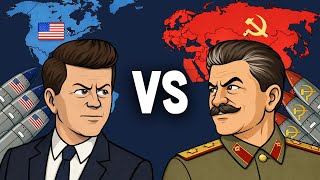

The Cold War: Closer to Extinction Than You Think
41sThe opening hook creates immediate intrigue by suggesting the Cold War nearly ended humanity, a high-stakes claim that grabs attention.
▶ Play Clip"The title is accurate, but the video includes a lengthy sponsor segment and some fluff, making it slightly padded."
This video provides a comprehensive overview of the Cold War, a 45-year geopolitical standoff between the United States and the Soviet Union that brought humanity to the brink of nuclear annihilation. It traces the conflict from its origins in the aftermath of World War II through key events like the Berlin Airlift, the Cuban Missile Crisis, and the eventual collapse of the Soviet Union.
The Cold War was a 45-year conflict that came closer to ending human civilization than most people realize, with the potential to destroy the world in seconds.
The US-Soviet alliance during WWII was a marriage of convenience, based on 'the enemy of my enemy is my friend,' and dissolved once the common enemy (Nazi Germany) was defeated.
The Soviet Union lost 27 million people in WWII, which rewired their worldview and fueled their determination to prevent any future invasion, contributing to their paranoia and expansionist policies.
Joseph Stalin ruled with an iron fist, purging his own military, sending millions to labor camps, and being deeply paranoid, viewing the West as an existential threat.
Winston Churchill coined the term 'Iron Curtain' in a speech in Missouri, describing the division of Europe from the Baltic to the Adriatic, which became the defining metaphor of the Cold War.
In 1948, Stalin blockaded West Berlin, cutting off 2 million people. The West responded with the Berlin Airlift, delivering supplies by plane, which was a logistical and PR victory, forcing Stalin to lift the blockade.
Mutual Assured Destruction (MAD) was a doctrine where both sides had enough nuclear weapons to destroy each other, ensuring that any nuclear attack would result in the attacker's own annihilation, thus preventing war.
The fall of China to communism led to the Domino Theory, which was tested in the Korean War (1950-1953). The war ended in a stalemate, with the border nearly unchanged, proving the Cold War could turn into a shooting war.
The Berlin Wall was built in 1961 to stop East Germans from fleeing to the West, an admission of communism's failure. At least 140 people were killed trying to cross it.
The Cuban Missile Crisis in 1962 was the most dangerous moment of the Cold War, with the US at Defcon 2. The crisis was resolved when the Soviets agreed to remove missiles from Cuba in exchange for a US promise not to invade and the removal of US missiles from Turkey.
During the Cuban Missile Crisis, Soviet submarine officer Vasili Arkhipov refused to authorize a nuclear torpedo launch, preventing a potential nuclear war. His decision is credited with saving human civilization.
Détente, a period of relaxed tensions, saw arms control treaties and US-China relations, but collapsed with the Soviet invasion of Afghanistan in 1979.
Ronald Reagan's 'Tear down this wall' speech at the Brandenburg Gate in 1987 was a symbolic challenge that, combined with Gorbachev's reforms, contributed to the fall of the Berlin Wall in 1989.
The Soviet Union dissolved in 1991, ending the Cold War. Despite the 45-year conflict, no nuclear weapons were used after 1945, though the world came close multiple times.
The Cold War was a 45-year ideological and military standoff that shaped the modern world, ending without nuclear war but leaving a legacy of division and tension. The video emphasizes that the world came closer to nuclear annihilation than most realize, highlighting the importance of diplomacy and individual decisions in preventing catastrophe.
How many people did the Soviet Union lose in World War II?
27 million
01:18
Who coined the term 'Iron Curtain'?
Winston Churchill
05:23
What was the Berlin Airlift?
A Western operation to deliver supplies to West Berlin during the Soviet blockade in 1948.
07:58
What does MAD stand for?
Mutual Assured Destruction
09:25
What was the Domino Theory?
The idea that if one country fell to communism, its neighbors would follow.
10:24
Who was Vasili Arkhipov?
A Soviet naval officer who refused to authorize a nuclear torpedo launch during the Cuban Missile Crisis, preventing a potential nuclear war.
17:16
What was the outcome of the Cuban Missile Crisis?
The Soviets removed missiles from Cuba, and the US promised not to invade and removed missiles from Turkey.
18:26
What was the INF Treaty?
A 1987 agreement where both sides agreed to reduce their nuclear arsenals.
21:47
What was the 'Star Wars' program?
A space-based missile defense system proposed by Reagan that the Soviets couldn't ignore.
20:50
Arkhipov's Decision
This is a critical moment where one person's decision potentially prevented a nuclear war, highlighting the importance of individual judgment in high-stakes situations.
17:16MAD Doctrine
The concept of Mutual Assured Destruction is a key principle in nuclear strategy, explaining why the Cold War never turned hot.
09:25Reagan's Challenge
The 'Tear down this wall' speech is an iconic example of rhetoric influencing political change.
21:59Berlin Airlift as PR
The airlift was not only a logistical feat but also a masterclass in public relations, demonstrating soft power.
07:58[00:02] destroy the world in seconds to a concrete wall that imprisoned millions of Germans to the officer who prevented World War II by refusing to press the red button. This is the Cold War, a 45-year conflict that came closer to
[00:17] ending human civilization than most people realize. Sir, don't do it. But it all kicks off at the end of World War II. Cuz when Germany surrendered, everybody celebrated. People flooded the streets of London, New York, and Moscow
[00:33] like it was the biggest global block party in history. And for a moment, it felt like humanity could finally exhale. However, underneath the confetti, a new tension was already brewing. Cuz the alliance that defeated Hitler was a
[00:47] marriage of convenience. More like the enemy of my enemy is my friend kind of relationship. And once that common enemy disappeared, so did the Alliance. On one side stood the United States. Young, wealthy, and casually holding the most
[01:02] powerful weapon ever created, the atomic bomb. On the other side was the Soviet Union, battle scarred, paranoid, and determined to make sure nobody ever marched into their country again. And honestly, I get it. The Soviets had just
[01:18] lost 27 million people in the war. And when you lose that many people, it kind of rewires how you see the world. But here was the bigger problem. Both nations looked at the world through completely different lenses. America
[01:33] championed capitalism, free markets, individual liberty, and democracy, while the Soviet Union pushed communism, a state controlled economy, collective ownership, and a one party system that was, let's just say, not a big fan of
[01:48] disscent. Hey, get your hands off me. Each side saw the other as an existential threat. And when two superpowers both believe their way of life is on the line, things can [music] spiral pretty fast. But this tension
[02:02] makes a whole lot more sense when you look at who is in charge. Cuz Joseph Stalin ruled the Soviet Union with an iron fist. He purged his own military officer corps, sent millions to die in labor camps, and was so paranoid he
[02:17] trusted almost no one. Stalin's worldview was simple. The West wanted to protecting the motherland meant installing puppet governments across Eastern Europe and steamrolling any hint of resistance, then hey, so be it. But
[02:32] on the American side was Harry Truman, who suddenly became president after Franklin Roosevelt died. And this guy was barely two weeks into the job when by the way, we built the most destructive weapon in human history." I
[02:47] mean, talk about a fast onboarding. My boy didn't even have a cup of coffee. Here you go, sir. But if you think you could go toe-to-toe with a dictator like Stalin and outmaneuver him, then you got to play Supremacy World War II, a free
[03:01] online PvP strategy game where you can channel your inner commander and chief and lead a nation, build your economy, and fight 99 other players in modern global warfare. Mobilize your army with tanks, jets, and nuclear submarines. And
[03:16] if that's not enough, unlock cuttingedge military tech to destroy anyone standing in your way. Yeehaw. But like real geopolitics, it isn't just about brute force. It's strategy, alliances, and when necessary, a little backstabbing.
[03:32] And right now, for season 19, they have fractured domination, a world split apart, where players fight for global control points in the middle of a nuclear winter. You'll recruit new legendary officers, command elite
[03:45] seasonal units, and battle to seize ultimate power before your enemies do. But my favorite mode is US Battleground, where instead of nations, you can pick your favorite state, invade your neighbors, and expand your empire like
[03:58] James Pulk on steroids. And look, as someone who spends a lot of time around presidents, sometimes I think I could do a better job. And this game is the perfect place to prove it. So, if you want to try Supremacy World War II, it's
[04:11] available for free on PC and mobile. Just click the link in the pinned comment or scan the QR code on the screen to get a starter pack with a powerful seasonal elite unit worth $40 for free. But let's get back to Truman
[04:25] and his nuclear dilemma. Cuz not only did he have to decide whether to use him on Japan, he also had to figure out what to tell Stalin, who was still technically our ally. FDR had planned to brief him after the war, but never got a
[04:38] chance. So Truman walked into a meeting with Stalin, holding a secret that could reshape the planet. But unbeknownst to Truman, Stalin already knew everything. Thanks to Soviet spies, Stalin ordered his scientists to build a bomb of their
[04:53] own. He was one step ahead. But here's the thing about Truman. Dude wasn't a pushover. He was blunt, decisive, and deeply suspicious of Soviet intentions. Truman even once said that you never saw such pigheaded people as the Russians,
[05:09] which honestly tells you everything about the vibe between the two sides. But to help the world understand this dynamic, in came Winston Churchill, the British bulldog who stared down Hitler and commanded the world's attention just
[05:23] by clearing his throat. Cuz while speaking at a small college in Missouri, he finally put a name to what everyone had been feeling. From Shettton in the Baltic to Trieste in the Adriatic, an iron curtain has descended across the
[05:37] continent. The Iron Curtain. I wish I thought of that. It was the perfect metaphor. Europe splitting in two with each side sealed off behind its own political wall. And over the next few years, that curtain didn't rise. It
[05:52] hardened into something close to permanent. Cuz here's the big picture. After World War II, Eastern Europe was destroyed. And there was a total power vacuum. So the Soviets rushed in and basically called dibs before anyone
[06:06] realized what was going on. Poland, Czechoslovakia, Hungary, Romania, Bulgaria, East Germany. One by one, communist governments were popping up. And if we're being honest, these weren't elections. This was the Red Army
[06:20] standing in the background like a bouncer, saying, "Yeah, you're voting this way today." The secret police handled the rest and anyone who resisted was imprisoned, executed, or taken on a
[06:32] leisurely midnight walk from which they never returned. Hey, where you taking him? So, the United States fired back with a strategy called containment, which was essentially, okay, we won't try to rip communism out of the places
[06:45] you already grabbed, but we're not letting it spread an inch further. And which had been carved up like a Thanksgiving turkey after the war. The western slices went to America, Britain, and France, while the eastern portion
[06:59] went to the Soviets. Seems fair, right? Well, there was one small problem. Well, there was one small problem. Berlin cuz the former Nazi capital sat smack dab in the middle of the Soviet zone and Berlin itself was divided too,
[07:13] creating a pretty awkward situation for West Berlin, which basically became a little democratic island floating in the middle of a communist ocean. In Stalin, he hated that. He wanted it gone. So in 1948, Soviet forces blockaded every road
[07:30] leading into West Berlin, cutting off 2 million people from food, fuel, and medicine. It was basically Stalin's way of saying, "Nice you got there. Shame if something were to happen to it, cause his game theory was simple. Either the
[07:44] Western powers would back off and abandon Berlin, or they try to smash through the blockade by force, giving him the perfect excuse to fire back. However, the West found a third option, one Stalin didn't see coming. American
[07:58] and British planes flew around the clock, delivering everything West Berlin needed to survive. Coal, food, medicine, and even candy for the kids. They called it the Berlin Airlift, which was not only a crazy logistical achievement, but
[08:13] a PR master class. Cuz it's kind of hard to look like the good guy when the other side is dropping chocolate bars from the sky. Um, tastes pretty good. Want a bite? So,
[08:26] eventually Stalin blinked. He lifted the blockade without accomplishing a single one of his goals. The West had just won the first major showdown of the Cold War without firing a shot. But speaking of firing a shot, back at home, the Soviet
[08:41] Union detonated its first atomic bomb, shifting the entire calculus of the Cold shifting the entire calculus of the Cold War overnight. How' they do it? Well, Soviet spies had secretly stolen tons of US nuclear research. And once America
[08:55] realized that, the race was on. Both superpowers started pouring ungodly amounts of money into building bigger weapons. Cuz by the early 1950s, they had hydrogen bombs, devices roughly a thousand times more powerful than the
[09:11] ones that leveled Hiroshima. And by the 1960s, they stockpiled enough nuclear warheads to destroy the entire planet several times over. Boys, [clears throat] why do we need multiple world ending bombs? I think one kind of
[09:25] gets the job done. Let's slow down production, please. But this gave rise to a doctrine with a pretty appropriate acronym, MAD. Mutual assured destruction. The idea was simple. If one side launched nuclear weapons, the other
[09:40] would fire back, ensuring both nations ended up in radioactive rubble. Needless to say, there were no winners in this scenario, proving that MAD was completely insane. But also, it kind of worked. Cuz when the guaranteed outcome
[09:56] of pushing the red button is your own annihilation, you suddenly become very committed to not pushing it. But zooming back out to the world stage, around this back out to the world stage, around this time, China fell to communism. Mao Zaong
[10:09] won the civil war and suddenly the most populous nation on earth had joined the communist block. And this terrified American politicians, giving rise to domino theory. The idea that if one country fell to communism, its neighbors
[10:24] would topple right after it. And domino theory was pretty much tested right away because in 1950, North Korean forces backed by Stalin stormed across the 38th parallel into South Korea. So the United States rushed in troops under the UN
[10:38] banner and fought 3 years of back and forth warfare. And at first, American forces pushed the North Koreans all the way up to the Chinese border, which in hindsight was not China's favorite thing to wake up to. So, China responded by
[10:53] sending hundreds of thousands of troops into the fight, smashing into US lines and triggering one of the worst retreats in American military history. As a result, General MacArthur took one look at this disaster and basically said,
[11:06] "Okay, time for nukes." And Truman said, "Absolutely not." And when MacArthur kept demanding nukes in public, Truman fired him for insubordination. Great move, sir. He can't be dissing you in public like that. Anyways, the
[11:21] armistice was signed in the border between North and South Korea ended up in pretty much the exact same spot as before. So, after three years of war, 36,000 Americans dead and more than 2 million Koreans killed, the peninsula
[11:35] was still divided. And this proved that the Cold War could absolutely turn into a shooting war. But luckily, both sides refrain from pressing the nuclear refrain from pressing the nuclear button. Phew, close call. But suddenly
[11:49] everything flipped on its head. Costalin died in 1953 after nearly three decades of absolute rule. And his successor Nikita Kruev seemed almost jovial by
[12:01] comparison. He was a bald bombastic former peasant who denounced Stalin's crimes and spoke optimistically about peaceful coexistence with the West. I kind of like this guy. But wait, don't let the folksy charm fool you, cuz Kruev
[12:15] was a hardcore believer in communism. A guy who promised that it would bury capitalism. And when Hungary tried to break free from Soviet control, Kruev didn't exactly send flowers. He sent tanks. And Soviet forces crushed the
[12:30] revolution in a matter of days, killing 2,000 Hungarians and sending a brutally clear message. Moscow would use whatever force necessary to keep its empire intact. But speaking of any force necessary, in 1957, the Soviet Union
[12:46] launched Sputnik into orbit and it did basically nothing except circle Earth basically nothing except circle Earth with a radio signal. Beep beep beep. But that beeping petrified America cuz rockets in space also meant that they
[13:01] could drop a nuclear warhead on any American city in minutes. So yeah, that whole space race thing, it was really a missile race in disguise. And the Soviets kept racking up wins like the first animal in orbit, first human in
[13:16] space, and the first spacew walk. I mean, at this point, the scoreboard was looking rough for Team USA. So, President John F. Kennedy decided America needed a goal bold enough to recapture the world's imagination. And
[13:30] in a speech to Congress, he declared that the United States would land a man on the moon and return him safely to Earth before the decade was out. It sounded impossibly ambitious. Like, did we really just promise that on live TV,
[13:43] we really just promise that on live TV, sir? But he meant it. And after JFK stepped off the air, the Cold War brought its most dangerous moment yet, brought its most dangerous moment yet, the Berlin Wall. Cuz in August of 1961,
[13:55] it went up virtually overnight. a concrete monstrosity lined with guard towers, search lights, and soldiers with orders to shoot anyone trying to cross. It was ironically an admission of failure from the Soviets cuz instead of
[14:10] making communism more appealing, Kruef just decided to trap people inside. In fact, at least 140 people were killed trying to cross it. But in ' 63, Kennedy
[14:22] visited the wall and delivered one of the most iconic lines of the Cold War. Freedom has many difficulties and democracy is not perfect, but we have never had to put a wall up to keep our people in. All free men, wherever they
[14:35] may live, are citizens of Berlin. And therefore, as a free man, I take pride in the words bin I'm Berliner, which was basically his way of saying, "Your fight is our fight." And JFK's speech had me so fired up, I was ready to run through
[14:50] a brick wall. Ah, actually, I'll just wait for reinforcements. But by the time JFK gave that speech, he had already stared down something far more terrifying. Cuz 90 m off the coast of Florida sits Cuba. And in 1959, Fidel
[15:06] Castro's revolution turned it into the first communist state in the Western Hemisphere. And after the CIA's failed Bay of Pigs invasion, Castro asked the Bay of Pigs invasion, Castro asked the Soviets for protection. So Kruev had an
[15:19] idea. placed nuclear missiles on Cuban soil close enough to reach Washington in 13 minutes. What could possibly go wrong? But when American spy planes spotted Soviet missile sites in Cuba, JFK immediately imposed a naval blockade
[15:35] and addressed the nation on live TV. For the first time, the public learned just how close the world was to nuclear war. And when Soviet ships steam straight toward the blockade line, American forces went to Defcon 2, the highest
[15:50] alert level the US has ever reached. Nobody panic. So JFK ordered B-52 bombers armed with nuclear weapons to fly constant loops along Soviet strike
[16:02] routes. A not so subtle message to Cruchef. Don't even think about it, Baldi. But then came the single most dangerous day of the entire Cold War. Because on October 27th, 1962, a Soviet
[16:16] submarine was detected near the blockade line. So, American destroyers began dropping depth charges as warning shots. Small explosives meant to say, "Hey, come on up here. We want to talk with you, pal." But Captain Seitzky didn't
[16:31] know they were warnings. He hadn't heard from Moscow in days. They'd been underwater, cut off from all communication. As far as he knew, World War II had already started. And the conditions on board were hellish.
[16:45] Temperatures soared over a 100° because the air conditioning failed. The crew was on the edge of collapse. And Zeitzky had a nuclear torpedo, one that could only be launched if three officers agreed. Zeitzky himself, the political
[17:01] officer, and the flotilla commander. And Zeitzky was ready to fire. We're going to blast them now. We'll die, but we'll sink them all. We will not disgrace our navy. The political officer agreed. That made two out of three. Then it all came
[17:16] down to Vasili Archipov, one man in a boiling metal tube under the ocean, standing between humanity and nuclear Armageddon. And he said, "No." While his
[17:28] captain raged and explosions thudded against the submarine's hull, Archipov argued that they didn't actually know a war had started. They should surface, contact Moscow, and just make sure they have the right information before they
[17:41] willingly blow up the entire world. And boy, did they have an intense argument came close to getting physical, but Archipropov wouldn't budge. And without unanimous approval, the nuclear torpedo couldn't be launched. So, the sub
[17:57] surfaced, and there was no war. Archipov had just prevented what certainly would have escalated into a full nuclear exchange. One man, exhausted, overheated, and surrounded by chaos, made a decision that may have saved
[18:12] human civilization. And thank the Lord, he did, cuz that same day, JFK and Kruev finally reached a deal. The Soviets would pull their missiles out of Cuba, and in return, America would promise not to invade the island and quietly remove
[18:26] its own nuclear missiles from Turkey. And just like that, the Cuban missile crisis was over. And somehow against all odds, nobody had pushed the button. And let's just say nobody wanted that to happen again. So JFK and Kruev
[18:41] established a hotline between Washington and Moscow to prevent future crises before they spiraled out of control. But even with the hotline, real peace remained elusive cuz JFK was assassinated in 1963. Cruchef was ousted
[18:56] by his own colleagues the next year and then came Vietnam. The Cold War's longest, bloodiest, and most divisive proxy war. A guerilla conflict where American military strategy built for fighting Soviet tanks in Europe proved
[19:12] almost useless against an enemy that could disappear into the jungle. And by the time it was over, more than 58,000 Americans and 2 million Vietnamese had died. It was traumatic, but at least it helped usher in dant, a fancy French
[19:28] word meaning relaxation. Or in cold war terms, it meant let's not freak out every 5 minutes. Cuz Richard Nixon, in one of the most improbable plot twists in history, opened relations with communist China, signed arms control
[19:41] treaties with the Soviets, and even had American and Soviet spacecraft docked together in orbit. See, boys, I knew we could all get along. I love to taunt almost as much as I love saying it. Dant taunt daunt.
[19:56] Sorry. For a few years, it seemed like the Cold War was finally cooling off. the Cold War was finally cooling off. But spoiler, it wasn't. Cuz in 1979, Soviet troops invaded Afghanistan. They were expecting a quick stabilization
[20:09] mission, but instead walked straight into their own Vietnam. A brutal guerilla war against Afghan fighters armed with American missiles. Dant was armed with American missiles. Dant was officially dead. No. [screaming]
[20:23] But when Ronald Reagan took office, he wanted to confront the Soviets head on. I urge you to beware of the temptation of pride. The temptation of bllightly declaring yourselves above it all and label both sides equally at fault. To
[20:37] ignore the facts of history and the aggressive impulses of an evil empire. Evil empire. Okay, this guy means business. And he put those words into business. And he put those words into action cuz defense spending skyrocketed.
[20:50] New American missiles rolled into Europe and Reagan unveiled Star Wars, a space-based missile defense system that sounded so science fiction most experts didn't think it could work. But the Soviets couldn't take the chance. They
[21:03] had to assume it could work. And just like that, the arms race was back on again. But this time, the Soviet system was falling apart. a stagnant economy, a
[21:15] losing war in Afghanistan, and three Soviet leaders dead in three years. It was looking bleak until Mikail Gorbachof arrived. He was young, dynamic, and willing to admit that the Soviet system needed serious reform. His policies of
[21:31] openness and restructuring were supposed to save communism. But instead, they basically hit the self-destruct button. Cuz Gorbachev and Reagan, despite vastly different worldviews, developed genuine rapport and in 1987 signed the INF
[21:47] treaty where for the first time of the Cold War, both sides agreed to reduce their nuclear arsenals instead of just slowing down production. But Reagan wasn't satisfied yet. He kept the pressure on and while standing at the
[21:59] Brandenburgg Gate in West Berlin, he delivered one of the most iconic lines of the Cold War. Mr. Gorbachev, tear down this wall. It was part challenge, part prophecy, a symbolic dare to let Eastern Europe breathe again. And I
[22:15] think the message started to work cuz Eastern Europe communist regimes began collapsing left and right. Poland held elections and the communist lost badly. Hungary opened its border with Austria, creating an escape route to the west.
[22:30] Czechoslovakia erupted in the Velvet Revolution. And every week, another country broke free from Soviet control. But unlike in the past, Gorbachev didn't send in the tanks to preserve their empire. He let it go. And for the first
[22:44] time of the Cold War, the Iron Curtain was rusting away. Which brings us back to Germany. Because when East Germany announced that citizens could cross the border freely, thousands flooded the checkpoints, they climbed onto the
[22:57] Berlin Wall, danced on it, and embraced strangers from the other side. It was a freaking party. Woohoo! In Europe, Germany finally reunified. The Warsaw
[23:09] Pact dissolved, and Soviet republics declared independence one by one. In the USSR, Gorbachev resigned. The Soviet flag was replaced by the Russian flag. And just like that, the Soviet Union ceased [music] to exist. To everyone's
[23:23] relief, the Cold War didn't end with a nuclear apocalypse. Great work, sir. Let's put that red button away before a future president starts poking at it. Cuz despite the Cold War lasting 45 years and shaping the world we live in
[23:37] today, no nuclear weapons were ever used after 1945. Though, we came a whole lot closer than most people realize. Also, don't forget to check out Supremacy World War III. Scan the QR code and get a starter pack with a powerful seasonal
[23:52] elite unit worth $40 for free. But speaking of wars that nearly destroyed the United States, this is the American Civil War explained. From the bloodiest day in American history to the emotional surrender of a Confederate general to
[24:08] the president saving America from the brink of collapse and then getting assassinated 5 days later. If you thought the Cold War was intense, then you aren't ready for the deadliest war in American history.
⚡ Saved you 0h 24m reading this? Transcribe any YouTube video for free — no signup needed.