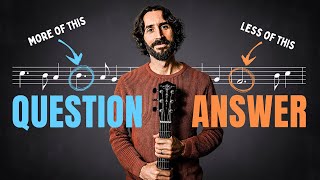

The 3 Most Stable Notes in Any Scale
60sThe simple stable vs unstable note framework is the exact unlock beginners need to write satisfying melodies without theory.
▶ Play Clip"The title promises a crazy-easy trick and the video delivers a genuinely simple, memorable framework for melody writing."
This video presents a simple, theory-free method for writing memorable melodies by treating melodic phrases as questions and answers. The approach is built on identifying stable and unstable notes within a scale, then using that tension-versus-release dynamic to shape song sections and vocal hooks.
In the key of C, the scale has seven notes before the octave. Some scale degrees feel stable and at rest; others carry tension and want to move.
The 1st, 5th and 3rd scale degrees are the three most stable notes, in that order. The 1st is the home note with no need to move.
The 2nd, 4th, 6th and 7th are unstable: the 2nd wants to fall to the 1st or rise to the 3rd, the 4th wants to fall a semitone to the 3rd, and the 7th wants to rise up to the octave.
Think of melodic phrases as questions or answers. Ending on a stable note creates an answer/statement; ending on an unstable note creates a question.
A melody rising through the 3rd, 4th and 6th then landing on the 5th sounds stable; moving it to an unstable note makes it feel unresolved, like a question.
Reversing the order and starting with a question makes melody-writing a conversational exercise: ask questions, then finally answer.
The shape and direction of a melody matter: rising-then-doubling-back and downward inflections produce different emotional types of questions.
Jumping to a note outside the scale creates a question with much more tension and anxiety, which can be resolved or followed by another unsettling question.
Hans Zimmer teaches melody writing as asking questions and delaying the answer; the open question is more interesting than the final resolved answer.
Use verses to ask questions and stay unresolved, then let the chorus provide the resolving statements by landing on the 1st, flat 3rd or 5th.
Melodies become engaging when they balance tension and release. By treating each phrase as a question or answer — and consciously delaying resolution — songwriters can craft memorable, emotionally compelling tunes with almost no theoretical background.
Which three scale degrees are the most stable notes in any scale?
The 1st, 5th and 3rd, in that order.
00:59
Which scale degrees are unstable and want to move?
The 2nd, 4th, 6th and 7th.
01:11
Where does the 2nd degree naturally want to resolve?
It wants to fall to the 1st or rise up to the 3rd.
01:27
Where does the 4th degree naturally want to resolve?
It wants to fall a semitone to the 3rd.
01:45
Where does the 7th degree naturally want to resolve?
It wants to rise up to the octave.
01:59
How do you make a melodic phrase feel like a question?
End the phrase on an unstable note.
03:42
What happens if you jump to a note outside the scale in a question phrase?
The question carries much more tension and anxiety.
06:43
According to Hans Zimmer, why is a question usually more interesting than an answer?
The answer feels resolved and final, while the question is open and invites the possibility of going somewhere else.
09:49
In the verse/chorus application, where should resolving 'answer' phrases go?
In the chorus, landing on the 1st, flat 3rd or 5th.
13:15
Melodies as questions and answers
Turns a music-theory idea into a conversational skill everyone already uses.
02:27Non-scale notes amplify tension
Shows a zero-theory way to inject anxiety into a melody without learning advanced concepts.
06:43Hans Zimmer: delay the answer
A master composer's principle that open questions make music more compelling.
09:34Verse/chorus question-answer structure
Gives songwriters a clear structural template for applying tension and release.
12:18[00:01] D. [Music] writing melodies that requires no complex theory, no experience, and no
[00:16] advanced skills on an instrument. Not only that, this way of writing melodies is so much fun and feels so creative. I guarantee it will be a gamecher for your songwriting. And we're going to start by taking the notes of a key and having a
[00:28] important concept, which is the idea that some notes in a scale are stable and some notes are unstable. So in the key of C, we have seven notes before getting to the octave. The first note in the scale is the most stable.
[00:44] The first note in any scale is the most stable. It's the home note. It has no tension or need to move. However, some of the other notes in the scale do have at those, let's talk about the other two stable notes in the scale. So, we have
[00:59] the one, then we have the five, and then we have the three. In that order, those are the three most stable notes in the scale.
[01:11] notes in the scale. 1 5 3. Now the other notes, the two, the 1 5 3. Now the other notes, the two, the four, the six, the seven are unstable in that they want to move. They want to resolve either up or down.
[01:27] And this is really important to what we're about to do. So that two note we're about to do. So that two note really wants to fall either to the one really wants to fall either to the one or it wants to rise up to the three.
[01:45] The fourth really wants to fall a semmit tone to the third.
[01:59] And the seven wants to rise up to the octave. these unstable notes resolving to stable notes is because that's what creates tension and then release. The unstable notes hold the tension. The stable notes
[02:14] want our melodies to have a good blend of tension and release. That's what makes it interesting for the listener. Now, once we have that idea laid out, it allows us to talk about the concept that I really want to focus on as a gamecher
[02:27] for songwriters, and that is to think of our melodies as either questions or answers. And the beauty of this method is that we're already familiar with it. are already used to hearing melodic phrases when spoken by other people in
[02:39] conversations. Every conversation we have, we have questions, we have answers, we have statements. And we know that we're hearing a question or an answer or perhaps a statement by the melody in the voice. So, I'm going to
[02:51] listen out for are a couple of key things. Firstly, we're really focused on the last note in the phrase, the last note in each of the melodies that we're listening for is are we landing on a stable note or an unstable note as that
[03:07] last note in the melody. So with those two things in mind, let's just play around with a couple of basic melody ideas. [Music] Now that melody rises up the third, the
[03:22] fourth, the sixth, and then lands on the fifth. So no matter what notes come before it, the last note we hear in that phrase is a stable note. [Music] If we move that melody down here though,
[03:42] hear that that's not stable. That's unresolved. So what is the difference between those two melodies? Well, you can hear that two melodies? Well, you can hear that this one
[03:57] feels stable. it feels like more of a statement or more of an answer. Whereas this one [Music] feels more like a question. Now let's reverse the order of those two and
[04:11] imagine that we start with the question. [Music] question with an answer. But we're not using any music theory other than
[04:26] understanding that there are stable and unstable notes. What we're really doing is using that knowledge to now think of this melody writing as a conversational this melody writing as a conversational exercise. I want to ask a question.
[04:39] exercise. I want to ask a question. Maybe ask another question. Maybe ask another question. And finally answer.
[04:53] simple onenote answer. And this is where it gets really fun when we start and even considering what type of question we might be asking. These questions all sound quite floaty and nice and gentle and the answer as well
[05:08] was very nice and pleasant. But we can introduce a little more attitude to some moment. The other thing we really want to pay attention to is the shape and the direction of the melody. Is it moving up or is it moving down or is it perhaps
[05:21] saying before, the direction is really important. And the direction of this melody is that it rises and then doubles back on itself.
[05:35] Let's reverse that and see if it makes a difference. to the second, up to the third, and still we land on the fourth. So, it's still a question, but is it a different kind of question?
[05:59] feel like a slightly different question because the first one is dropping down from a higher note so it has a downward inflection.
[06:12] question, but it's not the same kind of question as this. And what happens if we take that phrase and now jump up to the sixth instead of
[06:25] the fourth? [Music] Different kind of question again. What happens if we jump to a note that's not in the scale? [Music]
[06:43] That note there has a lot of tension in it. And so it really poses a very a question with a lot more tension in it, a lot more anxiety in it.
[06:56] [Music] But we can resolve. Or we can ask another question that is also unsettling. also unsettling. [Music]
[07:17] And I find this idea really powerful and a really lovely way to think about think about melody writing in a different way. It lets me ask the question, "What makes for a great conversation?" If I'm catching up with a
[07:29] and that friend doesn't ask any questions but just gives a series of statements, that's not really a conversation. That's the other person conversation is often one that starts with some great questions. That's what
[07:45] really opens up great conversations. And so if we take that idea and apply it to melody writing, we may find that our melodies open up and ask more questions that the listeners then want answers to. Just a quick reminder that our online
[07:59] songwriting community is now hosting weekly song feedback sessions. So, if you're a songwriter who's looking to get meaningful, highquality feedback on their songs, we're offering a 14-day free trial, so you can come along, jump
[08:12] growing community of songwriters from all over the world. You'll find a link at the top of the description. Hope to see you there. So, going back to that analogy of having a conversation with a friend who just keeps giving their
[08:25] but asks no questions, what would that sound like melodically? Well, given that the one is the most stable note, resolving down to the one would continually feel like our melody is just making statement after statement with no
[08:41] ambiguity. It would sound like this. [Music]
[08:59] the end of every melodic statement, it always feels like it's resolved. It always feels like the statement is being made or the answer is being given, but there are no questions being asked. But if we can just change maybe the first
[09:13] two of those melodic statements and ask a couple of questions, then the answer becomes very satisfying. [Music]
[09:34] was when I was watching Han Zimmer on masterclass.com and he talked about melody writing in exactly this way. He talked about asking questions and then asking more questions and then maybe giving an answer. But he made the point
[09:49] that the question is usually more interesting than the answer. The answer feels so resolved. It's final. But the question is open. It invites the possibility of this melody or this song going somewhere else. And so his thought
[10:03] was if you can keep extending the question, if you can keep delaying the answer, it makes for a more interesting musical experience. So let's switch to the key of C minor. Here's a melody
[10:19] which is using all stable notes, the one, the flat three, and the five. certain mood and give this melody a direction
[10:39] a pretty gentle kind of question. But if I do this, Han Zimmer would say that's got attitude in it. You know that is full of tension.
[10:52] But this is great because it means that instead of thinking of these intervals as numbers, we can just start thinking in terms of the mood they're creating. And if we're creating a song where we want a particular mood, this is a really
[11:05] fun and effective way to go about it. So there's a question there's a question [Music] followed by the answer. [Music]
[11:23] [Music] There's an extension to that question There's an extension to that question [Music] Now, I'm doing these on piano, but a really fun exercise is to take some of
[11:36] voice because after all, our voice is going to be carrying the lead melody of our song. Some of these ideas will sound singable and some will not. [Music] D and all
[11:51] D. [Music]
[12:05] It sounds quite haunting and it sounds quite singable. Now, I don't think I was sitting with my guitar and humming out some melodic ideas. So, another way we can apply this idea to songwriting is to think about the sections of the song
[12:18] we're creating. Perhaps in the verses, we want to avoid any kind of answer and just ask a lot of questions and then leave the answers or the statements up to the chorus section. So, here's our first little melody
[12:32] resolving down to the two. So, that's unstable. That's a question. Here's uh unstable. That's a question. Here's uh the second melody. the verse, listen to how unresolved it feels.
[12:59] [Music] N. of questions. Now, we're in a position to resolve those questions with answer
[13:15] statements. Lean into the one, the flat three, or the five in the scale. N. [Music]
[13:38] So before you go and write any more melodies, try this method. Ask yourself, what kind of conversations am I having with the melodies that I'm creating? Am melodies too resolved? Are they just giving too many answers or making too
[13:51] the comments what kind of results you get with this method and what kind of songs it leads to. So, please post in the comments any reflections or insights you gained from trying this method out. Happy songwriting. Bye.



⚡ Saved you 0h 14m reading this? Transcribe any YouTube video for free — no signup needed.