
AI Summary
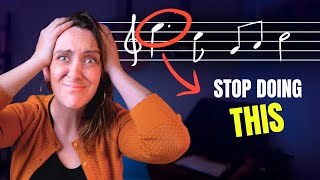
This video explains the biggest melody mistake beginner songwriters make: gluing every phrase to beat one of the bar. The instructor demonstrates how shifting the entry point of melodic lines off the downbeat creates rhythmic 'body language' that dramatically changes the emotional impact of a lyric, using examples from contemporary and classic songs.
Chapters
The biggest mistake beginner songwriters make with melody has nothing to do with pitch, notes, or intervals; it's something else entirely.
Shifting the second line off beat one by delaying its entry point opens up space that makes emotion flow differently.
Almost all beginner songwriters stick the melody like glue to beat one of the bar, an unconscious habit that makes songs sound samey.
If every phrase enters on beat one throughout a section, the song's body language is stuck in one position and emotion drains away quickly.
Speak a line of lyric over a 4/4 beat and practice entering the melody on different beats to break the habit.
Pushing lines 1–3 off the downbeat and landing the final line on beat one changes the emotional impact while keeping words and pitches identical.
There's no one right way; become aware of your habits, then experiment with line entry points until the emotion aligns with your lyrics.
Miley Cyrus's 'Flowers' starts verse melodies before beat one, pre-chorus on beat one, and the chorus hook after beat one for contrast.
Ask 'What emotion am I trying to convey?' – put stable, assertive lines on beat one; push fragile, tender lines off the downbeat.
The biggest melody mistake is not about pitch but about where phrases begin. By becoming aware of your entry-point habits and deliberately matching them to the emotion you want, you can transform the emotional impact of your songs.
Mentioned in this Video
Tutorial Checklist
Study Flashcards (8)
What is the biggest melody mistake beginner songwriters make?
easy
Click to reveal answer
What is the biggest melody mistake beginner songwriters make?
Starting every melodic phrase on beat one of the bar, making the song's body language stuck.
03:33
What practice breaks the habit of starting melodies on beat one?
easy
Click to reveal answer
What practice breaks the habit of starting melodies on beat one?
Speak a line of lyric over a 4/4 beat and practice entering the melody on different beats.
05:20
In Miley Cyrus's 'Flowers,' where do the verse melodies start relative to beat one?
medium
Click to reveal answer
In Miley Cyrus's 'Flowers,' where do the verse melodies start relative to beat one?
Before beat one.
10:01
In Miley Cyrus's 'Flowers,' where does the chorus hook enter relative to beat one?
medium
Click to reveal answer
In Miley Cyrus's 'Flowers,' where does the chorus hook enter relative to beat one?
After beat one (delayed entry).
10:14
In 'Dream a Little Dream of Me,' which lines of the verse start after beat one?
medium
Click to reveal answer
In 'Dream a Little Dream of Me,' which lines of the verse start after beat one?
The first three lines; the title/hook line starts on beat one.
10:43
Where should a melody line start to feel stable, solid, and assertive?
easy
Click to reveal answer
Where should a melody line start to feel stable, solid, and assertive?
On beat one of the bar.
12:04
Where should a melody line start to express fragility or tenderness?
medium
Click to reveal answer
Where should a melody line start to express fragility or tenderness?
Off the downbeat (pushed away from beat one).
12:32
What question should you ask when experimenting with melody entry points?
easy
Click to reveal answer
What question should you ask when experimenting with melody entry points?
'What emotion am I trying to convey here?'
11:52
💡 Key Takeaways
Stuck body language drains emotion
This pinpoints the core mistake in a single concept: static phrasing, not pitch, is what makes beginner melodies feel lifeless.
03:33Speak over a beat to practice entry points
Gives a concrete, immediately actionable exercise for any songwriter to break the beat-one habit.
05:20Same pitches, different emotion
Demonstrates that emotional change can come purely from rhythmic placement, proving the video's central thesis.
07:50Flowers contrasts section entry points
Shows a hit song using deliberate entry-point variation to create section contrast — a transferable lesson.
10:14Match entry point to emotion
Turns the whole lesson into a simple decision rule: ask what emotion you want, then place the phrase accordingly.
12:04Full Transcript
[00:01] that beginner songwriters make with melody is that the melodies are too repetitive or not repetitive enough. There's not enough notes. There's too intervals. There's too many intervals. All of these things are part of melody.
[00:14] But the truth is, the biggest mistake that beginner songwriters make with melody has nothing to do with pitch. It is something else entirely. In this video, I'm going to show you what the mistake is. I'm going to explain why
[00:28] beginner songwriters make it, but I'm going to show you how to fix it. And importantly, I'm going to demonstrate for you how when you do fix it, that the melodies in your songs will begin to amplify the emotion of your lyrics. This
[00:44] melody problem is the number one issue that we see come up week after week in the live song feedback sessions that we run with our membership community of songwriters. So, we want to shed some
[00:57] light on this particular thing because once you see it in your own songwriting, once you see it in your own songwriting, you can start to do something about it.
[01:09] idea, I want you to feel the difference in some simple phrases. We'll start with a simple beat in 44. And what I'm going to do is speak these two lines over the beat. And what I want you to do is tell me in the comment section below how you
[01:25] me in the comment section below how you experience the emotion of these two experience the emotion of these two lines. One 2 3 4. How do you say goodbye to someone you hate and love? How do you say goodbye
[01:39] to someone you hate and love? So that was version one. Now here comes version two. Again, use the comment section below to tell me how you feel
[01:51] the emotion being different in version two. Okay, here we go. How do you say goodbye to someone you hate and love? How do you
[02:04] say goodbye to someone you hate and love? to someone you hate and love? So notice that the difference here has nothing to do with pitch. You can feel that in shifting the second line off
[02:20] beat one of the bar by delaying the entry point of that second phrase that entry point of that second phrase that something has changed. Some space has something has changed. Some space has opened up and into that space emotion
[02:33] has started to flow in a different way to the first version. changed first and then I'm going to show you how to use this in a really musical
[02:48] way inside individual sections of your song using an example lyric. This practice and demonstration that I'm going to guide you through is so important because the habit of almost all beginner songwriters is to stick the
[03:03] all beginner songwriters is to stick the melody like glue to beat one of the bar. Like so many unconscious habits that we have as songwriters, if we don't name it and then change it, we will simply keep doing it. And if we keep doing it, our
[03:17] songs are going to sound the same. And we are also going to prevent our songs from reaching their full potential and really having the emotional impact and connection with listeners that is going to be the thing that brings listeners
[03:33] back again and again to your songs because your songs have an emotional impact on them. And the mistake I see so many beginner songwriters make is sticking every melodic phrase to beat one. So that every phrase comes in on
[03:48] beat one of the bar again and again throughout a section in every section and the song ends up feeling like its body language is stuck in one position. And it doesn't matter how beautiful the contours and intervals are of the
[04:04] melody. If all the phrases are coming in in exactly the same position, the emotion drains out of the song very quickly.
[04:20] section like a verse? And is there only one way to fix this? or are there many different ways that have different effects and create different kinds of body language? A quick moment to invite you to join us inside the HTWS
[04:35] live song feedback sessions and workshops throughout the year. And these are where songwriters just like you from around the world are getting the skills, knowledge, and confidence to write and release their best songs. Come and hang
[04:51] out with me, Benny, and the loveliest songwriters you'll ever meet. Start by joining us for free for 14 days. So, come have a look around. We can't wait to see you in there. The link for more information is in the video notes below.
[05:05] I'm going to show you by taking a fourline section and actually setting it to melody with music so that you can really hear the lines come to life with really hear the lines come to life with pitch but supported by this idea of
[05:20] changing the body language and really seeing how that affects the emotion of the section dramatically. All right. So the very first way, a very simple way to practice uncoupling your melody from that beat one of the bar, uncoupling the
[05:37] melody from when you strum a chord, for example, is simply to speak a line of lyric over a beat of 44 and practice entering the melody on different beats.
[05:49] Let's use the same first line that we just heard. The first thing I'm going to do is speak it starting on beat one so I know what I'm trying to move away from. know what I'm trying to move away from. Okay. So, here is my beat.
[06:07] How do you say goodbye? Now, what I'm going to do is I'm going to deliberately start the phrase after beat one. And I'll do it in a couple of beat one. And I'll do it in a couple of different ways. Here we go.
[06:24] How do you say goodbye? How do you say goodbye? How do you say goodbye? How do you say goodbye? How do you say goodbye? 1 2 3. How do you say goodbye?
[06:45] off beat one is a great way to break the habit of always starting melody lines on habit of always starting melody lines on beat one.
[06:58] picture with a fourline section. And we're going to experiment with different kinds of body language. And I'm going to demonstrate them to you so you can demonstrate them to you so you can really feel the difference and hear how
[07:11] the body language, the phrasing of the melody really changes the emotion that you feel coming from the same words and in fact the same pitches.
[07:24] in fact the same pitches. [Music] [Music] How do you say goodbye
[07:38] who held you down but was the first to pick you up.
[07:50] version of exactly the same lyric with exactly the same pitch melodies. This exactly the same pitch melodies. This time I'm going to push lines 1 2 and three off the down beat and come on the down beat with that final line. And we
[08:04] just want to feel the emotion change. And I'm also keen to hear which one you prefer in the comments. Okay, here we go. go. How do you say goodbye
[08:17] to someone you hate and love? someone who held you down but was the someone who held you down but was the first to pick you up.
[08:32] there are different kinds of body language that are possible and that is the whole point. There's no one right way to do this. It's so much more about way to do this. It's so much more about understanding that our goal is to become
[08:46] aware of our habits of where we start our melodies. To know that where we start our melody lines, our entry points are under our control. And then experimenting with the entry points of the lines in our sections until we find
[09:02] the lines in our sections until we find a version where the emotion aligns with our lyrics and our meaning and our intentions for that section.
[09:17] I'm sure you will now. That the songs that you love, whose lyrics and melodies that you love, whose lyrics and melodies move you, use this kind of body language to bring out the emotion of the lyrics in the song. It is in contemporary pop
[09:32] songs. It is also in the timeless and classic melodies of the canonized songs and songwriters. This is not one genre or one era of songwriting that we're or one era of songwriting that we're talking about. It is everywhere in the
[09:46] songs where the lyrics and melodies are important and they communicate to you as a listener. Miley Cyrus used it in the smash hit song Flowers which basically broke the internet when it came out. Each section of that song starts the
[10:01] melodic phrase at a different point in the bar. She really uses this idea of body language to create contrast between the sections of her songs. All the melody lines in verse one start before
[10:14] beat one. In the pre chorus, the melodies come in on beat one. And then in the chorus, the whole hook of the chorus is that the melodies have a delayed entry that comes in after beat one. But also, you could pick any of the
[10:29] cannon songs from the American song book and you will see the songwriters using and you will see the songwriters using the body language of melody to bring out emotion and mood. A beautiful classic but totally typical example of this is
[10:43] the song Dream a Little Dream of Me. And you can see this body language idea at play inside the lyric here. inside the four lines of each verse section. The four lines of each verse section. The first three lines all come in after beat
[10:59] one and then the hook line, the refrain line, the title of the song, that last line of the verse sections comes in on beat one. It's also a phrase whose
[11:11] language is written in the command. Dream a little dream of me. That is yearning, pleading, commanding. It's a different kind of language. and putting it on beat one is using the body language of the melody to convey the
[11:26] language of the melody to convey the emotion of the lyric. important one because if we want to write great songs or even just make our
[11:39] songs better than they already are, we need to understand that it's more than just kind of a technical prodding and pushing of lines on and off the down beat. If we don't understand this final point, we miss the point entirely.
[11:52] Whenever you are practicing or playing with this idea, I want you to ask yourself the following question. What emotion am I trying to convey here? If
[12:04] emotion am I trying to convey here? If you want a section to feel stable, solid, resolute, assertive, and you've got a line like stay and never leave, then by all means, put that line on beat one of the bar because beat one is the
[12:20] most assertive, stable, solid place to start a melody. But if you want to pull at the heartstrings, if you want to express a feeling of doubt, sensitivity,
[12:32] express a feeling of doubt, sensitivity, openness, fragility, tenderness, push openness, fragility, tenderness, push that line off the downbeat and use body language to bring out the feeling and the emotion that you want to create. The
[12:47] tools are in your hands, and I can't wait for you to use them. And if you ever want support, guidance, or feedback on your songs and songwriting, join us inside the membership community. Everyone is welcome. The link to join is
[13:03] in the video notes below. Happy songwriting. I'll see you soon.