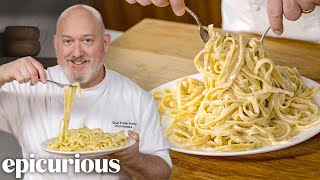

Real Alfredo Has NO Cream (Just 3 Ingredients)
35sControversial revelation that authentic Fettuccine Alfredo uses only butter, cheese, and pasta – no cream – shocks viewers and sparks debate.
▶ Play Clip"The title promises 'creamiest' and 'restaurant-quality' authentic Alfredo, and the transcript faithfully delivers techniques to achieve a rich, emulsified sauce without cream, matching the promise."
Professional chef Frank Proto demonstrates how to make authentic Fettuccine Alfredo using only three ingredients: butter, Parmesan cheese, and pasta. The key is proper technique to create a creamy emulsion without cream.
Authentic Fettuccine Alfredo is basically pasta with butter and Parmesan (pasta al burro or pasta con parmigiano e burro). The American version uses cream, but the original Italian version does not.
Real Fettuccine Alfredo only has three ingredients: butter, Parmesan cheese, and pasta. Technique is critical for success.
The dish comes together quickly, so have all ingredients prepped and nearby before starting.
Use real Parmigiano Reggiano from Italy (stamped on the rind). It emulsifies with butter to create a creamy sauce. Pre-grated cheese often contains anti-caking agents and isn't fine enough.
Grate Parmesan finely with a microplane so it melts easily. Avoid pre-grated cheese, which may have anti-caking ingredients and extra moisture that ruin the texture.
Use roughly a pound of cheese and a pound of butter per pound of pasta. The dish is indulgent and meant for small portions.
Use a smaller pot of water to concentrate starch from the pasta. Starch helps emulsify the sauce. Less salt is needed because Parmesan is salty.
Cook pasta just past al dente (to the tooth) to ensure it releases enough starch and holds the sauce well.
Use high butterfat European-style butter (e.g., Plugrá or Kerrygold) for better emulsification and creaminess.
Transfer pasta directly from water to butter without draining completely. Stir continuously while adding cheese gradually. The heat from pasta and pasta water emulsifies butter and cheese into a creamy sauce.
Mix in a glass bowl, not metal, to retain steady heat. If the sauce overheats, it breaks (butter separates from solids).
Plate and serve the pasta right away for best texture. Garnish with extra Parmesan if desired.
Master the technique of quickly stirring hot pasta with butter and finely grated Parmesan while adding starchy pasta water to create a silky, creamy emulsion. The dish relies on simplicity and quality ingredients, not cream.
What are the three ingredients in authentic Fettuccine Alfredo?
Butter, Parmesan cheese, and pasta.
00:29
Why should you avoid pre-grated Parmesan for Alfredo?
Pre-grated cheese often contains anti-caking agents that prevent clumping but also prevent proper emulsification, and it may be too moist, leading to a stringy texture.
01:46
Why does the chef use a smaller pot of water for the pasta?
A smaller pot concentrates the starch released from the pasta, which helps emulsify the butter and cheese into a creamy sauce.
02:33
What ratio does the chef recommend for butter, cheese, and pasta?
1 pound of butter, 1 pound of Parmesan cheese, and 1 pound of pasta.
04:29
Why does the chef use a glass bowl instead of a metal bowl for mixing?
Glass holds heat more evenly and does not disperse heat as quickly as metal, reducing the risk of the sauce overheating and breaking.
06:01
What type of butter does the chef recommend for better emulsification?
European-style butter with high butterfat, such as Plugrá or Kerrygold.
03:43
How do you know when the pasta is cooked just past al dente?
Taste a piece – it should have no white center but still have some chew (al dente means 'to the tooth').
03:28
Three-Ingredient Secret
Reveals that authentic Fettuccine Alfredo has only butter, Parmesan, and pasta – no cream – and technique is everything.
00:29Starch-Focused Water
Using a small pot concentrates pasta starch, which is the key to emulsifying the sauce without cream.
02:33Pound-for-Pound Ratio
Exact 1:1:1 ratio by weight of pasta, butter, and cheese ensures a properly rich and emulsified dish.
04:29Glass Bowl Heat Control
Choosing glass over metal prevents the sauce from overheating and breaking, a critical technique for home cooks.
06:01[00:00] I'm Frank Proto, professional chef and college instructor, and today I'm going to show you how to make the best Fettuccine Alfredo at home. We're talking silky creamy classic Fettuccine Alfredo. This is Fettuccine Alfredo 101.
[00:13] Fettuccine Alfredo is a classic dish that you normally don't see in restaurants in Italy, it's basically pasta with butter and parmesan, pasta al burro or pasta com parmigiano e burro. The American version of Fettuccine Alfredo uses cream. This is more the original version that came from Italy to
[00:29] America. Real Fettuccine Alfredo only has three ingredients. Butter, parmesan cheese and pasta. It's all about the technique and once you get that down you're going to make it perfectly every time at home. One thing I talk about all the time is mise en place. This dish comes together really quickly
[00:48] so you have to have everything close by. One of the main ingredients in our Fettuccine Alfredo is parmigiano reggiano cheese. It is really, really important that you use real parmigiano reggiano from Italy. You can tell that it's real because it's going to be stamped parmigiano reggiano in the outside.
[01:03] You're going to see that rind. The parmigiano reggiano and the butter when you mix it together emulsifies the sauce and makes it creamy. One of the key factors of this dish is getting good ingredients. Because there are so few ingredients getting the best you can afford is really, really important.
[01:18] So I'm going to start grading my cheese. It's really important that your parmigiano cheese be finally graded. I'm using a microplane. If you don't have a microplane you can grade it on a grader and then sift it or strain it just to get the big chunks out but I want this cheese to be nice and fine so
[01:31] that it melts once it gets hot. You can see that this microplane does that really well. Part of the reason I don't use pre-graded cheese is that I can't tell if it's real, right? Someone could be selling me parmigiano cheese and I don't see the rind so I don't really trust it. Second of all it's usually
[01:46] not ground fine enough and a lot of times when you buy pre-graded cheese there are things in the cheese that will stop it from clumping. They'll use anti-caking ingredients and that does not do well for us when it comes to making the finished dish. Sometimes also in pre-graded cheese it's very
[02:02] moist and this cheese is usually super dry and that makes our product a little string in the end so great your own cheese it's worth it. So it does look like a lot of cheese and I'm basically going to use like three quarters of a pound or a pound of cheese to a pound of pasta. It's indulgent.
[02:16] This is a luxurious dish. It is cheesy. It is rich. Don't skimp on the cheese here. The cheese is graded and what's funny about this dish is this is really the only action or the only reason why you have to do. I have a pound of boiling water and usually chefs tell people to use a
[02:33] large pot of boiling water. In this case I want a smaller pot. I want less water. When pasta cooks it gives off starch. I want this water to be extra starchy so when we add it to our pasta that starch will
[02:45] help bring the sauce together. Generally for pasta dishes I would use a larger pot with a lot more salt but because we're using parmesan it's super salty and I don't want this dish to be over salted. So I'm just going to use a little bit of salt in my water. I'm not going to go crazy. I just want
[02:59] some seasoning to get in the pasta. I chose to use dry pasta in the box. Now a lot of people say well Italy they only fresh pasta all the time but that's not really true. A lot of people use dry pasta in Italy. You could use fresh if you want. It's up to you but I like to use dry. It has a little more
[03:15] starch to it and I like the way it comes out a little bit better. You want to try and find the best pasta that you can afford because it's going to make the dish better because this dish has so few ingredients every ingredient matters. A lot of times chefs will say they want their pasta
[03:28] al dente. Al dente means to the tooth which means there's a little bit of bite. You bite into your pasta. There's no white center but it has some chew to it. I'm going just past al dente here. So you can see as I stir the pasta the water gets cloudy and that's what I want. That cloudiness is
[03:43] the starch washing off the pasta. I'm using a butter with high butter fat. It's a little creamier. There's less liquid or solids in this. I've used this blue grou or carry gold unsalted butter. So I would try and find a European butter. This will really help the emulsification help the dish
[03:59] come together. This pasta comes together really quick. Have your plates ready to go. Have all of your other amazing plots ready to go and serve the pasta to your guests immediately. The best way to check if your pasta is done is to actually taste the piece. People say oh throw it against the
[04:14] wall. No. It just says I'll process starchy. It's good. I think it needs another half a minute and we're good to go. Once this pasta is cooked we need to go quickly. It is not something you can kind of wait around and chat. You want to have everything ready to go. Basically I'm using the pound
[04:29] pound pound rule. You got a pound of pasta, a pound of butter, and a pound of cheese. And it seems like a lot but again this dish is super luxurious and meant to be in smaller quantities. So we're not going to skimp on anything. We got lots of cheese. We got lots of butter and we got beautiful starchy
[04:44] pasta. Deep cleansing breath. Let's start. The pasta is ready to go. So I'm going to shut my water off. Notice I don't have a calendar or a spider or anything strainer. What I'm going to do is take my pasta directly out of the water. Let it drain for like a second and then drop it right into my butter.
[05:00] Some of that pasta water is clean with my pasta and that's what I want. I'm not going to throw this pasta water away yet because I might need some to adjust the final dish. And this is where we start to mix, right? I'm going to start to melt my butter and this is where the key of the technique is.
[05:17] We're going to continuously keep it moving. We want the butter to emulsify with that pasta water on the pasta and I'm going to start adding cheese. You don't want to be shy with this cheese. Go a little crazy. I have a little extra cheese in case I need it but we're going to mix, mix, mix.
[05:31] And because that I use the microplane on this, you'll see that my cheese kind of melts right away. We've got to keep it moving. Keep it moving. Keep it moving. And that's what's the most important thing is here. I'm going to add a little more cheese. You could measure this out perfectly
[05:45] but I'm going to do it by eye because I want this to look a certain way. I want it to look creamy and delicious. The main component here is the technique. Stir, stir, stir. We want to continue to stir until the sauce starts to look creamy. So you can see that my sauce is kind of tight. I can add
[06:01] pasta water but look, once I add that water you'll see that it starts to look creamier and creamier. I use a glass bowl for this because a metal bowl will disperse the heat whereas a glass bowl holds that heat together. Nice creamy sauce. It starts to look like we added heavy cream to this
[06:19] and we didn't add any heavy cream. It's all about the technique that pasta and that cheese is emulsified and that's what we want. It's all about the stirring and getting our pasta super creamy. You might be tempted to do this in a pan over a heat source and the reason I chose a bowl is because if you
[06:35] overheat this sauce it breaks so you're going to have an oily mess where the cheese is in clumps and the butter breaks and gets greasy. When the butter breaks that means that the fat and the solid separate so you're going to get greasy fatty stuff and chunks of butter solids and cheese.
[06:50] One of the most important things with fettuccine Alfredo is to get it on a plate and getting your mouth as fast as possible. Let's plate this up. So we can go on the plate. You can see this super creamy now if you have guests you don't really have to put this on a platter. You can go directly onto
[07:05] their plates but this is the presentation here. Look at how creamy that sauce is and you can see why when this dish came over to America people thought there was cream in it because it does actually
[07:17] look like there might be some cream in here but it is just butter, pasta water and parmesan cheese. Look at that. If that doesn't make you smile you got no joy in your life people.
[07:29] So I do have a little bowl of cheese here on the side in case you or your guests want to add more cheese but I would suggest tasting it first the way it is and if you need more cheese and more cheese to be honest with you there is so much cheese in this dish already they probably won't need it
[07:43] but it's always good to give your guests the option. Let me go onto my plate. That is gorgeous. I'm going to bring it close so I don't slap it all over myself and not a spoon guy here. I just twisted around my fork. It's creamy, it's buttery, it's got some really nice bite from the parmesan
[08:04] cheese. You don't need a big bowl of this. Give small portions. Absolutely delicious. Like who could you serve this to that would hate this. Remember this is a super simple dish. It's all about the technique. You get that technique right and it's going to be beautiful so you might have to practice
[08:20] but it's well worth it.
⚡ Saved you 0h 08m reading this? Transcribe any YouTube video for free — no signup needed.
