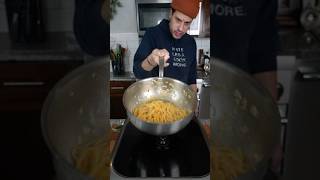

The Secret to Perfect Aglio e Olio
45sThe opening hook promises a secret technique, and the fast-paced cooking instructions with visual cues keep viewers engaged.
▶ Play Clip"The title promises a technique for combining oil and water, and the video delivers exactly that with clear, actionable steps."
This video demonstrates the classic Italian technique of making Aglio e Olio, combining olive oil and water to create a creamy, emulsified pasta sauce. The chef emphasizes using high-quality olive oil, cooking pasta directly in the sauce, and controlling the cooking process to achieve a perfect al dente texture.
Aglio e Olio combines olive oil and water, two ingredients that don't naturally mix, but the technique makes them emulsify.
Season pasta water generously and cook pasta for only 5 minutes instead of the box's suggested 11 minutes, as it will finish cooking in the sauce.
Cook garlic in olive oil until lightly golden brown around the edges to bring out a different flavor. The spectrum of garlic flavor depends on how it's cooked and cut.
Replace traditional pepperoncini with Calabrian chili for added acidity and heat, enhancing the dish's flavor profile.
Add stiff pasta directly into the oil along with pasta water, then increase heat. This creates creaminess and controls cooking, allowing the sauce to reduce while pasta absorbs it.
Use a spatula to gently toss the pasta, which is functional, not for show. This agitation helps emulsify the sauce.
The sauce should become thick and syrupy with no splashing of water and oil, indicating a successful emulsion.
If pasta needs more time, add a quarter ladle of water at a time to control the cooking and sauce consistency.
Add parsley for color and finish with a robust olive oil for extra flavor.
Mastering Aglio e Olio is about controlling the emulsion of oil and water through proper technique, resulting in a creamy, flavorful sauce that perfectly coats al dente pasta.
What is the core technique in Aglio e Olio?
Combining olive oil and water to create an emulsified sauce.
How long should pasta be cooked before adding to the sauce?
5 minutes instead of the box's 11 minutes.
00:13
What is the purpose of cooking garlic until lightly golden brown?
To bring out a different flavor in the garlic.
00:25
What replaces pepperoncini in this recipe?
Calabrian chili.
00:38
Why is pasta added to the oil while still stiff?
To control cooking and create creaminess in the sauce.
00:50
What tool is recommended for tossing the pasta?
A spatula.
01:12
What indicates a successful emulsion?
Thick and syrupy sauce with no splashing of water and oil.
01:26
How do you adjust if pasta needs more cooking time?
Add a quarter ladle of water at a time.
01:38
Emulsification of oil and water
Explains the fundamental challenge of combining two immiscible liquids and how to overcome it.
Garlic flavor spectrum
Highlights how cooking method affects flavor, a key principle in cooking.
00:25Controlling cooking with pasta water
Demonstrates a precise method to control sauce consistency and pasta doneness.
00:50Functional tossing
Clarifies that tossing pasta is functional for emulsification, not just for show.
01:12[00:03] масло смешивается с водой. Две вещи, которые несовместимы , но я покажу вам, как это сделать масла. Я собираюсь использовать два изделия от Shabikas. [музыка] Один готовить, а другой доводить до конца. Приготовление пасты занимает больше всего времени. Я щедро приправлю его специями. Опускаем
[00:16] приготовим это на пятерых. Начнём с нежного, сладкого оливкового масла. Мы чесноком. Их нужно готовить до тех пор, пока они не начнут подрумяниваться по краям. Светло-золотисто-коричневый. Что бы вам ни говорили, это придает
[00:31] карамелизировать. Вкус чеснока может сильно варьироваться в зависимости от способа приготовления и нарезки. Когда вы заметите, что края начинают подрумяниваться , классическим ингредиентом этого блюда станет перец и чини. Я заменю это
[00:44] небольшим количеством калабрийского чили. Это также придаст блюду приятную кислинку. А вот и секрет. Эта паста еще слишком твердая. Несмотря на свою густую консистенцию, она всё же попадает в масло. Одновременно с этим,
[00:58] придает соусу кремообразную консистенцию, но и контролирует процесс приготовления. Теперь мы можем уварить соус, пока паста продолжает впитывать его и готовиться, пока не получим идеальный сливочный соус, который загустеет и эмульгируется, а паста не будет готова до состояния al dente
[01:12] . Просто продолжайте перемешивать, пока вся вода не впитается. Мне нравится использовать пасту. Вот так я его и взбалтываю . То, как повара подбрасывают пасту, – это не из тщеславия. Это для [музыкального] действа.
[01:25] для [музыкального] действа. Приближаясь, вы можете начать ощущать вкус. сиропообразное. Не допускайте разбрызгивания воды и масла. Просто эмульгированный соус. Теперь
[01:38] еще не доварена. Для этого нужно еще немного времени. Затем добавляйте примерно по четверти половника воды за раз, пока не отрегулируете количество. Вот о каком контроле я говорю. Соус смешан. Это покрывает лапшу. Оно
[01:52] thick. And with a little bit of the parsley for color.


⚡ Saved you 0h 02m reading this? Transcribe any YouTube video for free — no signup needed.