
How a Triple-A Game Became a Disaster
45sHigh curiosity about a major game's failure, with a strong hook about publishers chasing trends.
▶ Play Clip"The title accurately describes the video's content, but the 'disastrous fall' is somewhat dramatized; still, it delivers a thorough breakdown."
This video chronicles the development, release, and eventual shutdown of Babylon's Fall, a live-service action RPG developed by PlatinumGames and published by Square Enix. It highlights the game's ambitious origins, the challenges of adapting Platinum's signature style to an online model, and the critical and commercial failure that led to its early termination.
The video opens by discussing how AAA publishers often chase trends, leading to clones like GTA clones and battle royale games. It notes that while this can be successful (e.g., PUBG influencing Fortnite and Warzone), it can also stifle creativity and lead to failure, setting the stage for Babylon's Fall.
Babylon's Fall was Square Enix's attempt to enter the live-service space, hoping for persistent revenue. Despite having a proven developer (PlatinumGames) and compelling mechanics, it launched with poor qualities, leading to catastrophic review scores and a dwindling player base.
Square Enix producer Junichi Ehara dreamed of a new hack-and-slash game. After considering other teams, he chose PlatinumGames, impressed by NieR: Automata. The project was a multiplayer online RPG with hack-and-slash mechanics, with a request for a high-fantasy setting.
Lead Game Designer Isao Negishi explained that instead of traditional weapon/armor/skill builds, Babylon's Fall used 'Battle Actions' to activate abilities, allowing for builds focused on evading attacks with pinpoint timing. The combat system initially had four weapons but was changed to two weapons per hand for more flexibility.
The visual style was inspired by 'Classical European oil paintings.' They hired Kouji Tajima, known for live-action films like Blade Runner 2049, as Character Designer. The art aimed for a 'polished and sophisticated' look, avoiding cartoonish styles, using a unique brushwork technique.
The story was written by Kenichi Iwao, known for Final Fantasy 11. The narrative positioned the player as a prisoner forced into a war, building reputation to win freedom. The ongoing battle fed into the 'never-ending goal' that fueled live-service features, with solo and co-op play.
Announced at E3 2018 with a 2019 release window, but delayed. Director Kenji Saito cited challenges with game systems and post-launch arrangements, new territory for Platinum. The addition of a PS5 version and COVID-19 further lengthened development, pushing release to 2022.
Limited promotion led to assumptions it would be a single-player game, so the E3 2021 live-service announcement was met with surprise. Beta tests revealed issues with the oil-painting visuals (blurry, headache-inducing), which were toned down. Players also noticed assets borrowed from Final Fantasy 14, which was explained as a gift from Naoki Yoshida.
Beta impressions criticized the tedious gear grind, minimal exploration, barren dungeons, and lack of puzzles or hidden secrets, making it feel bereft of Platinum's charm. Despite improvements across betas, fears remained about Square Enix repeating mistakes from Marvel's Avengers.
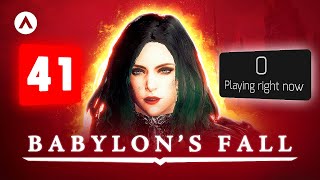
Babylon's Fall launched in March 2022 to widespread critical panning. Metacritic scores were 41 (PS5) and 46 (PC). Bland dungeon crawling, lackluster graphics, and dull combat were cited. Despite promises of long-term support, the player base dwindled rapidly.
Platinum continued with updates, including Season 1 content, a NieR: Automata event, and Season 2. However, player counts dropped to as low as 77 concurrent players, and even a single user at one point. Season 2 was extended from 3 to 6 months while reassessing the roadmap.
Square Enix terminated the service on February 27, 2023, about 12 months after launch. All larger-scale updates were canceled, premium currency sales suspended, and the Hanging Garden site shut down. Platinum CEO Atsushi Inaba apologized but deferred reasoning to Square Enix.
Inaba stated the experience taught Platinum valuable lessons for future live-service games: performing live service in-house and ensuring values are treasured by the same team. He emphasized moving forward and connecting the experience to future efforts.
Babylon's Fall serves as a cautionary tale about the risks of chasing live-service trends without proper execution. Despite PlatinumGames' pedigree, the game failed due to poor design, technical issues, and a lack of player engagement, ultimately leading to its premature shutdown and valuable lessons for the studio.
What was the inspiration for Babylon's Fall's visual style?
Classical European oil paintings.
04:42
Who was the character designer for Babylon's Fall?
Kouji Tajima, known for live-action films like Blade Runner 2049.
04:57
What was the original weapon system in Babylon's Fall?
Players were initially equipped with four weapons to switch in rotation, but this was changed to two weapons per hand for more flexibility.
03:58
What was the Metacritic score for Babylon's Fall on PS5?
41.
13:11
Why did PlatinumGames borrow assets from Final Fantasy 14?
Naoki Yoshida offered the assets freely to ease the burden of creating a broad selection of gear variations.
10:49
What were the two key pillars for future live-service games according to Atsushi Inaba?
Performing the live service in-house and ensuring values are treasured by the same team.
16:11
When did Babylon's Fall officially shut down?
February 27, 2023.
15:12
Trend-Chasing in Gaming
Sets the context for why Babylon's Fall was created, highlighting the industry's tendency to chase trends.
Development on Hard Mode
Director Kenji Saito's quote illustrates the difficulty of integrating online components into Platinum's style.
03:11Oil Painting Visuals
The unique visual style was a key differentiator but also a source of criticism due to blurriness.
04:42Borrowed Assets from FF14
Explains the controversy over reused assets and the collaborative relationship between Platinum and Square Enix.
10:49Lessons for Future Live-Service
Inaba's reflection provides actionable takeaways for game developers.
16:11[00:00] Triple-A game publishers have always chased the success of the industry’s latest trends,
[00:20] a phenomenon that inspired the creation of an exorbitant number of Grand Theft Auto clones throughout the sixth and seventh console generations. On occasion, such thinking has born good fruit, evidenced in PUBG’s quick claim to fame influencing everything
[00:34] from Fortnite Battle Royale to Call of Duty: Warzone. But on the flip side, pursuing popular trends runs the risk of stifling creativity and alienating players, a recipe for disaster
[00:47] that has taken many once-ambitious endeavors to an early grave. This Square Enix learned the hard way upon publishing Babylon’s Fall. The online-only adventure from Bayonetta creator PlatinumGames marked one of Square Enix’s many attempts to broaden its reach in the
[01:03] live-service space, whose persistent revenue streams has significantly boosted many a company’s bottom line. While Babylon’s Fall seemed to feature the hallmarks of a quality service game with its proven development team and compelling gameplay mechanics, it launched with few redeeming
[01:19] qualities, resulting in catastrophic review scores and a rapidly dwindling player base. Platinum maintained focus throughout the rough start, deploying and developing new content for what should’ve been a lengthy life cycle for Babylon’s Fall on PC and PlayStation. To cut
[01:35] its losses, Square Enix pulled the plug far earlier than anticipated, robbing developers of any chance to salvage the project. Thus, what began as Platinum bringing its signature style to the burgeoning games-as-a-service model concluded with what may go down as
[01:50] one of the studio’s least memorable outings. This is the tragedy of Babylon’s Fall.
[02:02] Square Enix Producer Junichi Ehara had long dreamed of producing a new hack-and-slash adventure. It was simply a matter of selling his
[02:25] vision to the best development partner. Other teams were under consideration, yet PlatinumGames’s genre-defining NieR: Automata[a] convinced Ehara and fellow Square Enix Producer Yosuke Saito that no one else would better fit the bill.
[02:39] The endeavor centered on a multiplayer online RPG with hack-and-slash mechanics. On top of a desire to expand upon NieR: Automata’s “action gameplay,” the publisher put forth one other “simple” request for the developer—“create a high-fantasy setting.”
[02:55] Tackling the desired setting and gameplay style wouldn’t prove a problem for the Osaka-based outfit. However, in a developer featurette, Director Kenji Saito likened the stipulated online component to “development on hard mode.” Either way, Platinum accepted the challenge after
[03:11] shipping NieR: Automata, then spent four-plus years crafting the world of Babylon’s Fall. Though there were inclinations to follow the path of traditional hack-and-slash experiences, experimenting with the formula seemed ideal in some cases. For example, Lead Game Designer Isao
[03:27] Negishi noted such games typically allowed users to build characters by combining “weapons, armor, and skills.” Babylon’s Fall instead boasted “Battle Actions” that activated certain abilities to draw out the player character’s “strongest powers,” thereby opening the door
[03:42] for builds structured around “evading attacks with pinpoint timing” and the like. The gameplay itself changed in accordance with these player-driven preferences, hopefully creating a level of depth rivaling Platinum’s previous action titles. Combat tools similarly received careful
[03:58] thought. Speaking to Famitsu post-launch, Negishi divulged the original intention of equipping players with four weapons to switch in rotation. Finding this setup too limiting, developers implemented a system wherein two weapons were equipped to both hands. Ensuring
[04:13] users could mix and match to reflect their preferred playstyles further elevated the breadth of gameplay possibilities. Attaching a pair of swords on one hand and two staffs on the other served as but one option, while affixing hammers in all four slots constituted another.
[04:28] It seemed Platinum had little trouble melding its trademark gameplay ethos with the hack-and-slash genre. But Square Enix’s request for a high-fantasy backdrop demanded a different set of eyes, particularly with respect to the visual style that would
[04:42] set the tone and tenor of Babylon’s Fall. “Classical European oil paintings” provided the source of inspiration behind the project’s visual language. Square Enix and Platinum, thus, sought
[04:57] an artist capable of rendering their fantasy world through a “deeply layered” lens, hence the hiring of Kouji Tajima. The companies considered Tajima a “perfect fit” for the Character Designer role, though his credentials were predominantly comprised of live-action films such as Terminator:
[05:13] Dark Fate and Blade Runner 2049. According to Tajima, fantasy suited his personal style enough to make the transition between the film and interactive mediums smoother. In minding the high-fantasy motif, along with the developer and publisher’s instructions to
[05:29] keep the designs “polished and sophisticated,” the artist steered clear of cartoonish styles. The result was art that complimented Babylon’s Fall’s oil painting-inspired “brushwork style," achieved through a technique developed specifically for the Platinum title.
[05:44] The studio outsourced talent for the storytelling, too, partnering with Final Fantasy 11 Online’s scenario writer, Kenichi Iwao, who focused on weaving a tale in which the protagonist felt forced into “unfolding events,” their skill level running in tandem with the narrative. As such,
[06:00] Iwao's scenario positioned the player as prisoner to a nation warring with a formidable empire. The story worked such that after reluctantly joining the war for their captors, the player character would build a reputation on the battlefield, win their freedom, then subsequently find
[06:15] motives of their own worthy of the fight. Notably, the ongoing battle fed into the game’s “never-ending goal,” which, in turn, fueled its live-service features. Given the solo play and four-player co-op hook, Platinum prioritized throwing users into the action as
[06:30] soon as possible. From there, the development team hoped regular content updates would keep players returning for even more. The Hanging Garden community website came online to extend the live-service experience by facilitating each player’s connection to Babylon’s Fall
[06:45] outside the game. Some would later argue these efforts ultimately proved for naught.
[07:05] Square Enix and PlatinumGames announced their second partnership at the former’s E3 2018 video presentation. The project bore a 2019 release window for PC and PS4 but barring these details,
[07:18] the developer and publisher shared precious little about what Babylon’s Fall would entail. Even the reveal trailer only teased the bare minimum, its less-than-two-minute runtime cycling through a series of far-future dates before pausing at two knights duking it out,
[07:33] then transitioning to four silhouetted knights standing side-by-side. In-game action finally sat front and center in the first gameplay trailer showcased during PlayStation’s December 2019 State of Play. The over-the-top hack-and-slash combat, mixed with footage of a larger-than-life
[07:50] boss character left quite the impression on viewers who still knew next to nothing about the adventure yet eagerly awaited its eventual arrival, which took longer than anticipated. Though initially scheduled for a 2019 rollout, Platinum spent much of the year keeping Babylon’s
[08:07] Fall under wraps. Speaking with JPGames, Director Kenji Saito admitted the first delay and lack of promotion came down to the team battling unexpected challenges with certain game systems and post-launch arrangements, all new territory for the crew at Platinum.
[08:22] Fitting the studio’s hallmark action into a persistent online mold brought its fair share of growing pains, too. The addition of a PS5 version and the COVID-19 pandemic’s impact on production considerably lengthened the development cycle as well, thus explaining the 2022 due date.
[08:39] But while the limited promo may have allowed for a greater focus on creating the game itself, it also let the public draw uninformed conclusions. As a result, pundits and hopeful players alike walked away from the late 2019 gameplay reveal thinking
[08:53] Babylon’s Fall would launch as another of Platinum’s single-player adventures. The E3 2021 announcement of live-service features was met with surprise and disappointment. Speculation that Square Enix had tacked on the service angle at the last minute took root,
[09:09] yet Producer Junichi Ehara maintained the online-only features came baked in at the start. Regardless, the beta sessions that followed E3 2021 indicated Platinum’s attempt at breaking into the oversaturated games-as-a-service space had missed the mark.
[09:38] Square Enix and Platinum hosted the first closed beta period in the summer of 2021, offering PC users a chance to try out and deliver feedback on Babylon’s Fall. An appreciable amount of the beta impressions critiqued the oil painting-inspired visuals; players found the art blurry above all
[09:55] else, an issue that made understanding the on-screen action incredibly difficult. Those with impaired vision complained of feeling strain while playing, sometimes to a degree that proved headache-inducing. Consequently, Platinum toned down the brushwork art, “improving legibility
[10:10] while retaining the unique oil painting-style.” Kenji Saito would later tell JPGames the filter used in the original beta boasted a “lower level of polish” and prioritized “artistic
[10:22] depiction,” effectively making the game look better in screenshots and less so in motion. Platinum made the necessary graphical adjustments in time for the third beta test; however, other questions regarding visual details pervaded the online discourse. Most notably,
[10:37] players noticed gear and emote assets that resembled content from Final Fantasy 14, leading to accusations that Platinum had “ripped off” the MMORPG. Producer Yosuke Saito explained
[10:49] in a Hanging Garden blog post that Babylon’s Fall “borrowed” data from the Final Fantasy-branded MMO, but only because FF14 Director Naoki Yoshida offered the assets freely. Yoshida corroborated[b] as much in a supporting message, noting that while attending an early
[11:05] Babylon’s Fall presentation, he recognized the pressure Platinum would be under to deliver a broad selection of gear variations and subsequently extended an opportunity to ease the burden with FF14 assets. Final Fantasy developers supervised “subtle design”
[11:20] adjustments throughout the process, ensuring the borrowed data complemented the world of Babylon’s Fall. No one expected the shared content to become such a “hot topic.” According to Saito, assistance from the Final Fantasy crew guaranteed Babylon’s Fall would receive more gear and emotes
[11:36] on day one than initially planned. Yet the graphics-related concerns merely scratched the surface, especially since gameplay impressions[c] were less than positive during the beta tests. For one, critics and players lamented the laser focus on the tedious grind for gear;
[11:51] Square Enix and Platinum’s blatantly obvious investment in retaining users long-term outweighed any investment in fun mechanics. And minimal exploration, along with barren dungeons and the absence of puzzles or hidden secrets, ultimately made for an experience that felt bereft of
[12:07] Platinum’s signature charm. At the very least, the final beta showed promise in that the studio had gone to great lengths to implement improvements across all three sessions. But the changes couldn’t alleviate fears of Square Enix failing to learn from the pitfalls of Marvel’s Avengers.
[12:26] Misgivings about Babylon’s Fall continued building throughout the weeks ahead of its March 2022 release. Square Enix's past bad practices with Marvel’s Avengers[d]
[12:41] prompted Platinum to clarify its approach to monetization, which included cosmetic-only microtransactions. Similar assurances concerning fair XP distribution and boosters made the rounds during the lead-up to launch, as well. Good intentions did not beget a good game, though.
[12:58] Babylon’s Fall hit PC, PS4, and PS5 in March 2022 and summarily received widespread critical panning. Bland dungeon crawling, lackluster graphics, and relatively dull combat felt all
[13:11] The Metacritic Score stalled at an abysmal 41 and 46 on PS5 and PC[e], respectively, engendering speculation about whether Square Enix and Platinum would pull the plug early.
[13:26] Maintaining previously stated commitments of supporting Babylon’s Fall through a “long operating period,” the development studio insisted that despite the poor reception, there were “no plans to reduce the scale of development.” Rather than linger on
[13:40] the disastrous release, post-launch promotion prepared players for future content—a Season 2 and Season 3 Battle Pass included, along with unspecified plans far beyond those. Incremental updates bolstered the Season 1 content, such as the Version 1.1.0 Resurgence
[13:57] Chapter[f] that introduced a new faction, Blockade Zone map, increased level cap, and the Gauntlet game mode just weeks after launch. In addition, a NieR: Automata event ran from March 29 through April 26, enticing players with collaborative quests and items.
[14:13] But even Platinum’s beloved NieR couldn’t endear users and newcomers to the online adventure. The PC user base dropped off considerably in May, with Babylon’s Fall entertaining the attention of
[14:25] a mere 77 concurrent players at one point. That same week unleashed another devastating blow when Steam Charts data showed a single concurrent user engaged in the action. And still, Platinum persisted, deploying Season 2 offerings on May 31. The new season,
[14:42] entitled The Light of Aaru, added another faction, 80 extra missions, and the pistol weapon type. Despite the massive update, the developer and its publishing partner had to reckon with the dwindling player count, presumably culminating in Season 2’s three-month cycle
[14:57] stretching into a six-month window while Platinum reassessed its content roadmap[g]. However, instead of yielding more content, the reevaluation of Season 3 and beyond ended with Square Enix deciding to terminate the Babylon’s Fall service on February 27, 2023,
[15:12] approximately 12 months after its market debut. All formerly planned “larger-scale updates” were canceled as a consequence. A suspension on premium currency sales immediately went into effect;
[15:24] sales of the digital version and physical copies on retail websites similarly ceased following the termination announcement. The Hanging Garden community site also shut down on February 27, the last vestiges of the live service fading into obscurity.
[15:39] Although dismal review scores and woefully low player counts likely expedited the demise of Babylon’s Fall, Square Enix never explained the service’s premature closure. PlatinumGames, for its part, could offer nothing save an apology via a VGC interview wherein studio
[15:55] CEO Atsushi Inaba said the reasoning behind the decision would need to come from Square Enix. The experience didn’t dissuade Platinum from possibly pursuing another persistent online game. On the contrary, the experience taught the storied developer a valuable lesson,
[16:11] which manifested as two key pillars for future live-service endeavors. Inaba noted that, “performing the live service” in-house would serve as another top priority. Furthermore,
[16:24] he argued these values would need to be treasured “by the same people, on the same team, at the very same company,” lest one pillar gain value over another and produce unfavorable results.
[16:36] But Inaba and company didn’t want to dwell on the frustration and what-ifs. According to the CEO, pressing on and “connecting the Babylon’s Fall experience to their efforts moving forward” was the only way to let go of the discontent in the long run. The tragedy of Babylon’s Fall,
[16:51] then, is that whatever live service Platinum builds next will have been laid on a foundation of broken promises and one publisher’s refusal to learn from past mistakes.
⚡ Saved you 0h 18m reading this? Transcribe any YouTube video for free — no signup needed.