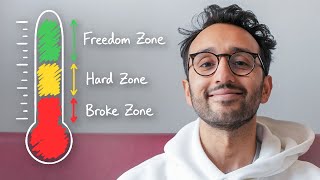

Selling Expensive is Easier? Here's Why
52sThe counterintuitive insight that selling high-priced items is easier than low-priced high-volume items challenges common assumptions, making viewers question their business strategy.
▶ Play Clip"Solid framework for beginners, but the '2026' in the title is unnecessary — timeless advice labelled as a trend."
The video breaks down the easiest business to start for financial freedom, focusing on the equation of customers multiplied by price point. It argues that beginners should sell high-ticket services ($2,000–$20,000) rather than low-priced products, and that done-for-you services for businesses with painful, money-related problems are the easiest path.
Revenue = number of customers × price per customer. Understanding this equation helps determine viability.
It's easier to sell 10 items at $10,000 than 10,000 items at $10. Higher price requires fewer customers, reducing volume pressure.
For beginners, the ideal price range is $2,000 to $20,000. This balances high enough margins with manageable customer acquisition.
Service businesses (doing work for clients) are much easier to start than product businesses (making something). Most beginners mistakenly focus on products.
The easiest service model is 'done-for-you' where you perform the work. This commands higher prices than coaching or courses.
Target customers with money (businesses or wealthy individuals) and solve a painful problem, preferably one that makes or saves them money.
Clients buy external, measurable results. Tying your service to money saved or earned makes selling at $2k–$20k much easier.
The best beginner business is a done-for-you service priced between $2,000 and $20,000 that solves a painful, money-related problem for a wealthy customer. This combination sets you up for financial freedom on easy mode.
What is the basic revenue equation for a business?
Revenue = number of customers × price per customer
01:19
Why is it easier to sell 10 items at $10,000 than 10,000 items at $10?
High volume requires many customers, which is harder for beginners; high price reduces needed volume.
03:08
What price range does Ali recommend for beginners?
$2,000 to $20,000
04:40
What type of business is easier to start: service or product?
Service businesses are much easier to start than product businesses.
08:11
What is a 'done-for-you' service?
A service where you perform the work for the client, rather than teaching them or providing a tool.
12:17
What two characteristics should your target customer have?
They should be rich (or a business with money) and have a painful problem.
16:13
Why is tying your service to money saved or made important?
It provides a tangible return on investment, making it easier to charge $2,000–$20,000.
18:10
Why are online courses becoming harder to sell according to Ali?
AI and free content (like YouTube) reduce the perceived value of courses; high-touch services are more defensible.
14:45
Volume Trap
Counterintuitive insight: selling expensive items to few people is easier than selling cheap items to many.
03:08Service vs Product Bias
Most beginners think of product businesses, but services are lower risk and easier to start.
08:11Niche Down to Money Problems
Targeting businesses with money and a painful problem directly ties your value to their revenue.
16:13Tangible Outcomes Rule
Clients pay for external results, not internal changes; linking service to measurable ROI is crucial.
18:10[00:01] going to be talking about what is the best easiest business to start as a financial freedom. And the video is broadly split up into three parts. We're equation. We're going to talk about the service to product spectrum. And we're
[00:14] a niche and an offer that's playing business on easy mode rather than on hello, my name is Ali. I'm a doctor turned entrepreneur. And since 2017, documenting my journey from broke medical student to then working
[00:27] building my own lifestyle business that's allowed me to reach financial freedom. And this is Freedom Fridays, the somewhat regular series on the ideas, strategies, and tools that can help you ultimately achieve the goal of
[00:40] life on your own terms as well. Okay, so if you are watching this video, then you free. Maybe you want financial freedom, you where you can spend your time broadly however you want, and you would also
[00:53] where you can work on stuff that fulfills and energizes you. That begs that? And maybe you've realized through watching maybe my content, maybe other people's contents that like start a business is a much nicer way for most
[01:06] people to get to financial freedom compared to follow a normal traditional career and get a job, for example. But then that begs the question of, okay, want to introduce you to a simple equation for basically how to make
[01:19] basically has two variables. It's basically your number of customers, i.e., how many people are buying your stuff, and then the price point of your stuff. That is literally it. And so when you're
[01:31] to figure out how many people do you need for your business idea to be to be viable, and what kind of price do you need to sell things at in order for your graph that I would like to show you that helps us figure this out. This is a
[01:43] say you want to make $100,000. Let's say that's your goal. If you wanted to, the way you could make 100k is you could sell something for 100k to a single person, right? So, we've got one person over here, and this is kind of like our
[01:56] one way of making 100k. Alternatively, you could sell something for $10,000 to could sell something for $1,000 to 100 people. Alternatively, you could sell something for $100 to 1,000 people. Or you could sell something for $10 to
[02:11] something for $1 to 100,000 people. Now, these are all theoretically different equation of it's basically number of customers, i.e., people multiplied by the world of business and I was a beginner, I was under I was laboring
[02:27] easier it should be easier, right, to sell things for $1, $10, $100 rather than to sell something for $10,000 or $100,000. Because as a normal person, know, I bought this Coke Zero for $1. I've bought stuff for $10. This doner
[02:42] more like $5, but whatever. And I've ranges, that's like like a MacBook or $10,000, that's like a really expensive car. 100k, like the only thing that you
[02:54] Like this was my conception of the world. And so I thought that if I were to start a business, I should sell cheap things for $1, $10, $100 and just sell easier. And that could not have been further from the truth. And this is very
[03:08] counterintuitive, but actually, if you want to make $100,000, it is way easier to do it selling, for example, 10 copies of something for $10,000 compared to selling 10,000 copies of something for $10. The volume is way harder than the
[03:22] individual level, it's easier to sell something for $10 than to $10,000. Like I probably couldn't sell you a $10,000 thing. I could probably sell you a $10 book for about $10. But if I were trying to make 100 grand, it's so much harder
[03:34] for me to find 10,000 of you to sell my $10 book to compared to just finding 10 people to sell a $10,000 service or package or product to. Oh, and by the learning process from this video, we have actually trained a custom GPT, a
[03:47] you do all of this stuff, and it's completely free. There's a link down OpenAI account, like a ChatGPT account, which you have already. You don't need you basically talk to it, and it's trained on like my material that we have
[04:00] to figure out your niche and your offer so that hopefully this can give you some you through the process and I'll help you figure out what business you want to rather than on hard mode. So, that'll be linked down below and there's a QR code
[04:13] check that out. Again, it's completely free. And so what this means is that business to start if we are a beginner is you want to be avoiding this zone. business in the red zone where you're selling cheap things that are like high
[04:28] volume, that is playing business on hard mode. It's not to say you can't do it. just playing business on hard mode and your chances of success are a lot lower, Similarly, as a beginner, you probably don't want to be in this kind of range
[04:40] you sell, you know, one thing for $100,000. That might be your reasonably well-paid job. But the zone we want to be in is in this zone, right? This zone of we're selling stuff ideally that's between the $2,000 to the $20,000 price
[04:54] to be when it comes to trying to build a business. Because like I said, the hard part is a lot less charging them lots of money. And so when it comes to figuring beginner, you really want to be thinking, what is the thing that I could
[05:08] sell for at least $2,000? And that is going to seem scary. You might be thinking, but I don't have skills worth $2,000. Like what 10k, 5k, completely impossible. And this is exactly what students in our Lifestyle
[05:21] online kind of business school, go through that I coach them through all And we really try and get them to figure out something that they can sell for at you're selling expensive things, it becomes so much easier to build a
[05:35] revenue compared to when you're trying to sell large volumes of a cheap thing. business and you make all this extra cash, you're going to need a place to invest that money for it to compound passively over time. And that is where
[05:47] Trading 212. Trading 212 is an online trading platform that lets you invest in stocks and ETFs. Me and my wife have both independently been using Trading 212 to manage a portion of our portfolio for absolutely years, since way before
[06:00] what I love about it is that it makes it super easy to invest in stuff without just launched the Trading 212 card, which lets you earn 1.5% cashback on fee, there are no hidden fees, and you get currency conversions at the true
[06:15] interbank rate, which is fantastic if you travel or you buy things online in integrates with your Trading 212 Invest account so that your uninvested cash can currencies while you are out there living your life. Plus, Trading 212
[06:29] auto invest features that helps you build a diversified portfolio on investing with fractional shares to make investing more accessible. And as an link, you can get a free fractional
[06:42] free money, you might as well. So, if you'd like to get started, head over to trading212.com/join/ali to claim your free share. That'll be check out the card as well. So, thank you very much, Trading 212, for
[06:54] one level slightly more complicated, but I know you can keep up because you're very smart and very good-looking. Um this was how to make $100,000. But if we want to make $100,000 a year, you know, a six-figure a six-figure business, we
[07:06] >> [music] >> It can either come from the price or it can come from the volume. So, for example, if you were to charge $10,000 per year for something, let's say, I don't know, you're selling expensive
[07:19] health insurance. People are paying $10,000 per year. So, now you only need 10 customers, 10 customers period, to be able to make $100,000 per year. But subscription. Let's say you're in my case selling a course on how to do
[07:31] YouTube for $1,000, but it's a one-off it's a one-off product. Like it's not a not a membership, it's not anything like that. In that context, the per year customers. So, I would need to get 100 new customers per year in order to build
[07:44] a 100k a year business selling $1,000 things. Mostly for beginners, this is to worry too much about are you selling subscription? Are you selling 2k per would say start off trying to figure out what is the one-off package or something
[07:58] And then you can always worry about the how do we turn it into a subscription point, hopefully we have established that the goal is to sell stuff for between two and 20k. This is really really helpful because this massively
[08:11] narrows down the list of potential business ideas that we could feasibly video is because I've done a couple of events here in Hong Kong over the last for hours and hours to speak to people after the events. And people come up to
[08:24] business ideas. And they'll either say they don't have any ideas at all, or actually, that they've got so many business ideas. And I'm making this want to show all of these people who are coming to me with all these different
[08:37] business ideas. Because for the most part, the ideas that I hear are playing a girl the other day, and she had a few different business ideas. One of those business ideas was she wanted to start a fashion brand that was accessibly priced
[08:52] that helped a sort of modest fashion wear for women who are into running in she was like, you know, there's not that much like modest fashion available for operating on hard mode, primarily because she's trying to sell cheap
[09:05] $1,000 packages. It'd probably be like, I don't know, somewhere between the 10 and $100 range for like a modest sports bra or like leggings or whatever. That things, which means in order to build a viable business, you need a ton of
[09:18] you're already famous. Similarly, we've got one of our students in our Lifestyle Business Academy who came in and initially what she wanted to sell was people who want to improve their lives. And I was like, okay, interesting. Like
[09:30] about? She was like, I was thinking maybe like $20 a month or something like that. That is again playing business on hard mode because when you are trying to order to build a viable business off it, you need a ton of volume. And now if she
[09:43] had loads of followers on YouTube or Instagram or LinkedIn or email list or model. But if you're a beginner, you probably are not famous on the internet, you to get customers and really hard for you to find that kind of volume. But now
[09:55] businesses that are operating on easy mode. So, we have um we have this Hayat. And what they're doing is they're selling a service that helps accountancy practices in London speed up their onboarding time for new clients so that
[10:09] to onboard new clients. And they're charging like $8,000 for this. This is amazing. They are playing business on easy mode. It sounds boring AF, right? To sell an onboarding improvement service for a new accountants and their
[10:22] practices, but they know accountants. They've got a background in like that accountants face. Accountants are a business that are willing to pay a lot because it will save them a lot of money. And so, that particular boring
[10:34] business on easy mode. And so, this is a video about what kind of business to Principle number one is that you want to be aiming for things in the 2K to 20K price point range. Principle number two is the general idea
[10:47] that service businesses are much much much easier to start than product thing that trips up beginners in the market. Cuz if you think of what is a business, right? When you imagine starting your own business, you probably
[11:00] product. I'd like to sell products. I'd like to sell hoodies. I'd like to sell brand. I'd like to build apps. That's to sell doner kebabs, you know, this selling a product. You probably don't
[11:12] really love to be a boutique web design agency. Man, I'd really love to help onboarding processes. Man, I'd really love to be a sales training service facilitation for businesses doing B2B sales that that are selling through
[11:26] uh conferences. Those are service businesses. And if you think of all the businesses you know of, probably 99% of them are product businesses. This is one have where if you imagine business, you probably think of Apple. They sell
[11:38] stuff. You think of Sony. They sell cameras. You think of the doner kebab the businesses that you come into contact with on a day-to-day basis are realize is that product businesses are really really really hard to start
[11:52] and then you have to go for big volumes and it's really hard to do volume. What you probably don't come across is the enormous list of businesses that are selling services. I think most of the economy, most of the GDP generated by
[12:04] countries, especially in places like the UK, certainly in places like Hong Kong, services, legal services, accounting services, like all sorts of there are there that are making way more money in the grand scheme of things compared to
[12:17] businesses are the ones that are cool and sexy and that you see marketing for everywhere. Whereas you very rarely see as an individual, as an individual for service based businesses. Now, the difference between a service based
[12:29] >> these are really the only two types of businesses. A service business is where you do something for your client or your customer. And a product business is you make something which does something. Right?
[12:42] stuff is because they want a problem to be solved. They want a job to be done. eating that's getting a little bit cold right now. This is currently doing the helping me have a good time. It is a product business.
[12:56] doner kebab shop is very unlikely to become financially free from running a expand to like multiple locations and build out a team and all all that sort the volume game and it's very hard to play the volume game. See my point
[13:09] around how that's business on hard mode. So, what you want to do is you want to when it comes to services, there's a little bit of a spectrum. Now, if we imagine something like uh web design, you know, let's say you
[13:22] helps people get websites. Let's say uh that helps e-commerce brands have better conversion rates on their website. Now, the easiest way to do that as a beginner the work for them. You are a full service provider where you are doing the
[13:37] the work themselves. You are doing the work for them. So, you're going into their Shopify and twiddling their whatever and dealing with their analytics. You're doing the work. This is the stuff that you can generally, as
[13:50] because you are literally doing the work. One level down from that, one where you can imagine for the same thing, you're selling a coaching program implementation. So, you are supporting them to do the work of increasing the
[14:04] one level more scalable than that is do-it-yourself where you're selling, let's say, a course or whatever. Yeah, a course or an app that they have to use work, but your product just sort of helps them along the way. Here you are
[14:17] selling implementation. You are actually doing the work. And if you are a get you to financial freedom, I would 100% recommend the place to start should be some kind of done-for-you service. Maybe at a stretch you go to done with
[14:31] consulting program, but you probably do not want to be trying to sell an online course cuz generally just selling an online course puts you in this kind of this kind of territory as it relates to price because it's sort of hard mode.
[14:45] don't think online courses are going to be around very much longer because um AI something, you just ask ChatGPT if you wanted to just learn how to do it yourself. And people are realizing this. The bar for what is free just keeps
[14:58] of like really good free content on YouTube completely for free. And so, I especially if you're looking to to start a business right now, is that more and more towards high-end high-touch services where you are doing a lot of
[15:11] way, as a reminder, if you would like to get the completely free custom ChatGPT content of this video so that you can figure out exactly what your service be, there'll be a link down below or you can like scan the QR code that is
[15:23] students in like our Lifestyle Business Academy, uh Elias and Hayat, why are they able to charge $8,000 to to up their onboardings? Well, because they're doing the work for them. If they
[15:35] were like, "Hey, we'll we'll sell you an online course that teaches you how to do accounting practice is going to be like, "Bro, I don't need an online course. things going on." Maybe they might buy it for like, I don't know, $80 or
[15:47] they would never log in and never actually use it. Because these these are they don't have much time. But, if you can do the work for them, if you can transformation without them having to do any work, you are able to charge way
[15:59] higher prices. And generally the way you do that is through a service business you are trying to do something for someone where they value the outcome.
[16:13] "Okay, then. So, I'm going to start a service business which is a done-for-you $2,000 and $20,000." So, then you're probably thinking, "Okay, well, what >> [clears throat] >> But, I can give you some ways of
[16:26] out our niche, there's kind of two things we need to figure out. It's like, who is the person and what is the problem that they have? Because people pay money to solve problems. And then your business is sort of like the bridge
[16:38] them solve their particular problem. Now, if you want to play business on is rich. If the person is rich or if they are a business with lots of money, to $20,000 for something. Whereas if you're trying to start a business
[16:51] money, it is very very difficult to do that. So, you want to be finding a rich. And ideally, this is a very painful problem for them because the motivated they are to solve the problem. Therefore, when your business positions
[17:06] for example, "Hey, you know how every time you onboard a new client for your and weeks of onboarding time and you say and you waste all this time and waste right? You know, it's a painful problem that accountancy firms have. And so,
[17:18] solution to the problem, then it becomes much easier to sell something like that. In a dream world, the problem that you have identified is a problem that if solved either helps that person make money, helps them save money. For
[17:31] based business that charges between two you solve is that, you know, you help a business that, you know, is struggling means they are literally making more money and therefore you are able to
[17:44] much money you've added to them. Those are the easiest things to sell because return on investment for your client. Then along the same vein, if, for business and you are saving the customer a lot of money, like, you know, save
[17:57] $100,000 on X, you can probably charge 10, 20, 30, 40,000 dollars for that kind lot more money than you are costing. Again, there is a very tangible return This again is playing business on easy mode when you are
[18:10] building a service done-for-you business between two and 20K that solves a painful problem for a rich person that ideally helps them make money or save thinking that you might not have the kind of skills that can help a business
[18:23] in our program that want to be life coaches, mindset coaches. I want to help syndrome. Those are harder businesses to We can certainly mentor people and help them out as best as we can in that
[18:37] to start because what you are solving, imposter syndrome, is not a tangible problem. It is not a uh for some people it might be a painful problem, but a way be like, "Okay, I help working
[18:51] syndrome so that they can get a raise, so that they can get a promotion." When tangible that they want, then they can example, getting a raise, getting a promotion, therefore making money, we
[19:03] outcome, it becomes much easier to charge $2,000 to $20,000 for this something that is intangible like, "I'll improve your mindset. I'll help you find productive." That's actually quite intangible. Uh I'll help you overcome
[19:17] imposter syndrome. I'll help you get over anxiety. Like these things, the more intangible they are, the harder it is for people to see the value that to price between two and 20K. And so, the sort of process that we take our
[19:29] students through is basically like a lot of back and forth around how can we tie you're offering to something tangible so that people can see the value of it. And then, you know, people generally don't tend to want to buy internal
[19:43] buy external results, external transformations. They want their life to improve in measurable ways that are obvious to other people. And of course, transformation, but it's hard to sell an internal transformation for a large
[19:56] more information on exactly how to do this, then I have a video over here, need to read if you want to become financially free. If you read those four teach you the principles that I've just taught you in this video, and they will
[20:08] that's going to get you to financial freedom. So, check that out over there. lovely day, and I'll see you in the next video.
⚡ Saved you 0h 20m reading this? Transcribe any YouTube video for free — no signup needed.