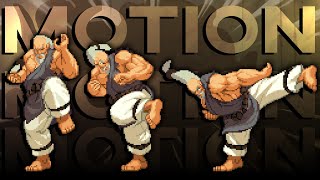

Why Motion is Key in Fighting Games
45sOpens with a broad, relatable concept about motion in games, then narrows to fighting games, hooking viewers interested in game design.
▶ Play Clip"The title promises the key to great fighting games, and the video delivers by thoroughly explaining motion's role through various techniques and examples."
The video explores the crucial role of motion in fighting games, from creating immersive experiences to communicating gameplay information. It examines different animation techniques like hand-drawn, rotoscoping, and motion capture, highlighting their impact on visual style and feel.
Motion describes movement, speed, direction, and acceleration. It's key for realism and immersion, especially in sports and racing games.
In sports games like FIFA, motion is physics-based for authenticity. In arcade racers, effects like motion blur and speed lines are embellished to feel faster.
Tiny movements have significant impact. All character actions (attacks, movement, blocking) rely on motion.
Smooth, fluid animations create a dynamic experience. SF3's hand-drawn sprites and rotoscoping (e.g., Elena) show different animation methods.
Rotoscoping gives smooth animation and saves time, but reduces detail (e.g., Elena's hands/feet). Elena's head is static, which is uncanny but often unnoticed in fast gameplay.
Mortal Kombat uses mocap for realistic, modern feel. Tekken uses it to showcase 3D movement and dodges like a martial arts movie.
Elasticity (stretching/compressing) gives dramatic, cartoonish feel. Skullgirls uses it to show power. Smearing (distorting or duplicating frames) creates motion blur for speed.
Realistic simulations (UFC) have randomness; creative moves risk balance. Fighting games share mechanics to stay rooted in martial arts.
Every move has startup, active, and recovery frames that communicate info to players. Light attacks are fast; special moves telegraphed. Missing/blocked attacks look and sound different, signaling punish opportunities.
Motion is fundamental to fighting games, affecting gameplay, strategy, and smoothness. Developers must choose animation methods wisely to balance excitement and clarity.
What three parameters does every move in a fighting game have?
Startup frames, active frames, recovery frames.
6:27
How does rotoscoping differ from hand-drawn animation in terms of detail and smoothness?
Rotoscoping gives smoother animation with less time but reduces detail (e.g., hands and feet). Hand-drawn offers more control and detail but takes more time.
2:40
What is ‘elasticity’ in animation and how does it affect fighting games?
Elasticity is the compression and stretching of limbs to show power; it gives a dramatic, cartoonish feel, as seen in Skullgirls.
4:10
Name two techniques used to create motion blur between frames.
Smearing (distorting in-between frames) and duplicating/overlapping frames.
5:01
Why does the UFC game not have a health bar?
Because moves have no fixed damage amount; reactions are random, just like in real life.
5:43
Controller Connection
Explains that motion is the only physical link between player and game, emphasizing its importance for immersion.
0:35Street Fighter Third Strike Animation
Highlights how detailed animation contributes to a game's lasting popularity and visual appeal.
1:17Motion Capture in Mortal Kombat
Shows how technology can retain a game's core identity while modernizing visuals.
3:10Realism vs. Creativity Balance
Reveals the design challenge of maintaining game identity while innovating.
5:27Frame Data Communication
Illustrates how animation conveys gameplay information, linking visuals to strategy.
6:21[00:00] motion
[00:02] the movement of an object from one place
[00:04] to another it can be described by its
[00:06] speed direction and acceleration in the
[00:09] world of video games motion plays a
[00:11] crucial role in creating realistic and
[00:13] immersive experiences but it can also be
[00:15] used to exaggerate those things as well
[00:16] for example in sports games like FIFA
[00:18] the motion of the players and the ball
[00:20] are often based on real life physics to
[00:22] create a more authentic experience but
[00:24] in something like arcade racing games
[00:25] things like motion blur speed lines or
[00:28] other effects are often embellished to
[00:29] make the cars feel faster than they
[00:31] would be in real life but one thing that
[00:32] both games have in common is how
[00:34] important character movement or object
[00:35] movement is the only physical thing
[00:37] connecting a player to the game is the
[00:39] controller so the input of a player's
[00:41] device must feel smooth and match up
[00:42] with what is happening on screen even
[00:44] the way those characters react to their
[00:46] environment or other players must be
[00:47] executed carefully in order to give that
[00:49] sense of immersion it's hard to get lost
[00:51] in a game that doesn't make you feel
[00:52] like you're there
[00:54] [Music]
[00:59] this implementation of motion is
[01:01] especially crucial when it comes to
[01:02] fighting games as even the tiniest of
[01:04] movements and have a significant impact
[01:06] on the game so today we're going to look
[01:08] at the importance of motion and fighting
[01:10] games and how it's the key to making
[01:11] them great if you want to see more
[01:12] videos like this then make sure to
[01:13] subscribe it helps the channel out and
[01:15] you can always change your mind now when
[01:17] I talk about motion and fighting games
[01:18] I'm referring to everything the
[01:20] characters do on screen this includes
[01:22] attacks movement like running and
[01:23] jumping and even things like blocking
[01:25] there are some cases where the movement
[01:27] of stages or other factors come into
[01:28] play but for Simplicity I'm gonna stick
[01:30] with just the characters as that is
[01:32] something that every fighting game has
[01:33] from a visual perspective motion is
[01:36] obviously important for making the game
[01:37] look good a character with smooth and
[01:39] fluid movements can create a more
[01:40] Dynamic and exciting experience for the
[01:42] player while a character with choppy and
[01:44] sluggish movements can worsen the
[01:45] overall experience part of the reason
[01:47] why Street Fighter third strike is so
[01:48] popular and is still being talked about
[01:50] today is because of its incredible
[01:51] animation the character designs are all
[01:53] incredibly detailed with each fighter
[01:55] having their own unique style and
[01:57] moveset the in-game animation also flows
[01:59] really well making the fights look and
[02:01] feel like real martial arts matches the
[02:03] way they did it was using a combination
[02:04] of traditional hand-drawn animation and
[02:06] computer generated Graphics the game's
[02:08] character sprites were mostly hand drawn
[02:10] and then transferred digitally allowing
[02:12] for a lot more control and detail at the
[02:14] cost of time and probably sanity however
[02:16] this wasn't the case for some characters
[02:18] like Elena you can tell something looks
[02:20] different about her from the rest of the
[02:21] cast and that's because some of her
[02:23] moves are rotoscope someone was actually
[02:24] able to find the sword's material for
[02:26] her Victory pose which kind of led to
[02:28] people looking further into it and it is
[02:30] believed that the same method was used
[02:31] for her Idol animation as well you can
[02:33] even see the Sprite change for a split
[02:34] second in Street Fighter New Generation
[02:36] when her heel animation is active an
[02:38] advantage that rotoscoping gives is the
[02:40] smoothest in animation and less time
[02:42] spent because every Sprite is basically
[02:43] drawn for you you just have to trace it
[02:45] but just like everything else it also
[02:47] comes with the cost you can clearly see
[02:48] the loss in detail when looking at the
[02:50] hands and feet compared to other
[02:51] characters that were fully drawn it's
[02:53] kind of like what happens when people
[02:54] use that Tick Tock filter also once you
[02:56] realize this it's very obvious that her
[02:58] head was just pasted on afterwards as it
[03:00] never moves which is kind of uncanny in
[03:02] the grand scheme of things it's not
[03:04] really a big deal as the game moves so
[03:05] fast anyway so you probably wouldn't
[03:07] notice it's just something once you
[03:08] notice you really can't unsee but the
[03:10] technique of how artists choose to
[03:12] animate motion plays a big role in the
[03:13] overall art style and feel of the game
[03:15] for example Mortal Kombat uses motion
[03:17] capture to realistically showcase moves
[03:19] accurately it's basically like how Elena
[03:21] was rotoscoped but for 3D this technique
[03:24] makes the game feel and look modern as
[03:26] you're essentially using real life moves
[03:27] and attacks for the base of your
[03:28] characters then changing or tweaking
[03:30] certain parts whenever needed it also
[03:32] makes the animation process slightly
[03:33] easier in terms of getting the core
[03:35] movement down at least as most of your
[03:37] time will be spent tweaking the
[03:38] animation instead of creating it it's
[03:40] been clear since the beginning that
[03:41] Mortal Kombat has always gone for a more
[03:43] realistic approach in how their
[03:44] characters move the first iteration of
[03:46] the game used real people as Sprites and
[03:48] then imported them straight into the
[03:50] game so it's only fitting that they'd
[03:51] use motion capture to retain that same
[03:53] Essence Tekken also has adopted this
[03:55] technique as well and in my opinion it
[03:57] gets to Showcase it better because the
[03:58] game's movement allows players to use
[04:00] every aspect of the 3D space if you've
[04:02] ever seen tasks used on Tekken
[04:04] characters the way they Dodge each
[04:05] other's attacks feels like you're
[04:06] watching a martial arts movie where both
[04:08] opponents are at similar skill levels
[04:10] now something that this style of
[04:11] Animation lacks in my opinion is
[04:13] elasticity it's not a bad thing if
[04:14] you're going for a more modern approach
[04:16] like Tekken or Mortal Kombat but it's
[04:18] definitely something you have to
[04:19] consider when choosing a style of
[04:20] Animation elasticity is what gives
[04:22] cartoons its dramatic feel when a Looney
[04:24] Tunes character gets bonked in the head
[04:27] the extreme movements and reactions of
[04:29] that character effectively showcase that
[04:31] the compressing and stretching of Limbs
[04:33] really sells how hard that frying pan
[04:34] hit Tom's face even though that kind of
[04:36] body Distortion isn't realistic you can
[04:38] see this technique in a lot of 2D
[04:40] animated games like skull grows the
[04:42] wind-up and release of attacks have this
[04:43] effect to show how powerful the move is
[04:45] the more your character basically breaks
[04:47] its limbs the more damage that move does
[04:49] although there are a few exceptions like
[04:50] dulcim whose whole moveset is based on
[04:52] him being stretchy this technique is
[04:54] often paired with something called
[04:55] smearing while elasticity can show the
[04:57] windup and release of an attack smearing
[04:59] displays the speed of it as it is often
[05:01] used between frames of key poses there
[05:03] are usually two different ways of
[05:04] smearing and animation the first way is
[05:06] to quite literally smear the in-between
[05:08] frames distorting them and stretching
[05:10] them as they move from one to another
[05:11] the second way is by sort of duplicating
[05:13] the frames with all of them kind of
[05:14] overlapping each other until the
[05:16] animation is finished both methods are
[05:18] effective and is sometimes used together
[05:19] as there really isn't a correct way to
[05:21] do it it will always look smooth as long
[05:23] as you can create some sort of motion
[05:24] blur between the frames because that's
[05:26] all you're basically doing one of the
[05:27] challenges in implementing Motion in
[05:29] fighting games is achieving balance
[05:30] between realism and creativity super
[05:32] realistic fighting games require
[05:34] accurate simulations of movement this
[05:36] introduces the element of Randomness
[05:37] where some reactions to moves don't
[05:39] always have the same result just like in
[05:41] real life for example in UFC you might
[05:43] be able to get a knockdown a certain way
[05:44] but if that situation happens again
[05:46] there's a chance that you won't this is
[05:47] why in the UFC game you don't have a
[05:49] health bar as there's no fixed amount of
[05:51] damage that moves have on the other hand
[05:53] overly creative and flashy moves can
[05:55] make it really hard to balance the game
[05:56] especially when those attacks have a lot
[05:58] of forward move I mean look no further
[06:00] than Luke I've talked about him enough
[06:02] so you guys already know and when you
[06:03] start to drift really far from the realm
[06:05] of martial arts at what point does the
[06:07] game stop being a fighting game and turn
[06:08] into something else like a shooter for
[06:10] example this is the reason why many
[06:11] fighting games share similar mechanics
[06:13] especially when it comes to martial arts
[06:15] because it's how the genre Roots itself
[06:16] but don't get me wrong it's good to
[06:18] think outside of the box but at least
[06:19] make sure you visit it once in a while
[06:21] something I never realized before is how
[06:23] important it is for each move to
[06:25] communicate info to the players every
[06:27] single move should have these three
[06:28] things startup frames active frames and
[06:31] Recovery frames now depending on what
[06:33] type of move it is these three
[06:34] parameters are tweaked accordingly light
[06:36] attacks should usually be very quick
[06:37] with minimal amounts of startup active
[06:40] and Recovery frames while special moves
[06:42] are usually slower heavily telegraphed
[06:43] attacks that have a large portion of all
[06:45] three and you can probably recognize why
[06:47] it's a bad idea to give normal moves
[06:49] long startup and Recovery frames or give
[06:51] special moves no startup or recovery
[06:52] another interesting thing to look at is
[06:54] how characters react to their attack
[06:55] missing or being blocked usually when
[06:57] this happens the animation looks
[06:58] different and a different audio queue is
[07:00] played this lets the opponent know that
[07:02] the other player has made an error and
[07:04] they can punish accordingly overall
[07:06] motion plays a significant role in
[07:07] fighting games as it affects the
[07:09] gameplay strategy and the smoothness of
[07:11] the game so it's important for the devs
[07:13] to consider the pros and cons of the
[07:14] ways they choose to implement it whether
[07:16] that's by 2D sprite animation 3d motion
[07:18] capture or even computer simulations
[07:20] each method has their own ways of adding
[07:22] excitement to the game if you guys
[07:23] enjoyed this video please make sure to
[07:25] like And subscribe join the Discord to
[07:26] hang out with us follow my Twitter for
[07:28] updates check out my twitch for streams
[07:30] and if you want to get access to extra
[07:31] perks and content you can head over to
[07:33] my patreon as always I hope you guys
[07:34] have a great day peace
[07:39] [Music]
[07:54] [Music]
⚡ Saved you 0h 08m reading this? Transcribe any YouTube video for free — no signup needed.