
Why Fighting Games Use Archetypes
60sRelates real-world stereotypes to video game archetypes, hooking viewers who love character tropes.
▶ Play Clip"The title is accurate and the video delivers a full breakdown of fighting game archetypes, exactly as promised."
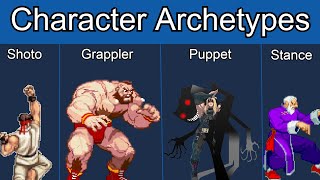
This video explores how stereotypes and archetypes are used in fighting games to help players quickly understand a character's playstyle and strengths. It covers the core archetypes — Shoto, Grappler, Zoner, Rushdown — and more niche ones like Puppet, Stance, Composite, Mix-Up, Gimmick, and Set Play, each with their own strengths, weaknesses, and matchups.
Stereotypes help us categorize and predict behavior. In fighting games, these become archetypes that define a character's game plan.
A Shoto is a balanced all-rounder with a fireball, invincible reversal, good anti-air, and decent walk speed.
Grapplers specialize in getting close and using command grabs to deal massive damage from one mix-up.
Zoners keep distance with long-range attacks and projectiles, but struggle up close.
Rushdown characters charge aggressively but have low health and poor range.
Puppet characters control two characters at once, offering complex pressure but weak defense.
Stance characters switch between two movesets, offering versatility but being vulnerable during switches.
Composite characters are made from moves of multiple other characters (e.g., Double from Skullgirls).
Mix-up characters rely on confusing opponents with high-low and cross-up attacks.
Gimmick characters use mechanics outside the game's universal rules, like special meters or flight.
Set play characters fish for knockdowns to set up abilities that snowball pressure.
Why do fighting games use character archetypes?
To help players quickly understand a character's game plan, strengths, and weaknesses.
00:41
What is a Shoto archetype?
A well-rounded character with a fireball, invincible reversal, anti-air, decent walk speed, and health pool.
02:21
What is the main tool of a Grappler archetype?
Command grabs and massive damage from one mix-up.
03:17
What is a key weakness of Zoners?
They struggle when the enemy gets close, lacking strong up-close options or reversals.
05:34
What is the main playstyle of a Rushdown character?
Charging headfirst at the opponent with little regard for safety.
06:28
What makes a Puppet character unique?
Controlling two characters with one controller.
07:51
How do Stance characters work?
They switch between two modes via a single input that changes their moveset.
09:03
What is a Composite character?
A character made from attacks of multiple other characters, like Double from Skullgirls.
10:11
What defines a Gimmick character?
They rely on a mechanic not defined by the game's universal mechanics (e.g., special float meter).
12:34
What is the strategy of a Set Play character?
Fishing for knockdowns to set up abilities that snowball pressure on the opponent.
13:50
Stereotypes in gaming
Connects real-world stereotypes to video game archetypes, showing how they help players understand characters.
00:08Grappler's command grab
Explains the core mechanic of grapplers — using command grabs to deal massive damage from one mix-up.
03:17Zoner's weakness
Highlights that zoners struggle when opponents close the distance, a key balancing factor.
05:34Rushdown vs Grappler
Explains how rushdown characters differ from grapplers — they need multiple openings rather than one mix-up.
06:28Stance characters as hybrids
Clarifies that stance characters combine two archetypes, with the weakness of being vulnerable during stance switches.
09:03[00:01] [Music]
[00:08] we as humans
[00:09] tend to like stereotypes it helps us put
[00:11] things in easily understandable
[00:13] categories
[00:14] and more easily make predictions and
[00:15] guesses based on what we think we know
[00:17] it makes sense that these stereotypes
[00:19] would find their way into popular
[00:20] culture as well
[00:22] many people would call batman a
[00:23] vigilante but less people would consider
[00:25] superman a vigilante
[00:26] even though technically he is that's
[00:29] because our idea of a vigilante is a
[00:31] small time hero protecting his community
[00:33] and not a space warrior fighting gods
[00:36] stereotypes also find their way into
[00:38] video games but appear in a slightly
[00:40] different form
[00:41] a stereotype is usually about a
[00:43] character's well
[00:44] character obviously one's personality
[00:47] can only affect gameplay so much
[00:49] which is why oftentimes video game
[00:51] characters fall into archetypes
[00:53] think of the tank a strong powerful
[00:56] character who specializes in protecting
[00:58] himself and his teammates while the
[01:00] glass cannon kills quickly but dies just
[01:02] as fast
[01:03] these archetypes play a big role in many
[01:05] popular video game franchises but in
[01:07] fighting games the scene is a little bit
[01:08] different
[01:10] it's not as easy to assign archetypes to
[01:12] characters who exist in such limited
[01:13] spaces
[01:14] being on a 2d plane instead of a
[01:16] battlefield or a capture point
[01:17] that's why character archetypes in
[01:19] fighting games tend to fit a little
[01:20] looser than
[01:21] roles in an fps usually a character
[01:24] archetype in a fighting game refers to
[01:26] the general game plan the character
[01:28] wants to run
[01:29] for example a grappler wants to get
[01:30] close up and grab you
[01:32] that being said in most cases one
[01:34] archetype doesn't encompass a character
[01:36] fully
[01:36] lots of times you'll see combination
[01:38] characters who do one or more things
[01:40] exceptionally well
[01:42] i like to envision fighting game
[01:43] characters as a recipe
[01:45] each character takes varying amounts of
[01:47] ingredients from their archetypes
[01:48] and then are prepared in a way that
[01:49] makes them unique for example if you
[01:51] were to cook a soul bad pie you would
[01:54] need fifty percent rush down
[01:55] thirty percent grappler twenty percent
[01:57] shadow and a hint of states change
[02:01] for this video i will briefly discuss
[02:03] what i think each type
[02:04] is and what i believe to be their
[02:06] strengths and their weaknesses
[02:15] first up we have shoto's named after ryu
[02:18] and ken from street fighter's fighting
[02:19] style of shotokan karate
[02:21] shoto's are designed to be all-around
[02:23] characters they are usually the type of
[02:25] character who generally falls into the
[02:27] jack of all trades master of none
[02:29] stereotype and generally excel at
[02:31] footsies using their wide array of tools
[02:33] to win the mid-range game
[02:35] most shadows typically have access to a
[02:38] strong fireball
[02:39] an invincible reversal a strong anti-air
[02:42] a projectile invincible attack good and
[02:45] honest buttons
[02:46] and finally a decent walk speed and
[02:48] health pool
[02:50] examples of the shoto archetype would be
[02:51] ryu from street fighter
[02:53] kai from guilty gear or even mario from
[02:55] [Music]
[03:02] smash
[03:09] grapplers are a powerful bossing class
[03:12] that specialize in getting up close to
[03:13] the opponent and dealing massive damage
[03:15] with just one mix-up
[03:17] the name grappler comes from their
[03:18] trademark command gram which is a main
[03:21] staple of practically every grappler's
[03:23] toolkit
[03:24] grapplers are designed to strike fear in
[03:26] the hearts of their opponents
[03:27] then squeeze the most they can out of
[03:28] their opponent's every mistake
[03:31] usually these characters have a tough
[03:32] time getting close to an opponent but
[03:34] once they do
[03:34] it's game over a grappler's major
[03:37] weakness tends to be its lack of range
[03:39] grapplers are usually slow and tend to
[03:41] not have moves to circumvent projectiles
[03:43] or keep away
[03:45] because of this grapplers lives hard to
[03:47] the zoner archetype
[03:48] that being said grapplers tend to
[03:50] perform very well against the rushdown
[03:52] character archetype
[03:53] as both need to be close range to
[03:55] function well and the rushdown character
[03:57] often does the work of closing in on the
[03:58] grappler for them
[04:00] examples of grapplers would be zangief
[04:02] from street fighter
[04:04] potemkin from guilty gear and cerebella
[04:07] from skullgirls
[04:30] zoners love to keep their distance while
[04:32] a grappler excels at close range
[04:34] zoners like being half screen or more
[04:35] from their opponent
[04:37] zoners typically have lots of long range
[04:40] attacks at their disposal to pressure
[04:41] their opponent from afar
[04:43] a very strong projectile and a tool used
[04:45] to knock the opponent back once they've
[04:47] closed in
[04:48] inside the zoner archetype there are two
[04:50] smaller categories of zoners those being
[04:52] projectiles owners and normal based
[04:54] sellers
[04:55] the key difference between these two
[04:56] archetypes are the tools that they use
[04:58] to sell
[04:59] the projectiles owner uses two or more
[05:01] strong fireballs to keep the opponent at
[05:03] bay
[05:04] then they abuse these strong fireballs
[05:06] by making the opponent want to jump in
[05:08] then countering with a powerful anti-air
[05:10] attack
[05:11] the normal base zoner usually uses long
[05:13] range normals
[05:14] by way of a long-range weapon or
[05:16] extendable limbs to make sure the
[05:17] opponent can't close in
[05:19] these characters tend to have extremely
[05:21] slow attacks but ones that cover pretty
[05:23] much anywhere on the screen if you know
[05:24] how to use them
[05:25] a unique weakness of the normal bass
[05:27] sonar is that their extended hitboxes
[05:29] can normally be attacked by the opponent
[05:31] leading to a counter hit that allows the
[05:32] opponent to close it
[05:34] zoners tend to struggle when the enemy
[05:36] gets in usually lacking strong up close
[05:38] buttons or a reversal of any kind
[05:40] because of this the rushdown character
[05:42] archetype tends to be designer
[05:44] adversely the zoner dominates over the
[05:46] grappler keeping him at bay
[05:48] and forcing him to take what the zoner
[05:50] dishes out
[05:52] examples of a projectiles owner would be
[05:54] guile from street fighter
[05:55] or peacock from skullgirls examples of a
[05:58] normal base owner would be dalson from
[06:00] street fighter or axel from guilty gear
[06:19] [Music]
[06:24] they want in and they want in now
[06:28] rush down or the less flattering unga
[06:30] bunga play style revolves around
[06:32] charging headfirst at your opponent
[06:34] with little regard for your own safety
[06:36] rush down characters want to close in on
[06:38] their opponent similar to a grappler
[06:39] but functions differently in the fact
[06:41] that a rushdown character tends to need
[06:42] to get in multiple times to win
[06:44] and usually has more tools to do it than
[06:46] a grappler a grappler's main
[06:48] weakness is getting in but once they're
[06:49] in they win
[06:51] a rushdown's main strength is getting in
[06:54] but this is usually balanced out with a
[06:55] low health bar poor footsies and poor
[06:58] range
[06:58] rushdown characters typically have very
[07:00] fast buttons
[07:02] lots of ambiguous cross-ups and mix-ups
[07:04] a way to negate the effects of a
[07:06] fireball
[07:07] extremely fast movement speed and strong
[07:09] up close pressure
[07:11] the matchups for a rushdown character
[07:13] typically are dependent on the game
[07:14] you're playing
[07:15] as in some games grapplers shut down the
[07:17] rushdown's close game
[07:18] and in other games it's the exact
[07:19] opposite generally though
[07:21] rushdown loses to grapplers and beats
[07:23] his owners and shoulders
[07:25] examples of rushdown characters would be
[07:27] kami from street fighter
[07:28] leo from guilty gear and everyone from
[07:31] dragon ball fighters
[07:37] puppet characters only for the most
[07:40] skilled of players
[07:41] truly the most difficult fighting game
[07:44] archetype
[07:45] and no bash did not pay me to saints
[07:49] puppet characters are unique in that
[07:51] they control two characters with just
[07:53] one controller this can be done in many
[07:55] different ways but typically we see both
[07:57] characters moving at different spots
[07:58] with the same inputs
[07:59] for example you input a move to summon a
[08:01] dummy full screen then make both
[08:03] characters walk forward
[08:04] press punch and the dummy and you both
[08:06] attack covering two different positions
[08:08] the enemy could be in
[08:09] this simple concept builds on itself so
[08:11] much and ends up becoming an incredibly
[08:13] difficult concept to master
[08:15] as characters with this strength usually
[08:17] have major weaknesses elsewhere
[08:19] puppet characters generally excel at
[08:21] pressure from anywhere and everywhere
[08:23] while they tend to have extremely poor
[08:24] defense it also doesn't help that by
[08:27] themselves
[08:28] each character's normals and specials
[08:29] tend to be underwhelming at best
[08:31] you really have to learn how to use your
[08:33] characters in tandem with each other to
[08:35] get the most out of them
[08:36] puppet characters tend to lose to rush
[08:38] down characters and win against
[08:39] grapplers
[08:40] examples of a puppet character would be
[08:42] zotto one from guilty gear
[08:44] misfortune from skullgirls and rosalina
[08:47] and luma from smash brothers
[09:00] an admittedly similar archetype to the
[09:02] puppet character
[09:03] stance characters split their utility
[09:05] not between two bodies but between
[09:07] two modes usually stance characters will
[09:10] be focused around a single input that
[09:12] changes most if not all of their moveset
[09:14] a stance character could be a rushed
[09:16] down character one second but transition
[09:18] into a grappler or his own or the next
[09:21] the weakness of a stance character tends
[09:22] to come from being in the wrong place at
[09:24] the wrong time
[09:25] as it takes time to switch move sets and
[09:27] in a genre where matches can be decided
[09:28] in seconds
[09:29] usually is not a good thing to waste to
[09:32] help balance this out
[09:33] stance characters are usually given
[09:34] overwhelmingly strong tools for the
[09:36] function they try to perform in their
[09:37] stance
[09:38] while having next to no tools for
[09:39] anything else because of the nature of
[09:42] stance characters being a combo of two
[09:43] archetypes there are no really
[09:45] any good matchups or bad matchups for
[09:47] the archetype
[09:48] that will come down to what two move
[09:50] sets they switch between
[09:52] examples of a stance character would be
[09:53] gen from street fighter
[09:55] vega also from street fighter and leo
[09:58] again
[09:58] from guilty gear
[10:08] another very niche archetype composite
[10:10] characters are characters that are made
[10:12] out of other characters
[10:14] now you might be tempted to think that
[10:15] these are clone characters or that i
[10:17] might be saying the word character too
[10:18] much
[10:19] but you would actually be incorrect
[10:20] idiot a clone character takes
[10:23] one character's toolkit and animations
[10:24] and repurposes them slightly to fit a
[10:26] different set of skills
[10:28] a composite character takes exactly the
[10:31] same attacks of many characters
[10:33] and matches them all together in one big
[10:35] goopy pile
[10:37] these characters are rarely seen as it
[10:39] is hard to make them make sense by a
[10:41] lore perspective
[10:42] how can you have one character that is
[10:44] 18 different characters
[10:47] these characters typically have attacks
[10:49] with the exact same animations and frame
[10:51] data as the character they're ripped
[10:52] from
[10:53] but function entirely differently in the
[10:54] context of their move kit as a whole
[10:57] the only real notable example of a
[10:58] composite character would be double from
[11:00] skullgirls
[11:01] while some lesser examples include kirby
[11:03] from smash and seth
[11:04] specifically his street fighter iv
[11:06] appearance from street fighter
[11:08] okay i'm done saying character so much
[11:10] you can you can rest
[11:11] now sorry i didn't mean to call you an
[11:14] idiot either
[11:15] sorry subscribe
[11:17] [Music]
[11:24] a much rarer archetype the mix-up
[11:27] character is built around hitting the
[11:28] opponent in ways they don't expect to be
[11:30] hit
[11:30] this includes lots of high-low mix-ups
[11:33] cross-ups and unders
[11:34] and grabs or unblockables usually these
[11:37] moves will share a similar animation to
[11:39] each other to make it hard for the
[11:40] opponent to tell which one they're going
[11:42] for
[11:43] a general weakness of the school of
[11:45] design is that the new player
[11:47] won't understand what a mix-up character
[11:48] is doing and will get frustrated
[11:51] while the high-level player will see
[11:53] through all of the mix-ups and destroy
[11:55] that same character
[11:56] because of this mix-up characters tend
[11:59] to be avoided by fighting game
[12:00] developers
[12:02] examples of mix-up characters would be
[12:04] el fuerte from street fighter
[12:06] lohane from grambling fantasy versus and
[12:09] anji from guilty gear
[12:11] although anji was the only one that was
[12:13] actually done right
[12:14] but that's a topic for another video
[12:24] many people define a gimmick character
[12:26] as one that abuses one or two strong
[12:28] options in a kit that makes them strong
[12:29] but i believe this definition to be
[12:31] false my definition of a gimmick
[12:33] character
[12:34] is one that relies on a mechanic not
[12:35] defined by the universal mechanics of
[12:37] the game
[12:38] for an example say you walk outside and
[12:41] you expect to be
[12:42] following the rules of gravity right but
[12:44] then old jimbulis iii comes up
[12:47] and he has a special meter that lets him
[12:49] float for a certain amount of time
[12:51] disregarding everything you previously
[12:53] knew about how the world works
[12:56] jongulus or whatever i said would be a
[12:58] gimmick character
[12:59] gimmick characters in my opinion are
[13:02] characters that
[13:03] don't follow the rules previously set by
[13:05] the game
[13:06] now lots of people would tell you this
[13:08] is a bad thing but i personally don't
[13:10] believe that to be true
[13:11] i think gimmick characters if done
[13:13] correctly can be really fun to play as
[13:16] and extremely fun to watch
[13:19] examples of gimmick characters would be
[13:21] bed man from guilty gear
[13:24] actually just a lot of the characters
[13:26] from guilty gear
[13:37] our final fighting game character
[13:39] archetype set play characters generally
[13:41] have very strong options for any
[13:43] situation
[13:44] with the drawback being that they have
[13:45] to set them up by way of a separate
[13:47] special move input or specific
[13:48] application
[13:50] these characters tend to fish for early
[13:51] knockdowns in the neutral with which
[13:53] they use the free time from to set up
[13:55] their abilities
[13:55] making it hard for the opponent to deal
[13:57] with them a major weakness of this
[13:59] character type is that if the enemy
[14:01] never lets them get set up
[14:02] they tend to have pretty weak options in
[14:04] general setplay characters want to
[14:06] snowball on you
[14:07] and you want to snowball on them
[14:10] examples of set play characters would be
[14:12] jacko from guilty gear
[14:13] answer also from guilty gear and jury
[14:16] from street fighter
[14:21] understanding each of these archetypes
[14:22] and how they apply to the characters you
[14:24] play
[14:24] can help new players figure out what
[14:26] types of characters they enjoy
[14:28] as well as how to deal with certain
[14:29] other characters i'm planning on making
[14:32] a character guide slash recipe book for
[14:34] guilty gear exart rev2 in the future
[14:36] and we'll go in more detail about what
[14:38] each of these archetypes mean to each
[14:39] character it applies to
[14:41] for now though that's all this has been
[14:43] adventure and i hope to see you in the
[14:45] next one
[14:56] peace
[15:05] [Music]
[15:10] [Music]
[15:22] [Music]
[15:40] you
⚡ Saved you 0h 15m reading this? Transcribe any YouTube video for free — no signup needed.