
Fix Cranky Knees with This Warm-Up
40sAddresses a common gym pain point and offers a simple, science-backed fix.
▶ Play Clip"Title accurately reflects the content: a detailed breakdown of the exact leg workout used for a one-year transformation."
This video details the exact leg workout the creator followed for a full year, resulting in significant leg transformation. It breaks down each exercise, the science behind its inclusion, and key technique cues for maximizing muscle growth.
The creator followed this leg workout for 365 days straight, transforming his legs. The video explains every exercise and technique cue used.
Starting with lying leg curls prioritizes hamstrings and warms up knees and soft tissues, improving squat performance and knee tracking.
Despite a study showing seated leg curls cause 1.6x more hamstring growth, the creator uses both: lying leg curls on one leg day and seated on another. Lying leg curls also target the Sartorius muscle better.
At the end of each last set, the creator performs partial reps after failure, leveraging the strength curve where the bottom half remains strong.
Letting hips pop up allows glutes and low back to cheat. Instead, drive hips into the pad and grip handles to stabilize.
Three sets of 6-8 reps on pendulum squat were the number one quad builder. It also works glutes and adductors. Alternatives include barbell, Smith machine, or hack squats with quad-dominant form.
Leave 1-2 reps in the tank for first sets, then push last set to failure. Pendulum squats are hardest at full depth, providing massive growth stimulus.
Every couple months, do a deload week by stripping weight back, especially when pushing last sets to failure weekly.
Cutting depth short reduces quad stimulus. Record sets from the side to ensure adequate depth.
RDLs made the biggest difference for hamstrings growth. Focus on pushing glutes back, slight knee bend, and keeping bar in straight line over midfoot.
Avoid collapsing spine or letting bar drift forward. Lower only as far as comfortable with neutral spine, typically just below knee level.
Leg extensions hit the rectus femoris harder than squats because hips are fixed. A 2021 study showed Smith machine squats didn't grow rectus femoris, but leg extensions did.
Setting the seat back as far as possible caused 170% more quad growth per a 2024 study. Strap in and use slow 3-second eccentrics for knee-friendly stimulus.
Letting butt pop off the seat reduces quad tension. Keep hips down; use an airline seatbelt extender if needed.
Perform hip abduction with hips extended (bridge position) to target glute medius, as recommended by Dr. Brett Contreras. Leaning forward targets glute max.
Many go too light; intermediate to advanced lifters should max out the machine. If you don't need to sit still after a set, you didn't go hard enough.
Use straight leg calf raises with deep stretch. Avoid bouncy reps; hold bottom stretch for 30 seconds on last set for hypertrophy.
This year-long leg workout emphasizes exercise variety, progressive overload, and proper technique. Key takeaways include prioritizing hamstrings first, using partial reps, and ensuring deep stretches for calves and quads.
What is the main benefit of doing lying leg curls first in a leg workout?
It prioritizes hamstrings, warms up knees and soft tissues, and improves squat performance and knee tracking.
00:13
According to a study, how much more hamstring growth did seated leg curls cause compared to lying leg curls?
1.6 times more hamstring growth.
00:52
Which muscle grows better with lying leg curls than seated leg curls?
The Sartorius muscle.
01:18
What technique did the creator use at the end of every last set on leg curls?
Length and partials: after failure, continue with partial reps.
01:44
What is the most common mistake on lying leg curls?
Letting hips pop up, which allows glutes and low back to cheat.
02:10
What was the creator's number one quad builder for the year-long experiment?
The pendulum squat.
02:34
How many reps in the tank should you leave on the first sets of pendulum squat?
One or two reps in the tank.
03:40
How often should you do a deload week when pushing last sets to failure?
Every couple months.
04:20
What is the main cue for Romanian deadlift form?
Push glutes straight back, keep a slight knee bend, and keep bar in a straight line over midfoot.
05:36
What is the most common mistake on Romanian deadlift?
Overreaching at the bottom by collapsing the spine or letting the bar drift forward.
06:10
Why do leg extensions hit the rectus femoris harder than squats?
Because on leg extensions, hips are fixed, causing the rectus femoris to stretch and squeeze, whereas on squats both hips and knees move.
07:04
What seat position on leg extensions caused 170% more quad growth in a 2024 study?
Setting the seat back as far as possible.
07:45
What is the most common mistake on leg extensions?
Letting the butt pop off the seat, losing stability and quad tension.
08:45
According to Dr. Brett Contreras, what hip position targets the glute medius on hip abduction?
Bridge position (hips extended).
09:27
What is the most common mistake on calf raises?
Not going deep enough; doing short, bouncy reps instead of emphasizing the deep stretch.
10:59
Hamstrings First for Knee Health
Starting with leg curls improves squat performance and knee tracking by activating the posterior chain.
00:13Partial Reps for Greater Stimulus
Using partials after failure leverages the strength curve to maximize muscle fiber recruitment.
01:44Pendulum Squat as Top Quad Builder
The pendulum squat's arcing path and difficulty at full depth provide a massive growth stimulus for quads.
02:34RDL for Hamstring Growth
Romanian deadlifts, with progressive overload, significantly contributed to hamstring and glute development.
05:09Seat Position Boosts Quad Growth 170%
A 2024 study showed that setting the leg extension seat back dramatically increases quad hypertrophy.
07:45Hip Abduction for Glute Medius
Using a bridge position on hip abduction targets the glute medius, as recommended by Dr. Brett Contreras.
09:12Deep Stretch for Calf Growth
Emphasizing the deep stretch and holding it under load is crucial for calf hypertrophy.
10:47[00:00] This is the exact leg workout I followed for 365 days straight. No skipping. And it took my legs from looking like this to this. And in this video, I'll show you every exercise and every technique cue that I used,
[00:13] and I'll break down the science behind why it worked so well. Let's get into it. All year, I kicked off this leg workout with lying leg curls. Putting them first was an absolute game changer for how my knees feel when I squat. By doing them first, not only do you prioritize your hamstrings,
[00:27] which is a muscle that a lot of bros neglect, but you'll also get your knees and soft tissues nice and warmed up for the rest of the workout. You may be surprised at just how much better your squats will feel when your posterior chain is slightly activated going into them.
[00:40] Your glutes will fire better, your knees will track more smoothly, and you should be stronger. So, if you've ever had cranky knees during squats, try curling first. Now, why does it take the lying leg curl over the seated leg curl?
[00:52] Well, most of you have probably heard me talk about this study before, which showed that across 12 weeks, seated leg curls caused 1.6 times more hamstring growth than lying leg curls, which is true. So, let me explain.
[01:05] First, I do lying leg curls on one day of the week, and then seated hamstring curls on my second leg day of the week. Also, research shows that having exercise variety is generally better for developing a muscle more proportionally across all of its heads.
[01:18] And, even though this study did show better hamstring growth with the seated leg curl, there is another big muscle in your legs, called the Sartorius, and it actually grew better with lying leg curls. Now, Sartorius is a really important muscle for bodybuilding,
[01:32] especially when you're leaning, because it's this vertical muscle that really tops out on your quad poses. And unlike the hamstrings, which are more stretched when you're seated, the Sartorius is actually more stretched when you're lying down.
[01:44] Now, the main technique difference that I made this year was doing lengths and partials at the end of every last set. So, once I couldn't get the pad all the way up, I kept going with partial reps. This works great because of the strength curve of the hand strength.
[01:57] You'll find that as you get close to failure, you're still really strong in the bottom half, but you can't get the weight all the way up. So we can leverage that by using partial reps at the end. Now, the biggest mistake I see on the music is letting your hips pop up.
[02:10] This will allow your glutes and low back to help you cheat the weight up. So instead, you should think about driving your hips into the pad as you curl. You can also grip the handles harder to help pull yourself into the bench.
[02:22] Remember, you want everything to be as stable as possible here, so that all that tension coming from the weight stack is being sent directly into your hamstrings. Okay, this is where the real heavy overloading starts.
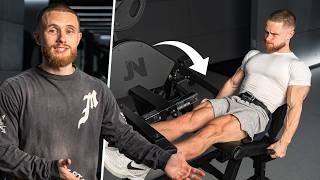
[02:34] Three sets of six to eight reps on the pendulum squat. This was easily my number one quad builder for my year-long experiment. And of course, it's not just for the quads. Like any squat, it'll also smash the glutes and the adductor muscles of the inner thighs.
[02:47] Now, obviously, not every gym has a pendulum squat machine, so if you don't have one, you can swap it out for another slot variation that you can progressively overload well, like a barbell slot smith machine slot or a hack slot For barbell slots you can make them more quad dominant by placing the bar higher on your traps and staying more upright For Smith machine squats you can increase the quad emphasis by keeping your feet back underneath you and letting your knees travel forward Same
[03:12] for hack squats. Feet back in a deeper knee angle for quad bias. I prefer the pendulum though, because you not only get low back support like on a hack squat, but pendulum squats are notoriously harder at full depth, so you have to fight more to get out of the bottom. This gives
[03:27] you a massive growth stimulus for the quads. I also find the arcing movement path of the pendulum squat feels a bit smoother than the linear movement path of a hack squat, but I'm kind of splitting hairs now if I'm being honest. Your quads should feel lit up even
[03:40] after just one set, and that's exactly why you don't want to push every set all the way to failure on these. So leave one or two reps in the tank for the first couple sets, this will still deliver a gigantic quad stimulus without hurting your performance for the subsequent sets.
[03:54] Then on the last set, I really hype myself up and give it everything I've got. I just tell myself to keep going up and down until I can't get up anymore. Then I let the weight drop on the safety pin. But remember, with the pendulum squat in particular,
[04:07] it will feel very hard in the bottom, especially as you approach failure. So even if it feels like you can't get the weight up, keep pushing. If you can just get through that sticking point near the bottom, you will be able to get all the way up and finish the rep.
[04:20] And you might surprise yourself with how many extra reps you can get once you really lock in and give it your all. And then, every couple months, you'll want to do a deload week where you strip the weight back. Trust me, you'll need that if you're pushing your last set to failure
[04:32] week in and week out while progressively overloading by adding a little weight or a rep from week to week. Now, the most common mistake I see here is cutting your depth short. One of the main advantages of the pendulum squat
[04:44] is that it's very quad dominant. But if you're not getting deep enough, your quads are really missing out on that juicy, high-tension spot toward the bottom, where torque is the highest. So, bury these as deep as you can comfortably go.
[04:57] If you're not sure what your depth looks like, record your set from the side, and you might notice that you're not going quite as deep as you thought. Now, when it comes to hamstrings growth, I do think the tried-and-true Romanian deadlift made the biggest difference for me this year.
[05:09] Obviously, a common theme I followed all year was choosing exercises that I could add a little weight to from week to week. So, if you start your program doing two plates per side for six hard reps, and you end your program doing three plates per side for six hard reps,
[05:24] your glutes and hamstrings will be bigger. That's just how it works. And this exercise obviously complements our hamstrings exercise from earlier, since the leg curl trains an inflection, while the RDL trains hip extension.
[05:36] And those are the two functions of the hamstrings. The main cue you want to focus on here is pushing your glutes straight back. That keeps the movement a true hip hinge and prevents you from turning it into a squat. I also keep a slight knee bend on the knees, but don't let my knees drift forward.
[05:51] Just enough of a bend to keep stress off my knee joints and keep tension on the muscles. And I'll say this, if you've never filmed your RDLs from the side, you should do it. This angle will give you the best insight on your form As you lift the bar should be moving up and down in a straight line centered over the middle of your foot not drifting out to the front
[06:10] Now, the most common mistake I see on the Romanian deadlift is actually overreaching at the bottom. A lot of people chase extra range of motion by collapsing their spine and letting their back round a lot, or by letting the bar drift too far out in front.
[06:24] Instead, you want to keep your back tight, keep the bar in close to your body, and only lower it as far as you comfortably can while maintaining a neutral spine and keeping tension on your hamstrings. For me, I usually stop just below knee level,
[06:37] and as long as I'm maintaining that neutral lower back, I can get an amazing hamstring stretch without needing to go in lower. Okay, I really think the best isolation exercise for the quads is, of course, the leg extension.
[06:49] And it complements the compound pendulum squat that we did earlier very nicely because it actually hits the big, long rectus femoris head of the quads harder than any squat variation will. That's because the rectus femoris crosses both the hip joint and the knee joint,
[07:04] so it actually won't change length much on a squat because your knees and hips are both moving. However, on a leg extension, your hips are fixed, which means the rectus femoris will actually stretch and squeeze.
[07:16] Some research backs this up. A 2021 study found that across five weeks of training, Smith Machine squats didn't grow direct as femoris, but leg extensions did. It's also just a really good finisher exercise for the quads, in my opinion.
[07:30] That locked-in position forces you to really isolate your quads without relying on your glutes or lower back at all. And I find I can really focus on feeling my quads work with a strong mind-muscle connection in a way that just doesn't work on a squat because there's too much going on.
[07:45] You don't need much volume here, just one or two hard sets where you're fighting for every inch will get the job done. The main technique difference that I made this year was setting the seat back as far as I could get it. This was shown in a new 2024 study to cause about 170% more quad growth than the standard upright seat position.
[08:04] And this may seem like overkill to some of you, but I also strap in on these. When you're fighting for those last few reps, it really does help to be fully locked into the seat. so I pull up on the handles as hard as I can to keep my glutes firmly planted,
[08:17] directing all the tension into my quads. And if you want to take it up another notch, you can try doing a slow 3-second eccentric. That isn't because slow eccentrics are inherently better for muscle growth, but they will allow you to get the same quad stimulus with slightly lighter loads,
[08:32] which might ease up some of the strain on your knees, which I needed to do after I injured my knee during a strength test for the experiment. You'll be surprised how hard these hit, even with moderate weight. Now, the most common mistake I see here is letting your butt pop off and down.
[08:45] Whenever that's happening, you're losing stability on the seat, and you are losing quad tension. So, keep your hips down at all costs. I even bought an airline seatbelt extender on Amazon for about five bucks, and lately, I've started using that to keep my hips down, especially if I'm going heavier.
[09:00] Okay and I would say that all the lower body muscles the one most responsible for really making it obvious that you lift whether you a man or a woman is the glutes So we going to hop into some glute isolation work on a hip
[09:12] abduction machine next. Now, up until the last month or two, I always did these leaning forward because conventional wisdom said that leaning forward should stretch the glute medius better. However, I recently started doing them like this, with my hips extended. And that's because the
[09:27] glute god himself, Dr. Brett Contorius, did a response video to my glute tier list video where he had this to say. If you look at the fiber directions of the glute medius, they're not well aligned for leaning seated hip abduction. However, you can just bridge up and do a hip thrust
[09:41] and then do bridge seated hip abduction, and then you're really targeting the glute medius, leaning forward for the glute max, bridge for the glute med. In fact, there isn't any direct research comparing these two techniques. I think what Brett is saying makes sense.
[09:53] Plus, I suspect that switching up your hip angle on these every now and then is probably better for overall glute development anyway. This way you're guaranteed to be hitting all the fibers from slightly different angles. So, since we already smashed the glute max pretty hard on the pendulum squat and the RDL,
[10:08] let's do these with straight extended hips, and really focus on stimulating those upper glute medius fibers. Now, the biggest mistake I see here is actually just going too light and not pushing hard enough. For whatever reason, a lot of guys see this as a kind of fluff and pump exercise,
[10:23] and just go through the motions, stopping well shy of failure. But, if you're an intermediate to advanced lifter, you should absolutely be maxing out most hip abduction machines and adding more weight with a gym pin.
[10:35] Otherwise, you're probably not pushing yourself hard enough. If you finish your set and you don't need to sit still for 10 seconds or so before popping up and walking away, you probably didn't go hard enough. Okay, and at this point in the workout, you'll probably want to skip calves,
[10:47] but I promise you, that is the main reason they're not growing. So, find a good straight leg calf raise that you feel well and push it hard for 8 to 10 reps, emphasizing the deep, stretched part of the range of motion.
[10:59] If calves are a priority for you, you could even put them first in a workout so you're less tempted to skip them. By far the biggest mistake I see here is not going deep enough. Most people do these short, bouncy reps up onto their toes, but we know from a growing pile of data that a deep stretch is crucial for forcing new calf growth.
[11:16] You don't even need to go all the way up onto your toes either. Just rotate up and down on the balls of your feet. then try this. At the end of your last set, sink into the bottom stretch position and hold it for 30 seconds. You might feel like your Achilles tendon is going to snap, but trust me, it won't, and this stretch
[11:31] under load stimulus seems to be especially effective for calf hypertrophy. Okay, so that's all I'm going to cover in terms of workouts from the new program here on the channel. If you want the full upper lower push pull legs routine, you can pick it up over on JeffNipper.com. I'll go ahead and put a
[11:45] discount code in the description box below, just for YouTube, so you can save 25% off. Also, it's not enough to just dial your training in, your diet is also super important. So if you pair the new program with my Nutrition App, Macrofactor, I guarantee you'll make better gains than you would
[11:59] with just the training program alone. So you can get a two-week free trial of Macrofactor at the link below. Just use code JEFF when you download. Alright, thanks for watching guys. I'll see you all here in the next one.
⚡ Saved you 0h 12m reading this? Transcribe any YouTube video for free — no signup needed.