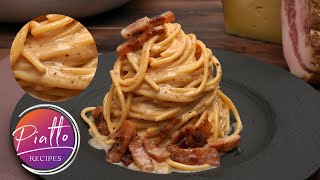

The Pasta That Connects Carbonara & Cacio e Pepe
45sReveals a little-known 'missing link' in Roman pasta history that intrigues foodies.
▶ Play Clip"The title accurately describes the recipe as underrated and thoroughly explains its preparation within the Roman pasta family."
Pasta alla Gricia is a classic Roman dish that combines crispy guanciale, toasted black pepper, and a creamy pecorino sauce. This video demonstrates the step-by-step technique, including deglazing with white wine and carefully controlling the cheese sauce temperature.
Gricia is the child of Cacio e Pepe and parent of Amatriciana and Carbonara, all using guanciale.
Freshly grind black pepper and toast for one minute before use.
Use half the weight of the pasta for guanciale. Cook on medium-low heat, no extra oil.
Deglaze with white wine (like Pinot Grigio) for acidity and flavor.
Cook pasta 3-4 minutes less than al dente, then finish in the pan with guanciale drippings.
Use semi-aged pecorino Romano (half pasta weight) and add hot pasta water slowly while stirring, keeping temperature below 140°F / 60°C.
Mix cheese paste into pasta off heat (mantecatura) and serve immediately to avoid clumping or cooling.
What are the pasta family relationships for Gricia?
Cacio e Pepe is the parent, and Carbonara and Amatriciana are the children.
What quantity of guanciale is used relative to pasta?
It should be half the weight of the pasta.
00:40
How do you deglaze the guanciale?
Deglaze it with white wine, such as Pinot Grigio.
01:46
What temperature must the cheese sauce be kept under and why?
Below 140°F / 60°C to avoid clumping.
03:48
What is the Italian term for mixing the cheese into the pasta?
Mantecatura (mixing the cheese paste into the pasta).
04:58
Gricia's place in Roman pasta family
Clarifies how Gricia relates to Cacio e Pepe, Amatriciana, and Carbonara, helping understand culinary lineage.
Temperature control for pecorino sauce
Critical rule (below 140°F / 60°C) to prevent cheese from clumping, a key success factor for creamy sauces.
03:48Serve immediately – Mantecatura
Emphasizes the importance of serving pasta alla Gricia right away to enjoy its optimal texture and temperature.
04:58[00:00] The real pasta la grigia, one of the pasta pillars of Roman cuisine. This mouthwater in pasta dish can be considered the child of Cache Pepe pasta
[00:12] and the parent of pasta matriciana and spaghetti carbonara. And just like them, it features fine Italian guanciale, which is pure pork cheek.
[00:25] Today, in the piatto kitchen, we'll show you how to prepare pasta la grigia just as they do in Italy. We start with a black pepper, whether we're making grigia, carbonara or Cache Pepe,
[00:40] the black pepper should be freshly ground and toasted for about one minute. And we move to the guanciale, which should be half of the weight of the pasta. As we do for carbonara and the matriciana, we cut the guanciale into strips and put it in the pan.
[01:02] I recommend using medium low heat and raise the temperature only at the end of the cook time. This way, our guanciale will remain crunchy on the outside but soft inside.
[01:16] As you can see, we have not added any additional oil or fat. In fact, the guanciale will give off plenty of it. And as per usual, you can use pancetta or pure pork belly if that's all you can find.
[01:33] And while the guanciale browns, I'm going to cook the pasta, spaghetti, tonarelli or whatever you prefer, even sure pasta can be used.
[01:46] Our guanciale is now browned and crispy, so it's time to deglaze it with a bit of white wine. I'm going to use pinot grigio, but any white wine will do.
[02:03] This will give a pleasant aftertaste to the guanciale, plus it adds a little bit of acidity to the dish.
[02:15] Okay, I'm setting the guanciale aside, but let's make sure to save all these drippings, which we're going to use for creating the mouthwatering pasta sauce at the end.
[02:27] When we're going to combine that with our pecorinochi sauce and with the starch from the pasta. In fact, this fantastic sauce will be very similar to the sauce that we make for ketchup.
[02:41] In goes the pasta, I cooked it 3-4 times required for al dente pasta, and now I'm going to finish cooking it the rest of the way in the pan with our lovely guanciale drippings.
[02:56] And by the way, you can find all of these famous Roman dishes on our cooking channel.
[03:11] I'm going to add a couple of little so hot pasta water. Now, in goes the beautiful pepper that we toasted earlier, and our guanciale,
[03:33] which has remained crisp even after the glazing, and it's time to make the cheese sauce. I'm using semi-aged pecorino romano cheese, also a quantity that's half of the weight of the pasta,
[03:48] and I simply drizzle in a little of hot pasta water and keep mixing. This is very important. I'm heading the hot water slowly to prevent the temperature from going over 140 Fahrenheit, 16 Celsius.
[04:02] And why is that? Because we're looking for a smooth paste, the same way we prepared the pecorino cheese for making cashew pepe, and if the temperature goes above 140, we're ruining our cheese sauce,
[04:16] and it won't be any more creamy and velvety as it should be. So, I'm going to keep stirring until I reach this kind of ricotta-like consistency, and this paste is ready to be incorporated with the rest.
[04:34] Speaking of the rest, look at the lovely sauce that we already have in the pan.
[04:46] Now, all that's left is to turn off the heat and stir in the cheese paste. The very best restaurants in Rome surely must finish the station at the table, just like to do with this so-called Alfredo.
[04:58] But why is that? The reason is that pasta a la grigia, just as well as cashew pepe, carbonara, and Alfredo, should be eaten right away. And since the process of mixing in the cheese, which is called mantecatura in Italian, lowers the temperature a little,
[05:16] we can wait any longer to eat it, or it will be cold. And on the other hand, we can keep hitting the pasta as we stir in the cheese, or we risk raising the temperature too much and creating a clumpy stringy sauce instead of the creamy masterpiece you see here.
[05:34] And look at this sauce, now really, come a little closer. Let me show you what we're talking about, and look at that.
[05:47] And with a dish like this, you just enjoy, don't think about the calories, which is exactly what I'm going to do now. And one appetito. And if you liked this video, or you learned something new, click the thumbs up and consider subscribing to our channel for more recipes like this, from Italy and beyond.
⚡ Saved you 0h 06m reading this? Transcribe any YouTube video for free — no signup needed.