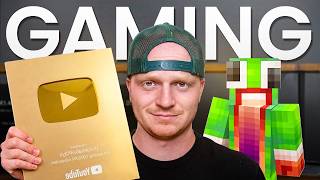

From 0 to 10M: My Gaming Journey
55sInspirational underdog story with concrete proof of success, motivating aspiring creators.
▶ Play Clip"The title promises a 'new way' to start a channel, and while it offers actionable advice, it's largely a rehash of standard gaming YouTube growth principles, delivered as a Q&A session rather than a groundbreaking method."
Nathan, a creator who grew multiple channels to over 10 million subscribers, shares his playbook for starting a successful gaming channel in 2026. He debunks the 'saturation is bad' myth, advises on choosing the right game and format, and stresses the long-term commitment required.
Saturation indicates viewer demand; a niche with many creators proves that people want to watch that content. Minecraft's growth shows how a saturated niche can expand.
Choose a game you know, like, and are good at. Ensure it's entertaining to watch, not just to play. Examples of watchable games: Minecraft, GTA, Roblox, Fortnite.
People connect with personalities, not games. Building your character takes repetition, and it's what keeps viewers loyal if the game dies. Personality is built over time.
Go all in on one format—long-form is preferred. Diversify only after reaching 50k-100k subs. Spreading focus across multiple formats splits your audience and slows growth.
Collaborations mix audiences, improve video quality with multiple personalities, and build a supportive peer network. Collaborate for genuine relationships, not just views.
Measure growth in percentages, not raw numbers. Early growth is slow, but it's still growth. For example, going from 100 to 1,000 subscribers is a 10x increase.
Most successful creators post 400-800 long-form videos before reaching a million views on one video. It took Nathan 574 uploads over 3.5 years.
What are the real signals that a gaming channel is starting to work?
Measured by engagement, view counts, subscriber growth, but more importantly by tracking growth in percentages, not raw numbers.
15:35
How many uploads did Nathan say it took to get his first viral video?
It took 574 uploads and three and a half years to get the first viral video.
17:39
Which game is cited as an example of being entertaining to play but not to watch?
World of Warcraft is a game that is more played than watched on YouTube, making content struggle to get past a million views.
03:52
What advice does Nathan give about measuring subscriber growth?
Measure your growth in percentages, not just absolute subscriber numbers, to acknowledge the progress you're making.
16:03
What format does Nathan recommend for new gaming creators?
He recommends focusing on long-form content when starting, then diversifying into shorts or live streams after reaching 50,000-100,000 subscribers.
11:34
When should you stop experimenting and go all in?
To go all in from the start, because if you don't commit fully, you won't get anything out of it.
15:35
What trait makes a game ideal for YouTube content?
A game where people enjoy watching someone else play, like Minecraft, GTA, Roblox, and Fortnite.
04:04
Saturated niches indicate demand
Challenges the conventional fear of saturated niches by reframing them as proof of viewer interest.
02:04Personality over the game
Highlights that audience loyalty is to the creator, not the game, which is key for channel survival.
05:23Stay long-form focused
Presents a clear strategy: focus on long-form first and diversify only after reaching a substantial audience.
11:34The reality of early growth
Cites that it took 574 uploads and 3.5 years for the first viral video, setting realistic expectations.
17:39Collaborate for growth and friendship
Emphasizes that collaborations mix audiences, improve content, and build a supportive peer ecosystem.
12:39[00:01] laptop so terrible that I had to delete the operating system and downgrade it in order to record my first video. And that channel, among others, reached nearly 10 million [music] subscribers. So, I'm going to break down how exactly I did
[00:17] it. So, when people tell me that gaming and YouTube is dead or oversaturated or whatever they say, I'm here to prove you wrong. The niche isn't dead, but the old anymore. So, in this video, we're going
[00:31] YouTube in 2026 [music] with a gaming the best ways to start a YouTube channel, cuz think about it. All you got to do is get a computer, a microphone, a way to record, and the video game, and
[00:43] basically for free. If you guys don't know who I am, my name is Nathan. I run multiple successful channels. Here's a little picture of all of my awards. I show this not to flex, but more so to prove to you guys that I've been in the
[00:57] trenches. I've done it. I've grown multiple channels to over 10 million subscribers. So, the advice I'm going to give you today is pretty legit. I'm not some YouTube guru that is basically just trying to fill your brain with nonsense.
[01:09] And I'm still actively doing it today. We average 100 million monthly views that for about the past 5 years. So, Johnny is going to ask me some questions about YouTube, and let's do it. >> go. Question number one. Is YouTube
[01:22] actually saturated or are most people just approaching it wrong? >> That's a good question. So, saturation is something that every YouTube creator talks about, and they say, "Oh, my niche is saturated." And, "Oh, there's too
[01:35] many people making these videos." And, "Oh, there's this. There's that." But yet, somehow, certain creators figure out a way to break [music] out of that saturation. So, it's not that the niche is saturated, it's more so that you
[01:49] don't know how to break out of the saturation. To be different enough to actually be seen amongst the crowd of competition. That is what you should be focusing on and asking yourself. In fact, I think a saturated niche is a
[02:04] incredible place to be because it proves that there is demand for viewership in that category of content. So, if anything, a saturated niche is what you want [music] to be in. Because if you go into a space that is not saturated and
[02:19] one's really talking about it, it's arguably going to be more difficult to grow in that space because no one even knows about it. Minecraft. Back in 2012 when I started, Minecraft was very saturated. In fact, Minecraft was the
[02:34] biggest game on YouTube. It had the most amount of videos, the most amount of creators, but I kind of thought to myself, think of it this way. If we keep uploading Minecraft videos, all of these creators [music] combined, the market of
[02:47] the game is going to get bigger and just keep growing. And that's exactly what keep growing. And that's exactly what happened. From 2013 to 2014 to 2015 to 2016, the game kept getting larger every single year, selling more copies,
[03:00] attracting more fans, attracting more views. So, if anything, I think being in a saturated niche is probably one of your best opportunities. Question number two. If you were starting a gaming channel from zero in 2026, how would you
[03:13] choose the right niche? [music] That's a good question. This is mainly about market do you want to be in? I think the first thing it starts with is it needs to be a game that you know. It needs to be a game that you like. Like, if you
[03:26] everyone is playing Fortnite, don't start a Fortnite channel. You should start a game that you enjoy. But on the flip side, you should pick a game that flip side, you should pick a game that has a lot of attention on YouTube.
[03:39] Because some games are really entertaining to film, and other games are really entertaining to play. A great example of this would be World of Warcraft. World of Warcraft is one of the biggest [music] games in the entire
[03:52] world. However, if you look up World of Warcraft on YouTube, you'll notice that a lot of videos struggle to get past [music] a million views because a lot of people are not watching this game, instead they're playing it. So, games
[04:04] instead they're playing it. So, games like Minecraft, GTA, Roblox, Fortnite, a lot of these games are enjoyed watching the experience of someone else play. So, [music] But you also want to pick a game that
[04:17] you're also good at. Now, of course, over time, as you post more videos, you'll get better at the game. When I recording it, I was not very good. I probably played the game for about a
[04:30] year before I started my YouTube channel. And then over time, as I posted game. And eventually, people saw me as an expert in the game when it comes to knowledge and survival and all the different things you have to do in the
[04:43] game. So, over time, that will grow because if you think about it, a lot of people watch gaming creators because there's some sort of professionalism into how they play. A great example of this would be Ninja when he plays
[04:56] Fortnite. He was like a pro gamer. People watched him because he was so freaking good, and they wanted to see his crazy moves and how he would pull off 30 kills [music] in one game. That's what you want to focus on. Question
[05:08] channels fail? Is it because they focus on the game, or is it because they focus question. We're talking about the character problem. That's actually one of the biggest mistakes [music] that I made in my gaming career as a YouTuber,
[05:23] and one of the things I decided to start pivoting. Because as a gaming creator, you have two things you have to balance. The first thing is the game, right? Like, playing the game, showcasing cool things in the game, maybe showing off
[05:37] those Easter eggs. But the other thing you have to balance is your personality. Because as a YouTube content creator, you are filming videos about you playing the game. Now, the thing is, I am a big believer that people will stick around
[05:51] for you and not for the game. If you make your entire YouTube channel specifically about the game, once the game dies, your channel is dead. That's to do is you want to get a lot of people to click on your video, and they need to
[06:06] enjoy an experience with you playing the game, but at the [music] same time, they need to enjoy hanging out with you and your personality even more. Now, again, this is something that is built through repetition. In our Blueprint University
[06:20] course, which is a free 11-hour course on our website, basically explaining to to think of video ideas, titles, thumbnails, editing, filming your video, That is on our website. I would highly recommend going to watch that because we
[06:33] dive very deep on what it means to be a really good creator in terms of that sense. [music] But the biggest thing you have to understand is repetition is what is going to get you there. If you go back and you look at any YouTuber's
[06:46] can look at Mr. Beast. [music] Go look at some of their first couple videos, and then look at his 50th [music] video, his 100th video, his 200th video. You can see the evolution of their personality shining over time. [music]
[07:00] So, personality is one of those things that takes time to grow, to build, to mold, and to figure out your brand, your style, and what you're actually going to be like as a creator. But the thing is, personality is significantly stronger.
[07:15] People connect with people. People don't connect with games, especially on game, you connect with the game. But when you're watching someone play the game, you're connecting with the human playing the game, not the actual game
[07:28] you're able to put yourself in a position to where if something happens to this video game, like the game dies, you still have an audience of maybe 100,000 people that love you for being yourself. So, then when you transition
[07:42] to a new game, everyone comes with you, and you can keep [music] your audience. learned about YouTube, if you want to get to the big numbers like 10 million subscribers, YouTube is a game of momentum. So, if you can get to 100,000
[07:56] That's awesome. But now you have to keep those 100,000 people entertained, and you have to keep them watching every single day or every single week when you post new videos. Because otherwise, if you get to 100,000 subscribers, but your
[08:10] videos are getting no views, you have no audience, my friend. You have no personality. Your audience is not loyal to you. It's kind of like when your mom is talking to you and it just goes through one ear and out the other. You
[08:23] audience. They need to listen to you, trust you, and like you as a person. So, time. It takes a lot of effort. It takes communication. And that's something we talk about very deeply inside Blueprint
[08:36] checking that out. Link in the top of the description. Another thing I actually want to work one-on-one with my team, and we can help you diagnose this you're going to have throughout your YouTube career, we actually offer more
[08:51] of a one-on-one solution where we can actually help you become a better Premium. That is also in the description. You can actually work with me directly and my team directly to fix those things. So, highly, highly
[09:03] >> Question number four. Why do most gaming creators fail before they even get traction? Is it simply because they choose the wrong format to focus on, or formats at the same time? >> I think it's a mixture of both. Picking
[09:16] the right format is very important. When I say format, I mean long-form live streaming or short-form content. You want to pick the right format. But you Because if you do all of them, you spread yourself thin. And if you do all
[09:30] of them, they all require different types of audiences. People that watch long-form videos might watch live streams, but people that watch long-form streams, but people that watch long-form videos might ever never watch short-form
[09:42] videos. So, sometimes they're different audiences, and if you try to grow for probably not going to get very much traction. And I know a lot of creators long-form video? And then what if I clip my long-form video into shorts? And then
[09:56] what if that short takes off and gets 10 million views? And that's going to funnel back to my long-form video. Yes. [music] In reality, that plan sounds accomplish it, that's not really what happens. I've made hundreds of shorts
[10:10] thousands of long-form videos. It doesn't work that way. It really way. You know, I got a good friend that does 200 million views a month on short-form content, and he's struggling to grow long-form. He gets 200 million
[10:25] can't grow his long-form. Like, that doesn't really make any sense, right? content, they're different types of audiences. Let's say you have a friend that only likes watching movies. What happens when you try to get that friend
[10:39] to watch a TV show of six different [music] seasons? It's one of those things, simple as that. But, my answer to you is First thing you want to do is you want to figure out what format is everyone [music] doing in this game. So,
[10:52] if you pick a game, and everyone's doing live streaming, it might be a smart idea to do some live streaming. But, the thing is, I'm a big believer that live streaming and long-form go hand in hand, right? So, I call it two L's, live
[11:06] things I would put together. However, I would not put together long-form and styles of content. Now, when you start to grow your channel, and your channel gets big, and you have enough money to hire an editor, then [music] I think it
[11:20] makes sense to diversify and start doing short-form and start doing other content. Or starting with short-form and then transitioning to long-form in the on how you want to do it, but the big thing is just focus. Perfect one format
[11:34] with long-form, just do long-form. That's [music] it. And then, once you getting an audience of, you know, 50,000, maybe 100,000 people, then you can diversify [music] into other opportunities. The problem with creators
[11:48] focus is too split, and it's so incredibly hard to grow a channel when once. It's already hard enough to be a creator as it is, period, and you don't need to split your focus. When I started YouTube, the only thing I did was
[12:02] long-form content. That's it. Now, fast forward 14 years later, the only thing I do is long-form content. I don't do anything else. I don't really make short. Do I have shorts on my channel? Yes. Do we focus on them? No. I have not
[12:14] filmed a short-form video in probably three or four months. We don't really focus on them. We don't do live streams. All we do is long-form. That's it. [music] years. We are incredibly focused on long-form because we think it's the
[12:26] built our entire team and everything we do around long-form [music] content. If grow. Question number five. How should gaming creators think about collabing with other gaming creators? [music] Is
[12:39] or overestimating? Definitely underestimating. I think collaborations are incredible for so many different reasons. I mean, first off, if you can collab with someone, obviously, you guys are kind of mixing your audiences. So,
[12:52] if you have 20,000 subscribers, and you collaborate with a guy that has 30,000, growth from that. Both of you guys are getting a lot of growth from that. On top of that, the second reason is that now you have someone to film content
[13:06] with. And typically, content is better when you have multiple personalities in it. Think of your YouTube content like a movie. When's the last time you watched a movie and there was only one person in the entire film? I can't think of a
[13:19] film. I mean, I'm sure there's a couple movies out there, but every single movie has multiple characters, it has multiple personalities. So, if you can multiple personalities and multiple people into your videos, which
[13:32] ultimately makes your videos better. And then, the third reason is once you start collaborating with creators in your niche, you start to build friendships, which is really, really exciting because then you can share things with this
[13:45] creator, and you could be like, "Hey, did this thumbnail work for you?" Or, "Hey, what was your retention on that video? I saw you post this video last retention so good? Like, what do you think you did to make your retention so
[13:58] good?" So, you start to establish these relationships with multiple creators, and you eventually form this little circle group. And this is exactly what I did. Some of my best friends and closest friends I have today are very big
[14:11] content creators, and we're constantly bouncing off ideas with each other. check this out." Or, "Hey, what did you do with this editor guy?" Or, "What did did you do with this?" You know, you kind of form a little ecosystem of
[14:25] friendships, but also people that you can rely on for expertise and [music] advice. And growing with people, growing together, is one of the most exciting ways to grow a YouTube channel, in my opinion. So, I think collaborating is a
[14:40] would just say my little bit of advice is don't ever collaborate with someone specifically just to get views because a lot of creators nowadays, they want relationships. I don't collab with people just to get views. I collaborate
[14:55] don't really care [music] how many views they get. Typically, most of the time, that are smaller than me [music] instead of bigger because typically, the bigger guys have more demands, they have more this, more of that, whatever it is. So,
[15:10] it's easier for me to just collaborate with someone smaller, and even though he might [music] bring less to the table, it's a more exciting relationship, and stand. I think everyone should focus [music] on collaborations. I think
[15:22] go round. You guys better leave a like on this video cuz I'm spitting some fire to get YouTube advice like this anywhere else. >> What are the real signals that tell you a gaming channel is finally starting to
[15:35] time to stop experimenting and just go all in? Well, to answer the second part of the question, you should go all in when you start. If you're not going to anything out of this. There's no like, "Oh, I'm going to like kind of work on
[15:49] Now, how do you know when your channel's actually starting to work? I mean, the simple answer is the numbers, right? Like, you're getting more views, you're subscriber growth. Now, one of the big things that I encourage small creators
[16:03] talk about in Blueprint Premium whenever I'm coaching a bunch of our creators, is I talk about measuring your growth in percentages instead of just looking at the numbers. Let's say you go from 100 subscribers to 1,000 subscribers. That's
[16:17] a pretty decent jump, but that's actually like a 10x growth. That's like 100 plus percent growth. Like, that is insane, right? Now, a lot of creators look at that, and they'll be like, "Man, I only have 1,000 subscribers. Like,
[16:32] that sucks. Like, I only have 1,000 subscribers." But, do you realize how much you just grew? Like, that is a insane amount of growth, right? So, you percentages, in my opinion, cuz it makes you feel like things are actually
[16:45] sometimes things are just so slow. You post a video, it gets two views. [music] You post a video, it gets three views. You post a video, it gets two views. You post another video, it gets six views. Yeah! Six views. And then, you post
[16:58] know the feeling. That's how exactly how it was when I started my YouTube channel. I remember the day after I posted like 20 or 30 videos, I finally got a video that got 50 views, and I was like, "Yo, this is insane. This video
[17:11] has 50 views. I don't even know 50 people. Like, this is crazy." I think obviously. Like, you'll see the viewership go up, you'll see the that first YouTube check. I remember my first YouTube check was like 156 bucks,
[17:25] come in the mail. And I think the other thing is like, you also have to give things time. A lot of creators, they work hard at something for six months, working." Like, bro, it took me three and a half years to get my first viral
[17:39] and a half years to get my first viral video. after like 574 uploads of long-form content. So, I think you need to adjust your expectations of how difficult something is going to be because if you post 100 videos, and you
[17:52] to 5x [music] that expectation. You need to post 500 that expectation. You need to post 500 videos, 600, 700 videos before you difficult it is to be a YouTuber. [music] I'm just being realistic. Now,
[18:05] you might get lucky. You might hit a trend perfectly, and you might post 82 videos, and then one goes viral, maybe. It's certainly possible. I'm just explaining to you what happened to me and what happened to all of my other
[18:18] creator friends. Typically, we posted anywhere from between, uh, 400 to 800 videos before we got our first video to a million [music] views. And this is all long-form videos. I'm not talking about shorts, straight long-form, 20 to
[18:31] 30-minute videos. And that is also [music] with constant iteration of thumbnails, titles, intros, improvement on personality, advancements on editing, of the above. We're constantly improving the content. So, it's one of those
[18:44] adjust your expectations. Usually, when you try to do something really cool in life, it's usually 10 times harder than whatever you think it is. So, yeah, guys want to join Blueprint, check out the link in the description. We have a
[18:57] check out on our website, and we have a work with my team, and we can help you grow. [music] grow. [music] So, subscribe. We'll see you next week.
⚡ Saved you 0h 19m reading this? Transcribe any YouTube video for free — no signup needed.