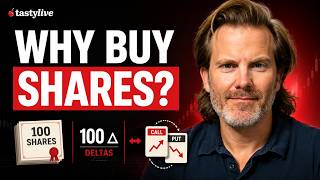

2 Ways to Simulate Stock Ownership with Options
60sDirectly addresses a common pain point (high capital requirements) and promises a solution, creating immediate curiosity.
▶ Play Clip"Delivers exactly what the title promises — a clear, practical demonstration of two strategies to save buying power, with real numbers."
The video explains two options strategies to simulate long stock exposure with significantly less buying power: the short put/long call at-the-money combination (the 'OG way') and the zero extrinsic back ratio (ZEBRA) strategy. The presenter demonstrates both setups using AMD as an example on the tastytrade platform, highlighting the capital savings and trade-offs.
The video aims to show two ways to simulate a long stock position with less buying power, as buying shares can be capital-intensive.
Buying shares is not wrong; many investors will still have long stock exposure. The issue is position sizing (3-7% of net liquid) when shares take up too much buying power.
Sell an at-the-money put (positive 50 delta) and buy an at-the-money call (positive 50 delta) to get 100 delta, simulating long stock.
Zero Extrinsic Back Ratio: buy two in-the-money calls (around 75 delta) and sell one at-the-money call (around 50 delta) to get 100 delta, aiming for zero extrinsic value.
You don't collect dividends or have voting rights, but you get the same upside exposure. Decide if proxy voting matters to you.
Using tastytrade, AMD at $480, 100 shares notional $48,000, buying power effect $24,000 with 50% margin relief.
The OG position saves about $5,000 in buying power compared to shares, with similar delta and probability.
Positions need to be rolled every ~46 days, unlike shares, but savings add up across multiple positions.
Buy two 75-delta calls (e.g., 410 strike) and sell one 50-delta call (e.g., 490 strike) to get 100 delta, with significantly lower buying power than shares or OG.
OG is simpler to manage, good for beginners. ZEBRA offers more flexibility but more decisions, suitable for experienced traders.
Both strategies effectively simulate long stock exposure with less capital, but they require active management and have trade-offs like no dividends. Choose the OG way for simplicity or the ZEBRA for greater flexibility and capital efficiency.
What is the 'OG way' to simulate long stock?
Sell an at-the-money put and buy an at-the-money call, giving 100 delta.
01:29
What does ZEBRA stand for?
Zero Extrinsic Back Ratio.
02:11
How many deltas does a ZEBRA strategy aim to have?
100 deltas, simulating long stock.
02:25
What are two trade-offs of synthetic stock positions?
No dividends and no voting rights.
02:40
In the AMD example, what was the buying power effect for 100 shares?
$24,000, with 50% margin relief on $48,000 notional.
03:47
How much buying power did the OG method save compared to shares?
About $5,000.
04:56
What is a key gotcha of synthetic positions?
They need to be rolled every ~46 days.
05:22
OG Synthetic Stock Setup
Provides a simple, classic method to replicate long stock with options.
01:29ZEBRA Strategy Introduction
Introduces a modern, capital-efficient alternative with zero extrinsic value.
02:11Buying Power Savings Quantified
Shows concrete savings ($5,000) that can be redeployed elsewhere.
04:56Rolling Requirement
Highlights the active management needed, a key difference from holding shares.
05:22Choosing Between Strategies
Offers practical guidance on when to use each method based on experience.
07:08[00:01] best ways you can help us out by liking the video or subscribing to the channel. Either one of those guys really helps us out a lot. So, you want to get long your your favorite whatever. And what is the classic way to do that? To just buy the
[00:17] shares. But man, the price tag on buying those shares in terms of buying power, it can be very very significant. I mean, a $200 stock, that's going to cost you that's just sitting there that you can't use for anything else. And so, what I
[00:32] want to walk through today are two ways to simulate the same position at a fraction of the buying power. We've got the OG way, and then kind of a modern twist on an old classic type of way. So, let's get into it.
[00:47] buying shares, there's nothing wrong with that. Like being long stock, being unequivocally nothing wrong with that whatsoever. And I think a lot of investors, when it comes to their overall portfolio, they're still going
[01:00] to have a lot of long stock exposure. All I want to do here today is when position sizing and trying to be, you know, 3%, 5%, 7% of net liquid per position, that's really difficult to do when you try to fit that within the
[01:15] framework of, you know, long shares and all the buying power those positions do take up. So, I want to talk through and work through two alternatives to simulate the same position with an option strategy that doesn't use nearly
[01:29] as much capital. So, method number one, the short put long call at the money the short put long call at the money combination. This is the OG way of simulating long stock. I don't even think it has a snazzy name.
[01:43] label. I think we just call it the OG way. And the way you set it up is very very simple. You sell a put at the at the money strike, that gives you positive 50 delta, and then you buy a call at the at
[01:56] the money strike that gives you positive 50 delta. So you combine those two together and you have the same 100 delta that you would have if you just bought Okay, that's method number one. Method number two, this is the new guy, the new
[02:11] kid on the block, the zebra strategy. So the zero extrinsic back ratio strategy. The idea here is this, I want to buy a couple of let's say we're playing this to the upside to kind of simulate long stock. I want to buy a couple of in the
[02:25] money long calls and then I sell one at the money call that gives me the same 100 deltas that I would have if I just bought stock, but again, I'm going to be able to do this at a fraction of the buying power. And with a zebra, the goal
[02:40] is to do this without having to pay any extrinsic value. I mean, it's right there in the name, zero extrinsic back ratio. Now, of course, you don't have collect any dividends, you're not going to have any voting rights, but you are
[02:54] going to have the same upside exposure that you would have with the shares. And so if something like, you know, the shareholder meeting or, you know, your annual proxy or what have you isn't as important to you, of course, you have to
[03:06] decide this for yourself, then a zebra strategy can be a really nice way to simulate that exposure. So, what I want to do now, let's hop into tastytrade and let's take a look at both of these strategies in the real markets.
[03:19] Okay, so I am inside of my tastytrade platform and I've got AMD pulled up. And so this is obviously advanced micro devices. You can see it right there or as we know on the streets, advanced money destroyer. So let's go ahead and
[03:32] go into the trade page here. Let's take a look at the September cycle with 46 days to go. Now again, if I wanted to, I could simply buy the shares, right? And just have my 100 long shares. And if you're in a margin account like I'm in
[03:47] right here, you typically get about 50% relief in terms of the capital you have to set aside to hold that position. So, if I go to AMD and I click on the ask buying power effect is going to be about $24,000.
[04:01] So, it's essentially 50% of the notional value of the position. Of course, 100 shares at $480 per share has a notional value of approximately $48,000.
[04:13] So, my buying power effect on this is half of that with the 50% margin relief, so 24,000. Okay, but we could set up our two synthetic stock positions as follows. So, number one, I could choose an at the
[04:28] away. I sell a put and then I buy a call both with the at the money strike. And what you see is this, I have the same delta exposure, you can see that
[04:42] So, I have the same approximately the same, it's not going to be exactly the same. I essentially have 100 deltas to the upside. I'm in a similar situation from a probability standpoint. Like, this is effectively the same position,
[04:56] but look at what has happened. I've saved about $5,000 in buying power. So, worth it, it's not that it's not significant enough to kind of do all and what have you, and that's completely fine. I don't know though, man. That's
[05:10] $5,000 that I could then use for something else or maybe $4,500 that I could then use for something else and I have the same position. Now, of course, it's gimmies and gotchas. The gotcha is, I mean, every 46 days or so I'm going to
[05:22] have to roll the position. I'm going to have to adjust the position, so it's not shares, but again, you do this for a couple of long stock positions and just choose this kind of OG version of synthetic stock and the buying power
[05:35] savings could start to add up pretty quickly. Okay, that's the first method. The second method though is going to be with this zebra strategy. And essentially, the setup for a zebra is I want to buy around the 75 delta call.
[05:49] I'm going to buy two of those and then I want to sell around a 50 delta or slightly above 50 delta call as the short call portion of the strategy. So it is a two by one, so I buy two and I sell one and what you're going to see is
[06:05] this is going to also simulate the same upside exposure, but this time there's going to be significant capital savings. So if I buy my 410 strike and then I
[06:17] sell my let's say I sell the 490 strike and then I go back up here to the 410 strike and I double up on that guy. Now I'm in a situation where the deltas
[06:29] on this position are the same, right? Effectively the same as what we saw with the first two options, but now again it's a 50/50 trade effectively with, you know, the long stock or the OG position. These are all going to be essentially
[06:42] essentially directional trades, but look at what has happened now. Now my buying power effect is indeed a fraction of what we saw with long shares or even the OG position. I mean this is much much
[06:56] less than we saw with either one of those guys and so when it comes to buying power savings, these are two options that could really be nice tools to put in the toolbox when it comes to long stock exposure. Now how do you
[07:08] decide which one to do? Well, I think to keep it really really simple, the OG call, that's going to be a lot simpler to manage. That's going to be a there's decisions that you're going to have to make. And so if you've never done this
[07:21] before, that might be where I would begin uh considering doing something a bit more experienced and maybe you're familiar with that, you want to try something new, this is where a zebra can come into play. Just understand the
[07:33] road, they're a little bit more numerous than with the OG synthetic position. It something for a future calculated risk. But just understand there's more flexibility, but with that flexibility is going to come more decisions that you
[07:47] have to make. And so, hopefully this helped and I'll see you guys next time.




⚡ Saved you 0h 07m reading this? Transcribe any YouTube video for free — no signup needed.