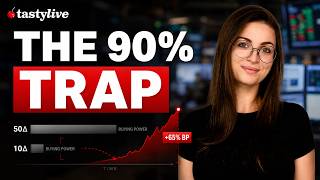

90% Win Rate? Hidden Risks Revealed
54sChallenges the allure of high probability trades, sparking curiosity about the hidden downsides.
▶ Play Clip"The title promises data-driven insights, and the video delivers exactly that—a clear, evidence-based breakdown of hidden risks."
This video breaks down the hidden risks of high-probability option trades, specifically far out-of-the-money strangles. While these trades boast win rates above 80%, the data reveals trade-offs in credit, capital intensity, and buying power volatility that can undermine profitability.
Comparing 45 DTE strangles managed to 21 DTE from 2013, lower delta (10, 5, 2) strangles have pops upwards of 80%, but credit collected and median P&L drop.
For 21 DTE SPY strangles, buying power only reduces by 12% from 50 delta to 10 delta, making wide strangles capital intensive.
Buying power can increase during a trade; Nvidia example showed a 65% increase within days, requiring buffer capital.
Monitoring 5, 16, and 50 delta positions, the maximum recorded increase in buying power was highest for 5 delta, indicating higher sensitivity.
Adding wings to a strangle converts it to defined risk, making the max loss known and mitigating tail risk.
What is the trade-off between probability of profit and credit collected for wide strangles?
Lower delta strangles (e.g., 10, 5, 2 delta) have higher probabilities of profit (upwards of 80%) but collect less credit, leading to lower median P&L.
01:09
How much does buying power reduce from 50 delta to 10 delta on 21 DTE SPY strangles?
Buying power only reduces by about 12% when moving from 50 delta to 10 delta on 21 DTE SPY strangles.
02:06
How can buying power behave during the life of a trade, and what example was given?
Buying power can increase over time as brokers adjust for perceived maximum loss, as seen with Nvidia where it increased by 65% within a couple of days.
03:56
Which delta position showed the highest maximum increase in buying power?
The maximum recorded increase in buying power was highest for the 5 delta positions, indicating higher sensitivity.
05:54
What is one way to mitigate the risks of an undefined risk strangle?
Adding a wing to the strangle converts it into a defined-risk trade, making the maximum loss known.
08:46
Probability vs. Credit Trade-Off
Reveals that higher win rates come at the cost of lower credit, which can reduce overall profitability.
01:09Capital Intensity of Wide Strangles
Shows that buying power doesn't drop much with wider strikes, making them capital-intensive relative to credit collected.
02:06Dynamic Buying Power
Highlights that buying power can increase during a trade, requiring buffer capital to sustain positions.
03:56Volatility of Buying Power
Demonstrates that far out-of-the-money positions have more volatile buying power, increasing risk.
05:54Mitigation with Wings
Offers a practical solution to cap losses by adding wings, converting to defined risk.
08:46[00:01] >> Let's do it. Okay, cool. So, this is a piece from Sahil over on Axe. If you want to give him a follow, about the hidden risks of high pop strangles. you know, the usual things about like the tail
[00:16] you collect. That's, you know, a lot of what we tend to talk about when it comes to the risk reward trade-off, but also some of the other risks that, you know, >> Yeah. >> I like it. I have a feeling where this
[00:29] >> I think you might. I think you might have a sneaking suspicion. different option strategies, right? And usually want this balance of risk and reward. Really, [snorts] you know, capturing enough upside for the amount
[00:42] of risk and the type of risk that you're taking. And we usually judge, you know, Lower delta strategies tend to be higher pops. And while this looks attractive at risks that we want to talk about. So, what are those downsides of high pop
[00:56] on their face, they look great. Probability of profit of like 90%, you know, that that can look nice at first, but what are the hidden downsides that sense? >> Make sense.
[01:09] >> Let's do it. Okay. So, here we're just comparing some strangles going back from 2013 to present. These are 45 DTE managed to 21 DTE. So, using a little what you can see is that when you're getting down to like the 10 delta, five
[01:24] delta, two delta strangles, you're getting pops upwards of 80%. But, the credit you're collecting and then the consequential median P&L drops expect. That's really the trade-off when you're going wider and wider. You're
[01:38] [snorts] of profit, but you're collecting less, you know, and that affects median P&L overall. And even though those can be like small steady you know, overwhelming majority of the time, those are not necessarily enough
[01:52] to compensate from the inherent tail risk that you see positions and then, you know, these undefined risk ones as well. >> Yeah. Right? So, let's go to the next one. So, this is just I pulled this, you
[02:06] know, like this morning. I'm just looking at 21 DTE buying power for spy strangles comparing 50 delta, 40 delta, 30, 20, and 10. And what you see is between 50 and 10, there's a 12% reduction in buying power. So, it's not
[02:20] a very big reduction in buying power from going wider and wider and wider and wider. Um, noting that these are 21 DTE. This is on spy and you know, different change what these values actually are, but buying power is really meant to be
[02:33] for an undefined risk position, what the kind of estimate for worst case losses know, there's this calculation that goes into it. This is basically, you know, loss for an undefined risk position when you don't really know what the risk is,
[02:48] you know, technically or the potential losses going into it. So, what you see you know, these 10 delta positions or these 20 delta positions have high probabilities of profit, um, one, they're capital intensive. They're, you
[03:01] know, comparably capital intensive looking at 21 DTE as a 40 or a 30 30 delta position, but if we're using BPRs as proxy for worst case loss, you're also subject to tail risk as unlikely as that might be, even though you're
[03:14] profiting most of the time, right? >> Yeah. And just so the crowd knows, this >> Yes. >> Yep. Yeah, I think that's the the big hidden risk is the you have this high probability trade, maybe you're
[03:28] contracts, but your out of the money losses, the especially the further out you go, you can realize a 2x, 3x, 4x, 5x loss and still be far out of the money. So, you got to take that into account. >> Yeah, that can totally happen. Um, and
[03:44] yeah, that's really the like that's a big part of the argument, but the hidden other piece of this as well, that's specific to undefined risk positions we'll talk about on the next slide, is that buying power is, you know, when you
[03:56] put on the trade, it's not necessarily going to stay at those levels throughout the duration of the trade, right? BPR adjusts throughout time, and you can actually, right, sometimes, even though you're putting, you know, a trade on for
[04:08] that can actually increase over time throughout the trade. So, looking at this Nvidia, for example, we saw that the buying power actually increased by 65% just, you know, within a couple days of holding the trade. Um, which again,
[04:21] like brokers trying to adjust for the perceived, you know, maximum loss of the that you need to start the trade initially, but also the capital to sustain the trade. That's kind of this other piece, that, you know, we don't
[04:34] always don't always talk about. >> Yeah, and I think this is why understanding notional value really helps out, because your notional risk is notional risk, like if you have a $100,000 account, and you're trading,
[04:51] uh, you know, a couple strangles in Nvidia, or whatever it is, you're running into problems with this type of stuff. But, if you're at like 1 and 1/2, 2 times notional exposure, you you have a lot less risk in terms of
[05:05] of a losing trade that might become a winner a week later. Um, watching, obviously, the stock slid down, saw buying power increase, but
[05:17] that kind of releasing buying power, so the way that it moves around. having that buffer capital, right? Like, sometimes it'll go back up, and with looking at, it went up, and then went right back down in terms of the buying
[05:30] power requirements, just looking at this one example. But, it's, yeah, having a little bit of buffer capital with an undefined risk position, just in case fluctuations, the, you know, volatility. And then when we go to the next slide,
[05:42] what we actually see is that the kind of like hidden risk of those high pop positions going out super wide is that those buying power, you know, fluctuations, I guess you should say, or that variability is actually a bit more
[05:54] volatile. So, when we're looking at the cases when we were monitoring five delta, 16 and 50 delta, when we looked at the maximum recorded increase in buying power, it was actually highest with those five
[06:06] which, you know, just kind of that makes sense. You're collecting less credit in get weird when you get very far out of the money. So, that's just kind of something other point to keep in mind, which is that not
[06:19] only, like, you know, is there this tail risk exposure that's kind of inherent to even when you're going very far out of the money, is that your buying power can be more sensitive and potentially increase, you know, relative to the
[06:32] amount that you're collecting more than those, you know, tighter positions or closer to at the money. >> 100% And this this says it all right If you're selling these far out of the money options, it can be high
[06:45] probability trade, but you got to make sure that if you do get that 10% 20% otherwise you're going to be stopped out at an out of the money loss, which is no good. >> It's no good. It's no good. So, it's,
[06:59] everything including those very far out of the money positions, but just being mindful of the risks that aren't immediately obvious cuz, you know, small credit, high pop, there there's those risks in there. It's just about being
[07:12] risks in there. It's just about being mindful of that about that >> It is. It is actually Friday. It's great. >> Oh boy, am I excited it's Friday.
[07:26] We can get into some into some takeaways though. But, lower delta trades, you know, wider trades might look attractive at first, end up having lower credit even though you do have that tail risk tail risk
[07:40] exposure. As unlikely as it might that's still there when you're trading a strangle, even though you're profiting, you know, the majority of the time with really just about collecting enough to kind of compensate for that tail risk,
[07:52] but then also having enough capital to sustain the trade throughout the time that you're going to be holding it. And just noting that like those very far out of the money positions can actually have larger buying power increases,
[08:04] But just being mindful about having that buffer capital as well. And then, you going very far out of the money. Just being mindful of that. Those some of those, you know, risks some of those nuances aren't immediately obvious
[08:18] just from the face value statistics. >> 100%. >> Cool. >> I think that's all I got. Well, yeah. That is a super important segment and that applies to really any
[08:32] trade you're doing. And you could see like even if you had a a five delta or still have to account for the buying happen if you get a big move against you, especially to the downside with
[08:46] >> Right. And then one way to kind of get around that is just by throwing a wing on, throwing a wing or two. Know what the max loss is on the trade, you're basically trading like a synthetic strangle or synthetic, you
[09:00] know, naked position effectively. That's one way to just kind of know in an undefined risk world what the worst case scenario is. >> Love it. >> Good stuff.



⚡ Saved you 0h 09m reading this? Transcribe any YouTube video for free — no signup needed.