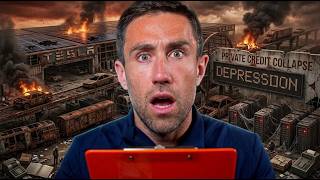

Private Credit Panic? The Truth Behind Blue Owl's Restrictions
45sTaps into fear of market collapse and explains a hot topic (private credit) with a clear, engaging breakdown.
▶ Play Clip"The title promises a reality check on market fears, and the video delivers a nuanced take, but it's padded with personal anecdotes and self-promotion."
The video analyzes recent stress in private credit markets, specifically addressing withdrawal caps at firms like Blue Owl and rising credit default swap costs. It distinguishes between credit spreads and actual yields, arguing that while there is fear, the systemic risk is overblown and may present a buying opportunity.
Credit spreads are widening and private credit tiers are growing, raising concerns about a potential collapse. The video aims to provide a realistic assessment of these fears.
Companies like Blue Owl are capping withdrawals at 5% per quarter despite requests for 39%, to avoid selling assets at low prices. This is a measure to stem the flow of redemptions.
There are two separate factors: credit spreads (extra basis points demanded by investors) and actual yields. Both are increasing, but the video suggests this is not necessarily a sign of systemic collapse.
The video references last year's peak fears in private credit, comparing the current situation to a five-year chart for high-yield credit spreads. It argues that the market's reaction may be overblown.
The video suggests that the current stress could be a buying opportunity, as credit stress on companies may come down, reducing the overall risk.
Rising CDS costs on Oracle are discussed. The video explains that CDS are used by hedge funds for hedging, not just as a signal of bankruptcy risk, and may not indicate a major problem.
The video mentions that Oracle's fundamentals are improving, with a potential bottoming process around the $139 level. It references a previous deep dive on the company.
The video uses Nike as an example of fundamental analysis, noting that despite being labeled a 'disaster' a year ago, the stock has continued to decline, showing the importance of sticking to fundamentals.
The video argues that the fear around private credit redemptions is overblown, especially considering the $1 trillion+ market. It suggests that investors might prefer other opportunities like Nvidia.
The video concludes that there are many market opportunities, and the current private credit stress is not a systemic issue. It encourages viewers to focus on fundamentals.
The video concludes that while private credit markets are experiencing stress, the systemic risk is overblown and may present a buying opportunity. It emphasizes the importance of fundamental analysis over market fear.
Withdrawal Caps
Illustrates a concrete measure firms take to manage liquidity stress, which is a key indicator of market strain.
00:24Buying Opportunity
Challenges the prevailing fear by suggesting that market stress can present opportunities, a contrarian insight.
10:27CDS Misinterpretation
Clarifies a common misconception about credit default swaps, emphasizing their hedging purpose.
10:39Nike Example
Demonstrates the importance of fundamental analysis over short-term market sentiment.
12:08[00:00] Credit spreads are widening. Private credit tiers are growing. Does this mean we're due for a collapse? Big doom and gloom pains!
[00:12] Let's put some reality on today. Okay, the first thing that's happening is there's a lot of talk about, once again, withdrawals getting limited at companies like Blue Owl.
[00:24] Once again, capping withdrawals of two business development corporations after massive withdrawal requests. Basically, they're saying, hey, we'll let people take 5% of their money out, even though people want 39% out.
[00:37] And so they basically limit it to 5% per quarter so they can stem the flow and they don't have to sell the underlying assets at bargain-basement prices. There are some explanations for what's going on, and it's useful to look at some charts for what's going on,
[00:52] because then we can understand how big of a deal systemically is this rise in credit default swaps, so protection for some form of default in private credit, but also where do we sit on credit spreads in general.
[01:10] So first, you have to know that there are two things going on here. There are credit spreads, and then there are the actual yields that are being paid right now.
[01:22] Both of these are showing an increase on the right side of the chart, which makes for good kind of TV when people pull these up and go, oh, my gosh, you know, we're seeing this spread over here.
[01:34] Okay, so this top panel right here, this is the spread. Okay, this is basically how many extra basis points are investors demanding to hold high yield.
[01:48] You hear high yield things like junk bonds, right, versus a broader basket of either government bonds or just the straight up risk free rate.
[02:01] Generally, what we argue is that when this line is stable, and so we're demanding, let's say, 2.7% above the risk-free rate. So, the risk-free rate is 5%. I'll draw this out just to make this really simple.
[02:16] I think this is awesome. If the risk-free rate, and we call it risk-free because we make the argument that the U.S. government will never default. If people are demanding 250 basis points above that, It means they're demanding 7.5% for junk, basically, also known as HY or high yield.
[02:37] Okay? As people's concerns about the economy go up or underlying businesses being able to afford these, they demand more here. So they might say, you know what, right now we want, let's see, it's up at 325.
[02:51] We want 325 basis points. Okay? well, that means we no longer want 7.5%, we want 8.25%. That's what we want to be compensated to lend this business money.
[03:04] And so that's what you see when this top line goes up. The bottom panel indicates the average yield that companies are paying right now
[03:17] for triple C rated bonds. And this is written as just a straight percentage. So if you're a C-grade company, you're basically paying 10% right now.
[03:29] I mean, this is kind of like where core we sit. And so there are a few important things that we can take away just from these charts alone that tell us a little bit about the private market and stress and some things that they really don tell us The first thing that we know is that one of the reasons this is rising so much especially
[03:51] this little hockey stick portion right here, is because overall yields have skyrocketed. The 10-year treasury has hockey stick just in the last two weeks, three weeks, from 4.9
[04:05] to like 5.27, which is what I'm calling peak. I could be wrong about that. But the point is, some of this lies right here is just straight mechanical around rates are going up.
[04:19] But that doesn't explain the spread going up. So in fairness, the spread is also going up. Now, why could the spread be going up? Because there's a greater risk that when companies have to pay higher rates, this does affect artificial intelligence as well.
[04:33] This is where it shows up. When a company like Corby's has to pay more in interest, or a company like Nscale has to pay higher interest when they go public and they're losing money, the risk is that those companies are more likely to not be able to pay their bills and then they need to get bailout financing and then people worry, uh-oh, the AI trade is about to collapse and the whole economy is going to go to poopy-doop.
[04:58] Which, in fairness, if the AI trade collapses, the whole economy is going to go to poopy-doo. It will be very bad. The New York Times actually had a piece talking about how AI accounted for a hefty chunk of the economy,
[05:11] per Mark Sandy over at Moody's Analytics, estimating that 0.6 to 0.7 percentage points, or about 30% of inflation-adjusted growth, comes from AI. I actually think that's understated.
[05:23] I actually think that GDP is almost entirely growing because of artificial intelligence. It's just harder to segment out. And so a company that's growing because its health insurance premiums are going up or whatever,
[05:36] they might not call that AI, but it could be because of AI. They can get more pricing power because they're, who knows, they're able to raise prices better because AI is helping them raise prices better. I don't know. But the point is, I think there are ways that the economy can grow
[05:48] that doesn't get captured as AI growth, even though it's actually growing because of AI. And so in their article here in the Times, they made it very clear, look, right now, earnings are rising faster than stocks are.
[06:00] We have now seen P-E ratios come down because over the past three months, earnings expectations for S&P 500 companies have grown more than 29% in just three months.
[06:14] Maybe it's all a bubble that's forming, but that is actually really conducive to cheap stock market valuations. You know, we've been making this call that the NASDAQ 100 is going to get to $750 by next Friday, which would be the 9th, October 9th.
[06:31] We've already hit it. And we have another call for the end of the year. And spoiler alert, we're very, very bullish on the economy. But we are also very aware that the whole thing can go to crap. Now, I'm going to take a quick moment just to say that if you want all of my calls, short, medium, long-term calls, come join us over at meetkevin.com.
[06:51] It's going to be Kevin.com. It'll redirect you here to our Reinvest One membership, where you get every product we offer for life in one bundle. Lifetime subscription to the alpha membership we do every morning, those short, medium, long-term calls. We sent a trade alert this morning on a sold put. I think we did great on that option. You get those trade alerts as well.
[07:18] you get the reinvest terminal that coming out the entire stock rewrite that we got coming towards the end of the year which is really exciting You got the Reinvest Homes platform You got online courses the course number live stream the business blueprint launching
[07:34] in Q1. Man, you've got a whole lot of stuff. Lifetime access to that. Go to meetkevin.com and join us there. If you join us there before the end of the year, you will never have to pay any kind of recurring fees for these products here.
[07:48] No data licensing, no monthly fee, none of that. If you join in 2027, you'll end up having to pay on sort of an annual renewal basis for this product rather than locking in lifetime access.
[08:00] So consider that over at meetkevin.com. Now, right now, the stock market, I actually think, does offer quite a few inexpensive deals. And we talk a lot about these over the alpha membership, but just an example.
[08:13] I've been calling for a breakout on NVIDIA over 227. It's finally at all-time highs here, slightly above only, but I still think there's plenty of an opportunity in NVIDIA. It trades for just a 0.7 peg right now.
[08:26] So I think the New York Times is right when they say that companies are actually getting cheaper, not more expensive right now. But there are risks because a sharp decline in the market would damage the broader economy due to the wealth effect going in reverse, essentially.
[08:42] I agree with this. But my take is that you don't hedge by shorting the market. You hedge by paying off debt. But I do not think that what we are seeing in private credit stress right now is that bad.
[08:55] Because when you look at this chart that we just marked up, and we zoom into this chart right here, a lot of this on this side can be explained by rates going up on the broader economy,
[09:08] which does add more pressure to especially triple C rated junk bond companies that may go bankrupt through this. Credit stress does go up, especially when you break over 50 on the 10-2 curve.
[09:21] We're at like 44 right now. We've gone up a lot, but we're not quite at the shock territory yet. In fact, you can see that here. Spreads are not as high as they were back when we started our war with Iran.
[09:33] Credit spreads were nowhere near as high as where they were over here in 2025. So, yes, they're rising. But if you only look at this and you don't look compared to what we survived in 2025, we're doing fine.
[09:48] You know, that's when we really had peak private credit fears was last year. I mean, you zoom in on or zoom out, rather, to the five-year chart for high-yield credit spreads.
[10:00] Come on, man. Come on. People are freaking out like little weenie babies about the number on the right side of the chart. And I get it. Some people, they don't want to read this crap.
[10:12] That's fine. That's why I make these videos. That's why we put together our alpha reports. That's why we put together our bottom line. Because I believe this is not a big deal. And you get in the wrong deal, that hockey stick on the right is going to come straight back down
[10:27] because people are going to see the overall levels of race come down. and therefore credit stress on these companies comes down. To me, it is not a big deal. I actually think that generates a buying opportunity.
[10:39] Now, yes, then I know people are like, oh, but Kevin, what about credit default swaps on Oracle? The credit default swaps on Oracle, they keep going higher.
[10:52] Well, you have to remember that credit default swaps are more than just a sign that, oh, we think this company is going to go bankrupt. Look, CDS is a tool for hedge funds to hedge. So if you have a lot of exposure to data centers of course you want some protection if you a hedge fund because it in the damn name You a hedge fund Like people forget that as hedge funds try to make more money on artificial intelligence the demand for imagine hedges goes up
[11:29] So, yes, that doesn't necessarily mean that Oracle is going to zero. Yes, the CVS is on Oracle now. I know. But there's a point for that.
[11:41] Actually, we looked at the fundamentals of Oracle the other day. I have to say, they are not as bad as they were last year. I actually think they are in a bottoming process around this 139 line.
[11:56] This is roughly where they sit right now. I actually think they're in a bottoming process. We did a deep dive fundee on this in the course of the live stream. And the peg range here they have right now, the balance sheet, hey, you ought to look at it. Go look it up.
[12:08] You know, when you join, you can literally score it by the stocks and when we last talked about them. We did the same thing with Nike in our alpha membership. We looked at Nike a year ago. A year ago. And we're like, this is a disaster.
[12:20] They have no pricing power. And then we did an update in December. And we're like, guys, this is even worse than we thought. And look at what Nike Dunst has said.
[12:32] From October, it was at $70. In December, it was $60. It's now at $33. It just keeps getting worse.
[12:44] The fundamentals do tell your stories. And if you don't do the fundamental analysis, then at least come read ours or listen to ours. Remember, that's at meetkevin.com. But anyway, to me, this private credit stuff,
[12:56] especially with this talk right here about the Blue Owl redemption. I get it. But I feel like it's a smaller part of the market. It is a problem if the whole thing rolls over. You know, there's over a trillion dollars out in private credit.
[13:10] But I think right now the levels that we're seeing are a little bit overblown in terms of fear and these redemptions that are happening. I think of people saying, look, I'd rather, rather than being in your stupid private credit fund
[13:23] exposed to some of these triple C companies or whatever, I'd rather have exposure to Nvidia. because I could get a cheaper and safer deal, which makes sense to me. Or maybe people want to take their money out of this
[13:36] and invest in House Act. You can't right now. We don't have a fund. But I'm being facetious. Okay, dear SEC, this is not a fundraise. I'm not pitching anything.
[13:49] I'm not pitching you buy, reinvest one. I think that's pretty cool. But as far as market opportunities out there, yeah, I think there are a lot of market opportunities where people will be like, why?
[14:02] Why do I want to be sandbagged into that when I can get a good deal on something else right now? And so I think that's why you're seeing a lot of this private credit play. And to me, it's a little overdone right now.
[14:14] But, hey, you know what? Maybe you're one of those people that sees a deal in private credit. And, you know, what you end up saying is, Here we go. I like that video.
[14:32] Check this one out. I think you're going to love it. I don't know how to advertise these things. I feel like nobody else knows about this. We'll try a little advertising and see how it goes. Congratulations, man. You have done so much. People love you.
[14:44] People look up to you. Kevin, talk about their financial analysts. And you too, but me, Kevin. Always great to get your take.
⚡ Saved you 0h 14m reading this? Transcribe any YouTube video for free — no signup needed.