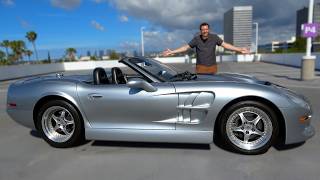

This $200K Shelby Is a Secret
35sImmediately highlights the car's rarity and high price, creating curiosity and a sense of exclusivity.
▶ Play Clip"The title promises an exotic sports car you don't know about, and the video delivers a thorough review of a genuinely obscure car, though it's padded with a lengthy sponsor segment."
This video reviews the ultra-rare Shelby Series 1, a modern tribute to the iconic 1960s Shelby Cobra, of which fewer than 250 were built. The review covers the car's background, design quirks, interior quality, performance, and driving experience, concluding with a Doug score.
The Shelby Series 1 is an ultra-rare American sports car developed by Carroll Shelby as a modern-day tribute to the 1960s Shelby Cobra. Fewer than 250 exist worldwide.
The Shelby Cobra was a 1960s icon with a massive powertrain in a small car. In the 1990s, Carroll Shelby wanted to create a modern take with a big V8 and a small, tossable open car, resulting in the Series 1.
The Series 1 features over-the-top design elements like massive side vents, a large hood opening for heat extraction, and a rear center-mounted fuel filler, which some found excessive compared to the original Cobra's purposeful design.
The car uses a 4.0L V8 borrowed from the Oldsmobile Aurora, tuned to 320 hp and 290 lb-ft (up from 250 hp in the Aurora). Optional supercharger could boost power to 540 hp. Curb weight is under 2,700 lbs, and 0-60 mph is in the low 4-second range.
The interior is notably low quality, with cheap plastic throughout, GM-sourced parts (window switches, door handles, turn signal stock, radio, climate controls), and a generic steering wheel. The gauge cluster even omits the '1' in 'Shelby Series'.
The car has no trunk and no glove box (a cutout is screwed shut). The owner's manual is stored in a side dashboard panel. The convertible top is fully manual and difficult to operate, requiring a key and two latches.
Originally priced at $80-90k, the price rose to $135k and up to $200k with options. This made it more expensive than a Ferrari 360, hurting its value proposition. Shelby planned 500 units but only about 250 were built.
Despite the cheap interior, the driving experience is surprisingly good. The car feels raw and muscular, with a loud V8, a nice six-speed manual, and a light curb weight. It's fun and compromised in a cool sports-car way.
The Series 1 scores 100 on the Doug scale, ranking last in its group. It performs well in weekend categories (fast, good steering, light) but suffers in daily categories due to poor build quality, impracticality, and high price.
The Shelby Series 1 is a rare and unusual car that offers a raw, fun driving experience but is let down by its cheap interior and high price. It's a flawed but intriguing tribute to the Cobra legacy.
What engine does the Shelby Series 1 use?
A 4.0L V8 borrowed from the Oldsmobile Aurora, tuned to 320 hp and 290 lb-ft.
05:56
How many Shelby Series 1 cars were built?
About 250, despite plans for 500.
19:47
What was the original price range of the Shelby Series 1?
Initially $80-90k, but rose to $135k and up to $200k with options.
09:48
What is the curb weight of the Shelby Series 1?
Under 2,700 lbs.
08:06
What is the 0-60 mph time of the Shelby Series 1?
Low 4-second range.
08:34
Why does the Shelby Series 1 have no trunk?
Because the central fuel filler and fuel tank take up the rear space, and the convertible top is stored there.
17:11
What is a notable quirk about the gauge cluster?
It says 'Shelby Series' but omits the '1'.
12:10
What type of seat belts does the Series 1 use?
Racing seat belts, not traditional ones.
18:49
What was the maximum power output with all options?
540 hp with a supercharger.
06:57
Lightweight Design
The car's curb weight under 2,700 lbs is exceptional for its era, contributing to its performance.
08:06Interior Quality Disconnect
The cheap interior contrasts sharply with the high price, highlighting a major flaw.
09:33Surprising Driving Experience
Despite flaws, the car delivers a raw, fun driving experience that aligns with the Cobra ethos.
20:32Doug Score Analysis
The score breakdown shows the car's strengths in weekend categories but weaknesses in daily usability.
25:55[00:04] an ultra-rare American sports car that most people have never heard of. This was developed by race car legend Carroll Shelby as a modern-day tribute to the
[00:16] Shelby as a modern-day tribute to the iconic 1960s Shelby Cobra, and less than 250 of these exist on the entire planet. Today, I'm going to review the Series 1 and show you all of its quirks and features.
[00:35] VPN. And if you spend any time online, which obviously you do because you're watching this, you should probably have it. One of the coolest things about Nord VPN is you can switch your virtual location. So, let's say you're traveling
[00:47] wherever, and suddenly your streaming services don't work the same. Well, with Nord VPN, you just switch your location back to the US and boom, everything there's a sporting event or a show that's only available in another
[01:02] country. Same deal. Click, switch, done. It also protects your private data. Your you don't really want floating around out there, especially if you're on a public Wi-Fi at a hotel or an airport. I'm constantly on random Wi-Fi networks,
[01:17] and Nord VPN keeps everything encrypted and secure. And here's something most people don't realize, you can actually save money by switching your virtual location when booking flights, hotels, even subscriptions. Prices can vary
[01:29] depending on the country, and Nord VPN lets you take advantage of that. It's super fast, no buffering, no weird slow down, and one account works on up to 10 devices. All of that for basically the price of a cup of coffee per month. So,
[01:44] to get the best discount on your Nord VPN plan, go to nordvpn.com/dougdemuro. months on the two-year plan, and there's no risk with Nord's 30-day money-back
[01:59] guarantee. The link is in the episode description box. All right, time for the quirks and features of the Shelby Series 1. But first, a quick note of thanks to the Petersen Museum here in Los Angeles, California. The Petersen is an amazing
[02:16] car museum with amazing cars and rotating exhibits that showcase all sorts of different and new stuff all the time. If you live in SoCal, if you're visiting SoCal, come check out the Petersen Museum. If you're into cars,
[02:30] you'll see cool stuff like this and much more. Thanks again to the Petersen Museum for letting me borrow the Series 1. So, let's talk quirks and features of the Series 1, starting with some background. The Shelby Cobra was a 1960s
[02:47] automotive icon, a massive powertrain in a little car. They were famously fast and crazy and insane and beloved. And the Shelby Cobra was the brainchild of Carroll Shelby, who was a famous automotive racer and car entrepreneur,
[03:03] who himself was also beloved for his work on the Shelby Cobra and other Shelby-related projects going back decades. In the 1990s, Carroll Shelby
[03:16] decided he wanted to create a modern-day kind of a tribute or a modern take on the Shelby Cobra, similar theme, a big V8 and a little open car that was
[03:28] V8 and a little open car that was tossable and fun, a modern-day Cobra. And that was this car, the Shelby Series 1. The Series 1 was built by Shelby in Nevada, where their headquarters are located. Not a lot of vehicle production
[03:44] going on in Nevada, but they were building this there. And again, the goal was a modern-day Shelby Cobra, and the body lines sort of look like that if you
[03:57] squint. You have that same kind of profile. You can see the sort of exaggerated fenders both front and rear. The overall general shape was sort of a
[04:09] '60s Shelby Cobra but modernized. And I emphasize sort of. There were also some design details that were kind of over exaggerated and not to a great effect.
[04:21] Like for example, the side vents, which the original Shelby Cobra also had side vents, but in this car they are massive. They are huge. They are so over the top compared to what the original Shelby Cobra had, digging all the way into the
[04:36] door panel. It's a little much. Same deal with the hood opening for heat extraction in theory, but it really is a massive one. The hood dives down for this large open panel to get as much heat out as possible. It seems a little
[04:52] over the top, as does the rear center-mounted fuel filler, which was kind of a trait that some muscle cars had, this chrome fuel filler mounted in the middle, but in the late '90s it maybe was a little much, maybe a little
[05:08] bit unnecessary, and certainly a little, let's say, over the top in terms of let's say, over the top in terms of style. Gave this car kind of a excessive look compared to the pretty trim and purposeful original Shelby Cobra. With
[05:24] that said, the Series 1 is certainly exotic. It's wide and it's low, and I drove it earlier and a lot of people look at it when you cruise around. It may not be quite the modernized beautiful Shelby Cobra people were
[05:39] hoping for, but it does turn heads. The powertrain, however, is not quite so exotic. The hood is front-hinged, so it opens sort of the opposite way of your typical hood, and it reveals the engine, which is a 4-liter V8 naturally
[05:56] aspirated like you want, but it's borrowed from the Oldsmobile Aurora, which was sort of a mid-sized a large luxury sedan that General Motors made throughout the 1990s and into the 2000s. The Shelby Cobra of the modern era
[06:12] The Shelby Cobra of the modern era borrows its V8 from a a mid-size luxury sedan. Wasn't exactly the hairy-chested old-school persona they were probably going for. However, it is modified for more power. In the
[06:26] Oldsmobile Aurora, this engine made 250 horsepower and 260 pound-feet of torque. horsepower and 260 pound-feet of torque. In this car, it's been tuned up to 320 In this car, it's been tuned up to 320 horsepower and 290 pound-feet. Still not
[06:42] massive numbers, but you could get more if you wanted There were engine options for more power, including a supercharger. And if you got all of the max power packs that this car offered, you could bump up to 540
[06:57] horses, which was a really serious figure, although that also increased the price significantly. This car was already pretty expensive, which I'll get to in a minute, and that meant that not too many people ordered the extra power,
[07:11] and most Series 1 models just have the factory 320. Couple interesting things under the hood. One is the carbon fiber look covering up the engine, which I assume is placed there in order to hide the fact that the engine says Aurora on
[07:27] it from the Oldsmobile Aurora, like it wouldn't. Also interesting under here is wouldn't. Also interesting under here is inboard suspension, which this car has. I had no idea of that, but you can see suspension components mounted here sort
[07:40] directly at the wheels. A little bit more advanced than I would have expected from the Series 1. I'm also surprised to see how relatively open and basic and mechanical it is under here, which I think is kind of a cool thing. It does
[07:54] sort of hearken back to the original Shelby Cobra. There's not a lot of over-wrought extras despite how it looks on the outside like it would have that. on the outside like it would have that. And in fact, this car's curb weight is
[08:06] under 2,700 lb, which is unbelievably light for a car from this era. It's actually really exceptional. That was one of the things people loved about the original Shelby Cobra, big power, small size. Despite
[08:20] its kind of large looks, this car delivers that, too. And indeed, performance reflected that. A six-speed manual was the only available transmission, which kind of gave credence to its focused, lightweight,
[08:34] modern Shelby Cobra ethos. 0-60 was in the low 4-second range, which was quick back then and is still quick today. This car was actually more focused and performancy, at least on paper, than I expected it would be just from seeing
[08:49] pictures. Also kind of quirky under the hood, I love on the inside of the engine cover they've integrated the Shelby logo, the Cobra eye and the checkered flag on this piece that sort of curves out. It's kind of perfectly made for the
[09:03] logo to go there, and they did, which is a pretty cool touch. It's kind of a neat attention to detail quirk under the hood. But, while the specs for this car were pretty impressive, if you looked at the numbers for power and acceleration
[09:17] and curb weight, things started to unravel a bit when you actually climbed inside. Take a look around this interior and you will notice it is not particularly high quality. In fact, it is particularly low quality with cheap
[09:33] plastic just about everywhere you're looking, which was especially a problem considering the price point. When this car was first announced, pricing was said to be in the high 80 to 90 thousand dollar range, but under a hundred grand.
[09:48] However, as it got closer to production, the pricing went up. First to a hundred and thirty five thousand dollars and then well beyond that to the point where some of these were equipped with options going out the door with sticker prices
[10:03] of around two hundred thousand dollars. And remember, this is in 1999 money. This car was radically more expensive than the Ferrari 360, which was new and
[10:15] than the Ferrari 360, which was new and hot and mid-engined and a Ferrari. At the time, the Series 1 was more expensive. And take that price point, keep it in mind as we go through the interior in a little bit more detail
[10:28] starting with the door panel, which as you can see is just straight cheap plastic. No high quality, high touch materials, no stitching, just a bunch of cheap plastic with General Motors sourced window switches. They look like
[10:43] they probably came out of a Chevy Cavalier because honestly, they probably did. Same deal with the door handle itself. You can see very cheap plastic again borrowed straight from General Motors and not especially high quality.
[10:57] Motors and not especially high quality. Amazingly, the situation gets worse. Go further inside the car and again, you're confronted with well, cheap stuff. Again, cheap plastic all throughout the dashboard, the center control stack.
[11:11] Nothing here looks especially nice. And once again, everything here is just borrowed from run-of-the-mill base model General Motors vehicles. The turn signal stock, you can see General Motors. The windshield wiper stock, General Motors.
[11:26] The radio head unit, the climate controls, all borrowed from relatively cheap looking and feeling General Motors cars from this era, it just didn't really say special like they were trying to convey, particularly at this price
[11:41] point. Even the key and the key fob looked like they came from basically any Chevy Blazer off the line at the time. And same deal with the gauge cluster, which again is fairly generic General Motors stuff, just looked exactly like
[11:56] the cars they borrowed it from and not special. Although the gauge cluster provides a rather interesting piece that kind of shows actually the lack of attention to detail in this car. You look in there and you can see it says
[12:10] look in there and you can see it says Shelby Series, but strangely enough, it doesn't say Shelby Series 1. Did they leave that off? Is that really the level of detail we're talking about here? It's kind of disappointing. Same deal with
[12:25] the climate control, the vents. There's only four of them mounted right here in the center. Four small circles center-mounted because they didn't want to run climate control plumbing to the outsides of the dashboard like basically
[12:38] every other car has. Quite disappointing. One thing they didn't borrow from General Motors, but maybe they should have, is the steering wheel, which you can see is just this sort of generic basic vehicle steering wheel
[12:52] like what you might expect when you go to the arcade and you play a driving game. They didn't get this from GM because GM's steering wheel would have had airbags and Shelby got exempted from requirements for airbags since this was
[13:05] such a low production car, but the result is we have this generic, almost like a a boat steering wheel that they stuck in here. It doesn't really add to stuck in here. It doesn't really add to the luxury experience. And neither does
[13:18] the passenger footwell area where there's an exposed like hose that comes there's an exposed like hose that comes through from the dashboard area and into the engine compartment. Not exactly the highest quality stuff. That kind of
[13:32] original Shelby Cobra. So, maybe there's some like raw sports car feel to it, but some like raw sports car feel to it, but at this price point, that the glove box. You can see down here it's not a glove box. There's a cutout for a glove box,
[13:46] but this piece is actually screwed in place, so you can't open it. Almost like they were going to put in a glove box and realize late in production that they couldn't, but they had already finalized the design of the dashboard, so you got
[13:58] a cutout, but no glove box itself. Then, because there isn't a glove box, that required some more kind of, let's call it, creative auto manufacturing solutions. So, on the left side of the dashboard, when you open the door, there
[14:14] is a panel here that says fuses. And you open up this panel and you get to the fuses, which is actually a pretty common location where a lot of cars have it. On the right side of the dashboard, when you open the door, a similar panel is
[14:29] here for the owner's manual. Because there is no glove box, place where you can put the owner's manual, it is instead hidden in this side pocket of the dashboard, only accessible once you open the door in this area labeled
[14:46] owner's manual. That is interesting. The only indication that you have in this entire interior that you're in something special is the plaque over on the passenger side. And even that is a little cheap and chintzy. And it just
[15:02] includes everything. You have the name of the car, Series 1, the powertrain, Aurora VH. You have Carroll Shelby's signature, and you have the VIN CSX of this car. And then, in addition to that,
[15:16] you have the Shelby logo. But, which Shelby logo do we go with? Here, you can see the snake eye with the checkered flag just like you saw under the hood. But, in the gauge cluster, you have the old school Shelby logo with a race
[15:32] course graphic. In the center of the steering wheel, you have the Shelby logo with the snake eye and the checkered flag. But, in the wheel center caps, you have the old Shelby logo with the race course graphic. Up front, you have the
[15:48] course graphic. Up front, you have the Cobra eye with the checkered flags. But, there's no continuity. It's like they went back and forth randomly between logo designs with no real thought that maybe it should be standardized. And in
[16:02] the back, where people are going to come up on the car and see it driving, you just have the words Shelby Series 1 written out in a rather generic font, not looking very special at all, and making use of neither of the two logos
[16:18] that we keep going between all throughout the car. But, maybe my throughout the car. But, maybe my favorite logo situation in this car is the pedals. It's a manual transmission. They all were six-speed manual, and so
[16:30] you have three pedals. So, on the left pedal, the clutch, it says Shelby. On the middle pedal, the brake, it says Series 1. But, that left one extra pedal. And so, on that pedal, you have the Shelby logo. Which one? Whichever
[16:44] one they happen to decide that moment, which was the Cobra eye with the which was the Cobra eye with the checkered flag. So, Shelby Series 1 and then sort of the afterthought pedal with the logo. But, if all that stuff wasn't
[16:59] kind of making you question the desirability of this car, let's move on to the fact that it has no trunk. There is no trunk storage compartment in this
[17:11] car because adding that central fuel filler back there, which made it cool and muscle car-y, meant that the fuel tank is back there and the trunk is not. Now, they could have put the trunk further up, but this space was saved for
[17:25] the convertible top, and so there is no trunk at all in this car. And remember, I already showed you there's no glove box at all, even though it looks like box, there is neither. However, you do have a
[17:40] center storage compartment, which opens up. Although, it doesn't open up that much because it appears to get stuck, maybe with the seat, and so it only opens a little bit, but at least you have some place to put stuff in this
[17:54] car. Your other compartment in this car is, like I said, the one directly behind the seats, where you have the roof. And opening it is almost laughably difficult. The first step of the process is you put in the key and twist it,
[18:08] because this part is locked, as if someone is going to try and steal your roof. Once you've twisted the key, then there's a latch on the driver's side that you can use to open it a little bit, but then there is
[18:22] another latch on the driver's side that you use to fully open it and gain access to your top panel. And by the way, the convertible top in this car is completely manual. Despite its price point, there is no button, no power top
[18:36] point, there is no button, no power top situation. It's all fully manual here. You got to completely do it yourself. Take it over the seats, put it in place, you're doing it all. Then, by the way, speaking of the seats, they're a little
[18:49] interesting themselves. You can see there are no traditional seat belts in this car. Instead, you have racing seat belts put through the center, the open part of the headrest to make way for your racing belts, but the seats
[19:04] themselves aren't really racing seats. They're kind of overly comfortable leather, not very bolstered, no Alcantara to provide friction and keep you in place. It's sort of like a leather comfy seat, but with a racing
[19:19] leather comfy seat, but with a racing belt. Maybe because they couldn't get normal seat belts safety approved in this car, but either way it's got racing belts. At least the seats have Carroll Shelby's signature on
[19:32] them stitched into the backrest, which must add some benefit to the nostalgia for the kind of people who are willing to pony up big money for this car. And let's end on that. There weren't a lot of people who were willing to pony up
[19:47] big money for this car. At the price point, it really was a bad value proposition. And although Shelby said he was going to build 500 of these limited production for the whole world, only about 250 ended up getting created.
[20:02] There just weren't more buyers for the car than that. And when you look around and you check out some of its flaws, it's probably easy to start to see why. those are the quirks and features. I am still curious about driving this car cuz
[20:17] a nice V8 and low curb weight in a small size car is usually a pretty good combination. So, let's get behind the wheel and see how it drives. All right, driving the Shelby Series 1. I have always wanted to drive one of these
[20:32] You know, I kind of thought this car was sort of like real boomer energy type thing until I really looked up the specs. And I didn't really realize how lightweight it is. You know, that was always the thing
[20:46] about the original Shelby Cobra. It had a big V8 and it didn't weigh much, and so it scared the hell out of everybody who drove it. And I'm sitting here in this car now, and I've never driven an original Shelby Cobra, but I
[21:00] it's got the same vibes that I would expect, which is a big, loud, rumbly V8, expect, which is a big, loud, rumbly V8, a tight cabin, a small car. Like this feels like what I would expect a modern-day Shelby Cobra to be. As
[21:15] ridiculous as that is, considering that, you know, it it's it doesn't it doesn't seem on the outside like that's what it is, but actually driving it it sort of has that feel. This Oldsmobile Aurora V8 is an interesting choice for them to
[21:29] use. It wasn't particularly powerful in the Aurora, although it was never a slow car. Uh that V8 in that second gen Aurora, it was fine. But obviously they'd breathed on it a little bit and got some extra performance and power out
[21:44] of out of it. And the result of that is that it feels a little bit stronger. Now you combine that with obviously a manual transmission, a big rowdy exhaust, and a lightweight little car, and you have kind of an experience
[22:00] experience? Well, it's a little bit of raw muscle car energy. I mean, in a that's like sort of what muscle cars have in their in your mind, you know? But it has like that feel. It has sort of like that Shelby Cobra feel. It was
[22:15] never respected like the original Shelby Cobras were, obviously. Cobras were, obviously. But like
[22:27] It's actually pretty quick. It's got some juice to it. totally honest. I'm driving it here around LA, you know, it's a museum car. It's hard to really get the performance aspect out of it that, you know, would
[22:41] really drives, like taking it out on a canyon road somewhere. But it does have sort of a rumble to shake the feel. Just accelerating just there for a little bit, you could tell there's power to this car. Like it it might be kind of a
[22:54] cheap chintzy little thing with a sort of over-styled body, but um wasn't that also the original Shelby Cobra? Just a big powertrain and then it looked cool? and I think there's something that looks really cool here. It does feel cheap,
[23:08] like all the plastic is kind of creaking as you drive along. Like, it definitely has the feel of a relatively inexpensive car from a driving perspective. Um but sort of like the Viper, which really was kind of a modern-day take on the
[23:22] original Shelby Cobra. I mean, that's also what this car feels like. The transmission actually feels pretty nice. The uh there's a little bit more play. I was expecting, but there's no play in the gears themselves. That's kind of a
[23:36] fun feel. And the the clutch is fine, like it it it it's heavy, but you kind the real feel of the car, what you're like thinking it probably should be. You want a heavy clutch. I'm actually more kind of into the driving experience than
[23:51] more athletic and just a little bit more muscular and kind of fun than I thought. Aurora V8, this sort of like maybe too tame kind of car. It isn't really that. It actually does have like kind of a mussely feel to it. Uh it is definitely
[24:06] mussely feel to it. Uh it is definitely like a cheap car on the inside. Um but what they were going for intentionally. Like, yeah, it's it's it's cheap. It's cheap speed. That was the fun of it. Although I I it wasn't in the end
[24:20] pretty strong. And so, I have a suspicion that that's probably kind of what took them out of the game and and only made them sell 250 of these was it was just too expensive for what it was. Um driving it and thinking about it as
[24:34] I'm into it. I'm also surprised how many people notice it on the street. It's loud. It definitely looks different than what you might expect to see. Of course, taxi from the Petersen Museum. That may have a bit of an effect. These two cars
[24:48] driving around together is kind of a ridiculous sight. Um but they're This is a really This is a surprisingly cool car. I'm not sure I I buy one. It's a It enough. I'm not as obsessed with the interior
[25:01] in terms of like quality, but I do enjoy I am really enjoying the experience to the extent that it's a big old V8. It's surprisingly fast. It's fun to drive and it feels compromised in a cool way. Like it's compromised like a sports car
[25:15] should be where it's a little tight in here, a little little too loud. You know, like a little ridiculous like you kind of want from a sports car and that's how the original Cobra was and in a way, I mean, that's how this car
[25:27] level of insanity and insanity and iconicness. And so, that's a Shelby iconicness. And so, that's a Shelby Series 1. This is a very rare and very
[25:40] unusual car. One of Carroll Shelby's last big hurrahs before his death in 2012. Most people have never been around one of these, but now you know all of its quirks and features thanks to the Petersen Museum. And now it's time to
[25:55] Petersen Museum. And now it's time to give this Series 1 a Doug score. 100, which puts the Shelby Series 1 here against similar cars, last in this group
[26:10] the weekend categories, the Series 1 does pretty well, tying or beating some nice cars from its era like the 996 Porsche 911 and the Dodge Viper. And indeed, the Series 1 is legitimately
[26:22] pretty fast, nice looking, and surprisingly good to drive thanks to good steering and a low curb weight. The drawbacks come in the daily categories where you're stuck with poor build quality, shocking impracticality, and
[26:34] higher pricing than it deserves. The Series 1 is fine, but it's not Shelby's Series 1 is fine, but it's not Shelby's finest.
⚡ Saved you 0h 26m reading this? Transcribe any YouTube video for free — no signup needed.