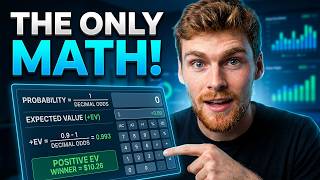

Why Most Bettors Lose: The Locks Mindset
42sDirectly challenges the common 'lock' mentality, creating immediate relatability and a hook for viewers who've heard these phrases.
▶ Play Clip"Delivers a solid explanation of EV with real examples, though it's a promo for OddsJam."
This video explains the concept of expected value (EV) in sports betting, emphasizing that long-term profitability comes from understanding probability and finding value, not from picking winners. It uses examples like coin flips and real OddsJam data to illustrate how bettors can gain an edge over sportsbooks.
Bettors who rely on 'locks' or 'I just know' lose long-term because they ignore probability.
Sports betting is not about picking games correctly but understanding probability better than the sportsbook.
Expected value (EV) is the key to viewing betting like a professional or Wall Street trader.
The video will break down EV simply and show how to implement a positive EV strategy.
Most bettors think being smart or watching games is enough, but profitable bettors may never watch a game.
Sportsbooks aim to price probability, not predict outcomes perfectly.
Using OddsJam's probability calculator, -110 odds imply a 52.38% true probability of hitting.
Sportsbooks build a hidden fee (vig) into odds, pricing both sides of a spread at -110 instead of +100 to create an edge.
At -110 odds, you need to hit 52.38% of bets just to break even; winning more than 50% can still lose money.
Sports betting is a long-term probability game, not a one-night prediction contest.
Instead of asking 'will this bet win?', ask 'is this line priced correctly?'
EV is asking: 'If I place this bet a thousand times, would I make money long-term?' Positive EV = profitable, negative EV = not.
A 50/50 coin flip at even money breaks even; if you get even money on a 55% heads coin, you have positive EV.
You can win negative EV bets short-term but lose long-term; sportsbooks profit from this.
Bettor A winning 70% at -300 favorites can lose to Bettor B winning 54% with better value.
A 25-cent difference (e.g., -125 vs +100) is massive over hundreds of bets.
Professionals obsess over price, casuals obsess over picks.
OddsJam compares sportsbook odds to market consensus to find EV edges.
A 10.99% EV bet on Caleb Durbin over half a double at +600 on FanDuel vs +418 average.
Under 3.5 first half team total corners at +105 on BetMGM vs -115 consensus, a 20-cent value or 5.83% EV.
Sharp bettors repeatedly take advantageous prices, like poker players making profitable decisions.
Even with a 5% edge, you can lose 10 in a row; most people panic and abandon the strategy.
Bankroll management is as important as finding good bets; goal is thousands of good decisions over time.
View bets as prices to take advantage of, not predictions; best bettors are probability hunters.
Use promo code 'takes' for a free week trial and 35% off first month.
The key to long-term sports betting success is understanding expected value and focusing on finding value rather than picking winners. By treating betting as a math game and managing variance, bettors can shift from emotional guessing to probability-based decision-making.
What is the true probability implied by -110 odds?
52.38%
01:27
What is the vig in sports betting?
A hidden fee built into odds that favors the house.
02:09
What win rate is needed to break even at -110 odds?
52.38%
02:24
Define expected value (EV) in sports betting.
EV is asking if placing the same bet a thousand times would be profitable long-term.
03:19
In the coin flip example, what creates positive EV?
Getting even money on a coin that lands heads 55% of the time.
04:02
Why can a bettor with a lower win rate make more money?
Because profitability is based on value, not just win rate.
04:57
What is the difference between sharp and casual bettors?
Sharp bettors obsess over price, casuals obsess over picks.
05:43
What is the main reason most people still lose despite knowing EV?
They can't handle variance emotionally and abandon the strategy.
08:32
Winning is About Probability
Shifts the focus from picking winners to understanding probability, a core principle.
00:17Minus 110 Implies 52.38%
Concrete number that illustrates the break-even point.
01:27The Vig Explained
Reveals how sportsbooks build in an edge, a key insight for bettors.
02:09EV Simplified
Provides a clear, actionable definition of expected value.
03:19Win Rate vs Value
Illustrates that value matters more than win rate, a counterintuitive truth.
04:57Sharp vs Casual
Distills the mindset difference between professional and casual bettors.
05:43Variance and Emotion
Highlights the psychological challenge that defeats most bettors.
08:32[00:02] amount of time, you've probably heard people say things like this is a lock or I know this team can't lose tonight or even I just know this is hitting. And even I just know this is hitting. And honestly, that exact mindset is why most
[00:17] bettors lose long-term. Because winning in sports betting is not about picking games correctly. It's about understanding probability better than that, you can stop betting emotionally,
[00:30] you can stop chasing locks, and you'll start viewing sports betting the same way professional bettors and Wall Street traders do. Today, I'm going to break down expected value or EV in the simplest way possible and show you
[00:44] exactly why sports betting is really just a math game. And then, I'll show you how you can start to implement a positive expected value strategy into Because once you understand this concept, sports betting will make way
[00:59] more sense. You see, the average better thinks that sports betting is about being smarter than everyone else. They think, "I know ball. I watch every game. I just know this player is going to go off tonight." And don't get me wrong,
[01:13] negative, but some of the most profitable sports bettors never watch a profitable sports bettors never watch a single game. Simply knowing ball does not make you a profitable sports better because sportsbooks are not trying to
[01:27] predict outcomes perfectly. They're trying to price probability. Now, let's take a look at a probability calculator over on Odds Jam. We can see that if a sportsbook prices a line at a standard minus 110 odds, the true probability of
[01:41] minus 110 odds, the true probability of that bet hitting is 52.38%. interesting, especially with point spreads. You'll typically notice that both sides of a spread are going to be at minus 110 odds. And a lot of people
[01:54] never stop to ask, if a point spread is supposed to be a true 50/50 probability, why are both sides of this spread not at plus 100 to truly represent 50/50? Well, that's because sportsbooks build in what's called a vig or the juice.
[02:09] Essentially, the vig is a hidden fee that bettors pay every time they make a bet. Sportsbooks aren't just making money because people lose bets. They are priced in a way that favors the house. By pricing both sides of a spread
[02:24] at minus 110 and instead of plus 100, sportsbooks create a mathematical edge for themselves over time. In fact, if we were only to take plays at minus 110 odds, as you can see on the probability calculator, you need to hit 52.38%
[02:38] of your bets long-term just to break even. Think about that. You can win more than 50% of your bets and still lose money long-term. And that's exactly why sports betting isn't just about being right. It's about consistently getting
[02:52] better prices than the true probability of an outcome because even great bets can lose consistently. And that is something that casual bettors never understand. You could make an amazing bet and still lose tonight. And that's
[03:06] because sports betting is a long-term probability game, not just a one-night prediction contest. And once you realize that, you'll stop asking will this bet that, you'll stop asking will this bet win and start asking is this line priced
[03:19] correctly? And that right there is the true game of sports betting. So, let's now simplify expected value as much as possible. In sports betting, expected value is basically asking, "If I place this same bet a thousand times, would I
[03:33] make money long-term?" That's all that EV really means. Positive EV means over time, mathematically, that bet should be profitable. Negative EV means that over time, mathematically, that bet should not be profitable.
[03:48] Here's an easy example. Let's say a coin flip is truly 50/50. 50% of the times the coin is going to land on heads, 50% of the time the coin is going to land on tails. And let's say you flip the coin 100 times. 50% of the time the coin
[04:02] should land on heads, the other 50% of the time the coin should land on tails, and you would break even at the end of the 100 flips. Now imagine they offer you even money when flipping the coin, but tell you the coin is going to land
[04:15] but tell you the coin is going to land on heads 55% of the time. Now suddenly, at even money, you have an edge. And that's because the payout is now bigger than what the true probability should allow. That right there is positive
[04:28] expected value. And the same exact concept holds true in sports betting. You can take negative EV plays and win for a day, a week, maybe even a month, but if the math is against you, you are going to lose long-term. And that right
[04:42] there is a major way on how sportsbooks make money. Most bettors never think the outcome. Now here's the part of positive expected value that truly breaks casual bettors' brains. You can win more bets than someone else, but
[04:57] still lose more money than them. And that's because profitability is based on value, not just your win rate. Here's an example. Let's say that better A wins 70% of their bets, but they're consistently betting minus 300
[05:11] favorites. And better B only wins 54% of their bets, but they're consistently getting good value and good numbers. Better B can absolutely make more money long-term. And this is exactly why line shopping matters so much. If one
[05:27] sportsbook has the Dodgers at minus 125, and another sportsbook has the Dodgers at plus 100, those 25 cents are a massive difference long-term. And most casual bettors think, "Who cares? It's only a few cents." But over hundreds or
[05:43] thousands of bets, that can be the exact difference between winning and losing long term. Professional bettors obsess over price. Casual bettors obsess over picks. And that right there is the difference between a sharp better and a
[05:58] casual one. Now, this is where tools like OddsJam become insanely powerful. Manually calculating true probability would take forever. So, what OddsJam does is compare sportsbooks against market prices. And here we are on the
[06:12] a look at a couple of examples. We can see right here, there's a 10.99% EV bet on the Philadelphia Phillies versus Boston Red Sox games where you could take Caleb Durbin to go over half a double on FanDuel at plus 600 odds.
[06:28] more, we can see that FanDuel has this at plus 600 when average odds are plus 418. That right there is a massive difference between FanDuel and the rest of the market. So, you are gaining an extreme edge by taking this on FanDuel
[06:44] DraftKings which is offering this play at plus 396. Now, to look at an example that has a bit of a higher probability of actually happening in this bet actually hitting, we can look at this soccer play here where we can see the
[06:58] under 3 and 1/2 first half team total corners is at plus 105 on BetMGM when market consensus is minus 115. So, that right there is giving us 20 cents of
[07:10] right there is giving us 20 cents of value compared to the market or a 5.83% edge of expected value. Now, just like in our coin flip analogy, if you consistently get an edge against the sportsbooks over hundreds and thousands
[07:24] of bets, you are now setting yourself up for immense long-term success. And finding an edge is exactly where I think a lot of people misunderstand sharp betting. Sharp bettors aren't trying to predict every game perfectly. Because if
[07:37] wouldn't look at this Corbin Carroll over half a single prop and wondered to yourself if Corbin Carroll is actually going to get a single this game. What you'd be doing as a sharp sports better
[07:49] is recognizing that you have a 8.17% edge on BetMGM compared to the rest of the market because you can see that MGM offers this prop at plus 120 odds when average odds are plus 103. Sharp bettors are simply taking
[08:03] advantageous prices over and over and over again. It's the same mindset as poker players. Great poker players are going to lose hands consistently, but they're also making profitable decisions repeatedly and sports betting works the
[08:17] exact same way. Now, here's the uncomfortable truth. Even if you know all this, most people still won't win long-term. Why? Because they can't handle variance emotionally. Positive EV betting still loses all the
[08:32] time. You can have a 5% edge and still lose 10 bets in a row. That's normal. That's part of probability. But when this happens, most people panic. They start doubling their unit size. They start chasing losses. And worst of all,
[08:48] they start ignoring the math. And next thing you know, they abandon the exact strategy that actually works to make long-term profits while sports betting. That's why bankroll management matters just as much as finding good bets. The
[09:01] goal isn't to get rich tonight. The goal is to make thousands of good decisions over time. That's exactly what professional sports bettors do. At the end of the day, sports betting becomes way less emotional once you understand
[09:15] expected value. You stop viewing bets as something that you think will win and priced incorrectly that you're taking advantage of. This shift in your mindset will change everything. Because the best bettors in the world aren't fortune
[09:29] tellers. They're probability hunters. And they understand that sports betting is really just math mixed with patience. And tools like Odds Jam can help you value for you. And if you want to test out Odds Jam, you can use promo code
[09:44] takes for a free week trial and 35% off your first month. If you've been struggling long-term with sports betting, stop focusing on locks, stop focusing on guaranteed picks, and start focusing on the numbers. Because the
[09:57] second you stop guessing, you'll finally have understood how professional sharp have understood how professional sharp bettors think.

⚡ Saved you 0h 10m reading this? Transcribe any YouTube video for free — no signup needed.