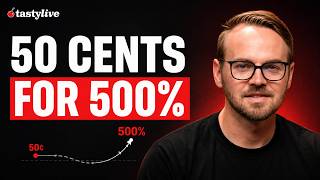

Super Bull Setup Explained
44sThis segment introduces the 'Super Bull' setup, a strategy that pays you a credit to bet on a rally, immediately piquing curiosity about a unique options trading approach.
▶ Play Clip"The title accurately describes the strategy, but the explanation is conversational and could be more concise."
This video explains the 'Super Bull' options trading strategy, a bullish setup that collects a credit while offering the potential for significantly higher profits if the market rallies. The speakers detail how to construct the trade using a put spread and a call spread, and they compare its risk-reward profile to a standard short put.
The setup is not a premium-selling trade and can be adjusted based on the trader's preference. It is not recommended to sell an iron condor or strangle 300 days out or during earnings.
The trade is compelling because it allows a directional bullish play while collecting a credit, which is unusual. It is described as a risk reversal type setup.
Instead of selling a put spread alone for a $1 credit at the expected move (e.g., 7345/7340), you can add a call spread (e.g., 7500/7505) to create the Super Bull. This gives up half the premium but adds upside potential.
Giving up 50 cents of premium reduces the break-even by only 50 cents, which is a non-factor. However, if the market rallies 100 points, the max profit increases by $450, a 450% increase on the initial max profit.
A Super Bear (bearish counterpart) was placed when E-minis were up 60 points pre-market. The E-minis went from up 60 to flat, resulting in a $500 winner versus a 70-cent winner for a standard short put.
The trade takes on a fraction more risk (giving up 50 cents) but increases max profit potential by 500%. This makes it attractive in any environment.
The strategy can be applied to long-dated options, such as a 600-day setup on SpaceX, where a short put is paired with a long LEAP call to capture upside rallies.
The Super Bull setup is a versatile bullish strategy that offers a credit while significantly boosting profit potential with only a marginal increase in risk. It is a powerful tool for traders looking to capitalize on directional moves with defined risk.
What is the Super Bull options strategy?
A bullish trade that combines a short put spread with a long call spread to collect a credit while gaining upside potential.
01:04
How does the Super Bull improve max profit compared to a standard short put?
It can increase max profit by 500% (e.g., from $100 to $500) while only giving up 50 cents of premium.
02:30
What is the risk of selling an iron condor 300 days out?
It is not recommended because the premium is not strong enough and the risk is too high.
00:26
What is the 'expected move' in the context of this trade?
The expected move is the price range the underlying is likely to stay within, used to select strike prices.
01:33
What was the outcome of the Super Bear example with E-minis?
The E-minis went from up 60 points to flat, resulting in a $500 winner versus a 70-cent winner for a standard short put.
03:10
Directional Play with Credit
This is the core innovation of the strategy: getting paid to take a directional bet.
01:04Risk-Reward Asymmetry
The trade offers a 5x increase in max profit for a minimal increase in risk, making it highly efficient.
02:30Real-World Validation
A concrete example shows the strategy outperforming a standard trade in a live market scenario.
03:10Long-Dated Application
The strategy is not limited to short-dated options, showing its versatility across timeframes.
04:45[00:01] >> We can answer your question about that Super Bowl and Super Bear. What are they asking specifically? >> Uh just over the setup. Um I've heard y'all say it, but never seen the setup. Well, you know, that means
[00:13] you got to watch the show more cuz we talk about it just about every single >> Yeah. Um you know, it's funny cuz like I I really wish I had a a really strong answer for
[00:26] >> I know. >> You can do You can do it however you want because it's not a premium selling trade. Like there's there's things I standpoint. I'm not going to sell an iron condor at 300 days out cuz you're
[00:38] profit potential. I'm not selling an iron condor or strangle in an earning say you have earnings in 20 days, I'm that cycle cuz I know that the premium's not going to go away until the earnings
[00:51] >> So what does that translate to? It translates to a lot of risk. These are literally whatever you want. Um I usually we like to go to the expected move. So like if I were to put this on right now on SPX and I wanted to to
[01:04] >> I I think we should start here. >> It's what makes this trade compelling is that it's a especially in SPX, you can use it in a big product to take a directional play. And you're using a
[01:17] You're getting a credit to make a directional play. You just don't get >> Yeah. Yeah. And it's really risk reversal type setup. So like Let's of selling a put spread by itself for a dollar. 7345 7340 right at the expected
[01:33] move. Instead of collecting this dollar where I have neutral profit potential to the upside here if we isolate just this trade that I have on the screen. Neutral profit potential from an expiration standpoint.
[01:47] >> And it's a bullish trade. >> It's a bullish trade. Uh I can have a lot of winners regardless regardless of how high SPX moves or if it's just >> Mhm. >> The reason why we put these trades on is
[02:01] put this on, I'm going to have to wait till the end of the day to get, you >> Mhm. >> Instead, maybe you go up here and you give up some of that premium, you go up to like even like the 7,500, 7,505.
[02:17] Okay. Now, I've given up half my premium, assuming I collect 50 cents of credit here, this is a one-day cycle, but I'm still collecting a credit in the premium, it's still a high probability
[02:30] trade because I've only reduced my break-even by 50 cents. It's basically a non-factor. Like my max loss is still basically my max loss from the other >> However, now if you do get a rally of 100 points over
[02:43] the next day and this thing goes fully in the money, what's the difference in my max profit for this one versus the other one? It's an extra $450. That's an other one? It's an extra $450. That's an increase of 450% on my initial max
[02:56] previous one, right, just sold the put, is a dollar. This max profit is $500. We put the super bear on when the E-minis were up 60 points pre-market, and we watched the E-minis go from up 60 to
[03:10] watched the E-minis go from up 60 to flat. That resulted in a $500 winner, it would have only been a 70-cent winner. >> So like you think about these these issues that people have with short
[03:22] premium trades, uh especially in, you know, zero days or one days, and it's it's high probability picking up the premium, and then boom, boom, boom, you your premium uh is not as strong that you collected
[03:37] >> Now, you throw this on and you get a you get the directional move right in a big way, you've just made five winners, six winners in a row in one day. >> And it's also, again, the call spread is
[03:52] a bullish trade. And so, what where Mike started it is exactly that. Say you sold what? I'm selling this put spread here. I want to sell it out of the money. I want to collect this. And I think somehow S&P 500 is going to go above
[04:04] 7,500." Well, guess what? That's why you put the call spread on, too, right? Like strikes are going to work, but just the idea behind that trade, you sold that go up. And not only that, you're like, "You know what? We might go above 7,500,
[04:17] free call spread on, right? And your risk profile to the downside is exactly kicker. Yeah, there it is. >> And that's it. It's really just like, "Okay, I'm I'm taking on a little bit more risk. My max loss over time is
[04:31] much. I'm giving up 50 cents, but my max profit potential increases 5x. It's like you're taking on a fraction more risk, and you're increasing your max profit by 500%." Like that's how these these set up, and that's why we really like these
[04:45] any type of environment. I have one on in SpaceX that's 300 days out. Sorry, 600 days out. Sold a put to buy a leap call. Still a neutral premium in the middle, but if I get that rally to the upside, my short put that would have
[04:58] winner can turn into thousands and thousands of dollars cuz I have the long a credit. So, that's the whole the whole point here. But, hopefully that is helpful. And yeah, keep the questions coming in
[05:13] And yeah, keep the questions coming in the YouTube chat, but




⚡ Saved you 0h 05m reading this? Transcribe any YouTube video for free — no signup needed.