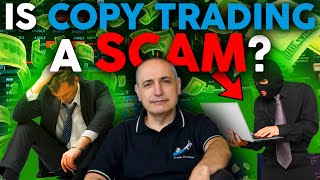

Is Copy Trading a Scam? The Shocking Numbers
37sOpens with a provocative question and reveals the massive $2.5 billion industry, immediately grabbing attention.
▶ Play Clip"The title asks a provocative question but the video only gives a balanced overview, not a definitive answer—average content with some padding."
This video from Unger Academy examines whether copy trading is a legitimate investment strategy or a potential scam. It explains how copy trading works, highlights the risks of blindly following other traders, and emphasizes the importance of financial education and risk awareness.
Copy trading is a popular technique where investors mimic the trades of other traders. In 2022, it generated nearly $2.5 billion, with Europe contributing $1 billion and Asia 50% of the total.
Under 25s make up 44% of copy traders, 25-35 year olds 32%, 35-55 year olds 17%, and over 55s only 7%. Older investors are less willing to entrust their investments to others.
Copy trading is similar to copying a neighbor's answers in school—you mimic a trader's operations without necessarily understanding them. It requires a platform, a broker, a trader to copy, and initial capital.
Investors must ask: which trader to choose, what criteria to use, what instruments are traded, and what risks are involved. Without understanding these, you have no control over your investments.
The lack of required training is presented as simplicity, but it hides the fact that platforms want you to trade immediately without knowledge, forcing you to rely on others and increasing your risk.
Copy trading is not necessarily a scam, but it is challenging to manage and difficult to generate consistent profits. It is presented as a shortcut but leaves you handling losses without understanding why.
Copy trading is not inherently a scam, but it carries significant risks, especially for untrained investors. The video stresses the need for financial education and risk awareness before engaging in this practice.
How much revenue did copy trading generate in 2022?
Nearly $2.5 billion.
00:12
What percentage of copy traders are under 25?
44%.
00:37
What are the four components required for copy trading?
A copy trading platform, a broker, a trader to copy, and initial capital.
01:18
Why is the lack of training in copy trading considered a risk?
It hides the fact that platforms want you to trade without knowledge, forcing you to rely on others and increasing your risk.
03:35
Copy Trading is Big Business
Provides concrete market size data showing the scale of copy trading.
00:12Copy Trading Analogy
Uses a relatable school analogy to explain the concept of copying without understanding.
01:03Training as a Hidden Risk
Highlights a critical insight: the absence of training is a deliberate design to keep investors dependent.
02:53[00:00] Is copy trading a scam? This is a technique that's popular and well advertised. One of the coaches at Unger Academy here, and today we want to understand if copy trading is all it's cracked up to be,
[00:12] or if there might be a scam behind it. Before we determine whether copy trading is legit or not, let's quickly see how it works. Copy trading is big business. In 2022 alone, it generated nearly $2.5 billion.
[00:25] A billion of that comes from Europe alone. Asia accounts for 50% of the total, while America and Canada appear to have less confidence in this trading technique. All age groups are giving it a try.
[00:37] Under 25s make up 44% and 32% of traders are between 25 and 35. The not so young, like myself, in the 35 to 55 year age group represent 17% and those over 55 make up 7%.
[00:51] So it looks like it's getting less popular as you go up the age groups. Maybe because we get older we tend to be less willing to entrust our investments to other people. But what is copy trading? Let's try to understand it a bit better. I don't know if you're familiar with it,
[01:03] but back in school when you didn know anything you would copy from your neighbor There were certain subjects where not only did I not know the answers but even when copying from a neighbour I still had no clue as to what I was copying Copy trading to some extent is similar in the sense that we mimic a trader operations
[01:18] Let's see what's required for copy trading. Companies offering these services, like eToro and ZuluTrade, present copy trading as follows. They tell us that, first and foremost, a copy trading platform is necessary, that we need a broker to execute market transactions, and of
[01:31] course a trader from whom to copy the trades and initial capital to invest and they say we don't have to do much in a way they're right because the copy trading platform is offered by the provider who also serves as a broker so we don't even have to worry about finding a broker and linking it in
[01:44] with a trading platform they also provide us with the trader to copy and they offer many of them but the capital sadly well we have to provide that ourselves so it seems like it's all ready to go out of the box but is it really that simple other questions we should be asking ourselves before
[01:58] starting to trade. For example, which trader should we choose? How can we select the best trader to copy? There are so many to choose from. Platforms are filled with traders and their performance rankings showcasing all their profitable traders. But assuming these
[02:10] are genuinely profitable traders and haven hidden their poor performance how can we choose between trader A or trader B for example What criteria can we rely on Is it solely based on the performance achieved in the last period How do we know which instruments
[02:25] they traded for example? Are we familiar with them? Do we know the difference between a derivative or another instrument, a future or a CFD as opposed to stocks? Are we aware of the risk to which we're exposing our capital? Can we quantify the risk? Do we know what
[02:37] risk is? Can we even ask this question? What kind of risk control do we have? Without being able to quantify it, we can't define it at all and we won't have any control. We'll be We're at the mercy of the wind copying the directions given by our new friend, the trader. Lastly, and the ultimate question of all is, am I diving into this without any training?
[02:53] Those questions we mentioned earlier need answers, but to answer them, we need to educate ourselves, understand what financial instruments are, what risk they entail. But we know nothing about this, so behind each of these questions lies a risk that, unfortunately, we have to bear.
[03:05] To return to the starting point, it might be as genuinely easy and as simple as they present, but we must be willing to shoulder all the risks. So is copy trading a scam or not? We can't say it's not a scam, but from everything we've seen,
[03:18] it's certainly a challenging technique to manage, and it's also very difficult to consistently generate profits It presented to us as a shortcut and we told that all we need to do is follow someone else However this leaves us with all the difficulties of handling what happens to us with a good level of awareness
[03:35] We might frequently find ourselves handling loss situations without knowing why or what to do. The total absence of training is presented as a form of simplicity in our favor, but it hides the fact that they want us to start trading right away with almost no knowledge, so that we always need
[03:49] someone else, a trader by our side to copy from in order to trade in the markets. All right, so today we wanted to give you a quick overview of copy trading and the pros and cons of this technique that have become so trendy in recent years. I hope it's helped you gain some clarity on the
[04:03] opportunities and risks associated with this practice. If you have options or questions you'd like to share with us, please let us know in the comments below. If on the other hand, you need assistance in starting to invest in the market systematically, then I recommend clicking on the
[04:16] link below. From there, you can sign up for a free presentation by Andrea Unger or get our best selling book, The Younger Method, covering only the shipping costs. Or you can even book a call with a member of our team to get a free strategic consultation. If you've enjoyed the video,
[04:29] please give it a thumbs up, subscribe to the channel and click on the bell to stay updated on our new videos. See you soon with new videos on systematic trading. Until the next time, bye-bye for now.
⚡ Saved you 0h 04m reading this? Transcribe any YouTube video for free — no signup needed.