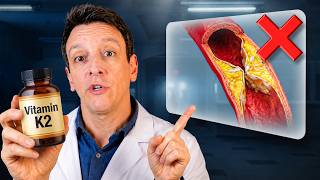

The Vitamin K2 Heart Health Myth
60sDebunks a popular supplement trend with a clear explanation, sparking curiosity and potential controversy.
▶ Play Clip"Title is honest and delivers exactly what it promises—a doctor's evidence-based explanation of why he doesn't take K2."
The video examines the popular claim that vitamin K2 supplements improve heart health by keeping calcium out of arteries. A recent randomized trial showed K2 slowed calcium accumulation but also increased total plaque, raising concerns. The doctor explains why he doesn't recommend K2 for heart health, emphasizing the need for outcome-based evidence.
Vitamin K2 helps calcium stay in bones, theoretically leaving less for arteries, but this theory needs testing.
160 participants with high calcium scores were split into K2 (360 mcg MK7) and placebo groups for 2 years.
Blood tests confirmed participants took the supplements as instructed.
K2 group had a ~30% slower rise in calcium score compared to placebo.
Calcium is part of the scarring process that stabilizes plaque, so reducing it may be counterproductive.
Statins and PCSK9 inhibitors increase calcium score but reduce heart attack risk, suggesting calcification is protective.
Total plaque increased 42% in placebo vs 67% in K2 group, suggesting K2 may make plaque less calcified without reducing it.
Authors state it's uncertain if the calcium score reduction translates to fewer heart attacks or strokes.
A 2023 trial found no significant difference in events, though numbers were tiny.
K2 may benefit post-menopausal women with osteoporosis, but not general populations.
Natto is the best food source, but check for soy allergy or blood thinner interactions.
What dose and form of vitamin K2 was used in the trial?
360 micrograms of MK7 (menaquinone 7)
01:29
What was the effect of vitamin K2 on calcium score progression?
About 30% reduction in the rate of calcium accumulation
02:51
Why is calcium in artery walls not necessarily harmful?
Calcium helps stabilize plaque and makes it less likely to rupture
03:18
How do statins and PCSK9 inhibitors affect calcium score and heart attack risk?
They increase the calcium score while reducing heart attack risk
03:48
What was the increase in total plaque over two years in each group?
42% in the placebo group and 67% in the vitamin K2 group
06:34
What did the authors say about the clinical significance of their findings?
It is uncertain whether the reduction in calcium score translates into fewer actual events like heart attacks or strokes
07:41
What did the 2023 trial find regarding heart attack events?
No significant difference in events between the K2 and placebo groups
08:37
What is the most concentrated food source of vitamin K2?
Natto (fermented soybeans)
12:01
Calcium is part of the scarring process
Challenges the common assumption that calcium in arteries is inherently bad, explaining it can stabilize plaque.
03:04Plaque grew faster with K2
The 67% vs 42% plaque increase is a counterintuitive finding that questions the supplement's benefit.
06:34Outcome trials vs surrogate markers
Highlights the importance of measuring real events like heart attacks, not just calcium scores.
07:41Evidence over hype
The doctor's refusal to recommend K2 without outcome data is a model of evidence-based medicine.
09:34[00:02] found that taking a vitamin K2 supplement can help keep calcium out of your arteries. So, does that mean we should all be taking a vitamin K2 supplement? Well, I wouldn't. In this video, we'll talk about vitamin K2, what
[00:16] is known about it scientifically as far as heart health, and we'll talk about a So, vitamin K2 is one of the most popular supplements out there on social media. It's widely recommended for heart health by a number of influencers. But
[00:32] the logic behind this recommendation hinges on a fundamental misunderstanding of heart health and heart disease. What vitamin K2 does physiologically is it vitamin K2 does physiologically is it helps calcium set in the bone. And so
[00:46] more calcium stays in the bone, less calcium is left in the blood to go to other places including the artery walls. So the theory became okay less calcium in the arteries lower calcium score less stiff arteries healthier arteries good
[01:03] great for heart health and this is a fine theory but in science we take theories and we test them we don't just spray the public with the theory and suggest that it's demonstrated science so a new randomized trial set out to
[01:15] test some of this idea by giving people a vitamin K2 supplement they took about a vitamin K2 supplement they took about 160 participants with documented plaque, with a high calcium score, so with a lot of calcium in their artery walls, and
[01:29] they split them randomly into two groups. One group was given a vitamin K2 groups. One group was given a vitamin K2 supplement, specifically 360 micrograms of the form of vitamin K2 that's called MK7, which is short for
[01:43] menquinone 7. And the other half were given a placebo pill. So, it's a pill don't know which one they're getting, but it doesn't contain any vitamin K2. And then they followed the participants for 2 years on these two regimens. And
[01:57] the first thing they did was to measure the blood levels of vitamin K2, which is smart because it tests if the participants really are taking the pills as instructed. And they found that indeed the blood level of vitamin K2
[02:12] supplement and not in the group receiving the placebo. So that's good. The participants are behaving well. They're doing as recommended. Next, they looked at their calcium score, a measure of the amount of calcium present in
[02:26] their artery walls over time. And in the placebo group, what they saw is that the calcium score keeps going up over time. So, more and more calcium is accumulating inside the artery wall where it's technically not supposed to
[02:39] supplement, they saw essentially a slower rise. So, the calcium level is still going up, but not as fast. And it was about a 30% reduction in this rate
[02:51] was about a 30% reduction in this rate of calcium accumulation. So substantial. So is it a good idea to take this supplement, vitamin K2, to keep the calcium out of your arteries or at least to accumulate it slower? And this is the
[03:04] take vitamin K2 supplements and I don't or who have high calcium scores including some of my family members because the whole idea of trying to remove or trying to prevent the
[03:18] deposition of calcium in the artery wall is based on a fundamental misunderstanding. Calcium is basically part of the scarring process of the artery. So calcium can actually help stabilize plaque and make it less likely
[03:33] stabilize plaque and make it less likely to burst, to rupture, and to cause an For example, a number of medical therapies that reduce the risk of heart attacks like something called BCSK9 inhibitors, that's a drug. Statins are
[03:48] more wellknown. Their bottom line effects are similar. And both of those therapies reduce the risk of heart attacks in patients who are at risk. And both of those increase the calcium score. They increase the amount of
[04:02] calcium in the artery wall and in plaque. And their benefit, their effect of reducing heart attacks, is thought to work at least in part through this
[04:14] increase in calcification, which is thought to help stabilize the plaque, make it less likely to burst, and less likely to elicit a heart attack. Okay, so if that's true, why is a high calcium score considered a bad thing? Doesn't
[04:28] seem to make sense, right? It is true that a high calcium score is considered bad news. It's not a good sign. But that's because in an artery that has all this scarring process, that's a diseased artery that has been building plaque
[04:44] That's the problem. That's why a high calcium score is a warning sign. Not because the calcium itself is a problem. In fact, if anything, the current the scientific understanding is saying that the calcification per se might actually
[05:02] be damage control. Here's a simple analogy. Imagine a street where there's a lot of repair patches, like those patches of uh asphalt that plug
[05:14] potholes. If we find out that there's a lot of car accidents on a street like that, we don't assume it's because of the plugs, because of the repair. A an old street with a lot of damage. That's probably why the damage is taking
[05:28] That's probably why the damage is taking place. And trying to remove the repairs or trying to slow down the repair work and leaving the potholes there, if anything, would be expected to make things worse. Calcium is somewhat like
[05:40] this. and trying to slow down calcification by itself without trying to address the actual problem misses the point and could even be a step backwards. It could actually do more harm than good. So, how do we know if
[05:54] vitamin K2 supplements are actually helping? Just looking at calcium score and seeing that go down or accumulate slower doesn't give us that answer. The calcium score could be lower because there's less plaque overall and that's
[06:07] good. or the calcium score could be lower because there's less calcium but right? Or even more plaque, which would be a concern. So, here's something really cool about this trial that teaches us more, allows us to see a
[06:19] little further. They didn't just measure calcium in the artery wall. They also measured total amount of plaque, calcified or not. And in the placebo group, the total amount of plaque went up by 42% in those participants over the
[06:34] two years. So, that's a substantial rise. And that's typically what you see in a western population. In the average individual that has a disease, we typically see it being progressive. Now, the group receiving the vitamin K2
[06:47] the group receiving the vitamin K2 supplement, they saw an increase of 67%. Now, this difference did not reach statistical significance. So, we can't say that it's growing faster in the guys receiving the supplement, but we're
[06:59] certainly not seeing it grow slower. And the authors explain in the paper itself they write that their findings suggest that the vitamin K2 supplementation is slowing down the calcification of non-calcified plaque. So by reducing the
[07:14] amount of calcium, it seems that what we're doing is we're not reducing the amount of plaque overall. We're just making that same plaque be less calcified. And that's a concern. That's like stopping the road repairs, right,
[07:27] the patches from being put in place, but leaving the potholes there, doing nothing about that. So, that would be a concern that would be expected to make authors are very clear about this. They write in their paper, it is uncertain
[07:41] whether the relatively small reduction in the evolution of the calcium score that they saw that they reported, whether it translates into a reduction of actual events. So, events means actual heart attacks and strokes. these
[07:54] things that we can feel that actually change our quality of life. And at the about in heart disease. And the authors also say only a well-designed outcome trial can answer whether MK7, the vitamin K2 form they used, is
[08:09] beneficial. So outcome trial is what we call a trial that actually measures the number of heart attacks and strokes and things like that, not just these surrogates like the amount of calcium or some other morphological feature of
[08:22] black. Now, for more context, we do have a trial from a couple of years ago, pretty recent that reported the number of events, the number of heart attacks and things like that, and it's somewhat reassuring their findings are although
[08:37] the numbers are tiny, so it's hard to be sure. So, this was published in 2023, and overall, they found no significant difference in events between the folks getting the vitamin K2 supplement and the folks getting the placebo. And then
[08:51] looking only at those that had a very high calcium score over 400 to begin with, they actually see a suggestion of a reduction in the number of events on the folks receiving the K2 supplement. But again, the numbers are tiny. This
[09:05] trial was not designed to pick up events. It was 13 events total, I believe, both groups combined. So, it's much from that, but at least the number of events didn't go clearly up uh in the
[09:20] Another thing that's worth pointing out is in these trials we have so far, there are very few if any side effects reported in folks receiving the K2 supplement. So, that's good news. Now,
[09:34] we'll touch on other uses of K2, including bone health, in a second, and also other sources of vitamin K2, like getting it from actual foods. But the bottom line from the evidence we have is I don't take vitamin K2 for heart health
[09:49] some close family members that have a lot of plaque and that have a very high calcium score. The reason I don't recommend it and don't take it myself is right now we don't know if the vitamin K2 supplement is providing any actual
[10:04] benefit and I keep seeing people on the internet hawking K2 supplements on the the arteries. Vitamin K2 is a great thing to take for people who've got some calcium score, already had heart disease, stent bypass, stroke.
[10:19] >> You're 40% less likely to have coronary artery disease if you take vitamin K2. >> Any opportunity to decrease the amount of coronary calcium and buildup in your arteries and to improve your elasticity and your distensibility of vessels, take
[10:34] it. So, I give my patients vitamin K2. K2 keeps the calcium in the bones and out of the arteries. So K2 is very important. That's why we created our product called Super K. And our multivitamin is also loaded with K2. You
[10:49] want to bear in mind this is not a good scientific reason. It's not a good logic because as we said that could come with more events, fewer or no change. And hopefully K2 works in a big way in future trials. it pans out because we
[11:02] need all the options we can get in terms of therapies and solutions. But I think before we start hawking supplements to millions of people and say go take it, we want to see some evidence that it's actually providing benefit as opposed to
[11:16] Okay, real quick because people always ask about the bone health side. There's some evidence suggesting a benefit of taking K2 supplements for specific populations and it's usually post-menopausal women with osteoporosis.
[11:32] So these populations at risk of having lower bone mineral density and more fractures. That's usually where we see a suggestion of a benefit uh not in a general healthy population or in a male population for example. Uh that's much
[11:46] less supported by evidence. So, I don't take K2 for bone health either, but I think it could be defensible in specific cases. Okay. What about getting vitamin K2 from actual foods that contain it as opposed to a pill? So, the most
[12:01] concentrated source is natto, fermented soybeans, and the evidence we have is that the higher consumers of natto tend to have a lower risk of dying of heart disease. And we don't see a ton of issues. So natto is generally considered
[12:14] a healthy food, a food that's totally fine to include in a diet. Some caveats, soy allergy obviously. Also, if you're on blood thinners, some specific blood thinners can interact with some of the components in natto. So if you are on
[12:29] before you start eating substantial amounts of natto. Otherwise, including some natto in your diet is a good idea. It's not a popular food. The taste and the smell is a little funky. It's an acquired taste. What I recommend for
[12:42] heart disease, what has the highest level of evidence is first and foremost diet and exercise. We have a lot of information on that in previous videos. And for people who have established black already have heart disease or have
[12:54] very high calcium scores, then medical therapies on top of diet and exercise, not instead medical therapies that have been demonstrated to actually reduce the risk of events, heart attacks and such. And for more information on that, check
[13:08] out this previous video and I'll meet you in there.


⚡ Saved you 0h 13m reading this? Transcribe any YouTube video for free — no signup needed.