
Pile Driving Kills Fish Instantly
60sShocking discovery that construction noise underwater can kill fish up to 1km away.
▶ Play Clip"The title is engaging but accurate; the video delivers on the 'weirdest tool' promise with solid science and demo."
This video explores the use of bubble curtains as a noise mitigation technique in underwater construction, specifically during pile driving for the San Francisco–Oakland Bay Bridge replacement. It explains the physics of sound underwater, the damage it can cause to fish, and how bubble curtains reduce noise through acoustic impedance mismatch, while also discussing other applications like turbidity control and oil spill containment.
The 1989 earthquake collapsed a section of the Bay Bridge's eastern span, prompting a replacement project that required over 250 heavy-duty piles.
During test pile driving in 2000, fish began dying due to intense sound pressure from the steel pipe ringing like a bell, affecting wildlife up to a kilometer away.
The answer is bubbles: a bubble curtain creates an acoustic impedance mismatch between water and air, reducing sound transmission.
Decibels are a logarithmic scale; underwater decibels use a different reference (1 µPa vs 20 µPa in air), so comparisons are not direct.
Sound reflects at boundaries with large impedance differences (like water-air). Bubbles exploit this to attenuate sound by ~30 dB in transmission.
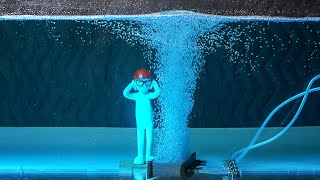
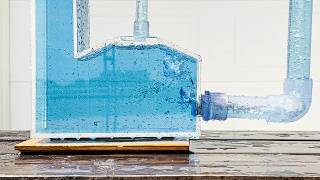
A demonstration using air stones to create a bubble curtain between a speaker and hydrophone shows attenuation, especially at higher frequencies.
Large curtains require compressors, filters, and multi-level plumbing to maintain a continuous screen against currents.
Caltrans' report on hydroacoustic effects suggests bubble curtains achieve about 5 dB attenuation, which halves sound pressure and reduces injury zone area dramatically.
Bubbles also aerate water, create currents to separate trash, contain oil spills, control turbidity, prevent saltwater intrusion, and confine herbicides.
Humpback whales use bubble nets for feeding; humans use them to keep fish out of areas (e.g., preventing invasive species spread).
Bubble curtains are a clever, effective tool for reducing underwater noise from construction, with the 2005 Bay Bridge project winning an excellence award for its environmental mitigation. Their ability to cut sound pressure nearly in half dramatically shrinks the area where fish are injured.
What is barotrauma?
The term for damaging effects of compression and decompression on wildlife due to sound pressure.
03:13
How much does the acoustic impedance mismatch between water and air reduce sound transmission?
About 30 decibels.
06:14
What is the reference pressure for underwater decibels?
1 micropascal.
04:33
How much sound attenuation do bubble curtains typically provide for pile driving?
About 5 decibels, which corresponds to nearly halving the sound pressure.
11:32
Besides noise reduction, name two other uses of bubble curtains in construction or environmental management.
Controlling turbidity and containing oil spills.
13:14
Fish Die from Sound
Demonstrates the severe environmental impact of underwater construction noise.
01:08Bubbles Are the Tool
Reveals the surprisingly simple solution to a complex problem.
02:16Impedance Mismatch Effect
Explains the physics principle that makes bubble curtains work.
06:14Injury Zone Reduction
Quantifies how a small dB reduction dramatically decreases impacted area.
12:00[00:02] In 1989, the Loma Prieta earthquake shook the central coast of California, collapsing buildings and damaging infrastructure across the Bay Area. Bridges, in particular,
[00:14] suffered extensive damage. In one case, a major section of the eastern span of the Bay Bridge's deck collapsed, falling onto the lower deck like a trapdoor. Sadly, one person
[00:26] died driving off the upper deck. Crews had the bridge repaired within a month, but Caltrans knew that the next earthquake could be worse and started making plans to replace the structure.
[00:38] Knowing that the replacement project would require heavy-duty piles, Caltrans developed a testing program to identify risks and challenges during design and minimize the chance of unanticipated
[00:50] problems cropping up during construction. And they found a pretty big one. In October of 2000, the barge began the pile driving operation, dropping a large hammer to drive the 8-foot (or 2.4 meter) diameter steel pipe deep into the seafloor. Almost immediately,
[01:08] fish began dying in the surrounding area. Biologists involved in the project collected fish and documented injuries to their organs and swim bladders. They weren’t being directly hurt by the hammer itself; it was above the water anyway. The damage was coming from the intense sound.
[01:26] That massive steel pipe rang like a humongous bell on every hammer blow, radiating sound pressure through the San Francisco Bay. It even had serious impacts on aquatic wildlife up to
[01:38] a kilometer away, which was a pretty big deal. Because San Francisco Bay is home to quite a few threatened or endangered species of fish. The problem was that the replacement bridge would need more than 250 of these piles. Caltrans had to figure out how to install them without
[01:55] affecting the wildlife in the process, and the way they did it, I think, is pretty cool. And I even built a model in the garage to show you it works. I’m Grady, and this is Practical Engineering.
[02:16] If you want to know the answer right away, it's bubbles. But I think the most interesting part is why it works in the first place. And this matters. Pile driving isn’t the only thing that creates excessive noise underwater. We do a lot of construction in waterways, oceans,
[02:32] rivers, and bays. We also occasionally have to blow stuff up underwater, like for demolition of structures or safe disposal of old munitions and mines. Any loud work underwater has the potential to disrupt, injure, or even kill aquatic
[02:49] wildlife. The phenomenon we know as sound is just fluctuations in pressure within a medium, whether it’s air or water (or even concrete). We sense those fluctuations mainly through our ears,
[03:01] but pressure fluctuations can do a lot more than just vibrate the thin membranes, tiny bones, and hairs. Barotrauma is the term used to describe the damaging effects of compression and decompression
[03:13] on wildlife. And it really has only been in the past few decades that we’ve really started to apply the science of hydroacoustics to our own activities and try to mitigate the impacts.
[03:25] You’ve probably heard of sound pressure expressed in decibels. It’s really just a logarithmic scale of convenience thing because meaningful pressures can range across many orders of magnitude. So the
[03:37] decibel system just makes the numbers easier to compare. The equation for a decibel is just 20 times the base 10 logarithmic function of the sound pressure divided by a reference pressure.
[03:50] Sounds complicated, but it just means a 1-decibel increase corresponds to an increase in sound pressure of about 26 percent. The amount of time over which sound pressure is
[04:02] measured also matters. Look at a waveform and you can see there are peaks (both in compression and rarefaction). But that’s only for a split second. So a lot of measurements use a root mean square of the sound pressure over a given time to provide a better estimate.
[04:17] We don’t have to go into the math of that, just think of it as a fancy kind of average. It’s important to point out that, in air, we use 20 micropascals as the reference pressure, which is approximately the limit of human hearing. So that’s 0 decibels. Underwater,
[04:33] we use a reference pressure of 1 micropascal, mainly just for standardization purposes, so just keep in mind that underwater decibels aren’t really equivalent to sound pressures you might have as references in your head like the 75-decibel vacuum cleaner or the 140-decibel jet engine.
[04:53] And really, what you think of as sound has less meaning underwater because our ears and brains are calibrated for the physics of sound in air. The underwater version of “loudness”
[05:05] doesn’t translate well to human perception. But it matters a lot to fish and marine mammals. Sound behaves a lot differently in water than air. Of course, water is denser, and sound moves through it at roughly 4 times the speed it does in air. Sound also carries
[05:22] a lot further in water, and importantly, the acoustic impedance of water is way different than air. Impedance is basically a measure of opposition to sound flow, kind of like resistance in an electrical circuit. It’s a function of the medium’s density and the
[05:39] speed of sound through it. And at a boundary between two media, there are two things that can happen to sound. It can transmit into the new medium or it can reflect back, and the difference in impedance between the two determines how much of each will occur. If impedances match,
[05:57] more sound will transmit through the boundary. If they’re way off, like water and air, most of the sound is reflected. The practical effect of that is a transmission loss between air and water of about 30 decibels. It’s why stuff happening underwater is quiet above the surface,
[06:14] and we can take advantage of impedance mismatch in underwater construction. I built a new acrylic tank for this demo, and I’ve got a new helper in the shop. This is Brady.
[06:28] I figured since half the internet calls me that anyway, we might as well get a Brady in here. He can wave and nod, and he can probably do a lot of other stuff too, but that took me several hours, so he’s just going to bravely hold the hydrophone for now. And on the other end of the tank,
[06:43] I have this bluetooth speaker. It claims it’s underwater rated, so we’ll see if it works out. And here’s the setup; pretty simple. I found a few recordings of hammering and pile driving sounds to
[06:55] play on the speaker. And this is how they come across on the hydrophone, which is connected to a sound recorder.
[07:11] I also did a frequency sweep so we can do a little more scientific comparison.
[07:29] At this point, one of my glue joints on this tank catastrophically failed and flooded my garage with water. I didn’t catch it on camera, but Brady took the brunt of the fall. I got it all fixed up, and now let’s see if we can soften these construction sounds.
[07:47] I have four air stones made for aquariums hooked up to an air pump. When I flip these on, we get a nice curtain of small bubbles between the speaker and the hydrophone. And I’ll record those same sounds again.
[08:11] Here’s a look at the waveforms from the hydrophone with and without the air. Although it’s not a dramatic difference, you can definitely see a difference, especially for the higher pitched hammering sounds toward the end. And here’s a look at
[08:23] the waveforms without and with the air for the frequency sweeps. Even though the sweep should have had a constant sound pressure across the full range of frequencies, the water and demo itself cause pretty serious distortions. You can see a lot of resonance at
[08:39] low frequencies, and a lot of attenuation at high frequencies. That makes it a little hard to gauge the effectiveness of the bubbles. It’s similar to the hammering sounds - not much difference at the lower frequencies, but a pretty substantial reduction at higher frequencies.
[08:55] This is not an ideal setup for one reason: even though there’s a big mismatch in acoustic impedance between air and water, there’s not that much difference between acrylic and water. So,
[09:08] it’s pretty easy for pressure waves to propagate into the acrylic, travel past my bubble curtain, and back into the water on the other side. So I’m not getting the kind of sound reduction, what the pros call attenuation, that you might expect in the real world,
[09:24] for example, by surrounding a pile with a circular ring of air pipes. Thankfully, the researchers studying solutions like this have put a lot more resources into figuring out the right way to do it. The measurements at the Bay Bridge compared fairly well with mine. Attenuation
[09:40] was highest as the higher frequencies. But this is not as simple as just blasting air out of a pipe. These bubble curtain systems require a lot of logistics. Massive compressors or blowers feed
[09:53] air sometimes deep below the surface into complex plumbing assemblies. They usually have filters to remove oil from the air to make sure the water isn’t being contaminated. The system has to sit
[10:05] flush with the bottom to make sure sound can’t travel underneath the bubble curtain. But also, there are currents. Any movement of the water is going to move the bubbles too, potentially creating gaps in the curtain or dispersing it altogether. So it’s often
[10:19] necessary to have multiple levels of plumbing to keep a continuous screen all the way to the surface. If that’s not enough, there are ways to confine the bubbles around a pile or construction activity using an outer casing or even a flexible membrane. But how do you know it actually works?
[10:36] Maybe the most comprehensive engineering guidance on this topic is put out by Caltrans in their manual on the Hydroacoustic Effects of Pile Driving on Fish. Appendix 1 in the report is
[10:48] a nearly 300-page compendium on pile driving sound data. You might not have known this, but we’ve been measuring a lot of pile-driving sounds! If you’re an engineer or environmental
[11:00] scientist trying to get a permit to build something underwater and sound is going to be an issue, this is kind of your bible. It’s got quite a few ways to minimize impacts, including timing work when important species aren’t present, changing designs to reduce
[11:15] underwater work, using vibratory hammers instead of conventional equipment, and bubble curtains that reduce the propagation of underwater sound pressure. Based on all the testing and real-world case studies so far, they suggest you can get about 5 decibels of attenuation this way.
[11:32] Just like my demo, sounds don’t only travel through the water. They also move through the sea floor and even through the barge on the surface, bypassing the bubbles. 5 decibels doesn’t sound like a big reduction, but you have to remember that it’s a logarithmic scale.
[11:47] A 5 decibel reduction means the actual sound pressure is nearly cut in half. You also have to remember that what we care about most is area. For any loud construction or demolition activity,
[12:00] there’s an invisible ring some distance away that marks the injury threshold level. Since sound pressure decreases with distance, eventually you’re far enough away from the sound that it doesn’t result in injury. So every foot or meter that you can pull that ring back toward
[12:16] the activity through attenuation reduces the impact area proportional to the distance squared, dramatically reducing the area in which fish may sustain injuries. That’s why bubble curtains are
[12:28] used in so many underwater construction projects these days, but that’s not all they’re used for. What’s that old saying? If your only tool is a bubble curtain generation system, every problem starts to look like a loud underwater sound. Something like that. It turns
[12:44] out that bubbles can do a lot more than create an impedance mismatch for sound pressure propagation. For one, they aerate water, which can be useful to prevent algae and other issues with stagnant
[12:57] pools. For two, they create vertical water currents. That can help keep things separated, like trash. You can see it’s a lot harder for me to move this little boat across the barrier Of course, a net or boom or rack can do this too,
[13:14] but those don’t allow boats to pass through. And this doesn’t just work for trash. Bubble curtains have been used to contain oil spills, and they’re often used in underwater construction not just to control sound but turbidity. We really don’t want disturbed sediments clouding up our waterways,
[13:32] again, primarily for environmental reasons, so these can be an important tool when booms aren’t practical. They’ve also been used to control saltwater and keep it from migrating up rivers in tidal areas. And they’ve even been employed to confine herbicides for invasive plants,
[13:48] allowing for fewer chemicals and less non-target damage to nearby flora. I’ll definitely be in trouble with the biology folks if I don’t point out that it’s not just people who use bubbles as a tool. Humpback whales cooperate to create bubble curtains
[14:03] that corral fish to a central point. Then they lunge into the center to gulp them down, And we use bubbles this way on occasion as well, not for fishing but to keep fish out of certain areas, usually to prevent the spread of invasive species.
[14:21] By 2005, the pile driving operation on the east span replacement of the Bay Bridge was complete, Excellence Award by the Federal Highway Administration for all the work they did
[14:35] on minimizing underwater noise impacts on endangered fish species. And the lessons from that project have been applied across the world in the two decades since. You know I love heavy construction. The bigger and louder the machinery, the better. But I think
[14:50] that anything we can do to limit the effect we have on the other things we share this world with is a win, especially when it’s something as clever and creative as blowing bubbles.
[15:03] My first exposure to this topic was reading about how unexploded ordnance is handled in the Baltic Sea. They use bubble curtains to reduce the effects on fish, and I’m curious if any of you know other cool applications in the industry that I didn’t mention here. I’m so fascinated
[15:19] to see and learn more about the differences in techniques and infrastructure across the world. And there’s probably nowhere you see those differences better than in transportation. My friend Mike from the DownieLive channel is on an adventure to travel from the Arctic all
[15:35] the way to Africa, as much as possible, by train. The series is called DownieExpress, and it’s such a cool combination of adventure and infrastructure. So many cool trains,
[15:47] from modern high-speed transit to the most basic coach. I first started watching DownieLive when he was filming this wild quad tandem bike race, and this DownieExpress series just has me hooked. And if you want to watch the whole thing, it’s only available on Nebula.
[16:02] You probably know about Nebula now, even if you’re not subscribed. It’s a streaming service built by and for independent creators. No studio executives deciding what gets the green light, no
[16:14] advertisements driving the content into a single style. It’s just independent creators making stuff they’re excited about with as few barriers and distractions as possible between you and us. My videos go live on Nebula before they come out here, and my Practical Construction series
[16:30] was specifically produced for Nebula viewers who want to see deeper dives into specific topics. monthly cost to keep track of, but I also know that if you’re watching a show like this to end,
[16:44] there is a ton of other stuff on Nebula that you’re going to enjoy as well. So I’ve made it dead simple: click the link below and you’ll get 40% off an annual plan. Pay just one time, 36 dollars, for an entire year’s access at go.nebula.tv/practical-engineering. Or if
[17:02] you have subscription fatigue, but still want to support what I’m doing, you can get a lifetime membership. Pay once and have access for as long as you and Nebula last. Hopefully that’s a long time! If you’re with me that independent creators are the future of great video,
[17:17] I hope you’ll consider subscribing. Thank you for watching, and let me know what you think!
⚡ Saved you 0h 17m reading this? Transcribe any YouTube video for free — no signup needed.