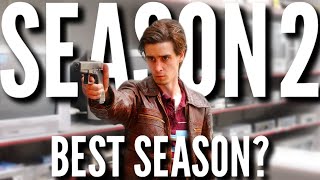

Why The Wire Season 2 Was Hated Then Loved
45sThe dramatic shift in setting and initial fan backlash creates a compelling narrative of misunderstood genius, perfect for sparking debate.
▶ Play Clip"The title is accurate; the video genuinely argues and provides evidence for why Season 2 is *The Wire*'s most underrated season."
This video discusses Season 2 of *The Wire*, arguing it is the show's most underrated and prophetic season. It examines how the season shifted focus from the drug trade to the struggles of dock workers in Baltimore's dying port.
Viewers were confused and felt betrayed by the shift from corner boys to white dock workers in Season 2.
Creators David Simon and Ed Burns used Season 2 to expand the show's critique from the drug war to the larger forces destroying American cities.
Baltimore lost 75% of its industrial employment (over 100,000 workers) between 1950 and 1995.
A scene of automated port technology from Rotterdam shows the present crushing the past, highlighting automation's threat to jobs.
Frank Sabatka's line, 'We've made shit in this country... Now we just put our hand in the next guy's pocket,' encapsulates the shift from a manufacturing to a finance-based economy.
To save the union, Frank makes a deal with 'the Greek,' a symbol of amoral global capitalism, highlighting how desperation forces people into crime.
The discovery of 13 dead trafficked women in a container shows the horrific human cost of the global shadow economy that Frank becomes implicated in.
Both groups have codes of silence, distrust authority, and operate on principles of survival through solidarity, showing systemic rot affects all at the bottom.
Nick moves from stealing cameras to dealing drugs for the Greek, blurring the line between honest work and crime when the former doesn't pay.
Ziggy represents a generation with no future, acting out for respect in a world that has made him invisible, culminating in a devastating murder.
Omar's testimony against Bird and his cross-examination by Levy is a defining moment, as he exposes the hypocrisy of the legal system.
Stringer orders D'Angelo's murder in prison, staged as a suicide, showing the limit of Stringer's business philosophy and signaling he is a liability.
Proposition Joe offers Stringer access to the Greek's superior heroin in exchange for territory, positioning himself as the essential connector between supply and distribution.
McNulty, exiled to the Marine Unit, gets drawn into the Sabatka case by recognizing the dead women are connected to something bigger.
The season elevated *The Wire* from a crime show to an examination of how American institutions work and fail, predicting economic anxieties for decades.
Season 2 of *The Wire*, initially divisive, is now recognized as the show's most underrated and prophetic season, offering a masterful critique of deindustrialization, automation, and systemic failure that remains urgently relevant today.
Between 1950 and 1995, what percentage of industrial employment did Baltimore lose?
75%.
02:36
What line from Frank Sabatka encapsulates the shift from a manufacturing to a finance-based economy?
'We've made shit in this country... Now we just put our hand in the next guy's pocket.'
03:17
What does 'the Greek' symbolize in Season 2?
Pure, amoral capitalism operating beyond borders and laws, not a traditional gangster but a businessman.
06:05
Why did Frank Sabatka make a deal with the Greek?
To get illicit money to lobby politicians and try to save the port and his workers, as the legitimate system had failed him.
05:52
How does the show parallel dock workers with drug dealers?
Both groups have codes of silence, stonewall police, distrust authority, and operate on 'survival through solidarity.'
07:38
What object does Ziggy buy in a desperate attempt to prove he is somebody?
A duck (a leather coat and a duck are mentioned).
09:22
How does Stringer Bell have D'Angelo killed?
He arranges for Muggs to strangle D'Angelo in the prison library and stages it to look like a suicide.
15:37
What is Proposition Joe's key business strategy?
He is a dealmaker who avoids violence, aiming to see the drug trade as a business that could be run rationally.
18:31
What institutions does each season of The Wire examine?
Season 3: city politics and police reform. Season 4: education system. Season 5: the media.
10:55
Core Economic Quote from Frank Sabatka
It perfectly encapsulates the central theme of deindustrialization and the shift from a productive to a financialized economy.
03:17Discovery of Trafficked Women
Shows the human cost of the global shadow economy and the moral price of Frank's compromises.
06:17Ziggy's Character as a Lost Generation
Illustrates the psychological and social devastation of having no economic future or identity beyond crime.
09:08Omar Exposes Levy's Hypocrisy
Defines Omar's role as the only character who can call out the systemic hypocrisy of both criminal and legal systems.
14:18Season 2 Elevated the Show
Explains the critical argument that this season transformed The Wire into a complete portrait of American institutional failure.
21:38[00:00] In our first video, we explored how The Wire Season 1 revolutionized television storytelling.
[00:22] Today, we're tackling what many consider the show's most divisive and most prophetic season, Season 2. Three and a half inches of hard blue steel. When The Wire season 2 premiered in June 2003, fans were confused.
[00:34] Where were the corner boys? Why are we suddenly watching white dock workers? Many viewers felt betrayed. How much more betrayal can I take? But looking back two decades later, with the 2008 financial crisis, the decay of American manufacturing,
[00:46] and the ongoing supply chain disruptions behind us, season 2 now stands as one of the most prescient pieces of social commentary in television history. We used to make steel there, though. Season 2 of The Wire does something almost unprecedented in television.
[01:01] It splits its focus between two parallel narratives. While continuing the Barksdale storyline from Season 1, the show introduces an entirely new world. The stevedores of Baltimore's dying port and their struggle for survival under union leader Frank Sabatka.
[01:14] David Simon and Ed Burns weren't just being contrarian. They were expanding their thesis about institutional failure beyond the drug war to examine the larger forces destroying American cities. The Barksdale investigation continues, but now it's viewed alongside a completely different community facing the same systemic rot.
[01:30] The shift was jarring. The opening credits changed from inner-city imagery to shipping containers and 18-wheelers. The theme song shifted from a soulful version to a grungier Tom Waits rendition. Everything signaled, this is different. Michael K. Williams, who played Omar, was initially upset about the change.
[01:44] When he came back to season two with the docs, you know, I was very angry. I thought that, you know, this white man had taken something that black people had made good and now he wants to make it a white show.
[01:57] The answer is that The Wire was never meant to be just a cop show or just a drug show. It was always intended to be a complete portrait of an American city. All the institutions, all the communities, all the way systems fail people, regardless of race or class.
[02:09] The season aired from June to August 2003, just five years before the 2008 financial crisis would expose the fragility of America's economic system. But the conditions that led to that collapse, deindustrialization, the abandonment of the working class,
[02:23] the transformation from a productive economy to a financialized one, were already visible on Baltimore's docks. Between 1950 and 1995, Baltimore lost 75% of its industrial employment, shedding over 100,000 workers.
[02:36] The Wire Season 2 puts faces to these statistics through the Sabatka family and their fellow dock workers. Frank Sabatka, played brilliantly by Chris Bauer, is a union treasurer fighting a losing battle against history itself. The Port of Baltimore, once a thriving hub of American commerce,
[02:50] is being strangled by multiple forces. automation, global trade shifts, political indifference, and the fundamental transformation of the American economy. In one of the season's most devastating scenes, Frank attends a seminar showcasing automated port technology from Rotterdam.
[03:04] He watches in horror as robots do the work that once employed hundreds of men. This isn't science fiction. It's the present crushing the past. And Frank knows his men have no future in this new world. The iconic line that captures everything comes when Frank tells his lobbyists,
[03:17] We've made shit in this country. Build shit. Now we just put our hand in the next guy's pocket. This single line encapsulates the economic transformation that would contribute to the 2008 collapse and beyond.
[03:31] America had shifted from a productive, manufacturing-based economy to one based on finance, service, and speculation. The working class that once built things, ships, steel, cars,
[03:46] was left behind, disposable in the new global marketplace. The challenges faced by stevedores from automation to decreased shipping traffic weren't just background details But were integral to understanding character motivations season 2 shows us workers confronting technological obsolescence in real time
[04:01] The Rotterdam video shows exactly what's coming today in 2025 We're living through another wave of automation anxiety with artificial intelligence But the wire showed us this pattern 22 years ago technology advances workers become redundant and the social safety net
[04:15] that's supposed to catch them doesn't exist. Frank's dream is simple. Get the canal dredged, reopen the grain pier, bring back the jobs. But he's fighting a tide that no amount of lobbying can reverse. The global economy has moved on,
[04:27] and Baltimore's port is just collateral damage. The tragedy is that these were good jobs, union jobs with benefits, pensions, and dignity. They represented the American dream for working-class families. And they were disappearing, not because the workers failed,
[04:39] but because the system had decided they were expendable. What the fuck are we doing down here with the war cracks for all her goddamn money. Here's where season two becomes truly prophetic. It shows us what happens when the social contracts between labor, capital, and
[04:52] government completely breaks down. Frank Sabatka is fundamentally a decent man. He's not corrupt for personal gain. Every illegal dollar he makes goes toward trying to save the port and his workers. Hey, Brucey. I think they're your size.
[05:05] He's lobbying politicians, funding campaigns, trying to work within the system to preserve his community. But the system doesn't care. The politicians want photo ops and real estate development. They'd rather turn the port into luxury condos than preserve industrial jobs.
[05:18] The police department is more concerned with stats and petty feuds. Major Valchek starts the entire investigation because Frank's stained glass window donation to their church was bigger than his. This is the betrayal at the heart of season two.
[05:30] America promised that if you worked hard, played by the rules, and stood by your community, you'd be taken care of. But that promise was a lie. When the market decides you're obsolete, there no safety net no retraining no transition plan There just economic death Frank used illicit money not for personal gain but to lobby politicians and try to save the port demonstrating how fundamentally decent people are forced into an extra economy
[05:52] when the legitimate system fails them. To keep his union alive, Frank makes a deal with the Greek, a shadowy figure who represents pure, amoral capitalism operating beyond borders and laws. He's not a traditional gangster with territory and reputation to protect.
[06:05] He's a businessman who deals in whatever is profitable, drugs, chemicals, stolen cars, and horrifyingly, human beings. When a container of 13 dead women is discovered, trafficked victims who suffocated to death,
[06:17] we see the human cost of this global shadow economy. Frank didn't know about the women. He thought he was just moving drugs and stolen goods. But his willingness to look the other way, to compromise his principles for the greater good of saving jobs, implicates him in something monstrous.
[06:30] It's a perfect metaphor for how economic desperation corrupts everything it touches. The season asks an uncomfortable question. When the legal economy abandons you, what choice do you have? Frank tries the legitimate route. Lobbying, political donations, working within the system.
[06:44] It gets him nowhere. The only thing that works is crime. And once you're in, you can't get out. The Greek is played by Bill Raymond with an eerie calmness that makes him more terrifying than any traditional villain. We never learn his real name or nationality.
[06:56] He claims to be Greek, but in the finale, it's revealed he isn't. He has connections everywhere. When the police investigation closes in, he simply disappears. In the finale, Spiros reveals to the audience the depth of their deception.
[07:08] He knows my name. My name is not my name. Are you? To them, you're only the Greek. I'm of course. I'm not even Greek. This is the Wire's comment on globalized capitalism itself. Local institutions, police, unions, city government are trapped in their jurisdictions, fighting over scraps.
[07:24] Meanwhile, the Greek operates above them all. This is our last day. One of season two's subtlest achievements is showing how the dock workers and the drug dealers are playing the same game. Both groups operate in institutions that demand absolute loyalty.
[07:38] When police try to interview dock workers about the dead women, they get the same stone walling they'd get from the bark sale crew. Negro, you cannot travel halfway around the world and not speak any motherfucking English. Neither group trusts authority. Both have elaborate codes of silence.
[07:52] The dock workers whistle warnings when police approach, just like the corner boys. They protect each other, lie for each other, and understand that snitching means death. Social death for the dock workers, actual death for the drug dealers.
[08:04] The institutions are different, but the logic is identical. Us against them. Survival through solidarity. What do you say, Johnny? What do you say to any question? I take this commandment. Nick Sabatka, Frank's nephew played by Pablo Schreiber,
[08:16] makes this connection explicit when he transitions from stealing cameras off the docks to dealing drugs for the Greek. The line between honest work and crime blurs completely. When honest work doesn't pay enough to survive, crime becomes rational. This is why David Simon insisted on Season 2.
[08:30] He needed to show that the failures depicted in Season 1 aren't unique to the drug trade or black Baltimore. They're systemic. The same institutional rot, the same economic abandonment, the same broken social contract affects everyone at the bottom, regardless of race.
[08:42] If Frank represents the old guard trying to hold on to a dying world, his son Ziggy represents the generation with no future at all. Ziggy Sabata, played by James Ransone, is impulsive, insecure, desperate for respect, and utterly lost.
[08:55] He pulls pranks, makes bad deals, gets mocked by everyone around him. He's a joke, and he knows it. Ziggy's arc is about what happens to young men when there's no path forward. His father has the docs, has the union, has meaning.
[09:08] But what does Ziggy have? A dead-end job checking containers in an industry that's disappearing. No education that would help him transition to the service economy. No prospects. His escalating criminal behavior, stealing cameras, stealing drugs, buying a leather
[09:22] coat and a duck to prove he's somebody, is all about trying to matter in a world that's made him invisible. Ziggy was brash and annoying, flagrantly pursuing a criminal lifestyle and showing off his illegal wealth, landing himself and others in trouble with his pranks and goofy behavior.
[09:35] On first viewing, Ziggy feels like a joke character compared to the cool, calculated operators of season one. Viewers didn't want to watch this clown when they could be watching Omar rob another stash house. But here's what people missed. represents something far more serious than the show initially suggests.
[09:49] Every stupid decision he makes is about trying to be somebody when the economy has decided he's nobody. When he finally snaps and commits murder in episode 10, the violence feels inevitable. James Ransone plays his emotional distress incredibly well in that moment.
[10:02] Ziggy transforms from an annoyance into one of The Wire's most devastating characters. Frank says to him in jail, I don't want to let you in the jail. You're a sabacc. But Ziggy responds, Fuck. This is what I am.
[10:14] That line captures the generational divide. Frank could be a sabatka and have dignity, purpose, a community. Ziggy can only be fucked. The Wire is showing us the death not just of industry, but of identity, of the meaning that work once provided.
[10:28] Before we continue, it's important to acknowledge that James Ransone passed away on December 19th at the age of 46. Ransone is survived by his wife, Jamie McPhee, and their two children, Jack and Violet. His performance as Ziggy remains one of The Wire's most memorable and devastating portrayals.
[10:43] Rest in peace. Although it was initially controversial, the choice to keep changing the show's cast and setting in each season ended up becoming The Wire's biggest strength. Season 2 established the temp rate that would define the rest of the series.
[10:55] Each season would function as a new chapter examining a different Baltimore institution. Season 3 would tackle city politics and police reform. Season 4 would dissect the education system. And Season 5 would critique the media.
[11:07] Without Season 2's bold pivot, none of that happens. If Simon had just given fans more Barksdale organization drama in season 2, The Wire becomes a very good crime show instead of a transcendent examination of American institutional failure.
[11:20] Season 2 helped dramatically shift audience expectations for what kind of show The Wire would be making it easier for viewers to embrace new characters and settings in later seasons More importantly season 2 expands The Wire critique beyond race and the drug war to class and economic policy The white dock workers and black corner boys face different specific challenges
[11:38] but they're caught in the same trap, an economy that's decided they're expendable, institutions that won't help them, and a system designed to perpetuate itself at their expense. Season two ends with almost everyone worse off than when they started.
[11:50] Frank Sabatka is murdered by the Greek after trying to turn informant. His body is found in the harbor. Detectives remark that numerous defensive wounds indicate he died fighting. Even in death, Frank was still fighting for something. After his death, his fellow dock workers re-elect him as treasurer in defiance of federal warnings,
[12:06] which leads to the dissolution of his local union office. It's a gesture of loyalty and love, but it seals the union's fate. The institution Frank died trying to save dies with him. Ziggy is in prison for murder, facing decades behind bars.
[12:19] Nick survives but has to live with what he succumbs. The Greek and Vondas disappear, untouched. The politicians move on to their next photo op. The containers keep moving through the port, only now with different people getting paid off. The game continues.
[12:32] Over time, Season 2's reputation has improved significantly. When you know what The Wire is trying to accomplish, when you understand that each season is a chapter in a larger novel about American cities, Season 2 makes perfect sense.
[12:44] Critics now describe Season 2 as an underrated gem and a critical piece of The Wire's narrative puzzle. The season also deserves credit for its character work beyond Frank and Ziggy. Beattie's compassionate outsider perspective. Spiros Bondas as a fascinating criminal who's utterly professional and eerily calm.
[12:59] And even Ziggy gets redemption in retrospective analysis. The season maintains the Wires' commitment to the Barksdale storyline even while focusing elsewhere. Stringer continues building his real estate empire and consolidating power while Avon's in prison.
[13:12] Omar launches his vendetta after Brandon's murder. These storylines simmer in the background, setting up Season 3's explosive confrontations. Episode 6 contains what many consider Omar's defining scene, and one of the greatest moments in the entire series, his testimony in Bird's murder trial.
[13:27] The episode drew nearly 4 million viewers, and was the second most popular program on U.S. premium cable television that week. The Futon critic named it the ninth best episode of 2003, specifically citing Omar's courtroom performance.
[13:39] Omar takes the stand to testify against Bird, the Barksdale enforcer who killed William Gant, The witness from D'Angelo's season one trial, Omar shows up wearing his street clothes and a flamboyant tie. Because when the prosecutor told him to wear something with a tie, he interpreted that literally.
[13:52] Defense attorney Maurice Levy tries to destroy Omar's credibility by attacking his character. You're feeding off the violence and the despair of the drug trade. You're stealing from those who themselves are stealing the lifeblood from our city.
[14:05] It's a brutal cross-examination designed to make the jury dismiss everything Omar says. But Omar doesn't flinch. Like the culture of drugs. Excuse me? It's a mic drop moment that cuts through all of Levy's pretensions. Omar's saying what everyone knows but won't admit.
[14:18] Levy makes his living off the drug trade just like Omar does. One uses violence, the other uses legal manipulation, but they're both profiting from the same broken system. The only difference is Levy pretends to be respectable. The scene defines Omar as a character who exists outside both the police and criminal structures,
[14:34] the only figure who can call out the hypocrisy on both sides with equal authority. The scene works because Omar isn't pretending to be something he's not. I got the shot, cuz. I got the briefcase. So the game's alright.
[14:46] He's a criminal testifying against another criminal, and he owns it completely. There's something about self-interest and honesty that's more convincing than any performance. Omar doesn't care about the law, doesn't care about respectability, doesn't care what anyone thinks.
[14:58] And that authenticity makes him the most believable person in the room. The same episode that gives us Omar's triumph gives us D'Angelo's tragedy. While in prison, D'Angelo has begun using heroin and growing distant from Avon, though his uncle still protects him and gets him a cushy job in the prison library.
[15:13] D'Angelo is trying to distance himself from the Barksdale organization, finding some measure of peace by reading and working in the library, but Stringer Bell sees D'Angelo as a liability. Stringer had secretly become involved with D'Angelo's girlfriend, Donette,
[15:25] using the relationship to keep watch on D'Angelo and growing concerned about his increasingly hostile attitude toward his uncle. When D'Angelo cuts himself off from the family, Stringer makes his move. Stringer arranges to have D'Angelo killed.
[15:37] The Connection's cousin, Muggs, strangles D'Angelo with a belt in the prison library and stages it to look like a suicide. The decision to kill D'Angelo in season two was bold and devastating. He was a main character, the conscience of season one,
[15:49] the figure audiences rooted for to escape. David Simon gave him no redemption, no last-minute save. D'Angelo tried to be better and died for it. Stringer's choice to order the hit shows the limits of his business school philosophy.
[16:01] All the economics courses and corporate rhetoric can't disguise what he really is when pressured. D'Angelo becomes a liability, so D'Angelo gets eliminated. The murder wouldn't be fully investigated until season three, when McNulty examines the autopsy photos and realizes it was staged.
[16:14] D'Angelo's death will prove to be the catalyst that ultimately destroys the Avon-Stringer partnership, but we'll get to that in the season three video. While season two focuses on the docks, it plants seeds for one of the series' most memorable partnerships,
[16:27] Omar Little and Brother Mouzon. Brother Mouzon is a Muslim hitman from New York hired by Avon Barksdale to protect the Barksdale Towers from Proposition Joe's dealers, who were working the towers as part of Stringer's secret agreement with Joe.
[16:39] Mouzon, played by Michael Potts, carries himself like a scholar who happens to kill people for a living. His formal manner of speech and disciplined bearing set him apart from every other enforcer in the series. Stringer manipulates Omar into believing Mouzon was responsible for Brandon's brutal torture and murder.
[16:53] Omar tracks Mouzon down and shoots him in the gut. But as Omar prepares to finish him off, Muzone's calm composure in the face of death makes Omar realize he'd been manipulated by Stringer. Omar saves Muzone's life by calling an ambulance.
[17:07] This encounter plants the seeds for what becomes one of season 3 most compelling storylines which we explore in the next video Season 2 also expands the role of one of the series most underrated players Joseph Proposition Joe Stewart played by Robert F Chu Got a proposition eh
[17:21] Joe is an East Baltimore drug kingpin who operates very differently from Avon Barksdale. Where Avon is territorial and violent, Joe is diplomatic and business-minded. His nickname comes from his tendency to propose solutions to problems,
[17:33] rather than resorting to violence. He's a born dealmaker, always looking for the angle that benefits everyone. Season 2 reveals that Joe has been the Greeks' primary client for years, receiving pure heroin through the Baltimore ports. But he lacks the territory to maximize profits.
[17:46] This creates the central tension of his operation. He has the best product, but not the real estate, to move it at scale. Joe acts as the crucial bridge between the Greeks' international smuggling operation and the street-level drug trade. He's the middleman who translates global capitalism into corner distribution.
[18:00] The Greeks supplies the major drug dealers in East Baltimore with pure heroin, using Eaton to move his drugs. With Proposition Joe as his chief client, Throughout season two, we see Joe maneuvering carefully. When Nick Sabatka gets into trouble with Joe's nephew Cheevy's over a bad drug deal involving Ziggy,
[18:15] Joe accommodates Nick at the request of Sergei Malatov to resolve the dispute, compensating Nick for Ziggy's destroyed car out of respect for Malatov. Joe's scheming becomes more visible when we see him working with Stringer Bell behind Avon's back.
[18:31] Due to Avon Barksdale's arrest, the Barksdale organization is cut off from their suppliers and is forced to sell weaker heroin. This gives Joe leverage. He can offer Stringer access to the Greek superior product in exchange for territory, specifically allowing Joe's people to deal in Barksdale Towers.
[18:45] The brilliance of Proposition Joe is that he sees the drug trade as a business that could be run rationally if everyone stopped the violence and worked together. This philosophy will fully materialize later in the show with the formation of the New Day Co-op,
[18:57] a cartel of Baltimore drug dealers who pool resources and share territory. But the seeds are planted in Season 2, as Joe positions himself as the essential connector between international supply and local distribution. Joe represents a different kind of villain than what we saw in Season 1.
[19:11] He's not interested in bodies or rep. He wants efficiency, stability, and profit. In many ways, he's closer to a legitimate businessman than a gangster, which makes him both less viscerally threatening and more systemically dangerous. Joe understands that the real power isn't in controlling corners.
[19:26] It's in controlling supply. Season 2 shows us that the drug trade, like any other market, depends on supply chains, middlemen, and business relationships. Proposition Joe embodies all of that, a reminder that behind the violence in the corners,
[19:38] there's a global economic system at work. McNulty spends most of Season 2 in exile on the Marine Unit as punishment for his insubordination in Season 1. It's a humiliating demotion, Jimmy pulling bodies out of the harbor instead of working real cases.
[19:51] But this punishment reveals something important about McNulty. He can't help himself. Even pulling harbor floaters, he gets pulled into the Sabotka case because he recognizes the dead women in the container are connected to something bigger. McNulty's curse is that he's right about everything and destroyed by being right.
[20:06] Bunk Moreland continues to be McNulty's grounding force. While Jimmy's stuck on the Marine unit pulling bodies from the harbor, Bunk stays in Homicide doing actual police work. Their scenes together in Season 2 remind us why their partnership works.
[20:18] Bunk has the same talent as McNulty, but without the self-destructive need to prove he's right about everything. Lester Freeman continues his transformation from forgotten death jockey to the unit's most valuable detective. His patient, methodical approach contrasts with McNulty's impulsive grandstanding.
[20:33] Lester represents what McNulty could be if he had discipline and humility, natural police without the self-destructive ego. One of season two's subtlest achievements is showing Kima Gregg's beginning to mirror McNulty's worst tendencies.
[20:45] Kima had transferred to a desk job after being shot in season one, but she could not resist the lure of a good case. When Daniels recruits her for the Sabatka investigation, Kima jumps at the chance despite her girlfriend Cheryl's fears about her safety.
[20:57] Kima is walking McNulty's path, choosing the job over relationships, unable to turn off the cop in her head, restless and dissatisfied with domestic life. In 2025, Season 2's warnings feel more urgent than ever.
[21:09] We're watching automation threaten millions of jobs, just as Rotterdam's robots threaten the stevedores. We're seeing supply chain crises expose how fragile our global trade system really is. We're watching working-class communities across America faced the same economic death spiral that hit Baltimore's docks.
[21:24] The political dynamic Frank navigated, trying to save industrial jobs in an economy that's moved on, plays out in every election. Politicians promise to bring back manufacturing, but the structural forces that killed those jobs can't be wished away with lobbying or tariffs.
[21:38] Season 2 saw all of this coming. Season 2 elevated The Wire from being a binary crime show to one examining how all societal institutions fit together. Without it, The Wire is just a well-executed cop drama. With it, The Wire becomes something unprecedented, a complete portrait of how American cities work and fail.
[21:54] The season's examination of deindustrialization predicted the economic anxieties that would dominate American politics for the next two decades. Season two showed us the desperation, the rage, the sense of abandonment that would reshape American society,
[22:07] and it did it through patient, character-driven storytelling that trusted viewers to see the connections. Frank Sabatka deserves to be remembered alongside McNulty, Omar, and Stringer as one of The Wire's great characters. Chris Bauer deserves recognition for bringing such humanity and desperation to a man fighting a battle he's already lost.
[22:24] The Sabatka family tragedy deserves to be seen as equal to any storyline in the show's run. Season 2 is The Wire's most underrated season because it asks the most of its viewers and initially gave them the least of what they wanted.
[22:36] Two decades later, with the benefit of hindsight and multiple viewings, we can finally give Season 2 the recognition it deserves. The game is the game. Indeed.
[22:48] Bye.
⚡ Saved you 0h 23m reading this? Transcribe any YouTube video for free — no signup needed.