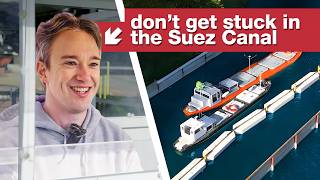

Why huge ships get stuck in canals
45sThe Suez Canal incident is a globally recognized event, and this clip teases a hands-on training solution, sparking curiosity.
▶ Play Clip"The title accurately reflects the video's content about tiny ships with a serious training purpose."
This video explores the Port Iława Ship Handling Research and Training Centre in Poland, a unique facility where maritime professionals train on 1:24 scale models of massive container ships. The host takes the helm of a model ship to navigate a simulated canal, experiencing firsthand the challenges of ship handling, including the bank effect, shallow water dynamics, and tugboat interactions.
The video references the 2021 Suez Canal blockage caused by a ship traveling too fast and experiencing the bank effect.
Port Iława Ship Handling Research and Training Centre has been operating since 1980, moving to its current lake in 1991. It features scale models at 1:24 ratio, replicating various waterways, canals, and restrictions.
The facility includes tugboat simulators that simulate the effect of tugs on the ship, crucial for maneuvering in tight spaces.
Over 6,000 pilots, masters, and chief officers have trained at the centre, averaging 220-230 per year, including very experienced masters.
The 1:24 linear scale means time is scaled by a factor of about 5, making maneuvers happen five times faster than in reality, which is a challenge but allows five days of training to cover extensive scenarios.
Early models were simple, but now they include precise GPS systems to measure ship model trajectories and add facilities like current generators to simulate shallow water effects.
The training covers interaction forces like the bank effect and repulsion forces that push the bow, requiring at least ten ship lengths to maneuver safely.
Real models provide psychological realism and allow trainees to feel current, wind, and weather conditions, which computer simulators cannot fully replicate. In case of mistakes, technical staff can rescue the model.
The Port Iława training centre offers an invaluable hands-on experience for maritime professionals, using scale models to teach complex ship handling in realistic conditions. The host successfully completes a lap around the lake without getting stuck, highlighting the effectiveness of this unique training method.
What is the scale of the ship models at Port Iława?
1:24
01:22
How many pilots, masters, and chief officers have trained at the centre?
Over 6,000
02:45
What is the time scaling factor due to the 1:24 linear scale?
About 5 times faster than reality
04:17
What technology is used to measure ship model trajectories?
A very precise GPS system
05:13
What is the bank effect?
A phenomenon where a ship traveling too fast in a canal gets sucked down to the ground due to shallow water.
03:11
Suez Canal Blockage Cause
Directly references a real-world maritime incident to explain the importance of training.
Time Scaling Challenge
Explains a key difference between scale models and reality, affecting training difficulty.
04:17Advantage of Real Models over Simulators
Highlights the psychological and sensory benefits of physical models for training.
09:00[00:00] that got stuck in the Suez Canal back in 2021? came out a few months ago, as I record this, It was travelling too fast,
[00:13] and there was the bank effect. You can get the theoretical explanation when travelling at speed along canals.
[00:28] you can learn it hands-on. Port Iława Ship Handling Research and Training Centre where the folks who steer those big ships
[00:41] Just to be clear, I'm not getting a full training course. a huge amount of theory work and study as well. for a lap around the lake, and...
[00:53] hopefully not get it stuck in the Suez Canal. We have started our training activity in 1980. In the '90s, we have moved from the old lake towards this one,
[01:07] and practically first training here was realized in 1991, We are performing training in ship handling. presenting different waterways.
[01:22] Everything was built using exactly the same scale, 1:24. different restrictions, rivers, canals. Permission to come aboard?
[01:36] Okay. It's one of the biggest in the world. 400 metre?
[01:49] 16 and a half. We can proceed. Dead slow ahead. And steady as she goes. Forward.
[02:02] These are the tugboat simulators. You've taken the controls here. and I'm just slightly nervous about driving a tiny boat.
[02:18] It's a 400m container ship. that simulate the effect of tugs on the boat. Hard to port?
[02:32] like the wheel of a pirate ship, Alright, so what's our plan now? Yeah, absolutely.
[02:45] I feel like I need to go left here. We have had, in our history, more than 6,000 pilots, masters, and chief officers
[02:59] On average, 220–230 a year. but we have also very experienced masters.
[03:11] Yeah. We will have If we have too high a speed, we touch the bottom. the more the boat is going to get sucked down to the ground.
[03:25] Oh! Sooner we do that, more time we have to apply any correction if necessary. That is such a tight spot to navigate through.
[03:39] Hard to star— Starboard, starboard. It's all going to fall apart. And starboard— yep. Starboard 20.
[03:51] Oh, I think I've overcorrected there! being done by the tugboats here, thank you. Yeah, starboard 20. Starboard 20.
[04:04] I can't see how close we are there. (wheezes) Again, solid tugboat work. Starboard 20. Okay!
[04:17] A linear scale, 1:24, means that timescale is equal to more or less five. five times faster than in reality.
[04:32] It's a disadvantage. But on the other hand, five days of training Hard to starboard. Hard to starboard.
[04:46] Hard to port again. Okay, I think we can make half ahead. We are clear of the lock.
[04:59] Phew! Did I need to slam that forward so dramatically? Our first models were really very simple.
[05:13] and that's it. we have started to add different facilities. It means a very precise GPS system,
[05:28] which allows to measure a given ship model trajectory Suddenly the nerves have gone. Starboard 10. Starboard 10.
[05:43] We're still going quite strongly to port Ages ago, and the wind? Due to the wind, yeah. You have to imagine that such a ship, fully loaded,
[05:57] with the windage area. Everything during exercises is measured, we can discuss step by step,
[06:11] Ooh! ...I'm sorry, I got distracted by a cormorant. Current, especially in the case of shallow water, It means we have current generators.
[06:24] This current velocity can be changed according to our needs. Oh, we did. That's me, sorry. It's not like this thing has rear-view mirrors.
[06:37] We're sailing a massive container ship Do I need to put a little bit of rudder in here? Right. You can make a port 10.
[06:51] Midship. Midships. Okay. Port 20. Port 20. And a full ahead.
[07:06] Starboard 20. Starboard 20. from the starboard wall. So it feels like I could go midships now.
[07:20] Except... It means the repulsion force pushes the bow. Hard to starboard. Gah, yeah!
[07:34] I'm putting full right lock on here. Yep... it is! You would have hit this wall. Yeah.
[07:49] That's so powerful! Midships. I was midships. I have to help you with that task.
[08:01] I should've done that earlier. Clear. Oh, cleared?! Hard to port.
[08:13] That was more luck than good judgment, that was! It means interaction forces, and... We have started
[08:28] three or four years ago, because... We need at least ten ships' lengths... And that harbour is here.
[08:44] Hard to port, okay. is realised in real conditions. you can feel very well current,
[09:00] and everything what deals with weather conditions. in case when using computer simulators. our training centre for training prefer very often to use
[09:16] Every driver's instinct in me is going, No, it won't. That's not how this works. The main difference regarding computers and our models
[09:33] you can switch off everything, In the case of our training centre, call technical staff for rescue tugs.
[09:50] directly from the training centre to our "shipyard" And this psychological effect influences People realise everything a little bit differently
[10:07] Alright, we are home. (sighs) I know very few people get to do that. (laughs) ...very easily.
[10:23] [Caption+ by JS* caption.plus | @caption_plus] Can I push the whistle button, please?
[10:37] Thank you! (laughs)
⚡ Saved you 0h 10m reading this? Transcribe any YouTube video for free — no signup needed.