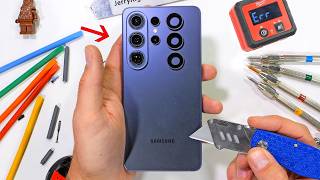

S26 Ultra Privacy Screen: Game Changer?
45sThe dramatic reveal of the privacy screen's dimming effect and its 45° viewing angle sparks curiosity and debate about usability vs. privacy.
▶ Play Clip"The title hints at unmentioned features, and the video indeed reveals several design changes not highlighted by Samsung."
This video presents a durability test of the Samsung S26 Ultra, examining its build quality, scratch resistance, and structural integrity. The host highlights new features like the privacy screen and camera design changes, while also noting the switch from titanium back to aluminum.
The host introduces the Samsung S26 Ultra and prepares to test its durability through scratching, bending, and other stress tests.
The privacy screen dims the display and narrows the viewing angle to 45° with max privacy mode, compared to 80° without. It uses narrow and wide-angle pixels, disabling wide-angle ones in privacy mode.
Privacy notifications only dim the notification text, leaving the rest of the screen unaffected. The host finds this more useful than full privacy mode.
The S Pen is thinner with a curved back end, and no longer has Bluetooth or wireless charging capabilities. It now only functions as a stylus.
The screen uses Corning Gorilla Armor 2, which scratches at level 6 with deeper grooves at level 7, but the level 6 scratches are barely visible, suggesting an improved glass recipe.
Samsung switched from titanium to armor aluminum for the frame, which the host approves of due to easier workability and recyclability.
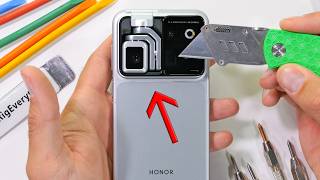
The camera lenses are now removable with the glass intact, making repairs cheaper and easier while maintaining IP rating. The host praises this as a fix to a previous flaw.
The S26 Ultra passes the bend test with zero flex, proving it is structurally robust despite the switch to aluminum.
The Samsung S26 Ultra demonstrates excellent durability with improved scratch resistance and a solid build, though the privacy screen dims the display significantly. The switch to aluminum is a practical choice, and the camera lens design now allows for easier repairs.
What is the viewing angle with max privacy mode enabled on the S26 Ultra?
45°
01:41
What material did Samsung use for the frame of the S26 Ultra instead of titanium?
Armor aluminum
04:51
What is the scratch resistance level of the S26 Ultra's screen according to the test?
Scratches at level 6 with deeper grooves at level 7, but level 6 scratches are barely visible.
03:54
What feature did the S Pen lose compared to previous models?
Bluetooth and wireless charging capabilities.
03:25
How does the privacy screen achieve its effect?
By disabling wide-angle pixels, leaving only narrow beams of light.
02:27
Privacy Screen Innovation
The privacy screen uses pixel-level control to narrow viewing angles, a unique approach compared to traditional privacy filters.
00:28Improved Scratch Resistance
The glass shows significantly better scratch resistance than expected, suggesting a reformulation by Corning.
03:40Switch to Aluminum
Samsung's decision to revert from titanium to aluminum is a practical choice for sustainability and repairability.
04:51Camera Lens Repairability
The new removable lens design turns a previous flaw into a feature, allowing easy and cheap replacement.
06:09[00:00] People, prepare. Today we present Samsung's pristine and premium S26 Ultra—a polished, pocketized powerhouse packed with potent processing, privacy pixels, and plenty of prestige. It'll presently be pressured with painstaking poking,
[00:16] prodding, prying, and un poquito of peeling to see if the polished paint on this pricey piece of personal preference prevails. Perhaps parts pop, or perhaps portions persevere. So,
[00:28] prepare your popcorn as we pontificate on its performance. The punishment procedure proceeds. The coolest part of this S26 Ultra is probably the privacy screen. I personally probably
[00:40] wouldn't use it a whole lot since it does dim the screen considerably, as you'll see in a second. But first, I noticed that instead of a similarly colored piece of glass around the camera plateau, Samsung has stuck a milky clear glass under the circles instead. You can see the way the plateau
[00:56] glows and illuminates as I shine my flashlight into it. And we can also see there's still a tiny gap between the lens and the translucent portion. I imagine this means the circular lenses are removable. We'll have to find out here for sure in just a second, as we always do.
[01:12] It would be epic of Samsung if they could turn this translucent plateau into a notification of some kind, like how the smartphone brand Nothing does. I don't know if an internally glowing camera island would help justify the $1,300 price point or not, but it would still look pretty cool.
[01:27] The part that bothers me the most about the privacy display is how dim it gets when maximum privacy protection is turned on. I mean, it works for sure—100%. I have an angle finder here that can tell the exact angle at which a person might be
[01:41] able to still see your screen. And with max privacy mode enabled, it's basically a 45° window of visibility from the side. Without privacy mode, anyone standing within an 80° radius can basically see your screen. Privacy mode cuts the viewing angle visibility in half.
[01:57] If I were to get an S26 Ultra, which I probably won't, I would probably just turn on the privacy notifications. This is where a text or email comes in, and the only portion of the screen that gets dimmed or blacked out is the notification text itself. Really incredible isolation.
[02:13] iPhone users are going to be ecstatic when Apple invents this in a few years. Busting out the microscope, you can see that Samsung basically has two types of pixels: narrow pixels and wide-angle pixels. Normally all of them are turned on and working together
[02:27] for the full 1440p screen resolution. But as soon as privacy mode is enabled, we lose about half the pixels—all the wide-angled ones—leaving just the narrow beams of light meant for your eyes only. Now, this shouldn't affect
[02:40] the scratch resistance of the screen, but there's only one way to find out for sure. Pulling out the S Pen—this guy is about the same length as last year, but it's definitely a lot thinner this time around. The shape of the back end is also curved, so it does matter which way it
[02:54] goes into the phone. But it is nice knowing that it does not get stuck if it goes in backwards like it used to on the original Samsung Note 5, which came out about 10 years ago. If you remember that phone, I do promise that stretching at night will help your lower back not hurt so much.
[03:09] The cool thing about the S Pen is that it has a roll of copper coils in the tip. These help the digitizer behind the phone screen better triangulate its position. It makes the stylus more exact. About two or three years ago with the S24 Ultra, the S Pen had a capacitor inside
[03:25] that would wirelessly charge off the copper coils, but that capacitor and the capacity to charge has since been eliminated. There are no more Bluetooth functionalities with the S Pen this year either—just a little spring in the top that lets the pen click in and out of the phone.
[03:40] Back to the scratch test. Samsung is using Corning Gorilla Armor 2 on the S26 Ultra. Plastic would normally scratch at a level two or three, but tempered glass like we see here
[03:54] scratches at a level six with deeper grooves at a level seven. But for some reason, that doesn't appear to be the case this time around. It is the same piece of branded glass as last year,
[04:06] but this year the level six scratches are extremely difficult to find. They are there, but barely. We're almost getting to the point where we can't say the thing. One mistake that I'll never make again, though, is not having a screen protector on my phone. I
[04:20] cracked the glass on my S24 Ultra a few months ago and ended up spending nearly $300 to get a genuine AMOLED screen replacement reinstalled on my phone, and that was doing it myself. A screen
[04:32] protector would have saved me. So, not having a screen protector is a very expensive mistake that I won't be making again. I'll just pop the S Pen back into the slot where it belongs. sponsors—is that it even works with privacy mode. They come two to a box and are foolproof
[04:51] to install. And of course, they are made with real glass. Link is down in the description. It's also interesting to find out that Samsung ditched titanium this year. We're back to using armor aluminum, which I'm actually okay with. The buttons are
[05:06] still removable. Titanium is cool and all, but aluminum gets the job done just fine, and it's easier to work with and easier to recycle at the end of its life. Now, the entire phone frame is made with just one metal and not two separate metals glued together.
[05:22] The bottom of the phone has our 60W USB-C port as well as our SIM card tray, and it has a gray rubber ring to help with the IP68 waterproof rating. There's no expandable really long time but also doesn't like to delete stuff. The logo on the back glass
[05:40] looks impressively etched. Apple could learn a few things about glass etching from Samsung. And moving up to the camera plateau, we have our top 50-megapixel ultra-wide-angle camera protected with glass. Then our 200-megapixel camera, also with glass. And at the bottom,
[05:56] our 50-megapixel five-times telephoto camera that we took apart during the teardown. If you want to see Samsung's new 37% improved ALOP design that they didn't tell anyone about, feel free to
[06:09] watch the teardown video after this one. Then we have the 10-megapixel 3x telephoto and the laser autofocus on the side. The single-tone LED flash is also protected with glass. I know I gave Samsung some grief about the lenses popping off on last year's phone,
[06:24] but this year I think they fixed it. Yeah, they still come off, but this time around it's almost like they're supposed to. The rings come off with the glass still intact, which means if you were to crack the glass on one of your camera lenses,
[06:37] it might just be a $10 fix that still keeps your IP rating intact, especially since the lenses just click right back into place. I'm impressed. Samsung took a flaw and turned it into a feature. Huge thumbs up from me, but let me know what you think down in the comments.
[06:52] The screen itself has basically remained the same as last year. Still 1440p if you don't have privacy mode engaged, still 2600 nits if you don't have privacy mode engaged, and still 120 hertz. It lasts for about 20 seconds under the heat from my lighter
[07:07] without any major damage to the pixels. Samsung has continued with the under-display ultrasonic fingerprint scanner, but again, for some reason, my level seven deeper grooves just ain't slapping like they used to. I imagine Corning tweaked something in the
[07:20] glass recipe since last year because it's holding its own against my picks quite a bit better. The ultrasonic scanner still works even with the level seven scratches. Finally, the bend test. The only Samsung to ever fail this test, of course, is the Samsung Trifold,
[07:35] which is to be expected. And this S26 Ultra, even with the switch back to aluminum, is still a rock-solid beast of a smartphone with zero flex when bent from the front or when bent from the back. The only thing that will ever break this phone is a drop.
[07:51] And you might be like, "Hey, wow, that is the most manliestly, rugged case I've ever seen." And yeah, Dbrand took some creative liberties with the ultra-rugged Tank case. It's got more than a dozen little Easter eggs built in, from GPS coordinates of Area 51 to Braille and Morse code. Fingers
[08:07] crossed nobody steals these Easter eggs. If you know, you know. It even has built-in magnets. Speaking of which, Dbrand's Totally Clear Zero Yellowing Ghost case also has magnets built into it. If Samsung isn't going to innovate, then Dbrand sure will. We even put magnets
[08:24] on my favorite case, the Grip case, with my teardown skin installed. Magnets for days. at your local Best Buy if you ever, you know, go outside—because protection is always a good thing.
[08:38] Thanks a ton for watching. I'll see you around.
⚡ Saved you 0h 08m reading this? Transcribe any YouTube video for free — no signup needed.