
Google's Pixel 11 Pro XL: Durability Test
45sThe opening sets up a high-stakes durability test with a controversial comment on Google's market share, creating immediate curiosity.
▶ Play Clip"The title promises a durability test and teardown, which is delivered, but the 'they said' framing is vague and the content is padded with sponsor segments."
This video is a durability test and teardown of the Google Pixel 11 Pro XL, examining its build quality, scratch resistance, and internal repairability. The host tests the phone's screen, frame, and components, then provides a step-by-step guide to disassembling the device, highlighting its ease of repair.
Google claims the Pixel 11 Pro XL is its most durable Pixel Pro yet, with an anti-scratch coating on the display. The host plans to test these claims.
Google holds about 1% of the global smartphone market, suggesting they have little to lose by taking design risks, yet the host criticizes the lack of innovation.
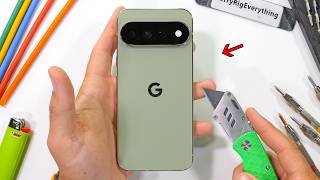
The phone is made with 100% recycled spacecraft-grade polished aluminum. The back panel color is compared to split pea soup, and the design is criticized as uninspired.
The screen has a proprietary 800nm thick anti-scratch coating over Gorilla Glass Victus 2. Scratches at level 6 are less pronounced, but deeper grooves at level 7 still appear, so the coating offers limited protection.
The phone features a 42MP front-facing camera, a 50MP main camera, a 48MP ultrawide, and a 48MP telephoto with 5x optical zoom. The bottom has a 45W USB-C port.
The camera bar houses the main, ultrawide, and telephoto lenses. The host criticizes the design as uninteresting, comparing it to a container in the back of a work fridge.
The Pixel 11 Pro XL passes the bend test, showing no flex, indicating a solid build.
Google sells genuine replacement parts through iFixit. The screen can be swapped in about 10 minutes, and the phone is one of the easiest to repair of 2026.
The teardown involves removing the back glass with heat and a pry tool, unscrewing green T4 screws, and removing brackets. The battery is glued securely, and the pull tabs are not very effective.
The rear cameras come out as one unit, allowing seamless switching between perspectives. The main camera has OIS, the ultrawide does not, and the telephoto has internal OIS.
The Tensor G6 chip is located on the motherboard with thermal paste, resting against a large vapor chamber. The earpiece speaker contains small balls for sound.
The most common repairs (screen and battery) are very doable, with a technician able to perform either in about 10 minutes due to clean internal design.
The Pixel 11 Pro XL is a solid, repairable device, but its design is uninspired and the anti-scratch coating offers only marginal improvement. The teardown reveals a well-engineered interior that makes common repairs easy, reinforcing Google's commitment to repairability.
What is the market share of Google in the global smartphone market?
About 1%
00:17
What material is the Pixel 11 Pro XL frame made of?
100% recycled spacecraft-grade polished aluminum
00:30
What is the thickness of the proprietary anti-scratch coating on the display?
800 nm
00:56
What are the specifications of the rear cameras on the Pixel 11 Pro XL?
50MP main, 48MP ultrawide, 48MP telephoto with 5x optical zoom
03:16
How long does it take to replace the screen on the Pixel 11 Pro XL?
About 10 minutes
04:55
What type of fingerprint scanner does the Pixel 11 Pro XL have?
Ultrasonic, under the screen
02:21
What is the charging speed of the USB-C port?
45 watts
02:48
Which camera does not have OIS?
The 48MP ultrawide camera
07:51
What is the name of the chip inside the Pixel 11 Pro XL?
Tensor G5
08:17
Market Share Insight
Reveals Google's small market share, providing context for the host's criticism of the lack of design risks.
00:17Anti-Scratch Coating Effectiveness
Provides a concrete test result showing the coating reduces but does not eliminate scratches, which is valuable for potential buyers.
00:56Bend Test Success
Confirms the phone's structural integrity, a key durability metric for consumers.
04:12Repairability Emphasis
Highlights Google's commitment to repairability, a growing concern for consumers and the environment.
04:42Repair Time
Provides a concrete estimate for common repairs, making the phone's repairability tangible.
08:30[00:03] They say it's their most durable Pixel Pro yet with an anti-scratch coating on the display. I'll have to be the judge of both of those things. I've always wondered why Google doesn't take more risks with their Pixel line of phones.
[00:17] Google has cornered a solid 1% of the global smartphone market, so they have literally nothing to lose by trying something new. They are pretty great at centering the glossy logo on the back glass, though. Thumbs up for that.
[00:30] Today, we're going to find out if that big G stands for great or garbage. Right off the bat, the phone feels nice. Google says the Pixel 11 Pro XL is made with 100% recycled spacecraft grade polished aluminum, and the back panel
[00:44] reminds me of split pea soup. Not my first color choice, but to each their own. When I suggested Google take some risks with their phone, I thought it might be something other than the aura of a depressed avocado. Scratch
[00:56] resistance is pretty cool, though. if it works. Google says the screens are more than twice as scratchresistant as previous models. It has a special proprietary coating that's 800 nm thick, sitting right above that Corning Gorilla
[01:10] Glass Victus 2 and below the olophobic coating. And I don't know, maybe it does help with micro scratches because the scratches at a level six do appear to be slightly less pronounced than usual, but the deeper grooves at level seven are
[01:25] definitely still there. So, we'll have to chalk this up to a maybe it kind of enough though to roll without protection. Luckily, my channel sponsor Dbrand has all of us protected with their far too easy to install Prism
[01:39] screen protector. If I set on the applicator and slide my finger down the center, the Pixels are pretty perfectly protected from scratches and impacts, which is great since Google wants you to set your phone face down to use their
[01:53] you two screen protectors in each package, and they're always made with real glass. I'll leave a link down in the description. DBR does make these mainstream devices, and they probably have one that fits your phone, too. The
[02:08] Pixel 11 Pro XL has a 42 megapixel front-facing hole punch camera, very respectable, right below an earpiece slit.
[02:21] polished spacecraft grade aluminum with a removable volume rocker and removable power button. The fingerprint scanner on this bad boy is ultrasonic and under the screen. We'll have to find that here in a second. Up top, we have a SIM card
[02:35] tray and a noiseancelling microphone hole. If you got your phone in the USA, it'll only have the internal eSIMs. The international version though does have the black rubber ring and it slides into the phone hamburger style and not hot
[02:48] the phone hamburger style and not hot dog style, if you know what I mean. The bottom of the Pixel 11 Pro XL has our 45 watt USBC port and two chain mail- like mesh coverings over the loudspeaker opening. These will not be
[03:03] falling out on their own. Making our way to the back glass panel, I do wish it was the composite glass fiber we saw in the Pixel Fold this year, but alas, it is shatterable Shrek to colored satin glass. Up in the camera bar, we have our
[03:16] 50 megapixel main camera on the left, 48 megapixel ultrawide in the center, and 48 megapixel telephoto with 5x optical zoom on the right. And of course, the highlight LED flash, which let's be honest, a flashlight is really all it'll
[03:32] ever be used for. It's definitely not a nothing. The whole shiny edge running around the plateau is made with the same glossy metal as the rest of the frame, but it does not easily pop off like we see on Samsung's individual camera
[03:44] rings. I don't know. I just feel like both Apple and Google are both worth like $4 trillion each. And everyone knows Android is the superior operating system of the two, but Google isn't complenting
[03:58] it with sufficiently interesting hardware. All they gave us this year is container at the back of the work fridge that no one wants to open. The Pixels do hold their own for 20 seconds against fire, though. Don't try this at home.
[04:12] Finally, the bin test. And luckily, for Google's sake, the Pixel 11 Pro XL is extremely solid with barely any flex to speak of. This latest flagship Pickle [laughter] Pickle, I didn't even plan that. This latest
[04:28] flagship Pixel survives my durability test. Every year, the Pixel phones are some of the most repairable smartphones on the planet, which I can for sure appreciate. Thankfully, the insides always look better than the outsides.
[04:42] Google sells genuine replacement parts directly through iFixit, which is super helpful, and it looks like this year is no different. With a little bit of heat on the front screen, it comes off easily. I did break like 50 phones back
[04:55] way. So, don't expect success on your first attempt. The first step to being kind of good at something is being bad at something. And there you go. The screen of the Pixel 11 Pro XL can be swapped out in about 10 minutes with
[05:08] long as you don't slice through the ribbons that sit about a/ inch inside the screen, Google has once again made one of the easiest phones to repair of 2026. I'll turn off the phone and get it unplugged so we can work on the back
[05:22] side. back here. It would be far better if Google had installed that composite glass fiber, but we can use the heat gun and our pry tool again, taking very special care around the left edge since that's where the ribbons are for the
[05:35] highlight LED and wireless charging coil. I'll unscrew the two green T4 help us know which order by which to remove the components. It's kind of a nice touch. With the first two screws out and the bracket removed, the back
[05:49] glass panel can come loose. This has our pixel snap magnets as well as the 25 pixel snap magnets as well as the 25 watt wireless charging coil
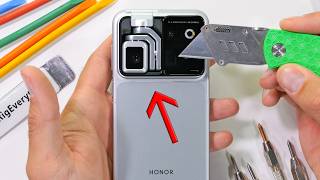
[06:02] Google's significantly over complicating a flashlight that nobody asked for explains a lot. For reference, Honor, another smartphone manufacturer, has a robot arm camera gimbal extend out of their phone and both phones cost about
[06:17] video on that device here soon, so hit the subscribe button so you don't miss it. With the other three green screws gone over the rather substantial metal plate covering the motherboard, I can pull it off. It's got a cool G6 decal on
[06:31] point and pop off the long extension ribbon just like a little Lego. There are four more green screws over the charging board. Then I can use the included pull tab to try and pull out the battery. It's still very securely
[06:45] glued into place. The pull tabs aren't helping all that The pull tabs aren't helping all that much, but I do appreciate the sentiment.
[06:58] remove three more non-green screws near the loudspeaker. This frees up the phone. It has a gray rubber ring around the tip to help keep everything IP68 watertight. The loudspeaker comes out next. It has its own waterproofing mesh
[07:12] over the speaker opening along with a red rubber ring and a whole lot of balls inside. The haptic vibrator is in the other lower corner of the phone. And we chamber that was tucked under the battery. There's a whole empty pass
[07:25] through compartment on the back side of that front screen. I'll remove three more T4 screws and one special standoff screw in the bottom right corner of the motherboard. Luckily, most repairs will never have to go this deep. I'll pop off
[07:38] one more bracket holding in the front-facing 42 megapixel selfie camera. This does not have any OIS. The main rear camera units can all be individually unplugged next. Then they come out as one whole unit. When they're
[07:51] physically bound together, they can switch between perspectives more seamlessly. The large 50 megapixel main cameras on the left with optical image stabilization. Then the 48 megapixel wide-angle camera in the middle does not
[08:03] have OAS. And the 48 megapixel 5x telephoto on the right has internal OAS. There's one more tiny screw holding in the motherboard. And then she's free. This is where the Tensor G6 lives. It's got some thermal paste joining it with
[08:17] the bare non-anodized aluminum, which is then resting up against the super large vapor chamber on the other side. The upper earpiece stereo speaker has more balls inside. But there you have it. The most common repairs, the screen and the
[08:30] battery, are very doable, and a technician could perform either of those repairs in about 10 minutes thanks to Google's very clean internal designs. As a side note, Google must be especially proud of how their phones look this year
[08:43] since starting today, you can get the tearown skin and Dbrand's Pixel Snap Grip case for your Pixel 11, Pixel 11 Pro, and even the Pixel 11 Pro XL right from the Google Store. Pretty epic. Look how clean that case is. Our Dbrand is
[08:59] all grown up and playing with the big boys. For the other 99% of you who don't own a Pixel, there's dbrand.com. Protection is a good thing. I'll leave a description. And thanks a ton for watching. I'll see you

⚡ Saved you 0h 09m reading this? Transcribe any YouTube video for free — no signup needed.