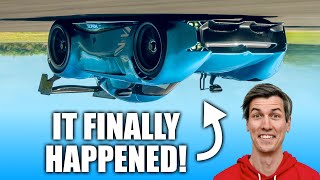

Driving Upside Down at 0 MPH?
42sThe surprising fact that a car can drive upside down without any speed using fan-generated downforce shocks viewers and sparks curiosity.
▶ Play Clip"Delivers exactly what the title promises with a thorough engineering breakdown, no fluff or bait-and-switch."
The McMurry Spearling fan car uses fans to create a vacuum underneath, generating 2,000 kg of downforce that allows it to drive upside down at any speed. This engineering feat relies on a pressure differential and a proprietary skirt seal, achieving remarkable efficiency compared to passive aerodynamics. The video explores the physics, the team's approach, and the potential applications in motorsports like Formula E and F1.
The McMurry Spearling can drive upside down without speed, using fans to generate downforce that holds the car to the surface even when stationary.
Downforce is calculated as pressure differential times area. Atmospheric pressure is 100 kPa; the car's area is 6.5 m², giving a theoretical maximum of 65,000 kg of downforce if a perfect vacuum were achieved.
The Spearling produces 2,000 kg of downforce, which is only about 3% of the theoretical maximum, showing the effectiveness of the fan and skirt system.
A skirt drops to create a seal against the ground to maintain the vacuum. Only a 20% vacuum in a 1 m² area is needed to achieve 2,000 kg downforce, or lower vacuums over larger areas.
When sideways, the car experiences 1,000 kg weight downward and 2,000 kg side force. Friction must exceed 1,000 kg to avoid sliding. With grip tape, the coefficient of friction is above 0.5, preventing slip even on wet steel.
The fans consume 30–60 kW, yielding 30 watts per kilogram of downforce. In contrast, a helicopter-style fan would need 2,000 kW (1,000 W/kg), and passive aero like the Dodge Viper ACR requires 180 W/kg.
With 1,000 hp and 2,000 kg downforce, the car corners at 3 Gs, brakes at over 3 Gs, and accelerates 0–60 mph in under 2 seconds despite being rear-wheel drive.
In Formula E, fan technology could improve energy efficiency by allowing more downforce without drag penalty, and enable full regen on rear axle. In F1, it solves dirty air problems, maintaining downforce even when following closely.
The McMurry Spearling demonstrates that fan-based downforce is highly efficient and could revolutionize motorsports, though it's unlikely for street use due to practical constraints.
What is the maximum theoretical downforce if a perfect vacuum is created under the Spearling?
65,000 kg (650,000 N).
01:41
How much downforce does the Spearling actually produce?
2,000 kg.
02:48
What is the power consumption range of the fans?
30 to 60 kW.
08:05
What is the efficiency of the Spearling's fan system in watts per kilogram of downforce?
30 W/kg.
08:35
What is the efficiency of the Dodge Viper ACR's passive aerodynamics in watts per kilogram?
180 W/kg.
12:03
What safety measure is used to prevent the car from sliding when sideways?
Grip tape on the surface to increase friction.
07:37
What is the car's cornering capability in Gs?
3 Gs at any speed.
12:57
What is the 0-60 mph acceleration time?
Under 2 seconds.
13:12
Theoretical Downforce Potential
Demonstrates the immense potential of vacuum-based downforce, far exceeding what is actually used.
01:41Energy Efficiency Comparison
Shows that fan cars are dramatically more efficient than passive aerodynamics (30 W/kg vs 180 W/kg) and helicopter-style fans (1,000 W/kg).
07:51Skirt as Proprietary Technology
Explains the critical yet secretive component that makes the vacuum feasible, leaving room for future innovation.
03:51Solving the Dirty Air Problem in F1
Fan technology could eliminate the loss of downforce in turbulent air, enabling closer racing in Formula 1.
15:12[00:03] driven upside down using only the downforce it creates. No stunt loop momentum trickery, just brilliant engineering. It's a fact that has been recited countless times that if you drive fast enough, race cars like those
[00:19] in Formula 1 could actually drive upside down. Well, someone finally proved it and with their own clever twist. No speed was required to make this happen. speed was required to make this happen. At 0 mph, the car is genuinely capable
[00:33] of holding itself to the surface while upside down. Dab the throttle pedal and boom, you're driving upside down. Insane. And the task is actually a very difficult engineering challenge. So, I spoke with the team behind the McMerry
[00:48] Spearling. And in this video, we're going to learn how they did it. So, the Spearling is a fan car. It's using fans in order to pull the car to the ground. creating a pressure differential. So, we
[01:02] need to understand air pressure. So, air pressure is acting all around us, right? there, air pressure is pushing it down on it. It's pushing up on it. It's pushing on the sides. So, net, it's not forcing this car in any direction,
[01:15] whether up or down. However, if you reduce the pressure underneath the car by creating a vacuum using fans and pulling out that air from underneath the pressure differential between the top and the bottom and you force that car
[01:29] into the ground. Now, I want to figure out how much potential do we actually have here for downforce. Now, if we want to calculate the force, we need to look at the pressure and then the surface area that it's acting on. That will give
[01:41] us force. Pressure time area. So what we're interested in is what is the difference between the pressure on the top minus the pressure on the bottom and then multiply that by the surface area that it's pressing down on. So if we
[01:53] look at atmospheric pressure about 100 kPa or 14.7 psi and if we look at the area we're going to have looking down on the car from above it's about 1.78 m
[02:05] the car from above it's about 1.78 m wide and about 3.7 m long. So that gives wide and about 3.7 m long. So that gives us about an area of 6.5 m squared. Now, removed all the air from underneath the car and we have this perfect vacuum.
[02:18] we're going to assume here to see what is our potential downforce that we could is our potential downforce that we could create. So, we have 100 minus 0 multiplied by 6.5. And that tells us that we can produce
[02:33] 650,000 newtons of downforce. Or if we're to divide that by gravity, then we divide by about 10 m/s squared. And that gives us gives us 65,000 kg of downforce potential. Now,
[02:48] this car is actually only producing 2,000 kg. I say only, that's an extraordinary number. But the point is, we have a lot of potential downforce to work with. All right, so here's where we get into the secret sauce of the McMurry
[03:00] Spearling. Now, it uses a fan to remove air from underneath the car and create a vacuum, thus creating that pressure differential that pulls the car to the ground. But creating a vacuum is very difficult. So, you'll notice right
[03:12] before the fans kick in, you have a skirt come down and contact the surface and create a seal. Not a perfect seal, of course, but it's trying its best to seal to the ground so that you can maintain a vacuum underneath the car.
[03:25] Now, if you're a conspiracy theorist, this is where you go, "Aha! They just holding the car to the ground." Impressive deduction and critical thinking, I say. Though, that's not actually what's happening. Mc Merry has
[03:38] revealed a lot about this car, but this skirt is the bit of proprietary tech they're keeping their carts close on. What materials it's made of, how long it lasts, how well it seals, and what vacuum it enables. Those are things we
[03:51] don't know. But we can do some math and get a bit of an idea of how it's done. So, we know that we don't need to seal the entire area underneath the car because we have so much potential, right? 65,000 kg of downforce potential.
[04:05] We're only trying to get 2,000 kg. So, if we were to cut off one section with that skirt underneath the vehicle of one square meter, well, we know that one square meter has the potential of 10,000 kg of downforce, right? 65,000 kg, 6.5
[04:22] m. Divide those 10,000 kg in one square meter. We only need 20% of that. So within that one square meter, if we could just pull a 20% vacuum, in other words, a 20 kphpa drop, well then we could hit our target of 2,000 kg. 1 m
[04:37] could hit our target of 2,000 kg. 1 m squared * 20 kilopascals, 2,000 kg. Or if you don't want to pull a 20% vacuum, say just pull a 10% vacuum, which would say just pull a 10% vacuum, which would be easier, use a 2 square meter area. 2
[04:50] * 10 kilopascals, only a 10% vacuum there, 2,000 kg. Or if you want even less of a vacuum, but now you have to seal an even greater area. 4 meters squared times just a 5% drop in pressure. 5 kPa. Four times 5 kPa, 2,000
[05:06] kg of downforce. So, we don't know exactly what area they're sealing they're able to pull, but it's probably going to fall somewhere within this range. Now, you might be surprised to learn the upside down portion of the
[05:19] experiment isn't actually the sketchiest part. There's something that can be even more challenging, and that's holding the car sideways as it rotates around. So, when the car is upside down, actually, this is a pretty chill scenario. So, the
[05:33] car weighs about 1,000 kg. Of course, you have to keep in mind the weight of the driver. So, that's pulling it down. Though, you have 2,000 kg of downforce, or in this case, up force pushing that car up. So, net you've got about 1,000
[05:47] kg of force pushing it up. So, this is going to drive just like any normal car, except you're upside down. Very cool. Now, things get sketchy, though, when you're rotating over to that and you're sideways. So, when you're sideways, that
[06:02] down force is pulling you to the side, whereas the weight of the car is trying to pull that car down. So, you've got 1,000 kg pulling it down, 2,000 kg pulling it to the side, and the car wants to slip down this surface. So when
[06:16] these tires and this wall, we can calculate the minimum force needed in order to make this car slip. And we need that force that's going to cause it to slip to be greater than 1,000 kg, right? Because we have 1,000 kg pulling it
[06:31] down. So if it's less than that, the thing's going to fall. So that force is equal to our frictional coefficient multiplied by our normal force. In this case, let's say we have a perfect road surface on a dry day. Frictional
[06:44] coefficient of 1.2. 2 and we know we have 2,000 kg of downforce. Well, 1.2 * 2,000 that gives us of a force of 2,400 kg. So, way bigger than 1,000 kg.
[06:57] You don't have to worry about it sliding, but we're not on a perfect road surface, right? So, at what frictional coefficient would this thing start to slip? Well, we can set 1,000 kg equal to our frictional coefficient time 2,000
[07:10] kg. And that means if we have any frictional coefficient of less than 0 five, then we're going to have this thing start to slide down that wall. So, for example, we are on a smooth painted steel surface. And if that smooth steel
[07:25] surface were to get wet, well, it's going to drop the frictional coefficient dramatically. Wet painted smooth steel can have a frictional coefficient of can have a frictional coefficient of anywhere from around 0.1 to 02. That is
[07:37] a concern, right? So, if this platform was just a little bit wet, the car could slide off. So, what do they do? Well, as a safety measure, they put grip tape to worry about the frictional coefficient dropping too low from any
[07:51] moisture that could be present. All right, so the key to creating a vacuum is, of course, using high-powered fans. But one of the things I was most surprised about with this system is just how little energy it actually uses. It's
[08:05] remarkably efficient in terms of the amount of downforce generated relative to the power used. So, we have two fans powered by electric motors. And these two fans can spin up to 23,000 RPM. Now, in order to do that,
[08:19] they're going to require about 30 to 60 kW of power in order to generate that 2,000 kg of downforce, the appropriate vacuum to create that downforce. So, estimate here and say it's requiring that full 60 kW of power in order to
[08:35] create that downforce. So 60,000 watts divided by 2,000 kg gives us an divided by 2,000 kg gives us an efficiency of 30 watts per kilogram of downforce created. Now one of the beautiful things about this solution is
[08:49] that allows your car to be a very aerodynamic shape because the shape of the car isn't what's creating the downforce. That's done with the fans. So that means you can have more energy saved by having a very efficient shape
[09:01] of your car as it's driving along the road at a very high speed. and thus you want to use that for power to make the car faster or to give the car more range. Now to provide some context for this 30 watts per kilogram, I thought,
[09:15] well, what if we had a car that was basically a helicopter but upside down? So the propellers are pushing you into the ground. So you have this massive 1 m fan that's on top of the car that's just spinning really fast. How fast and how
[09:28] much power would be required in order to actually give you 2,000 kg of downforce? which you would use for helicopters, and we're just doing everything in reverse here. And so, you can find out that the amount of power you would need if you
[09:43] had a 1 m fan in order to produce 2,000 kg of downforce would be about 2,000 kW. That's with perfect efficiency, or about 1,000 watts per kilogram. So, 33 times
[09:57] the amount of power versus our fan car here. So, you can see how remarkably efficient of a solution using a vacuum underneath the car is in order to create downforce. Now, this got me thinking, how much energy do passive aerodynamic
[10:13] features require, like splitters and big wings? To figure this out, we're going to be analyzing a Dodge Viper ACR for two reasons. First, Dodge provides really good data on these cars. And second, because this machine went on a
[10:27] track record-breaking spree thanks to the immense amount of downforce it creates, which admittedly pales in comparison to the Spearlink's numbers. All right, bear with me through some mental gymnastics here. So, here we have
[10:40] a Dodge Viper, and then here we have a Dodge Viper ACR. And as you can see, it's got a lot of really cool fancy aerodynamic bits that are thrown on the the challenge with this is once you throw all these aerodynamic bits on it,
[10:54] the car's drag coefficient goes way up. Dodge provides these numbers. So stock Dodge provides these numbers. So stock car at 369 versus the ACR a drag coefficient of.544. Now what this means is this car
[11:06] has a lot more drag. It takes a lot more power to drive through the air especially at high speeds. Okay, so we can find out the difference in how much power each of these requires in order to drive down the road at 177 mph. How much
[11:21] power is lost from aerodynamic drag and then we can look at the difference in how much downforce they create. And so using this ratio, we can calculate what's the efficiency, right? how much power is required in order to create the
[11:35] amount of downforce that this creates which is about 695 kg for the ACR versus just about 34 kg for the regular bike. So we do the math which I will show on
[11:47] the screen and that gives us a number of 180 watts per kilogram of downforce of 180 watts per kilogram of downforce added. So look at this. We've got 1/3 of the downforce of this car, yet it requires twice the power in order to do
[12:03] it. So, six times the power per kilogram of downforce. And if you look at the Viper Extreme, which has a bit more efficient of an aerodynamic package, efficient of an aerodynamic package, that comes out to about 160 watts per
[12:16] more efficient aerodynamic shape. But regardless, you can see here how this production car is using so much energy to create that downforce. Whereas you could be saving that energy to make the
[12:29] car faster. If you have a car with a really aerodynamic shape combined with lots of downforce from fans, net, you're actually going to save energy. Now, you do have to keep in mind that more downforce will increase rolling
[12:43] resistance, but aerodynamic drag tends to consume a lot more power. All right. So, not only does the McMerry produce the downforce efficiently, but the sheer amount of downforce combined with a,000 horsepower from two independent motors
[12:57] powering the rear tires leads to absolutely bonkers stats. The car can absolutely bonkers stats. The car can corner at 3Gs at any vehicle speed. It can break over 3Gs, again, all the way down to 0 mph. and it can accelerate
[13:12] from 0 to 60 in well under two seconds, even though it's rear wheel drive. It's no surprise that it has been smashing lap records left and right. Now, from my perspective, I don't see this technology being implemented in street legal cars.
[13:27] There's simply too many reasons why on public roads, it doesn't make sense. But in racing, it really does seem like this kind of technology could offer a better kind of technology could offer a better experience for fans. Fans? No. All
[13:39] right, so let's start by comparing it to Formula E. So this technology could actually improve energy consumption. In Formula E, they're actually extremely efficient vehicles. But for example, if you're able to make this much downforce,
[13:52] you're able to corner faster, you don't have to break to as low of a speed as don't have to break as much, well, you're saving energy. So you're going to have better efficiency while improving your lap times. You also get lots of
[14:07] downforce without the drag penalty. One of the big reasons why Formula E is very low downforce is because it comes with that huge drag penalty, right? The cars don't have enough energy on board in order to deal with it. So, you have to
[14:20] have low downforce cars, therefore lower grip, therefore the racing is slower. And finally, the Spearling is actually capable of reaching the regen limit of the battery despite the fact that it's rear wheel drive. So, typically if
[14:33] you're braking and you want to use regen to do the braking, you'd want that to be most of the weight is going to shift. But in a car that's a fan car pulling itself down on both axles, you have so much weight on that rear axle that you
[14:47] can actually get the full consumption, the full amount of regen just using those rear brakes. So, unlike Formula E where you have another motor in the front just for regen, you don't need that excessive waste, that extra mass,
[14:59] that extra complexity. You can do it all with the rear axle. So, a very cool solution in comparing this technology to something like Formula E. Now, what about Formula 1? Well, one of the things they're always trying to do in Formula 1
[15:12] is to enable the cars to drive really close together, right? Because that's fun racing. That's exciting to watch. The challenge is as one car gets closer to the car in front of it, it has that dirty turbulent air coming off of the
[15:25] car in front of it. And so, it disrupts its aerodynamics. it loses its downforce and suddenly it can't corner as well and it can't break as well. So, it's a huge problem to try and create cars that can follow closely but that don't lose their
[15:37] downforce because that downforce is dependent on that clean air being in front of the car. Well, with a fan, you don't have to think about this, right? the car and you can still produce all of your downforce because it's based on
[15:51] suction underneath the car. So that means you get the benefit of less drag by following a car in front, but you still maintain your downforce. So you're as the car in front of you, and you're able to break just as fast as the car in
[16:04] front of you. And speaking of using this technology, of course, Formula 1 is dependent on speed to get that downforce and thus create a lot of grip. So in your lower speed corners or in your lower speed braking scenarios, you could
[16:17] braking if you were using a fan that's not dependent on passive aerodynamics. So with fan cars, you could get some crazy lunges in Formula 1. And of course, historically, there was a fan car in Formula 1, though the technology
[16:31] was banned. So what an absolutely insane vehicle and such a cool achievement of driving the thing upside down by the McMurry team. A huge thanks to them for have any questions or comments, feel free to leave them below. Thanks for
[16:45] free to leave them below. Thanks for watching.



⚡ Saved you 0h 16m reading this? Transcribe any YouTube video for free — no signup needed.