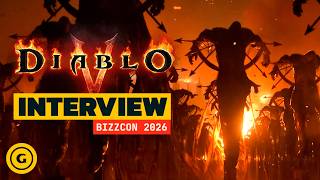

Why Diablo 5, Not Just an Expansion?
45sDirectly answers a major community question about the game's existence, sparking curiosity and debate.
▶ Play Clip"The title promises insights into Diablo 5's announcement, and the interview delivers exactly that, though it's more of a discussion than a reveal."
In this interview, Diablo developers Matt and Tiffany discuss the decision to announce Diablo 5, explaining that it stems from a deep understanding of player desires and the need for structural changes that expansions cannot accommodate. They emphasize the importance of early community feedback, the darker post-apocalyptic tone, and the evolution of combat and storytelling.
The decision to create Diablo 5 was driven by understanding who Diablo players are and what they want. The team realized that achieving their ambition required deeply structural changes that are hard to do in an expansion.
Diablo himself is the main villain, and the team wants to tell a story on par with or exceeding Lilith and Mephisto's. This required a full game, not an expansion.
Diablo 5 takes place 100 years after Diablo 4, allowing the team to set the stage for Diablo's return and conquest of Sanctuary in a way that would be challenging in an expansion.
Announcing the game early opens the door for player feedback, which is crucial for development. The team is already gathering feedback from BlizzCon and will use it to shape the game.
Diablo exists in a space between live service and narrative-driven games. The team balances serving players who love seasons with those who want a complete story experience.
The upcoming season 'Hell's Legacy' and the Amazon class are examples of how the team is bridging Diablo 4 into 5, ensuring players are satisfied with both games.
The team plans to engage the community starting in 2027, with betas and community activations, to gather feedback early and ensure Diablo 5 ships as the experience players want.
While details are not ready, the team is exploring how player choices in character building and combat express themselves in the world, especially in a world where Diablo has already won.
The post-apocalyptic world makes the story fundamentally dark, but the team balances it with levity, like the character Zarg the Charger Goblin, to avoid fatigue.
Diablo 5 will remain an isometric action RPG but will evolve combat to be more visceral and action-forward. The team is also improving cinematic rendering tech for personal stories.
Diablo 5 is a deliberate evolution of the franchise, driven by player feedback and a desire to tell a darker, more personal story with Diablo as the central villain. The team is committed to engaging the community early to ensure the game meets expectations when it launches in 2029.
Player-Centric Design
The developers emphasize that understanding player desires is the critical first step in game development, a principle applicable to any product.
Early Feedback Loop
Announcing early to gather feedback is a strategic move that allows for meaningful changes during development, contrasting with later announcements.
02:59Dark Story with Levity
Balancing a dark narrative with moments of levity is a nuanced approach to storytelling that prevents fatigue.
09:51Evolving Combat
The commitment to evolving combat while maintaining the isometric genre shows a balance between innovation and tradition.
11:35[00:00] What inspired you to, I mean, not launch, but I guess announce Diablo 5, rather than saying, hey, we're going to do more expansions for 4? Like, why start a whole new game? Yeah, I talked a little bit about this in the panel, and it really started by looking at who our players are.
[00:18] Who are Diablo players? Why are they playing Diablo? What do they want out of a Diablo game? That is a really critical step in the early conceptual phase for a game, Even before you're thinking about, oh my gosh, should we make this an expansion?
[00:30] Should we make it a sequel? How do we do this? Really deep in understanding who our players are and what they want. And from there, looking at, again, past examples, looking at what's working well and for, where there's opportunities for improvement.
[00:42] And we kind of build our ambition for the game, the conceptual phase, through those avenues of information. And as we started to understand and kind of solidify what that ambition was, It became very clear to us pretty early that in order to achieve what we wanted to achieve with this game,
[01:00] we needed to make some more deeply structural changes to the way the game works. Changes that are just frankly hard to do in an expansion. And so, again, it's all about figuring out what is the best way to make the best Diablo game we can for players.
[01:15] That's where it starts. And on top of that, Diablo is the main villain. Diablo is the guy that we want to tell a real story about. We want to tell a story that's on par with
[01:29] and hopefully exceeds the story we told with Lilith and Mephisto. And to do that in an expansion just didn't feel right. We needed to give him his own game. And at the same time, again, we talked earlier about
[01:41] wanting to have great things coming to floor with the Amazon and the ending season and continue to build on that and think about how we bridge players from four to five
[01:53] in a way that should be very exciting for them. Yeah, I wanted to add that, you know, the events of Diablo V take place 100 years after the events of Diablo IV, and that affords us the opportunity to really set the stage for Diablo
[02:08] and his return and conquering of Sanctuary in a way that I think would have been challenging for us. and again we get to now tell that story that we haven't been able to before and Diablo 4 sets up such a great story
[02:21] like Nat was saying with Lilith and Mephisto that we just wouldn't be able I don't think it would be a larger stretch to be able to carve out space for the type of story that we want to tell
[02:33] with Diablo 5 and Diablo and then we really were invested in Lord of Hades did a really really great job of telling a more personal story and being able to lean deeper into those cinematic moments.
[02:46] And again, we go back to the caravan where we had this real desire to keep building upon the campaign and being able to get to know the characters and make sure it was a little bit better. I realize you asked about, well, why would you announce right now?
[02:59] And I think a key part of that is also about opening the door for feedback. We, as developers, put a lot of effort into understanding or a player if they're trying to really understand what motivates them to play a game,
[03:13] we still need to hear from them, right? We need that feedback. Announcing the game now lets us start the process of getting feedback. We're already getting it just from, you know, a couple days of BlizzCon and we already having all these conversations behind the scenes like oh that interesting Diner Oh did you see how see how that reaction happened What can we do with that And so by opening the doors early and bringing player feedback in now
[03:36] it lets us use it in the actual development of the game. If we didn't announce that and we kind of held back until we were much further along in development, at that point it's much harder to take that feedback and use it to make those really important changes
[03:49] and refinements of the game throughout development. And so I think, you know, when I joined the team, this was something that was already, you know, the team of four was doing a great job, you know, season over season, getting the feedback, listening to the community, making the changes along the way, you know, shaping the game based on the feedback of the community.
[04:10] And that was something that was important for us to bring forward into development of five and think about from the jump. How do we develop level five in a way where we're building on that momentum of team, you know, doctrine for in terms of feedback and making that a core part of our development philosophy?
[04:28] Yeah. And I think, you know, some of what you said just makes me think about, like, the current landscape of games right now. Because even 10, 15 years ago, I don't think that we were all chasing this idea of, like, a forever game, right?
[04:41] Like, everything wasn't seasonal. you know you had kind of this is the story and then it gets wrapped in a bow and it's done and Diablo kind of exists in an interesting space because it is part a live service game but it also
[04:55] is like a very narrative heavy like this is the experience and it's kind of done so I mean what is it like kind of navigating that space and you know maybe announcing Diablo 5 and I'm sure you've
[05:07] seen as looking into the feedback like people being like well what about 4 like why would I keep spending money on 4 or playing this if I know this is coming. How do you satisfy both needs of having this new game, this new story,
[05:20] versus maintaining this game that people are putting money into? Sure. Again, I think I want to reiterate the amazing stuff that's coming to 4. I did a panel earlier today talking about what's in the season,
[05:34] and I was watching the panel from the monitors in the green room, and there's just so much stuff in the upcoming season of Hell's Legacy. the Amazon coming to 4. So that's, I think, an example of where we are looking at how
[05:46] we're bridging the game from 4 into 5 in a way that should be satisfying for players. But to your question about how you think about making games in this age of, you know, there's live service games, there's games with more and less live service elements, again, for
[06:01] me, I think it comes back to looking at our players. What do Diablo players want? Well, There are Diablo players that love to play seasons, right? They love to play games. They love the moment where the game tells them,
[06:14] this is the time to come back. We've made changes to the game. This is the time to come back and start fresh with a new character. And so, to me, serving our players means serving that part of the community. And we're going to be able to get more into our post-launch plans later on
[06:29] as we kind of unfold more about the game. And when can we expect to find out a little bit more about the game? Or, you know, as you said, there's going to be opportunities for player feedback. So is early access something you're looking into or, like, doing betas?
[06:43] As I mentioned on the panel, in 2027, you'll hear from us again. We want to start engaging the community as soon as possible. Just to reiterate what Matt was saying we found a lot of success on Diablo 4 engaging with the community And on Diablo 4 we weren able to do that on a lead to launch until later
[07:03] than we would have desired. And so we're hoping that we can engage the community starting in the next year. We had a lot of successful datas and some community activations on Diablo 4,
[07:15] and we do want to carry that forward. And the reason for that is we love engaging with our community, but as a producer, to Matt's point, the earlier that we can get the feedback on what is and isn't working
[07:28] and what they want to see from our game, the easier it is for us to ensure that when we get to spring of 2019 and we're shipping Diablo 5, that it really is the experience that everyone is looking for.
[07:41] Just how we said it really well on our panel yesterday that obviously we are big, big fans of Diablo and players ourselves, But ultimately, we want to make sure that we are building the game that the community wants.
[07:53] So while we have no shortage of incredible ideas and areas that we want to innovate and things that we want to pull forward from previous games, it's really important that we keep that conversation going with our really engaged community
[08:06] and that we're hearing from them. Something that was said with a bit in Diablo 4, but not to the same extent as, like, let's say something like Bioware, right, is, like, this idea of choice. and some of the quests, like, you could choose to say something to,
[08:20] when you turned it in, you could say something that would lead to maybe this person having this sort of view. And it didn't have any sort of, like, overarching narrative consequences, but there was an element of choice that made it seem like you had a bit of control over the situation.
[08:34] Is that something in Diablo V, like, this element of choice and players getting to, you said, like, if you bring on a jeweler, if you do this, is that a major component of it? You know, we're not ready to go into details of how our storytelling systems are going to work.
[08:50] But what I can say is that Diablo is a game that, you know, how your player exists in the world and the choices you're making as a character in the character building process gets expressed in the way you do combat
[09:06] and the way that you play the game. And I think that that's a really interesting theme to explore. certainly when we're looking at the question of you know what must you become in a world where
[09:18] diablo has already won yeah um you know we're definitely looking at ways to you know make that feel like a um an experience that is played something i wanted to ask about too and i think i probably already know the answer based on just seeing diablo 5 like you know the teaser of it
[09:33] but diablo 3 came out i feel like a lot of people are like i mean it's not really dark enough Diablo 4 comes out, no pun intended, but it's dark as hell, right? And then with Diablo 5, where do you think that fits on the spectrum of how macabre people can expect this experience to be?
[09:51] Because of the post-apocalyptic world, the story is fundamentally dark. Diablo, for the first time, we're telling a story of what is it like when he has, when the battle is over. We lost.
[10:03] Sanctuary lost. and so the story at its heart is a darker story and you know again we were talking about the importance of bringing some levity to that I'll take a quick aside just to give a shout out to Zarg
[10:16] the Charger Goblin who is one of the caravan characters I think that is an example of like yes you have this dark world but how can we bring some levity to it But we you know if we talking about the tone of the art
[10:31] Sanctuary in Devil's Hall is very beautiful. Sanctuary after a forest fire has gone through is going to look a little bit different. Then we have all the drug commanders and the different palettes that they bring to
[10:43] like the literal art palettes that they bring to the spring because each of them has their own background. We have an undead one, and we're going to have some other ones that we're really excited to show in the future.
[10:57] And so we want to make sure that there is a balance, because I think if it is too far in one direction, it can be fatiguing, whether that's very, very bright or very, very dark.
[11:09] And so the great thing about Sanctuary or the story of Diabolos taking place on all of the Western continents is that there is a large range of palettes. And with a great, rich cast of characters,
[11:23] we can also explore different personalities, different backstories. So there's a lot more storytelling that we're doing on a character perspective to be able to give a lot of texture and nuance
[11:35] to the overarching story that we're trying to tell. The isometric camera angle I feel like for Diablo is so quintessential. but is something like that like are those things that you're looking at
[11:47] maybe tweaking as the series goes forward? Yeah, you know fundamentally we're, you know an isometric action RPG and we're not looking to shake that up with Diablo 5 we're looking to improve on it evolve it
[11:59] and we have some great interesting ideas about how to make combat feel even more visceral even more action forward kind of continuing to build on the success of that kind of excuse me fast action combat
[12:11] that started in 3 improved in 4 and want to take you even further in 5. So that's really what we're focused on from a combat and gameplay perspective. At the same time, we spend a lot of time and energy leveling up our rendering tech and
[12:25] thinking about how we can represent characters in our world. We talked about the caravan as being a place where you're going to get to know the characters that choose to join you. and that involves having opportunities to get up close and personal with them,
[12:42] talk about them. Our cinematic rendering tech is something that we've been pretty focused on because we want to tell those very personal stories, and we think our cinematics in 4 did a great job of that.
[12:55] We think that for a game coming out in 2029, we want to continue to build on that, and it's a great example of where we want to build on the success of 4. 4 had an amazing campaign I think the best campaign
[13:07] the best story we've ever told in a Diablo game and we looked at that for inspiration in about 5 this is a ridiculous question that I'm sure you cannot answer but I have to be the first person to ask if we're getting to know
[13:19] characters really well are there romance options? I have to I think we love Fire Emblem Baldur's Gate like I gotta ask we're not ready to talk about our air resistance day
[13:32] yeah I think that's all I can say about that alright you know what that's all I love that you asked I love it too I love it I love that you asked thank you so much Matt and Tiffany for joining us I really really
[13:44] appreciate it Diablo 4 players can play season 15 Hell's Legacy right now and for those of you waiting for Diablo 5 spring 2029


⚡ Saved you 0h 13m reading this? Transcribe any YouTube video for free — no signup needed.