
AI Summary
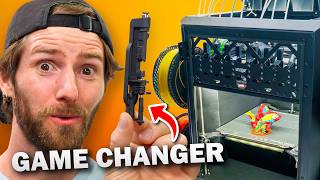
The video presents the Prusa Index, a tool-changing 3D printer developed by Prusa and Bondtech, which switches nozzles instead of entire hotends to reduce waste and cost. It supports up to eight print heads, enables multi-material printing without cross-contamination, and allows mixing of filaments for custom colors. The presenter highlights its potential to make advanced multi-material printing more accessible at a lower price point than alternatives like the Prusa XL.
Chapters
Single-nozzle printers require filament purging during material changes, resulting in significant waste, often more than the model itself.
The Index can do most of what the Prusa XL does at half the price, with up to 8 print heads and minimal waste.
Instead of switching full hotends, the Index switches only the nozzles, using induction heating for fast heat-up, reducing cost and footprint.
The Index combines the Prusa Core 1 printer with Bondtech's tool changer, which will be available standalone later.
Using different materials that don't bond (e.g., PLA and PETG) eliminates the need for a gap, resulting in better surface quality.
Prints can combine hard and flexible materials (e.g., PLA with TPU hinge) through interlocking during printing.
Prusa's Color Mix feature alternates layers of different filaments to create new colors, similar to halftoning in 2D printing.
Different nozzle sizes can be used in one print to optimize speed (large nozzle for infill) and detail (small nozzle for surfaces).
At $2,300, the Index is priced similarly to early Ultimaker printers, potentially pushing multi-material printing into the mainstream.
Core 1 owners can upgrade to the Index with a kit, though assembly is work-intensive.
The Prusa Index represents a significant step forward in affordable multi-material 3D printing, reducing waste and expanding creative possibilities. Its open-source nature and tool-changing capability could push the industry towards more sustainable and versatile printing solutions.
Mentioned in this Video
Study Flashcards (7)
What is the main source of waste in single-nozzle multi-color 3D printing?
easy
Click to reveal answer
What is the main source of waste in single-nozzle multi-color 3D printing?
Filament purging required during material changes to prevent cross-contamination.
00:15
How does the Prusa Index reduce waste compared to single-nozzle printers?
medium
Click to reveal answer
How does the Prusa Index reduce waste compared to single-nozzle printers?
It switches nozzles instead of entire hotends, eliminating the need to purge filament between material changes.
01:58
What heating method does the Prusa Index use for its nozzles?
medium
Click to reveal answer
What heating method does the Prusa Index use for its nozzles?
Induction heating, which allows rapid heating and reduces complexity.
02:13
What is the price of the Prusa Index?
easy
Click to reveal answer
What is the price of the Prusa Index?
$2,300 (USD).
10:10
How many print heads does the Prusa Index support?
easy
Click to reveal answer
How many print heads does the Prusa Index support?
Up to eight.
01:23
What is the purpose of Prusa's Color Mix feature?
medium
Click to reveal answer
What is the purpose of Prusa's Color Mix feature?
It creates new colors by alternating layers of different filaments, similar to halftoning.
07:02
Why can using different nozzle sizes in one print be beneficial?
hard
Click to reveal answer
Why can using different nozzle sizes in one print be beneficial?
A large nozzle can print infill quickly, while a small nozzle can handle fine details, optimizing both speed and quality.
09:00
💡 Key Takeaways
Multi-material supports
Demonstrates a practical technique for achieving better surface quality on overhangs by using non-bonding materials.
04:18Color mixing via layering
Introduces a novel method to create a wide color gamut without waste, leveraging the tool changer's speed.
07:02Accessible pricing
At $2,300, the Index brings multi-material capabilities to a broader audience, potentially catalyzing mainstream adoption.
10:10Upgrade path
Existing Prusa Core 1 owners can upgrade, extending the life of their investment and reducing e-waste.
11:07Full Transcript
[00:01] lab. It's got a Prusa i3 MK3S as a workhorse and then a few bamboo machines I know, I know. They hadn't gone full evil when we got them. And my kids are loving the setup. They've learned a ton. All three of them are doing basic 3D
[00:15] modeling now and they print a bunch of stuff both for personal use and for me and teachers. [music] But there's one thing that is driving me nuts, the waste. Because all of our printers use just one nozzle each, we have to purge a
[00:30] whole bunch of filament from the system every time there's a material change in order to limit cross-contamination. And with multi-color prints, this can result in a bigger pile of waste than the actual filament that goes into the model
[00:42] itself. And all of this is after tuning. Now, if I had a room full of Prusa XLs, each with five independent extruders, I wouldn't have this problem. And I could also do multi-material prints more easily for cleaner support removal. I
[00:55] could even do crazy stuff like mixing my own filament colors on the fly out of base colors, like making my own pink out of red and white. The only problem is those are really expensive, not to mention massive. And I love [music] my
[01:07] kids, just not that much. But maybe I could love them this much. This is the Prusa Index. It can do more or less everything that a Prusa XL can do out of the box, except at half the price. Oh, and did I mention that it tops out at
[01:23] eight print heads rather than five? I mean, look at this. And basically no waste. Just like I never waste an opportunity to tell you about our sponsor, >> Rain getting inside my stylish yet
[01:37] always adventure ready shoes? >> [laughter] >> I don't think so. Not with Vessi. Not with Vessi. No.
[01:58] instead of switching between full active tool heads like the Prusa XL does, it only switches the tools themselves, the nozzles. This is a little bit slower than the XL, which can keep its independent extruders hot while they're
[02:13] parked, but thanks to the Index's inductive hot end, it can heat these up wicked fast. And by getting rid of all of that redundant extruder hardware, you ditch a bunch of points of failure, save a bunch of money, and you massively cut
[02:27] down on the footprint. To be clear, the extruder is still in there. It's just that instead of all being one integrated unit, it just pulls up to this array of all the filaments you're going to need for your print,
[02:41] picks whichever one it wants, and then they somehow get attached to the >> How does that work? >> It's really clever. With a normal 3D printer, your cold filament goes into the extruder, which grips and pushes it
[02:56] down into the hot side, which includes your heat block and your nozzle. It's all self-contained. The Index takes that paradigm and rips it apart. We get one extruder with your usual gears, so far so good. We've got our nozzles right
[03:10] but here's where your mind is going to get blown. By switching to induction heating, the magnetic coils that heat the nozzles can live in the extruder assembly without risking any damage or premature meltuation.
[03:24] wondering, how does the extruder grab onto the >> Okay, this is pretty clever. When a command tells the Index to push, its levers are engaged, and then when it retracts the filament, they pull away
[03:38] and leave the nozzle free to just jump out with all of its material still out with all of its material still attached to it. Bondtech calls it a wireless hot end. Oh, Bondtech, we haven't mentioned them
[03:51] Oh, Bondtech, we haven't mentioned them yet. Well, we should. See, the Prusa Index isn't so much a product as it is two products that have been mashed together. The Prusa Core 1 3D printer and [music] the Index tool changer from
[04:05] Bondtech, who plans to make these available standalone at some point in for now. Let's look at some really interesting use cases for this tech. The interesting use cases for this tech. The most obvious one has got to be supports.
[04:18] While you can print supports out of the same material as your part, this approach comes with some pretty annoying compromises. The print needs to sort of float over the support structure, so there's a weak joint that you can just
[04:31] kind of break away later. But, what that means is a small portion of the part that you want is going to droop down a little and then ultimately be worse quality than in other places. With multiple nozzles, you can just mix
[04:44] entirely different materials that don't bond together, like PLA and PETG. Because they don't stick, you don't need a gap between your part and the support, much better quality. And then they just sort of
[04:59] lift off the support when you're done, most of the time. And that's just one aesthetic benefit. There's much cooler stuff, like soluble materials. When submerged, these materials will just melt away, leaving
[05:13] you with a final part that can have hard-to-reach complex geometries like point for professional 3D printers for ages because it both enables the production of parts that would otherwise be impractical or even impossible, and
[05:28] even just for standard prints, it's just so darn convenient. Now, Bambu does have a solution for this, pun intended, that's AMS compatible, but Bambu, right? Hmm. Oh, here's another one. How about combining materials into
[05:42] a single functional part? Take this clip, for instance. It has a hard clip, for instance. It has a hard plastic body and then a soft TPU hinge to help make it flexible. Well, TPU doesn't bond to PLA, but by interlocking
[05:55] them during printing, you can create something that's more functional and longer-lasting versus if you tried to make just a PLA string. You could even make a soft grip texture for something like a screwdriver handle. Though, I
[06:08] prefer the originals from lttstore.com. There are actually economical reasons to use multiple filament types, too. Whether they bond or not, sometimes you might be working with exotic or expensive materials. And you can save a
[06:21] materials where they're actually needed. Oh, and [laughter] another cool one, printing conductive traces. Yeah, there's conductive filaments. Though, we haven't tried those yet and we're not sure how well they work. The coolest
[06:35] the tip of the iceberg. The next layer made a great video recently highlighting a whole bunch of really specific applications. So, we'll have a link to that down below. As cool as the functional stuff is though, don't sell
[06:48] multi-color 3D printing short. There's a lot of really cool stuff happening to make color printing better. Like, did you know you can mix colored filaments almost like mixing paints to create entirely new colors? They did know that.
[07:02] I said it in the intro, but that does not make it any less cool. That is so freaking cool, right? Prusa just adopted the full spectrum Orca Slicer project and released Color Mix. It creates prints with layers of alternating color
[07:15] that at a normal distance create the illusion of an entirely new color. It's just like the old concept of half-toning in regular old 2D printing where little dots of cyan, magenta, yellow, and black can make up a pretty generous color
[07:30] gamut. Prusa is planning to release a CMYK filament bundle for mixing colors. And with eight tools, you could have say CMYK RGBW giving you a pretty generous
[07:42] range of colors to pick. Though for now, you're limited to three color blends in get. >> I think the coolest part of this is that whichever two or three colors you pick, they don't need to be specific colors to
[07:55] use color mix. You can just take whatever you've got, put it into the Prusa slicer, and then it'll just crap out a list of possible combinations with representative colors. Like, I can't even imagine how you could do something
[08:08] like this with an AMS. Or I guess I could imagine how you could, but it would involve so much filament changing that you'd create more waste than 3D prints. Meanwhile, the only waste from the Index is these tiny little priming
[08:20] the Index is these tiny little priming dots. Freaking awesome. And color mix is just what's happening lately. This software, called HueForge, has been really popular for a long while now for making 2D-ish art from 3D printers using
[08:32] a method that creators call filament painting. That system uses filaments with a known opacity to calculate light transmission through the layers, and then create new colors by overlapping. It's not the most user-friendly process.
[08:46] provides their filament's light transmission as part of the spec, you'll need a device to measure it, etc. etc. But, hey. More filament being available on more affordable devices like the Index is going to make all of that a lot
[09:00] easier and have a lot less waste. But wait, there's more. What if I didn't want different filaments? What if I wanted the same filament, but with different levels of detail? Well, with different nozzle sizes, each
[09:15] make, I don't know, a a Warhammer miniature where the base and the infill could be done at ultra speed with a big fat nozzle, and then the fine details could be done on a thinner nozzle. So I could
[09:28] optimize my print time and my print quality. But wait, there's even more. quality. But wait, there's even more. Every nozzle is a tool, but not every tool is a nozzle. Bondtech released CAD files for their mounting system, and
[09:42] people like the Kenna Creator have already mentioned how, say, a pen plotter tool would be super easy to make. So, imagine then, if you will, a world where you could have a a heat set inserter that puts all of
[09:57] your threaded crap in place while you are doing your print. And that would configuration, too. To be clear, that doesn't exist yet, but it's all been left open to the community thanks to Bondtech and Prusa's admirable
[10:10] Bondtech and Prusa's admirable open-source attitude compared to Bamboo. With all of that said, I'm sure you can understand why the Index is such an exciting release. Like, this kind of functionality, at least this kind of
[10:24] functionality without a metric ton of waste, was only really possible on much more expensive hardware. And while $2,300 is still a lot of money, what it also is is right around that threshold that pushed early Ultimaker
[10:40] printers into the enthusiast space, which gave them the momentum to push 3D printing as a whole into the mainstream. So, I think it is both realistic to say that Prusa's going to sell a butt ton of these to businesses and print farms and
[10:55] to individual enthusiasts, and also that this is going to contribute to making 3D printing more accessible for everyone. [music] And it gets even better. If you happen to already have a Core i 1 3D printer, you don't need to buy the whole
[11:07] thing over again. All you need is the Index upgrade kit, which costs a lot less. It's also more work to assemble than we anticipated. We've got the Founder's Edition, hoping that when they ship the Prusa Edition shortly, it's
[11:19] going to be a little bit easier. But even then, it's going to be a fair bit of work, so I'm sure once Prusa makes a pre-assembled bundle available, that's going to be a very popular option. For now, though, we're honestly really glad
[11:31] we put in the work. There's still a bit of calibration and tuning to be done, obviously, if you kind of look at the print quality, but the fact that we can do this at all with minimal waste, I think the result kind of speaks for
[11:43] sponsor. >> Vessi scientists have accelerated research and achieved great progress in a field of study directed at the protection of one of the human body's most crucial organs.
[11:56] >> SHOE SCIENCE! >> The crowning achievement, the Stormburst. An extraordinarily versatile piece of footwear with all-terrain capability and strikingly effective water-repelling qualities.
[12:10] >> This ability was made possible due to Vessi's patented Dyma-tex technology, engineered with four soft and flexible >> What does that do? Does it >> We're We're trying to >> Does it Does it laser zap it or
[12:24] >> Does it Does it laser zap it or >> Does it laser zap No, it it doesn't. The high traction coefficient of the rugged outsole is remarkably combined with the shock absorption of a dual-density midsole, producing footwear
[12:38] that is both extremely durable and supremely comfortable to wear, while lightweight. >> they come with a 1-year warranty and 30-day returns and free shipping and 15% off your first order if you use our
[12:52] off your first order if you use our code. out when we used the E3D tool changer to print a PC case.
[13:04] Tool changers have come a long way since then.