USD Plunges 200 Pips: No Warning!
45sThe dramatic, unexplained currency movement creates immediate intrigue and urgency.
▶ Play Clip"Delivers on the promise of uncovering hidden market news, though the conspiracy theory segment feels speculative and slightly off-topic."
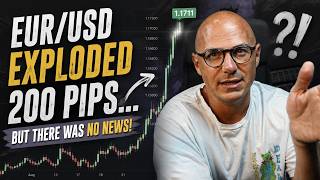
This video analyzes a significant, unexplained move in the EUR/USD currency pair, which surged nearly 200 pips without any obvious economic calendar catalyst. The creator investigates deeper and attributes the move to a repricing of the US dollar driven by Treasury bond buybacks and concerns over US fiscal health, rather than euro strength. The video emphasizes a critical lesson for traders: the absence of scheduled news does not mean there is no market-moving news.
EUR/USD moved almost 200 pips from low to high without retracements, a very rare event, with no obvious catalyst on the economic calendar.
The creator initially looked for typical drivers like CPI, Fed rate changes, or Powell speeches, but found nothing that explained the move.
The move is attributed to US dollar weakness, not euro strength, because EUR/USD rises when the dollar weakens.
Long-term US Treasury bonds were being sold, pushing the 30-year yield above 5.3%, a level not seen since 2007, indicating investor concerns about US debt and inflation.
The US Treasury announced it would double the maximum size of certain bond buybacks from $2 billion to $4 billion, which the creator interprets as an attempt to relieve pressure in the long-term bond market.
Following the announcement, long-term Treasury yields and the US dollar dropped, while gold and Bitcoin rallied, suggesting investors repriced the dollar due to concerns about debasement.
The creator concludes that investors were repricing the US dollar, and EUR/USD was just one place where this was visible, not a story about euro strength.
Traders who shorted EUR/USD based on overbought signals got caught in a 100-200 pip move against them, blowing up accounts.
The economic calendar does not show all news; markets react to Treasury announcements, capital flows, and institutional shifts that are not on the calendar.
The creator speculates that the US government might intentionally weaken the dollar to reduce the cost of repaying its $40 trillion debt, though this is presented as a tinfoil hat theory.
The video underscores that traders must look beyond the economic calendar to understand market moves, as hidden forces like Treasury operations and fiscal concerns can drive significant volatility. The key takeaway is to remain aware of broader market dynamics to avoid being caught off guard.
What was the approximate pip movement in EUR/USD mentioned in the video?
Almost 200 pips from low to high.
00:13
What was the 30-year US Treasury yield level that pushed above 5.3%?
It pushed above 5.3%, a level not seen since 2007.
01:36
What did the US Treasury announce on Wednesday regarding bond buybacks?
They announced they would at least double the maximum size of certain buyback operations from $2 billion to $4 billion.
02:30
According to the video, what is the key lesson for traders?
Just because there's nothing on the economic calendar doesn't mean there's no news; markets react to hidden factors like Treasury announcements.
05:07
What is the creator's conspiracy theory about the US government and the dollar?
The US government might intentionally weaken the dollar to reduce the cost of repaying its $40 trillion debt.
06:02
30-Year Yield Above 5.3%
This is a significant market signal not seen since 2007, indicating deep investor concerns about US fiscal health.
01:36Treasury Buyback Announcement
The doubling of buyback size is a concrete, actionable event that explains the market move, showing the importance of monitoring Treasury operations.
02:30Dollar Repricing, Not Euro Strength
This reframes the EUR/USD move, teaching traders to look at the underlying currency dynamics rather than just the pair.
04:04Economic Calendar Blind Spot
The lesson that the calendar doesn't show all news is a crucial principle for traders to avoid being caught off guard.
05:07[00:01] guard this week. There was no explanation for it and you had to dig to find the answers and I didn't find out until it was too late. The US dollar is the weakest it's been for the last year and this is a bad thing. If you traded
[00:13] thought to yourself, what the hell is going on? Because EuroUSD went absolutely nuts. From the low point this week to the high point, almost 200 pips. That is very, very rare. And what's even crazier is that it did this move without
[00:29] any retracements whatsoever. At first, I couldn't figure out why it was happening either. Normally, when Euro USD moves like this, there's something obvious. CPI comes out, the Fed changes interest rates, Powell says something, or the new
[00:41] guy that replaced Powell. Non-farm payrolls missed expectations, something. looking for the catalyst, and there was nothing, at least nothing that in my opinion explained this big move in economic calendar news events. So, I
[00:56] what else was moving, digging deeper into what actually happened in the markets. And here's what I think happened. Because I don't think this is a euro move at all. If you think about the dollar and the euro, the currency
[01:08] pair, if the dollar is weak, eurousd goes up. If the euro is strong, eurousd goes up. So, why did it go up so much? That's why I think this was a US dollar traders probably missed was something that happens in the market that we don't
[01:23] normally pay attention to, myself included. I got wrecked this week. And is the bond market. Let me explain. Going into this week, something pretty the US government debt. Long-term US Treasury bonds were getting sold. And
[01:36] when bond prices fall, their yields rise. The 30-year US Treasury yield eventually pushed above 5.3%. That's a huge number. So much so that we haven't seen numbers like that since 2007. So immediately I started asking why are
[01:50] investors demanding this much money to lend US government money? And once I gets pretty interesting. The United States is now more than $40 trillion in deficits. They have enormous amounts of debt and constantly need to be
[02:06] refinanced. And investors are becoming increasingly concerned about inflation, government spending, and long-term fiscal situations in the United States. So, if you're going to lend money to the US government, money for 20 or 30 years,
[02:18] want to be paid more for taking that been seeing these long-term yields pushing higher. And then something happened on Wednesday. Something that you probably didn't see on your normal
[02:30] forex economic calendar. The US Treasury announced that it was going to increase the size of certain Treasury bond buybacks, and not by a small amount. They said they were going to at least double the maximum size of some of these
[02:42] operations from $2 billion to $4 billion. Now, if you don't trade bonds and none of this makes any sense, here's a simple version. The US Treasury basically saw pressure building in the long-term bond market and announced that
[02:55] Treasury debt it was willing to buy back. Officially, these are liquidity sit here and simply say that the government was simply manipulating bond Treasury officially said. But look at what happened after the announcement.
[03:10] Long-term Treasury yields dropped and the US dollar dropped with them. Then Treasury Secretary Scott Bessant came out and basically said these buybacks when I think the market started looking at the situation very differently
[03:23] because now investors had to ask what happens if long-term US interest rates is actually trying to relieve some of that pressure in the bond market. Where does that pressure go? And the one possible answer is the dollar. And this
[03:36] isn't just my theory. Ruters reported this week that these Treasury buybacks were actually renewing concerns among some investors about what they called the dollar debasement. Basically, if investors aren't being compensated
[03:48] through higher yields, they may demand compensation somewhere else. And one place that the adjustment can happen is through a weaker currency. Now, look at started to click for me. The dollar was falling. EuroUSD was ripping higher.
[04:04] Gold was ripping higher, Bitcoin was ripping higher. And at the same time, in the US Treasury market. That's why I don't think this was a real story about euro suddenly becoming incredibly strong. I think investors were repricing
[04:17] the US dollar and eurousd was simply one of the places where we could see it happen. That's an important distinction because imagine you're sitting there trading eurousd and you see it move 50 pips and you look at the economic
[04:29] calendar, nothing. So you think this move doesn't make any sense. It's overextended. I'll short it. Price moves another 30 pips. Your RSI is screaming overbought. You're sitting at resistance. So, you short it again. It
[04:42] moves another 40. And now you're thinking, there's absolutely no way this thing can keep going. And so, you add another position. And suddenly, what started as a normal trade has turned into a 100, 150, almost 200 pip move
[04:55] against you. And that's exactly what blew people's accounts this week. Because there's one massive lesson from what happened this week. Just because there's nothing on the economic calendar doesn't mean there's no news. And I
[05:07] traders make. We're trained to open my FX book or Forex Factory or whatever economic calendar you use and look for the red folders. CPI at 2:30, interest rates at 8:00, the Fed has a speech at 4:00. And if there's nothing there, we
[05:22] day. But markets don't work that way, especially now. They're extremely especially now. They're extremely reactionary to random tweets or false articles published in the news. The economic calendar shows you the
[05:35] necessarily show you what's happening with Treasury issuance and it doesn't show you every Treasury announcement. It doesn't show you capital flowing out of building in the bond market. And it
[05:48] institutional investors suddenly change the way they're looking at US government off guard this week. There was no explanation for it and you had to dig to find the answers and I didn't find out until it was too late. I don't know,
[06:02] man. This whole fiasco is just a complete cluster And my tinfoil hat conspiracy theory is that if you are the president of a country that's over $40 trillion in debt and these debts are weighing on top of you, is it then your
[06:19] weighing on top of you, is it then your agenda to try to repay that debt at the lowest cost possible? And how are you supposed to repay $40 trillion worth of US debt when the dollar is strong? Maybe, just maybe, you intentionally
[06:35] make the dollar weaker, sell early access to your close friends about tweets that you're going to make, drive the dollar down to the floor, then try to repay the debt based on a weak dollar. I don't know. You guys need to
[06:48] look at money supply and inflation and how the Federal Reserve printing money affects our monetary supply and how that causes inflation. Let me know your thoughts and let me know how your
[07:01] trading went this week in the comments sections. Thanks so much for watching sections. Thanks so much for watching and we'll see you in the next
⚡ Saved you 0h 07m reading this? Transcribe any YouTube video for free — no signup needed.