
AI Summary
The video presents a practical workflow for maximizing the value of a Claude Code subscription, which the creator calls 'token maxing.' He shares how he spent roughly 70 million tokens in three weeks, breaking down his approach from design documents to delegating subtasks to parallel coding agents. It also covers cost analysis, hardware upgrades, and a comparison of subscription pricing against self-hosted local models.
Chapters
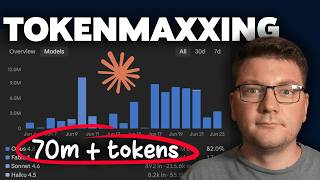
The creator spent roughly 70 million tokens using Claude Code over a 3-week period (June 4–22), on the $100/month 5x Max plan.
The workflow begins with a high-level design document covering architecture, code style, quality constraints, infrastructure components, and deployment approach.
High-level features are broken down into smaller subtasks that serve as actual work units handed off to coding agents.
Each subtask is handed to an agent in its own session, enabling parallel work and a faster feedback loop.
Feeding a task description into the goal command makes the agent keep working until it satisfies the goal, which helps produce a desired result.
The creator tells agents to work in separate git worktrees, write tests, ensure they pass, and create a pull request when done.
AI-generated code tends to be verbose, full of comments and unnecessary abstractions, but the trade-off is faster iteration and working solutions.
Using API pricing from Anthropic, ChatGPT estimated the token spend was worth about $1,850, despite paying only $100/month — highlighting hefty subsidies.
After working a week, the creator asked the agent to identify repetitive tasks and turned them into reusable Claude skills.
Running 5–10 parallel agents consumed all 32GB of RAM, forcing an upgrade to 64GB to keep working efficiently.
A $5,000 DGX Spark costs almost two years of 20x Max subscription, and local models are slower and weaker than Opus/Fable-level models.
Mentioned in this Video
Tutorial Checklist
Study Flashcards (8)
How many tokens did the creator spend on Claude Code in roughly three weeks?
easy
Click to reveal answer
How many tokens did the creator spend on Claude Code in roughly three weeks?
About 70 million tokens.
00:01
What command in Claude Code makes an agent continue working until it satisfies a goal?
easy
Click to reveal answer
What command in Claude Code makes an agent continue working until it satisfies a goal?
The goal command.
02:48
What two constraints does the creator set when delegating a subtask to an agent?
medium
Click to reveal answer
What two constraints does the creator set when delegating a subtask to an agent?
Work in a separate git worktree, and write tests that must pass before opening a pull request.
03:12
What is 'token maxing' according to the creator?
medium
Click to reveal answer
What is 'token maxing' according to the creator?
Using the maximum number of tokens available on a subscription plan to get the highest possible value from it.
04:47
What approximate API-value did ChatGPT calculate for the creator's token spend?
medium
Click to reveal answer
What approximate API-value did ChatGPT calculate for the creator's token spend?
About $1,850.
05:30
What hardware issue did the creator run into with 5–10 parallel agents?
easy
Click to reveal answer
What hardware issue did the creator run into with 5–10 parallel agents?
32GB of RAM became a bottleneck, forcing an upgrade to 64GB.
07:31
What is the price of the DGX Spark local-model machine?
easy
Click to reveal answer
What is the price of the DGX Spark local-model machine?
Almost $5,000.
08:43
Why does the creator think self-hosting LLMs is not worth it currently?
hard
Click to reveal answer
Why does the creator think self-hosting LLMs is not worth it currently?
Because $5,000 covers nearly two years of Claude Code 20x Max, and local models are slower and weaker than Opus/Fable-level models.
08:43
💡 Key Takeaways
Token maxing as a deliberate strategy
Reframes subscription usage as a resource to be optimized rather than just consumed.
04:47Parallel agents with git worktrees
A concrete technique that lets agents work simultaneously without stepping on each other.
03:12Subsidized AI economics
Reveals the real gap between API prices and subscription costs — a valuable data point for budgeting.
05:30Self-hosting cost comparison
Provides a practical framework for comparing local hardware vs. cloud subscription costs.
08:43Ask the agent to generate its own skills
A smart way to discover repetitive tasks and build reusable workflows from real usage patterns.
06:38Full Transcript
[00:01] little time to talk about my approach to software development using Cloud Code. And in the past two or three weeks, I think I've spent around 70 million tokens using Cloud Code. So, I've learned quite a few things that work for
[00:15] me, and I want to share my workflow with you in this video. Here's my Cloud Code desktop, where you can see my token spend starting from June 4th, which is when I started using this. Today is June 22nd, so I've been using it for almost
[00:28] three weeks. And that time, I've spent around 70 million tokens, give or take. Now, I've been using the $100 plan, which I believe is called 5x Max. I was on the 20x plan for a little while while Fable was available, but they took it
[00:42] continuing on that plan, so I downgraded. Now, you can see some days were more useful than others, but in the past couple of days, I think I've dialed down the approach that works really well and produces good results for me. Here's
[00:56] the workflow that I apply when using Cloud Code. So, number one, you need an idea. What are you going to work on, or what are you going to build? So, as I said, I start with an idea, and the first thing I want to do is produce a
[01:10] design document. So, this just contains the high-level description of what I want to build in a little more technical detail. So, here I would define things like architecture, code style, and quality constraints, maybe infra
[01:23] components if I'm adding something new to the system. We could also talk about the deployment approach, and whatever else I think is necessary to fulfill the design that I want to achieve. So, once we've got our high-level definition in
[01:36] place, we can then take that and use it to break down our high-level feature into smaller subtasks. So, let's say we've got a couple of subtasks here, and these are my actual work units that I'm going to hand off to the agent. Now,
[01:51] what I figured out that works really well for me is to hand off each of these well for me is to hand off each of these subtasks to a coding agent in a separate session. So now this becomes one session and I just expand across how many tasks
[02:05] isn't all too different from how you would lead a software development team in the real world. So I'm effectively just replicating what already works in the real world using agents except with this our feedback loop is a lot faster
[02:19] as we can produce a large amount of code in very short amount of time. Now this is also where I want on how you can actually rein in the AI and stop it from producing slop because it's very easy to fall into this trap of
[02:32] because you're generating a large amount of code. That's very far from the truth. Now I do want to comment on how I actually get the agents to work on something until it's done and this is by using the goal command in Cloud Code.
[02:48] Now I think this is an implementation of what's called a loop although there's also a loop command. It's all a bit confusing. Nonetheless, when I give it a goal, it's going to continue working on this until it satisfies the goal. This
[03:00] is where you can actually make it produce the desired result. So what you produce the desired result. So what you do is you take your task description and feed it to the goal command and then it's really important that you come up
[03:12] depending on your use case, these constraints can vary. What I do is tell the agent to work in a separate kit work tree. This is basically a copy of your repo on the file system. And then the agents can work in parallel on separate
[03:27] resource intensive but it allows you to parallelize the work as much as possible. Now what I also tell it to do is write tests and make sure they pass and when everything's done, I want it to create a pull request that I can then
[03:41] now have a lot of pull requests to review and make sure that everything is in order. Of course, if I'm working on something mission critical, I definitely want to go in and actually debug code, but if it's something trivial that I've
[03:55] done myself dozens of time before, I'm going to just review the code and make place to be sure that this is working correctly. Now, a couple of trade-offs that you're going to make with this approach is code quality is going to
[04:09] this is something that you are okay with. The benefit being that you're now able to iterate much faster and produce working solutions in less time. This also doesn't mean we're going to produce bad code, what people would call slop.
[04:23] It's just that AI-generated code tends to be more on the verbose side, and if you don't spend quite a bit of time reeling it in and telling it to remove unnecessary parts, you're going to end up with a code base that's quite
[04:35] verbose, full of comments, with possibly many unnecessary abstractions, for example, interfaces with just a single implementation that don't really do much except help unit testing using mocks, which in my opinion is not that valuable
[04:47] where it's most critical use cases. Now, this entire approach can be described with a single word that I'm going to just call token maxing. I totally did used dozens of times, but it's effectively what I'm trying to achieve
[05:02] here. I want to use the maximum number of tokens that's available to me while also one of the reasons why I've been less active on YouTube than usual. I've been working on a big project, as you can see by the token spend, that I hope
[05:16] to talk about more in the coming weeks. I also became a dad past month, so sleep is now scarce, and finding time to work is even more difficult. And as you can apartments, and I'm still setting up the new studio. A lot of things going on at
[05:30] the same time, and not enough time to work on videos. And hopefully, all of this gets better sooner rather than later. Now, I mentioned that this usage is subsidized. And I actually took my token spend and gave it to ChatGPT. I
[05:44] didn't want to give it to Claude on purpose just to see what ChatGPT is going to tell me. And it took the input and output token costs from Anthropic's documentation. Now, these are API costs, mind you, and I'm using a subscription,
[05:56] which is subsidized. And it came up with the figure of about $1,850 of token spent in the past 3 weeks. Now, mind you, I'm paying $100 a month, give or take, to get this much in token spent. And I'm not even maximizing my
[06:10] only figured out how to properly do this in the past couple of days. Just to give you a reference, I've managed to use up about 75% of my weekly limit, which is in the past two cycles. So, this time around, I'm really leaning into it and
[06:26] just trying to maximize my token usage on the 5x plan on Claude code. I've explained my high-level workflow. What about some low-level details? For example, some people are going to ask, "What about Claude skills?" I started
[06:38] out not using them. After a week or so on working on this project, I just asked the agent, "What are some repetitive tasks that I keep asking you to do, and think that's how you produce actually useful skills. You figure out the pain
[06:51] points while you work and turn those into repeatable skills that the agents can use. I also did not have a Claude MD or an Agents MD present when I started working on this. This is also something I asked Claude to generate for me. And
[07:05] one thing that Claude also has is hooks. I wasn't aware of this, and it's something that it suggested I should add. And I'm using it just to run some extra heavy tests before every command, and this is coming in handy because it's
[07:18] Actions because I was running into timeouts and resource issues with running so many agents in parallel. Now, another problem you're going to run into when using this workflow, and to give you an idea, I usually have like five to
[07:31] 10 agents running in parallel working on different aspects of my code base. And one roadblock that I hit was the available RAM on my system. It turns out that coding agents are incredibly resource hungry. And right now I've got
[07:43] 32 GB of RAM, and this forced me to do perform an upgrade. I opted for two 32 GB sticks, which is going to double my effective RAM, and you really don't want to know how much I spent on these. Like, the prices of RAM are basically insane.
[07:57] What I can tell you is that the 32 GB that I bought, I think, 4 years ago, are now worth double the amount that I paid at the time, which is unheard of in the guess this is the sign of the times that we are living in. Also, here's what it
[08:12] looks like when I get a bunch of results from my coding agents as pull requests that I now have to sit down and review. I think this is about nine or 10 pull by one, and almost all of these are based on some documentation I had wrote
[08:28] the baseline to produce the actual pull request. Now, as I already mentioned, I got nearly $2,000 of usage out of a $100-a-month plan. And I don't think this is going to last for a while. We already lost GitHub Copilot subsidies,
[08:43] and sooner or later the other providers going to have to follow. So, some people are exploring things like self-hosting large language models, and currently there's a popular DGX Spark machine, which is selling for almost $5,000, and
[08:56] you can run some local models on here. But, in my opinion, this is currently not worth it, even with all the subsidies in place, because $5,000 is almost 2 years of cloud code usage on the 20X Max, which is $200 And don't
[09:10] expect you're going to be running anything close to Opus or Fable level models, and even then, your local models are going to be just incredibly slow and actually be exploring this path? Well, as I said, privacy is a big concern when
[09:25] using AI from popular providers, and running local models gives you a lot of autonomy, and obviously full control over where your data ends up. Now, to actually to able to run something useful in terms of a coding agent and then
[09:38] scale that across a team, you're looking at a big spending bill to make that million or a million dollars to build a small data center, but you definitely need to spend multiple tens of thousands of dollars on hardware to be able to run
[09:52] these models locally. Now, take all that with a grain of salt as I haven't really been into the self-hosting space, which is something I'm going to explore and make videos on. I'll all of that in due time. My conclusion is that with the
[10:04] taking into account the subsidies, the cost of hardware, and the local models that we have available, it's still not worth it, at least to me. I'll be exploring this avenue, but I definitely think you should not be closing the door
[10:18] privacy and owning your data. Hope that at least something I shared today with you is valuable and you can maybe use it in your own work. I'm definitely late to agents, so I'm still learning things
[10:32] myself as I go and I'm going to be sharing them here with you as I gain more insights. If you found this video valuable, go ahead and smash the like button right below. Thanks a lot for watching. I really appreciate it and
[10:44] watching. I really appreciate it and until next time, stay awesome.