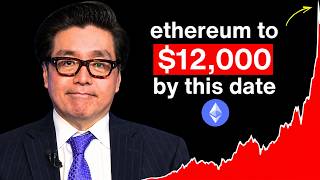

Tom Lee: A Tsunami Is Coming for Bitcoin & Ethereum
46sHigh-impact opening with a bold prediction from a respected analyst, immediately grabs attention.
▶ Play Clip"Title exaggerates 'tsunami' but content genuinely builds a bullish case for Ethereum with macro and institutional backing."
Tom Lee presents a multi-layered thesis for Ethereum's long-term potential, arguing that the current drawdown is structurally different from 2022 and that a bottom may be forming. He connects macro factors, institutional adoption, and the emerging AI agent economy to support a price target of $250,000 per Ethereum.
The bond market has removed four rate cuts from 2026, but Lee believes cuts will be priced in soon because June core CPI was negative, indicating deflation.
The Clarity Act, which would give the CFTC clear authority over crypto regulation, has only a 44% chance of passing according to prediction markets, but key senators believe it's close.
86% of venture dollars this year went into AI, diverting funds from crypto. However, signs of cooling AI spending could reverse this trend.
Financials are one of the worst S&P 500 sectors year-to-date, acting as a headwind for crypto, but Lee believes 'cryptospring' is here.
Tom Demar's timing work suggests Ethereum looks like the S&P in 1987, implying a recovery to $2,200 in August.
Lee describes Ethereum's 1.0 phase (ICO boom, NFT boom, ETFs) as capped at $5,000. Phase 2.0 involves tokenization and institutional use, making ETH 'money'.
Robin Hood's new chain on Arbitrum uses ETH as native gas token, processing over $1 billion in volume, demonstrating ETH as working capital.
Amazon was stuck at $6 for 12 years before AWS and Prime drove it to $241. Nvidia was stuck at $1 for years before AI drove it to $197. Ethereum may follow a similar pattern.
Lee applies the uncanny valley concept to AI wealth: as AI agents become wealthier than humans, blockchain becomes the barrier between humans and AI, driving demand for ETH.
Joe Luben, co-creator of Ethereum, predicts a 100x move to $250,000. Lee's range is $25,000 to $75,000, but he acknowledges radical upside if the 2.0 thesis plays out.
Tom Lee presents a coherent case for Ethereum's long-term value, driven by macro easing, institutional adoption, and AI agent demand. The near-term August target of $2,200 is just the first step in a potential multi-decade repricing.
What was the June core CPI reading according to Tom Lee?
Negative for the month, indicating deflation in the US.
01:07
What is the Clarity Act and what is its current status?
It provides a regulatory framework for crypto, giving the CFTC authority. It has a 44% chance of passing according to prediction markets.
01:21
What percentage of venture dollars went into AI this year?
86%.
02:06
What historical analog does Tom Demar use for Ethereum?
The S&P 500 in 1987, implying a recovery to $2,200 in August.
03:01
What is the 'uncanny valley of wealth' as described by Tom Lee?
A future where AI agents become wealthier than humans, causing discomfort and driving demand for blockchain as a barrier between humans and AI.
11:48
What price target does Joe Luben have for Ethereum?
$250,000, representing a 100x move from $1,800.
17:22
How does the Robin Hood chain use Ethereum?
It uses ETH as the native gas token, with transaction fees denominated in ETH and settled on Ethereum L1.
06:36
What are the three phases of Ethereum 1.0 according to Lee?
ICO boom, NFT boom, and spot ETFs/stablecoins.
05:05
Deflation in Core CPI
First outright deflation reading in core CPI in a long time, giving the Fed room to ease.
01:071987 Analog for Ethereum
Tom Demar's timing work suggests a bottom forming with a specific August target.
03:01Robin Hood Chain Using ETH
Demonstrates ETH functioning as working capital, not just a speculative asset.
06:36Amazon and Nvidia Analogs
Historical patterns show assets can stay rangebound for years before structural repricing.
08:25Uncanny Valley of Wealth
Novel concept linking AI agent wealth to blockchain demand.
11:48[00:01] per Ethereum. That number didn't come from a retail trader hyping a chart on social media. It came from Joe Luben, one of the people who actually built research team at Ether Realized. Tom Lee spent his latest market update walking
[00:14] through why both of them might be on to something. And the case starts in a place you would not expect, not a chart. Inflation data, a stalled bill in Congress, and a comparison to 1987. Lee has built a reputation on connecting
[00:26] crypto price action to the wider macro picture. And this update is one of his clearest yet. It covers why the current draw down looks structurally different from 2022, why a bottom may already be forming, and where the real long-term
[00:38] let's [music] get into exactly what he laid out. Here's how he frames where things stand right now. So, the bond market has removed four cuts from 2026. That's a lot of tightening. That being said, I think the bond
[00:52] market's going to start pricing in cuts this year. One of them is because inflation's pretty weak. Look at the June core CPI which came out on July 14th. That number for core was negative for the month. There was actually
[01:07] deflation in the US. It's been a long time since corpis had deflation. And I think in general we believe the inflation story is much weaker than many people believe. The second is the clarity act. That's an important act.
[01:21] clarity act. That's an important act. It's in limbo. that provides a framework so that we know which regulatory body um can set national policy for crypto. In this case, it's the CFTC, but the prediction markets only see a
[01:35] 44% chance the Clarity Act gets signed into law um which is below 50%. higher. So, for instance, Coinbase's vice chairman thinks we're at the one yard line and Senator Cynthia Lumis, who's been working tirelessly on this,
[01:51] believes that we are at the point where they're going to land the plane. The third has been AI FOMO. In case you haven't noticed, a lot of AI stocks have done very well and 86% of all venture dollars this year have gone into AI.
[02:06] That's siphoning money away from crypto. But things are may be changing. For instance, Chimath and CNBC says, "I think you're going to start to see a little bit of the wheels come off of AI spending and profits." Well, when that
[02:18] spending and profits." Well, when that starts to cool, that's good for crypto. The fourth is the crypto sector depends on the financial sector as the umbrella. And if you look at the S&P 500 sectors year-to- date, leading year to date are
[02:32] things like memory, tech, semis, energy, and materials, all related to the AI supply chain. And financials are one of the worst sectors year to date. So that acts as a headwind for crypto,
[02:45] but we believe cryptospring is here and it's not a straight line hire. Demarc Analytics and Tom Demarc who is our timing advisor for market purchases of crypto believes everything appears to be in order for a market bottom and that
[03:01] upside. These are pretty constructive comments. He's citing the 1987 analog. Ethereum today looks a lot like the S&P in 1987 and as you can see in 1987 over the next month the S&P recovered
[03:17] over the next month the S&P recovered nicely. This implies 2,200 per Ethereum in August. Before we go continue, if this kind of breakdown is useful to you, helps the channel reach more people who want their crypto analysis grounded in
[03:30] real data. Now, the bond market started this year pricing in two rate cut. War in the Middle East and heavy AI spending flipped that expectation and traders pulled four cuts off the table almost entirely. That's real tightening and
[03:42] it's a big reason crypto has struggled in 2026 even without the kind of forced deleveraging that defined 2022. But the June core inflation print actually came in negative for the month. The first outright deflation reading in core CPI
[03:55] in a long time. That matters because it gives the Fed room to walk hawishness Clarity Act, the bill that would hand the CFTC clear authority over crypto regulation instead of leaving the industry stuck in a turf war between
[04:09] agencies. prediction markets only give it a 44% chance of passing, but people sitting senator who has worked a bill for years, describe it as close to done. confidence is worth watching. And on the technical side, Tom Demar, whose market
[04:24] timing work has a long track record, is reading the current setup as a bottom forming with an August target for Ethereum built on a direct comparison to how the S&P recovered after its own 1987 low. None of that guarantees a turn is
[04:37] here, but it's a more layered case than the market is down, so it must be near a before moving to what happens next. A bottom call only answers half the Ethereum actually becomes once it forms. And that's where Lee shifts from timing
[04:51] to structure. Now, [sighs and gasps] you might say, well, let's say crypto is bottoming. You also have to believe in a future. And I think the future market for Ethereum is exponential. Here's some wisdom from Warren Buffett in his 1987
[05:05] may ignore business success for a while, but eventually will confirm it." Well, ETH currently, I think, is in its 1.0 phase, and it's transitioning to 1.0 phase, and it's transitioning to 2.0. But in the 1.0 phase, Ethereum had
[05:20] the ICO boom, the NFT boom that brought Ethereum to almost 5,000 in 2022. And then in the last 18 months, we had ETFs and stable coins. and that brought Ethereum almost to 5,000, but that was a 1.0
[05:36] down. Many people are going to look at ETH here and say, look, the [clears throat] top of the range is 5,000 and they don't see further upside. people are rage quitting at the bottom for Ethereum here. Why am I saying that?
[05:51] Well, unlike the cryptobear market of 2022, Wall Street is building on tokenization wins over the past 12 months. Black Rockck's Biddle, JP Morgan's Mooney, Securitizes continues to have a lot of success. Ono Finance as
[06:06] well, and there's been a lot of layer 2 wins. Robin Hood's chain, Coinbase, Krakens, Inc., but maybe the most notable breakout is Robin Hood's chain built in arbitum this year. Vlad, who runs the Robin Hood, believes that
[06:21] will eventually become onchain tokenized. Now, that's a view that we hold as well, but that's a big deal. And the Robin Hood chain, which just launched in July, has now processed more volume than many crypto exchanges. And
[06:36] on July 9th, it was 560 million. That's already crossed a billion as of today. In fact, as we point out, the Robin Hood chain is a big deal because it uses ETH as the native gas token. The transaction fees are denominated in ETH and they
[06:50] settle on the Ethereum L1. Guess what? That sounds like ETH is money. That's why I think this is important. Robin Hood chain is making ETH money. And but let me just highlight again. The Robin Hood chain uses ETH as its native
[07:04] >> Lee borrows a line from Warren Buffett's 1987 shareholder letter here. The idea that markets can ignore real progress for a while before eventually pricing it in. His thesis is that Ethereum has already lived through one full cycle of
[07:17] that. The ICO boom, then the NFT boom, then the wave of spot ETFs and stable coins. Each one pushed Ethereum close to $5,000, and each time it fell back. He's calling that phase 1.0 and his argument is that people writing Ethereum off at
[07:30] one chapter for the end of the story. 2022 is who's actually building on the chain now. Black Rockck's tokenized fund, JP Morgan's Onyx platform, and Ono Finance are moving real assets on chain,
[07:44] not experimenting on the edges. The standout example is Robin Hood's new chain built on arbitum and settling directly back to Ethereum. It uses ETH means every trade running through it creates direct demand for the asset.
[07:58] That's a meaningfully different kind of usage than speculative trading volume. It's ETH functioning as working capital inside a system, not just a token people are betting on. That distinction between ETH as a speculative asset and ETH as
[08:12] something institutions actually need to hold to operate is the thread connecting phase one was about proving the technology works, what does the next phase actually look like once it plays out? Lee reaches for free companies
[08:25] almost everyone already knows. Let's look at Amazon as an analog. Okay, look at Amazon as an analog. Okay, Amazon 1.0 saw Amazon from 1998 to 2010, Amazon 1.0 saw Amazon from 1998 to 2010, okay, a 13-year period, be stuck at a $6
[08:38] peak for 12 years. And in the middle of that period, AWS was launched, which was that period, AWS was launched, which was a huge deal because over the next 12 years, AWS became massive along with Prime Day, Amazon Studios, and their AI
[08:52] focus. But look what happened to the stock on Amazon 2.0. stock on Amazon 2.0. The stock went from $6 to 241. Look at Nvidia and their transition from a 1.0 company
[09:06] to a 2.0. Well, in that 17-year period listed here, Nvidia had the CUDA platform, uh, which is a actually an important what's used for GPUs today. It's the main reason why a Nvidia has almost a
[09:23] near monopoly on AI, high-end AI chips. And then in the 2014 period, they launched or their chips were used by crypto miners. Yet, Nvidia stock crypto miners. Yet, Nvidia stock basically kept peaking at a dollar.
[09:37] basically kept peaking at a dollar. Nvidia 2.0 chat GBT was launched in late 2022. Blackwell got announced in 2024 and the rest is history and went from $1 to 197 almost to 200x
[09:53] as Nvidia went to 2.0. And the final example I'm going to give you as addressable markets expand is JP Morgan. Okay, JP Morgan over this
[10:05] Morgan. Okay, JP Morgan over this 30-year period, okay, uh, transformed. Now, keep in mind, the JP Morgan today is not the JP Morgan that saved America in 1907. Actually, the JP Morgan today started
[10:18] off as Chase. Chase acquired Chemical and Manufacturers Handover Bank. In 2000, the year 2000, Jase acquired JP Morgan. and then over the next uh 15 years acquired Bear Sterns Bank One Washington Mutual.
[10:36] But despite all that, you can see these acquisitions here, JP Morgan was stuck acquisitions here, JP Morgan was stuck and peaked at around $70. But with the acquisition of JP Morgan and Bear Sterns, Chase became a global bank, a
[10:49] truly global bank. And as you can see, the 2.0 played out over the next 15 years. and JP Morgan stock went from 58 to $334. So you can see when the addressable market increases the asset price rises and sometimes it
[11:05] takes time. Well, that's why I'm talking about ETH because ETH 2.0 is the period when Ethereum not only becomes central to a lot of growth vectors but ETH the asset becomes money.
[11:19] So the first thing that's going to drive this is that we are in a new foundation area. the the Ethereum Foundation, which is a nonprofit, is still central to a lot of the core for Ethereum, but it's not the only story. In fact, today,
[11:34] given regulations, it may no longer be necessary to have nonprofit foundations. The second is that Gentic AI is becoming an important crypto story. Now, you might wonder, how is this possibly a crypto story? Let me explain.
[11:48] going to be something that people talk about called the uncanny valley of wealth. And let me explain. Japanese roboticist Masahiro Mori in 1970 published an essay titled The Uncanny Valley. And what he was referring to is
[12:03] Valley. And what he was referring to is the hypothesis that you get unsettled the hypothesis that you get unsettled when a robot looks too human. Okay, I agentic world. And what do I what do I mean by that? Well, consider the axis
[12:16] mean by that? Well, consider the axis being percentage of wealth created by AI with AI. AI today can do complex reasoning, multitasking, agentic trading. Generally, that's good progress and
[12:30] we're we're satisfied. It actually helps our lives and it may start to have a machine to machine economy and it might be a rising share of income, but we'll still be satisfied because we're making more money. But at some point, AI could
[12:44] actually be wealthier than us. The Amazon and Nvidia comparisons are doing real work here. Amazon spent 12 years cap near $6 a share before AWS Prime and something the market finally had to repric, and the stock went from $6 to
[12:59] $241. Nvidia's story runs even longer. CUDA launched in the mid200s. Its chips got adopted by crypto miners years later, and the stock still sat stuck around a dollar for most of that stretch. It
[13:11] wasn't until generative AI actually arrived that Nvidia went from $1 to nearly $200. In both cases, the technology was already working long before the price caught up to it. Then Lee pivots to something more unusual, an
[13:23] wealth. The original uncanny valley theory says people get uneasy when something looks almost human but not quite. His version applies that same discomfort to money. Right now, AI helping you trade or reason through
[13:36] problems feels like progress. But he's pointing toward a future where AI agents the people who own them. And that's the point where it stops feeling like a tool work for instead of the other way around. That discomfort is exactly why
[13:50] he thinks AI agents will need their own financial rails, ones that don't run could shut them off. Mark Andre has described this as a coming convergence of AI and crypto, autonomous agents that need to hold and move money without a
[14:04] human approving every transaction. That's not a small use case. It's a new category of demand nobody was pricing into Ethereum a few years ago. That's structural one. And it's the piece that actually connects back to a price
[14:17] target. And that's why Mark Andre of A16Z said that the grand unification is A16Z said that the grand unification is of AI and crypto. AI agents are going to need money. And so we'd argue that blockchain is the
[14:32] And so we'd argue that blockchain is the barrier between humans and AI. I don't think we're going to trust governments we won't trust financial institutions and we won't trust tech companies because they all thought all
[14:45] three of those could be taken over by AI I think it's a smart contract blockchain and if that's the case then we'll be satisfied when AI can produce a lot of income because humanity will ultimately win
[15:00] ETH is going to be the settlement layer for finance. We've already seen a lot of the Ethereum spin-offs from the foundation, ETH labs, Ethereum institutional, ETH systems, all driving this future. And finally, I think we're
[15:16] because if you're going to hold it for transaction fees and as working capital, that's what makes ETH money. Now, yes, and I want to get to this point cuz you might be skeptical this
[15:30] future of how crypto plays a role, but let me play a clip. This is from 1995. about the internet, but you got to listen to this. It's about a minute that? >> Sure.
[15:45] [laughter] >> Well, it's it's become a place where people are publishing information. So, everybody can have their own homepage. companies are there, the latest information. It's wild what's going on.
[15:59] You can send electronic mail to people. Uh it is the big new thing. >> Yeah. But you know, uh it's easy to criticize something you don't fully Go ahead. >> But I I can remember a couple of months
[16:11] announcement that on the internet or on some computer deal they were going to broadcast a a baseball game. You could listen to a baseball game on your computer. And I just thought to myself, does radio ring a bell?
[16:27] [applause and cheering] >> You know what I mean? I just >> It's not a huge difference. >> What is the difference? baseball game whenever you want. All right.
[16:40] >> Oh, I see. So, it's stored in one of your memory deals and then you come back later you talked about earlier. >> Yeah. Do tape recorders ring a bell? [laughter] [applause]
[16:55] >> 95 at the earliest days of the internet people were skeptical and I think people are going to be skeptical skeptical about a future where you need crypto to protect you from AI and where ETH is money because it's the future settlement
[17:08] money because it's the future settlement rails. But just follow with me in that future. What is Ethereum worth? If it's 1,800 today, is it worth 25,000 75,000 or even higher? Well, Joe Luben, the one
[17:22] of the co-creators of Ethereum, thinks Ethereum is going to 100x when that future arrives. That's 250,000. And Etherealiz published a big piece earlier this year about a path to 250,000. But they they view Ethereum as
[17:36] productive money. Where do I land? I don't know. But let's Where do I land? I don't know. But let's say that it's 2.0 like Amazon, Nvidia, and JP Morgan. Radical upside from here. So uh but again 1,800 250,000 is roughly
[17:52] >> The logic here is that if AI agents end up handling meaningful chunks of settlement layer nobody can quietly seize or shut down. Not a bank, not a government database, not a tech platform. A smart contract blockchain is
[18:06] the one thing in that list that operates by fixed rules rather than institutional discretion. Whether or not you buy every part of that framing, it's a coherent explanation for why serious money keeps showing up on Ethereum specifically
[18:18] closed systems. That's where the price target comes back in. Ethereum sits around $1,800 today. Lee lays out a around $1,800 today. Lee lays out a range from $25,000 up towards $75,000
[18:30] and beyond, landing on Joe Luben's public call of a 100 times move to $250,000. If this fully plays out, a number Ether realized arrived at independently through their own research on Ethereum as productive yield
[18:43] the Amazon and Nvidia comparisons from earlier, both of which saw their own multi-deade repricing once their addressable market actually expanded, and the shape of the argument becomes clearer. Demar's near-term target for
[18:56] August is really just the first rung on a much longer ladder Lee is describing. So, where does that leave things? The opening question was whether $250,000 Ethereum is a real thesis or just a headline number. What Lee actually built
[19:08] is a case with several independent legs supporting it. A macro backdrop that's quietly turning less hostile than headlines suggest. Real institutional infrastructure, not speculation, settling on Ethereum through names like
[19:20] Black Rockck, JP Morgan, and Robin Hood. A new category of demand emerging from AI agents that need programmable permissionless money. and [music] a historical pattern visible in Amazon, Nvidia, and JP Morgan alike, where
[19:32] assets can stay rangebound for years before a structural shift finally forces the market to repric them all at once. None of that makes $250,000 some of the most connected people in this space are willing to say it out
[19:46] that August target, will be the first real test of whether this cycle plays out the way he's describing. See you in the next one.
⚡ Saved you 0h 19m reading this? Transcribe any YouTube video for free — no signup needed.