
Impossible Sum From Black Hole Research
43sIntroduces a seemingly impossible math problem from black hole research, sparking curiosity.
▶ Play Clip"Delivers exactly what it promises: a real mathematician's approach to solving a tricky infinite sum using classic tools."
A physicist from the University of Nottingham demonstrates how to evaluate a tricky infinite sum that emerged from calculations on primordial black holes. Using bounding techniques and standard reference tables, he shows that the sum converges to 1/(2π) in the limit as a parameter tends to zero.
The sum arose from a calculation of the number of primordial black holes that could have formed in the early universe, needed to normalize a probability distribution.
The physicist initially thought the sum was impossible but realized it could be solved using high school mathematics and standard tools.
Numerical sums for different upper limits (N=10,20,50) show that as parameter f decreases, the sum approaches a constant near 0.16 (1/2π) before deviating, indicating the limit is non-zero.
By noting that sin² ≥ 0, the denominator is ≥ (π²n²), leading to an upper bound sum of (1/π²) Σ sin(nf)/n, which evaluates to (π-f)/(2π²). In the limit f→0, this gives 1/(2π).
The physicist uses Gradshteyn and Ryzhik's 'Table of Integrals, Series, and Products' to evaluate the sum Σ sin(nf)/n = (π - f)/2 for 0<f<2π.
Using sin² ≤ 1, the denominator is ≤ α² + π²n², giving a lower bound sum of (1/π²) Σ n sin(nf)/(n² + (α/π)²). Another formula from the book gives lim_{f→0} = 1/(2π).
The sum Σ n sin(nf)/(n² + a²) equals (π/2) sinh( a(π - f) ) / sinh(aπ). Setting f→0 yields (π/2), which after factors gives the lower bound 1/(2π).
Since the sum is both ≤ 1/(2π) and ≥ 1/(2π) in the limit, by the squeeze theorem the limit is exactly 1/(2π). Thus I = 1/(2π) and 1/I = 2π.
The physicist is pleased that the bounding gave a tight result, and jokes that the next part of the calculation is still unsolved.
By cleverly bounding the sum from above and below and using known series from a standard reference, the physicist proved that the limit equals 1/(2π), a result that will aid in further calculations on primordial black holes.
What is the limit of the sum I as f → 0?
1/(2π)
10:22
What formula gives Σ sin(nf)/n for 0 < f < 2π?
(π - f)/2
06:24
What is the reference book used by the physicist?
Table of Integrals, Series, and Products by Gradshteyn and Ryzhik
05:50
Why did the physicist use bounding instead of directly summing?
The sum was infinite and involved a tricky limit as f → 0; bounding allowed use of known formulas.
03:45
What inequality was used for the upper bound?
sin²(2πn/α) ≥ 0, so denominator ≥ π²n².
03:59
Bounding technique
Shows how elementary inequalities can tame a seemingly intractable infinite sum.
03:45Using reference tables
Demonstrates the practical value of standard mathematical tables in research.
05:50Squeeze theorem application
The upper and lower bounds coincide perfectly, yielding an exact result without direct summation.
10:22Result 2π
The appearance of 2π is a satisfying indicator of being on the right track in physics.
10:53[00:02] formula that's uh emerged that we've solved that's part of a calculation that we're doing to calculate how many primordial black holes could have formed in the early universe. Primordial black holes formed almost as soon as the
[00:16] universe began in in in many models and they could have formed the dark matter of the universe, but we don't know how many there were and what masses they had and how many of a given mass there were. And so that's a calculation people try
[00:30] and do and I'm trying to do it. But as part of it, this sum came up. And I looked at this sum and I thought we've no chance of doing this sum. But actually through a combination of uh high school maths, we were able to do
[00:45] it. So I thought might be fun to show you and and and on the way to show you some of the tools of the trade that you use when you're doing these maths calculations in theoretical physics. So the sum is the following sum. So I'll
[00:57] just call it I. So I is so it's an infinite sum for the variable is N and infinite sum for the variable is N and it runs from 1 to infinity and in the it runs from 1 to infinity and in the numerator it's N * S of NF and it's all
[01:12] numerator it's N * S of NF and it's all divided by a thing called alpha squared another sign except this is sin squared now of 2 pi n / alpha and that's then
[01:24] plus<unk> 2 n^ And I'm interested in the limit of f going to zero. That's what I need. Alpha is just a constant which we don't Alpha is just a constant which we don't need to worry about. It's tells me some
[01:39] information about the black holes. So this is the sum I've got. And I looked of doing this. >> So that just emerged from other work you were doing. Right? This is actually um we need this in order to help us uh
[01:54] calculate a probability and probabilities you know always add up to one. You can't have more than a probability of more than one. And to guarantee your probabilities add up to one you have to we call it normalize
[02:07] them. And this is helps normalize the probability. Now naively you might think this is zero because a sign of zero is zero. And so when f
[02:19] goes to zero, this sign is going to zero. But this is a bit more subtle because there are very very large values of n in here. And so you've got a very large number times a small number and it's it's quite tricky to take that
[02:34] limit and this will turn out not to be zero. So what we did was I didn't think actually we just had a quick look at it on the computer. So I'll just show you what we began to see. So this is one over this factor I. Okay, this is
[02:51] prefactor we're calling it. And I did a sum the green line, the orange line, the blue line and the red line are for different values of this upper value of different values of this upper value of n. So n of 10, n of 20, n of 50. And you
[03:04] n. So n of 10, n of 20, n of 50. And you see what was happening as f decreases. Remember I needed to go down towards zero. Then say if I take the green line, this line was coming down and it seemed to be going to this constant and then it
[03:16] shot off. And of 20, same thing was happening coming down to this dashed line and then it shut off and and it it was shooting off earlier and earlier but was shooting off earlier and earlier but as n increased this was staying on this
[03:31] constant line and then eventually going off. Remember n really has to go to there's this looks like it's a number of order six. So then I thought okay perhaps I can bound this it might might give me an idea of what to do. Bounding
[03:45] things is something we do at school. We ask is something less than one value and is it bigger than another value. So I thought I would just do that first. So that's what I did. And the way I did it was think about the denominator. So
[03:59] that's this term here. So if we think about this denominator. about this denominator. So what is it? It's alpha^ 2 So what is it? It's alpha^ 2 sin^ 2<unk>
[04:15] +<unk> 2 n 2. Now this here is always positive everything squared. So that means that this thing is always going to be um
[04:29] greater than just this term by itself, right? Because or greater than or equal to it because if this was zero then it would be the same. But otherwise it's always
[04:42] greater because that's always positive. But I want one over that. So it means that one over one over this will always be less than one over that. be less than one over that. So it means that I can now say that I
[04:57] So it means that I can now say that I will always be less or equal to the sum will always be less or equal to the sum of n = 1 to infinity of n sin nf / now
[05:10] I'll just include this term. I don't I don't include that. So that's p<unk>^ 2 don't include that. So that's p<unk>^ 2 n^2. And you can see this looks what is this actually equal to? Well, one of the n's cancelled, right? So, this becomes 1
[05:25] /<unk> ^ 2 times the sum times the sum of n = 1 to infinity of sin nf over n.
[05:37] Well, this looks a little bit better. Still a nightmare. We all have our tools of the trade, right? You're holding your tools of the trade. My dad was a joiner. His tools of the trade were hammers and saws.
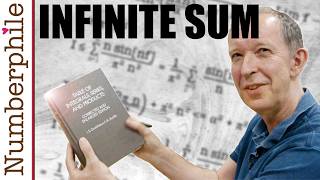
[05:50] This is one of our tools of the trade. It's the book of table of integrals, series and products. An excellent Christmas present. So in here are integrals and but there are some sums and one of the sums.
[06:05] So you just got to get the right one is there. Do you see what I want? I want there. Do you see what I want? I want sin nf / n. Well, this is sin kx over k. It's exactly the same thing. So this turns out to be 1 /<unk>^ 2 *<unk> / 2 -
[06:24] f / 2. Okay, that's what that sum is. But I'm interested in the limit of f goes to zero. And now I can take this limit. There's no ends multiplying it to cause me a problem. So it means that in the limit
[06:37] the limit of f goes to zero, I must be less than or equal to and what I have is 1 over 2 pi. That's the first. So that's an upper
[06:49] bound on what this sum is. And one over 2 pi is what? 6 point 3.14 6.28. >> towel. >> Tao. This is
[07:03] >> okay. Now let me try and get a lower band. And once again I go back to my denominator here. To get my lower band I can make use of the same thing. If I once again look at alpha sin^ 2 once again the denominator
[07:19] again the denominator 2 p<unk> n / alpha +<unk> 2 n^ 2 well sin^ squar is always less than or equal to 1. Right? The sin squar function looks
[07:34] something like this. It starts at zero and it will go up to one and then it will come down and it'll go up to one and it will come down. So this is always less than or equal to one which means that this thing will always be less than
[07:49] that this thing will always be less than or equal to alpha 2 +<unk> 2 n^ 2 because this thing is always less than or equal to one and that's having equal to one. So I can now do the same thing.
[08:02] I can now say that I is now greater than or equal. So this sum from n is 1 to or equal. So this sum from n is 1 to infinity of n sin nf over and now it's
[08:15] infinity of n sin nf over and now it's this thing alpha 2 +<unk> 2 n^ 2 and so I just want to write this if I pull this pi^2 out. So this is equal to 1 /<unk> 2
[08:27] pi^2 out. So this is equal to 1 /<unk> 2 * the sum from n is 1 to infinity of n * the sum from n is 1 to infinity of n sin nf over n^ 2 + alpha 2 over p<unk>^
[08:39] 2. I've just pulled the pi squ out and so it divides that alpha squ and leaves so it divides that alpha squ and leaves me with that n^ 2. So I've got this sum. So going, okay, it's looking better than the original, but it's still But I go
[08:52] >> the Christmas present, >> Christmas present book, and I see that >> Christmas present book, and I see that on the next page, I have this formula, on the next page, I have this formula, the sum of k sin kx, sum of n sin nf
[09:07] the sum of k sin kx, sum of n sin nf over k 2 + a 2 / n 2 plus this thing. This is equal to a a fixed function as well. It's it's a known function. So this actually is equal 1 /<unk>^ 2 into<unk> / 2 * by a shine not a sign
[09:27] into<unk> / 2 * by a shine not a sign shine of alpha minus f alpha / pi / shine of alpha. So that's what this sum is equal to. Remember I is going to be
[09:39] bigger than or equal to this sum. But remember I want the limit of f going to zero. So I can once again set f to zero. And can you see that I then get shine alpha divided by shine alpha which is one
[09:54] because it's one thing shine shine of alpha divided by shine of alpha is the same thing. You divided shine of alpha by itself and so it just gives me one. by itself and so it just gives me one. So this tells me that I must be greater
[10:06] than or equal to remember I'm looking at the limit of f goes to zero. The shines cancel and this becomes 1 over 2 pi. So I've got that I must be both less than or equal to 1 over 2 pi and I must be
[10:22] greater than or equal to 1 over 2 pi. There's only one way this can be if I equals 2 pi. So I've actually done this sum without doing this sum. >> Well done. >> Which means that I
[10:38] >> Which means that I equals 1 over 2 pi. And so if you then go back to this prefactor which is 1 / i. So 1 over i would be 2 pi which would be 6.1. And that's pretty much what that is.
[10:53] >> So for people watching you did this sum but this isn't this holes in the universe. >> It's not one over two pi primordial >> This is just a little tool. >> It's a tool on the way. It was just a an
[11:06] will allow us to then go and work out this probability distribution function >> how was I know >> you don't know. [laughter] Haven't been able to solve the next part of it yet.
[11:21] >> That must have been quite satisfying when that happened. happens. [laughter] Usually when you put a bound on it'll tell you that okay I has got to be less than some massive number and bigger than
[11:36] a number of order for whatever one over 2 pi and it you you can't do that much with it but to have it bound like that it was just chance. on the right track. >> Yeah that's right. And so it actually
[11:53] made me think, okay, I'm going to try and do this. And and the thing that I I and do this. And and the thing that I I thought might help was if I So you've got this sin squared in the bottom in the denominator here. If I first of all
[12:08] brought it up into the numerator, then you've got s time sin squares and and higher order terms. And then there are things we learned at school high school about trigonometric identities which I thought to myself if I can get
[12:24] it so it's of the form like these which is sign over something and then here you've got sign over something then I thought maybe may maybe I can then make use of these identities but in fact something even nicer happens which means
[12:38] I I didn't have to do any sums in the end I have to write things out as sums but I didn't actually have to do them and um we can do that if you want. do now? You're going to prove something. >> I'm going to prove it.
[12:52] >> I'm going to prove this result. I mean at some level I've proved it, right? I've bounded it already and I've said it's got to the upper bound and the lower bound are exactly the same. So it's got to be this.
[13:04] would you even prove it? Like >> no, I was a bit nerdy. [laughter] I think I just wanted to try and convince myself that I could do this uh because it was such a nice result. I mean, two pies. You you you always have a feeling
[13:18] you're on the right track if you've got a two pie hanging in there. And uh so had another go. That's it. >> The second part of this video will be posted over at number file 2. There are links below, but be warned.
[13:33] >> This gets a little bit hairy, but but hang in there. And while I'm here, can I take this opportunity to thank everyone who supports Number File on Patreon. It's a really important part of what we do. You make it possible for us to go
[13:47] the extra mile, make more videos, put more effort into them, and some of your moment. And if you have a look down below, I will link to the full list of all our Patreon supporters. That's down in the description. Thanks a lot,
[14:01] everyone. We'll be back soon with another video.
⚡ Saved you 0h 14m reading this? Transcribe any YouTube video for free — no signup needed.