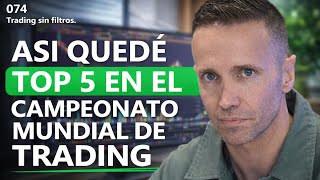

World's Top Trader Reveals Secret
60sThe introduction of the Robbins World Cup and a trader who placed 5th globally creates immediate intrigue and authority.
▶ Play Clip"Delivers on the promise of explaining how a top-5 trader achieved 60%, but includes lengthy tangents and promotional segments."
In this interview, Rubén Martínez, a top-5 finisher in the Robbins World Cup trading championship, discusses his journey from manual to algorithmic trading, his strategies, and his experience competing in the world's most prestigious audited trading competition. He shares insights on strategy selection, risk management, and the importance of understanding and replicating trading systems.
The Robbins World Cup is an official, audited trading championship featuring legends like Andrea Anger, Larry Williams, and Ivan Sherman. The winner is considered the world trading champion.
In 2025, Rubén Martínez, an algorithmic trader, placed fifth in the world in the Robbins World Cup, achieving a 60% return using trading robots.
Rubén started trading 12-13 years ago, initially with manual trading, then moved to quantitative analysis and programming, eventually finding a balance that suited his profile.
After manual scalping on the DAX, Rubén felt the localized advantage was fragile. A talk on algorithmic trading opened his eyes to automation and diversification, leading to a complete change in his approach.
Rubén advises looking for strategies that are replicable, understanding what you're doing, and ensuring the strategy fits your lifestyle and risk aversion. He emphasizes the importance of scalability.
Rubén has a personal account with higher risk and a fund with lower risk and more stability. He exploits different inefficiencies, often based on human behavior, using data-driven and automated strategies.
Managing a fund requires defining operations in detail, with auditors ensuring 100% compliance. You must specify maximum drawdown and projected returns, and you cannot deviate from them.
An audited track record is crucial. Darwin Exter is a tool that provides a real-time journal and audited track record for €45 per month, with a 20% discount code 'psychologist'.
Rubén works with Galiano to select strategies. They start with a base of strategies and discuss which to include or exclude, reaching a middle ground. The process is dynamic and evolves over time.
Rubén uses reversals, seasonality, breakouts, and any strategy that exploits inefficiencies. He prefers a deductive approach, starting from known strategies or hypotheses, rather than purely inductive data mining.
The objective is to achieve the highest profitability from January 1st to December 31st. Participants need a minimum real account of $10,000, and there are no rules on maximum drawdown, but futures must be used.
For Robbins, Rubén uses a portfolio of strategies rotated to maximize margin usage, as limited margin requires careful allocation to achieve high returns.
Last year, after reaching a 60% return in two months, increasing position size led to a fall. Timing is key; increasing size after a win streak can be risky due to variance.
Rubén decided to participate in Robbins after a conversation with Galiano, seeing it as a way to share his trading and document his process, which also helped his credibility.
Rubén's strategies have a win rate between 60-70% and a profit ratio around 3.5. The maximum drawdown for the Robbins portfolio is close to 30%, including compounding.
Rubén makes approximately 10-12 trades per month, sometimes fewer, as he uses swing strategies.
The City is an algorithmic training community with training, support, and synergies. It includes live streams discussing inefficiencies and strategy creation, fostering collective intelligence.
Rubén would tell his past self to keep pushing but be patient. He emphasizes that things aren't as important as they seem when starting out, and that consistent daily effort leads to success.
Rubén Martínez's journey highlights the importance of understanding, replicability, and scalability in algorithmic trading. His experience in the Robbins World Cup demonstrates that high returns are possible but come with significant risk, and that timing and risk management are crucial.
What is the Robbins World Cup?
An official, audited trading championship where the winner is considered the world trading champion.
00:42
What return did Rubén achieve in the 2025 Robbins World Cup?
60% return, placing fifth in the world.
01:10
What are the three key criteria Rubén looks for in a strategy?
Replicable, understandable, and scalable.
09:49
What is the minimum account size to participate in the Robbins World Cup?
$10,000 real account.
35:57
What is the win rate of Rubén's strategies?
Between 60% and 70%.
53:45
What is the profit ratio of Rubén's strategies?
Around 3.5.
53:45
What is the maximum drawdown for Rubén's Robbins portfolio?
Close to 30%.
53:57
How many trades does Rubén make per month on average?
Approximately 10-12 trades per month.
56:31
What is the fee for Darwin Exter?
€45 per month, with a 20% discount code 'psychologist'.
17:27
What is the key lesson Rubén learned about increasing position size?
Increasing size after a win streak can lead to losses due to variance and bad timing.
42:43
Fifth Place in World Championship
Demonstrates that algorithmic trading can achieve top-tier results in a competitive, audited environment.
01:10Replicability and Understanding
Emphasizes that a strategy must be replicable and understood to be effective, a core principle for traders.
09:49Risk of Increasing Size
Highlights the common pitfall of increasing position size after gains, leading to significant drawdowns.
42:43Importance of Audited Track Record
Shows the value of an audited track record for credibility and attracting investors.
17:13Patience and Consistency
Advises that patience and consistent daily effort are more important than short-term results.
01:00:13[00:01] operating, but I felt like I was saying, "I don't want to be doing seems to me that it was something very fragile." One a talk about algorithmic and quantitative logic, and I said, "This is what's
[00:15] start over and wanted to know more or less what might work well for you? What would you think of to replicable, that is, to understand what you are doing. We have created a suit the objective, which was the Robin. So, this year, by participating in
[00:29] Robins, we reached a 60% return in two or three months, okay? What's happening? increasing the size we fell. In other words, if you're unlucky enough to increase your size, harm you. So what happens? We also saw a significant drop in
[00:42] Hello traders, how are you? I don't know if you knew this, but there is a world championship for traders, an official, real, audited competition that has been held championship that has featured true trading legends, names
[00:57] like Andrea Anger, Larry Williams, or even the well-known Argentinian Ivan Sherman. And most importantly, the winner of that championship is considered by everyone to be the world trading champion, the best trader in the world, at
[01:10] talking about the Robins World Cup. And last year, in 2025, a trader incredible algorithmic trader named Rubén Martínez, came in fifth in the world, competing on the planet. He achieved something that very few manage, reaching a 60%
[01:25] of the championship. And he did all of this using trading robots, since he is an interview I'm going to ask Rubén things that I think are of interest to all of us. Furthermore, he is also competing this year , in 2026, he has already been competing for 2 months
[01:38] . And I want to ask him about his performance, what podium. You'll see, he'll tell me that the current leader in the ranking has an 800% return in just two months. So I want to know how
[01:51] become number one this year. I assure you that you're going to love this video, so I Rubén, how are you, man? Very well, how are you? Delighted to be talking so people know, that we've been here a long time, we
[02:05] recorded a podcast earlier. Uh, it's weird recording that kind of thing because we were just talking calmly and then the cameras are on and it feels a bit But I really want to talk to you about many things because it's been a long
[02:18] and many things have changed too. This year you were at La Robins, huh, you're with the background, huh, lots of things, okay? So, for those who don't know you, I'd context, if you want to explain who you are, where you come from, how you got into
[02:32] trading, and that way they can get a sense of who you are. Phew, so many questions, so many questions all at once , but hey, I'm algorithmic, you know, that's why we're here too. I started trading about 12 or 13 years ago,
[02:45] and I started by taking stock market licenses. Then, along with some colleagues, I'm also in an office where we do manual trading. After manual trading, I did some
[02:59] training in a fund, and I started with intensive quantitative analysis. That's when I got completely absorbed in this, spending about two or three years training on the other side, the exact opposite of manual trading. Uh, then from here I tried to create
[03:14] another methodology much more in line with what I believed or what I wanted to super comfortable, and with which is the methodology that I apply today, and well, we got to this point, from the workshop to this point, what
[03:30] has happened, I mean, I've summarized it very, very quickly because of course, but it's been 12 years as a professor, right? So, a lot has happened here, from initial self-funding, manual, then quantitative, then
[03:44] programming, then finding a balance between all of this, and in the end it has all been based on finding results when I have reached a balance between, that is, when I have managed to put together something that I have
[03:59] felt comfortable with, like your profile, right? The place is like your profile, right? The place is amazing, man. they start somewhere opening a strategy, the strategy may be
[04:12] good, but they don't find their profile. So, you're using a something that really exploits an inefficiency, but you're not able to be, you know? Yes,
[04:24] get to this point out of those 12 years you start until you reach the point where Look, I already had results, for example, the manual scalping on the DAX, uh, since it was so specific and it was a very concrete advantage, I already
[04:38] What's happening? So there I was, inside the office, operating, but I felt like , "Damn, I don't want to be
[04:50] localized advantage." It seemed very fragile to me, you know? It was like, very fragile to me, you know? It was like, yeah, but it's not something you can mean, I'd maintain it for a long time. And then, on top of that, one
[05:04] I had a talk about algorithmic trading and I thought, 'Damn, it's all automated,' this opens up a whole new universe for diversification, having more assets." So I
[05:17] This is what's coming." I 'm talking about 10 years ago, right? And of course, from then on, everything changes, like the whole operation, right?
[05:29] So, well, that's kind of the change when you start getting results in algorithmic trading. For the first two years I was training within the fund, I barely touched trading. I mean, because almost everything was models,
[05:42] because almost everything was models, algorithms, things that made me think, "Wow, I'm here all day [laughs] engrossed in this, We applied everything to trading, trained in fund management, but we were going to
[05:55] create a trading model, so, I mean, it was all like portfolios with curves, but in 3D, I don't know what, okay? Okay. But from what you're saying, I don't get the feeling that the money is really moving around here
[06:09] , you know? No. So, in the end, what happened after that time? Well, of course, since it was what happened after that time? Well, of course, since it was Right. And of course, well, I The results I was getting
[06:23] were just okay, you know? For a personal account, it was fine, yeah, nothing special, you know? There wasn't much risk, results, but it wasn't going anywhere. And then, when I started getting results, it was later when I saw that there were
[06:38] systems or strategies that were quite simple, that you could apply, and that were already there, you know? For everyone, that had been realize that, I'm also talking about this in the context of what I
[06:51] 'm saying, 10, 12, 8 years ago, the internet isn't what it is now. Now you search for information and you get a lot of information about systems, about strategies, listening says, "Sure, but if you had done a little research, you would have found a different
[07:04] where you don't have access, where you 're not surrounded by traders like that. And other things, but we have that good part the problem now is how the information is structured and how it's filtered. That's where we
[07:18] could get into something else. And the fact of comparing yourself, of seeing many results, can also backfire. That wasn't the case before , but there was the feeling of saying, "
[07:31] Damn, I want to learn about this, but I do n't even know if this exists." ? Sure, every time you search on the internet, on where people can get motivated, where people say, "Damn, it's possible, I
[07:44] Yes, yes, yes. But of course, I didn't know before if it was motivation, inspiration, right? I had n't thought about that, but of course, we used to talk about this too, since we started getting to
[07:56] know each other 7 years ago or so. Yes, of course. Even from 7 years ago that we mentioned, I'll even leave the tag here in case you want to check it out, it and some pictures of what we had back then. Almost 7 years have passed, and in 7 years,
[08:11] trading has changed a lot at the retail level in terms of access to information. Imagine what it was like here 10 or 12 years ago, it's another have much more capacity, many more tools to access good
[08:24] strategies that have been working for a very long time. Just the other day, while we Open Tang Breakout, for example. Yes, I already have it on my channel too. . These are things that people perhaps didn't
[08:38] wasn't as much information, but as you rightly say, now it's difficult to discern incorrect, isn't it? Yes. And now there are, perhaps, many nuances, what I see, right? I mean, I don't know, you can watch a
[08:52] video and say, "This is very profitable." And then you get down to brass tacks and say, but at least you have that to start from , right? Or maybe you can get lost in a lot of information, saying, "Hey, I'll try this, but now I've come across
[09:06] this information from another trader who also has results, and change comes up and I try it too, and now this," and then you say, "Wow, I've been starting for 2 years and I still can't figure it out, you know where." Well,
[09:20] find your place. But it's true that at first I think it's do a series of chats, right? Hey, things that maybe you should not, which doesn't mean it's better or worse." Obviously there are things that you don't see, things you do
[09:36] n't know, but then there are other things that depend a bit on your situations and your aversion to risk and be a bit of a tricky question, but could you give me
[09:49] some advice on what you would look for if you had to start over and wanted to know you? What would you think about when looking for it? Well, what I would look for is for it to be replicable, that is, that I, or rather, you have a result, right? So, how
[10:01] results from what I can learn, or from what I can right? That's about it. Then another thing is, hey, understanding what you're doing, I mean, for example, I do
[10:15] algorithms, but with strategies, but I understand the strategy and I apply it should also understand it because otherwise in the bomb, I'm going to throw it there and tell you, "Okay, then apply it." So
[10:29] because you're going to have one, and you're going to say, "Hey, what's going on with this? Uh, now what? What do I do now? Uh, this was supposed to be if you have strategies where you say, "Okay, this is what's happening, this is what's happening
[10:42] , this is what's happening," okay, fine, you have a downturn like before, but well, this strategy comes in here because of this point, because what's happening is an inefficiency, for example, it comes in on Fridays and out on Tuesdays because of this, this, and this, whatever
[10:55] , a seasonal snapshot or a blackout, a understand it perfectly, you feel comfortable with it, you look at the statistics and you say, "Hey, well, this is fine." So, understanding what you're applying
[11:07] So, understanding what you're applying is a pretty necessary point, also mean, it depends on your lifestyle, your philosophy. I mean, hey, well, if what I... What I want is, uh, to have something automated, well, you can
[11:20] do that. And on the other hand, whatever you want , well, I want, uh, I don't know, I really like having want to feel that adrenaline rush, of course, to feel that feeling of buying at such and such a moment,
[11:32] buying at such and such a moment,
[11:45] that regardless of whether you want to do it with third-party capital, your own, whatever you 're taking advantage of, whatever you're exploiting, has to be scalable, has to have capacity because, of course, if you have it, maybe it's something very niche and maybe you
[11:58] small account, but then as you grow, well, there's the moment you're going to grow, the projection that you're going to grow, so don't the capital, it's not like if you do it Well, you'll
[12:11] They're good, man. They're good. Yeah, and also, for example, I've talked to a lot of people who use strategies that are, I don't know, And they're good strategies, but they're not able to properly execute
[12:24] all the profit, right? To let it run or vice versa. Imagine a minute reversion that has huge swings, where there's a moment that's been going for three months and suddenly, on the third month, on that one day, bam, they blow it up. So they're not
[12:36] Yeah, it's very interesting what you say about of checklist where, look, more or less with what Rubén says, with what I checkbox where I'll mark things to define my profile. That's really
[12:49] define yourself within the world of trading if it were a profile? Imagine you define yourself? An algorithmic trader. What else? An algorithmic trader who exploits different inefficiencies. Ultimately, what
[13:02] exploit human behavior. For example, a micro-version, as exploits—in this case, yes, it exploits the behavior of the asset itself— but ultimately, the asset's behavior is influenced by the
[13:16] typically buying when the price falls. But not always; it's not that a price falls, but you get the idea. Or, in time, perhaps with commodities, you might be
[13:29] a specific day, or whatever. So, what I do is trade with data-driven and automated strategies. Okay, with that said, here's my trading strategy. Well, it
[13:43] depends on the variant I have. Right now, I have the personal part, which has more risk, and Robins, for example, which also has more risk. And then there's the part where I invest in third parties, which has
[13:56] less risk and more stability. Okay. And why that selection? you mentioned, right? It's because many people here have, like everyone else, two which is the issue of funding, which
[14:09] let's go back to the traditional ones. Do you have a personal account or do you manage The decision to go down this path mainly, what is it based on? Yes. Well, I also think it's because of the training I mentioned earlier
[14:23] that I had, so I was already kind of geared towards it. Of course, in the end, let's go back to the same thing, years ago the way to make this a good business was that, you know? So I What I've had is that I've
[14:39] "Hey, well, if I don't have capital, uh, when I started I'd say, well, I need need investors, I need an operating system for investors." So, uh, I've always gone that way . Besides, I like the
[14:53] could have said, "No, well, up to here and now, just something of my own, no, I also like the fact that I can manage it." that. And do you do the same thing in terms of
[15:06] strategies in your personal account as in the fund, for example? No, no, no, no, because in a personal account, what you look for is, as I was saying, more concentration and more profitability.
[15:19] And in a vehicle, what you look for more is stability, you know? The fact that in no case does the curve suffer too much, I mean, there what you look for is stability, profitability as well. Of course, but
[15:33] always prioritizing avoiding otherwise investors would run away, right? Well you have a prospectus that, as you mentioned, states you ca n't exceed a certain
[15:49] n't... can you explain that a bit so when you manage a fund, when you go to more institutional investors, what bureaucracy, or meet? Well, when you manage a
[16:05] fund, or when you have the operations within a fund, it's important to define your operations in detail. You have to define, well, they? You'll almost certainly have an auditor who will audit everything,
[16:17] absolutely everything, who will ensure that your operations are 100% followed, that you can't deviate from them. And of course, one of the things you say Look, I have this maximum drawdown, I project this return, and so on.
[16:29] we're talking about, well, imagine, right? Everyone chooses their want to go, go. But imagine you say, "Hey, I'm not going to go over 10% of Dragon." You can't go beyond that." I mean, you can't say, "No, I
[16:43] was 13, you know?" It kind of slipped out , I don't know what, or no, restart it because we're starting over again, right? Because a lot of money is spent on what an auditor costs per year, on setting up all that nonsense . So, that's
[16:59] Total, total, total traders, as you can see, one of the most important things about the audited competition. You can become the best trader in the world and everyone can share that opinion because Robins World Cup audits your results.
[17:13] Without that audit, without that public track record , it would be pointless to say that you Hence the importance of generating your own track record. And the best exists today to generate your own track record is Darwin Exter, and it
[17:27] 's also super cheap. It's 45 a month plus the 20% discount that I'm leaving you here the code psychologist, as you are seeing here on screen, using Dark Extero, you will have a real-time journal of your trading. You will simply have to
[17:40] Metatrader account. It's a completely virtual account of around €100,000. You trade as you would in your own account, and Darwin Extero replicates that strategy in on the screen, where you see all your data: what you generate, your drawdown,
[17:54] risk-reward ratio, your win rate—all the information strategy. You need to know it yourself, and it's automatically collected and track record that you generate completely automatically, for just that payment
[18:09] shows it to the thousands of investors they have on their platform. There are thousands of people, thousands of real investors with real money who Obviously, not everyone wants to be a trader or has the skill to
[18:23] money to invest in traders. This way it's a win-win for everyone. As a trader with no money, you receive the investment from the investor, who lacks skill, and the investor shares the profit from their investment with you. He
[18:36] taking the risk, and you take 15% of what you generate. In other words, if , for example, here's an example of Darwin Syo who is example of Darwin Syo who is
[18:50] everything you generate with that capital with zero risk. You have only paid a fee of €45 per month. There is nothing similar in the world today that allows you to left below for a 20% discount on Darwin Extero's fee
[19:02] and start auditing your trading right now. And you in this case, uh, you're not alone in make up? Well, I'm currently working with Galiano, we're doing everything, I mean, like, well, all the operational side and the community side, I'm
[19:15] Very good. There are two of you, huh? And what sense of, uh, because earlier we also had a very interesting conversation, I don't know if it was course, how do you decide which strategies to include and which to exclude? Uh,
[19:28] Yes, I think we've touched on it, it's like , uh, for example, a selection, a base of strategies created, I have a example, another selection for the same objective and then we start like, well, I
[19:44] throws it to me, well, I would include this because of this, I would leave this out because of this other thing. So we arrived at a middle ground that I don't like to call a consensus, I don't like it, but well,
[19:58] yes, that's how it would be, right? It's a point of understanding where we both say , and so on. But well, we already have it pretty well defined at the beginning, that's more at the beginning. Then it
[20:12] The trading process is always evolving; anyone who says otherwise is lying. I you have a number of strategies, but then it's dynamic because you continue to develop as a trader, you keep learning, you keep improving, and like
[20:25] look back a year and say, "Wow," or 6 months ago, or also the good thing about all this, and it's also the beautiful thing to say, damn, if it's you know? Absolutely. You have to evolve,
[20:39] maybe before and don't now. So little by little you have to adapt to become the trader you are. Today. That's totally right. And hey, that, have I? Well, he joined the City, he joined the
[20:52] Well, he joined the City, he joined the private community. Uh, that's where we met, and well, he's outstanding, a real pro, started doing things. I mean, he joins the community, he comes in like a
[21:07] whirlwind, solving everything, you know? Like, solving everything in the sense that before I joined he'd already done this, he was answering very active person, right? Yeah, yeah, like he was new,
[21:19] you know? And you'd say, "Wow, he's already like this and he hasn't been here long, you know?" " Imagine, with incredible potential, and that's exactly how it's been." I mean, you been." I mean, you throw something at him and he knows how to
[21:33] mean, he's one of those people you say, he knows how to read things really well, not just the part about, hey, it's a technical profile, it's not that he's the psychology behind it, to understand very well how to
[21:47] say, "Hey, I know why you're telling me this, you know?" there, you know? So, with just a few things we've talked about, it's already very easy for us to understand each other, you know? And you know, we're kind of on the same wavelength. That's the
[22:02] for example, which, from my point of view, is also how traders today, little want to express themselves, want to show themselves, want to create communities, want to be in sync with other people because they're
[22:16] caves all day, which we've talked about, we really like being going out from time to time is also cool, and talking to people and making different plans and having a community, and that's increasingly happening on social media, creating
[22:29] opportunities. No, for example, the City gives you the opportunity to meet incredible people. Someone might come in as a student or as someone who's there this guy is amazing" or "this person does an incredible job" and you want them
[22:41] as part of your team. And that ultimately makes your ecosystem as a trader exponentially, you know? With collective intelligence. Do you see it that way, or profiles within the City, I mean, those of us who are doing things, uh,
[22:57] has an algorithmic breastfeeding company in Mallorca. You know, people you're like , "Wow," they're really top-notch ? And that, and that even, well,
[23:09] people who may be just starting out, but are very good. So, at the last event, for example, a guy comes up and says, "Damn, we haven't talked much, you know? But anyway, if I can help you with something, I
[23:21] using artificial intelligence and patterns like that, and maybe , we can do something." Yes, something very interesting conversations come up because, of course, maybe these are people who are
[23:34] a background in something we this together, which has nothing to do with trading, but I learn a little from this and mix it all together, and I'm maybe much better than you.
[23:46] only focused on this, you know what to say?" And that happens in many sectors, where they say, "I'm not going to be better than you at something, you know? If I only compete in that one thing, but if I mix that with something else, I can be much better than you.
[23:59] Absolutely, yes, yes, yes, yes." And I've seen this with people too. It's happened to me psychology class or whatever, and I see one of them—we're talking about, I don't know strategies, or whatever—and I see that this guy is ahead, you know? I mean,
[24:11] , he doesn't say, "No, it's just that I come from data analysis, or something like that." this, I don't know, this ratio, I don't know how many, and you see that he's already contributing things from his niche, which he's transferring here, and that gives him a
[24:25] else. And you have to take advantage of that because, like you said, it's a Symbiosis. If you see a guy or someone within your community or group who elsewhere that's transferable here, damn it, squeeze it dry and exploit it because that's
[24:38] course, in the end, when you come from outside, you have a different perspective and that freshness of saying, "Damn, you're so focused on what you're Totally, totally, totally. Hey, man, and I also wanted to ask you, and
[24:51] what kind of strategies do you use? I understand reversals, seasonality, yeah, breakouts, uh, we basically use any kind of strategy that exploits inefficiencies and that is, well, that's
[25:05] always the kind of concept of saying, hey, it's something understandable market and replicate correctly, okay? But the process is always, how to put it? Deductive or inductive
[25:18] you can do Two things, right? That we can discuss. You can what already exists, a hypothesis you have, and you say, "Look, I think there's noticed, what I know about the market." I'll check if that's the case. Yeah?
[25:31] Or it can be inductive. In the sense of saying, hey, I first look for example, with programs like strategican, etc., with builders, and transferable to the real market because of their idea. What's that like? No, what we
[25:45] do is start from something that already exists in the market, that is, that already exists in the market, that already exists out there, some strategy that you can see in a paper, in a magazine, or wherever, that has been
[25:57] working for years. Uh, or maybe also from some hypothesis that you have, as you said, and you said, hm, well, I'm going to see if this advantage is profitable or not . But what we don't do is
[26:10] say, "Hey, let's look for strategies here to see what comes out." Because? Because, well, that can lead to you finding might work, but you might also find many others that don't. And
[26:24] so we prefer to skip that process and go straight to a strategy end, the process is always the same, is n't it? Because even if you use that I don't use it myself, but from what I've seen with other traders, etc.,
[26:37] have enough judgment to know whether it works or not. Data alone, what the program tells you, isn't enough. Because, as you said, if the inefficiency disappears, if there's a problem you can't detect, or if the
[26:50] what do you do? What do you have to do? Discarding that and starting over, and doing that all the time, I don't know, I don't see the point in not having the deductive part, do I understanding of why something works, why this drawdown point is reached,
[27:03] see it, eh. I don't know if you, who are more involved in that, think... Of course, it's what we were talking about before, about having control, that is, if you don't know what you have in your hands, uh, even, for example,
[27:15] when the market moves, imagine that you have a trend-following strategy and the market is in a range, uh, but you don't even know if it's special or not, because you say, "I'm losing and I don't know if this is losing now because, you
[27:29] failing or something." However, if you understand that it's a trend-following strategy, okay? It's great that when the trend returns you'll start making money, because you're probably more relaxed, you know
[27:41] what you have, you know what you're applying, you know when to disconnect, you know improve that, because you can also know how to improve and say, "Hey, let's we can minimize entries when it's in range." But if it
[27:54] have here, uh, four entry conditions, four exit conditions, and even , I've come up with something here that I'm going to apply because this is apply because this is strategy 1 2 3 4 5, in
[28:09] yes, but then it usually falls apart in the end. people normally use these kinds of tools in such an unprepared way, you know, simply because it's very costly to
[28:24] learn how to use them like real trading, how to really think about it.' I think they want to start there first to see if it works, and say, 'Well, maybe I have to investigate a little more, you know?' Yes, that's
[28:37] more attractive. Yes, but in reality, if you then work, you know, you've already done that work because You say, damn, I have five strategies that you know by heart, because you say, damn, it's because they're the five
[28:50] working for maybe 20-something years, like the one you mentioned about Delb, you know? For example, well, you can extract, well, imagine, four or five, and you don't For example, to start with. Well, maybe one of them
[29:03] I mean, you've already done the work, you don't need to be with Strategic One all day , you know? With the room at 150 degrees and, you know, leaving the computer at night, you know what I
[29:17] mean? No, no, you don't need to go that far. I've also seen a lot in the trading community and such, of course, there's a lot of teamwork, right? Barça, Madrid, also the sense of whether builders or not builders, for example, Sergi de
[29:29] Cher is very anti-builders, there are people very much in favor of The builders, I don't know what. extremes, but I think the one that always makes sense is saying, I mean, there are no shortcuts. Even if you want to use a tool or
[29:41] fast, eventually there will always come a time when it stops working and you'll need the fix it. There's no other way. I mean, I wish there were Of course, in the end, algorithmic trading is like manual trading,
[29:53] automated. That's what you have to understand. So it's like saying, "No, I do manual trading, but kind of like this, you know?" Like, what the computer tells me and you say, or what it throws at me, you know,
[30:06] the market and you say, I do n't know, you know? I do a plan, right? Know? You'll need to have a well-defined strategy, taking advantage of, the advantage, you know? So, well, what you 're
[30:22] issue of whether it's the same as shorting smallcaps, right? We were saying that, well, are very into short selling with SMCups, especially pre-market short selling, for example, and a lot of people think that by going short, you can
[30:36] backtest what we were talking about before and it will come out a winner, but if you don't have the knowledge know when a stock, for example, isn't diluted, which is the concept of the company starting to dissolve in some way, right? If you lack
[30:48] very simple because it's like, oh look, like churros, short strategies, consider the tail risks that are there, you don't understand many other things that you need to know. Or what I was saying before, the funding issue, right? There are
[31:01] beating funding through but well done, but if you don't know about trading, you'll win for a while and money." But if you don't know more or less about probability, ratios, risks, the
[31:15] risk of ruin, you can't do that because it's not impossible to survive long enough to earn sense, right? So, I see it a bit the same way,
[31:27] you know? I don't know. Yes, I mean, in the end it's all about knowing what you're dealing with, you know? It's all about funding, okay, but with everything that it entails, I mean, hey, with the pros and
[31:41] cons, knowing that many times the positive aspects are shown, but the well, they don't show, for example, what you pay for the accounts, you know? It's like, maybe it faith. I mean, I tell you, ' Okay, well, I paid one and I skipped it, I
[31:56] Of course, indeed. But who's to mean? In the end, it's all very , you all very opaque. Uh, and well, SMPs, well, I think they're
[32:10] a market that, well, can be very fascinating in the sense volatility and all that, and I think, well, it's a very attractive market, but you also have to consider, well, it has its pros and
[32:23] cons. Pros, what are they? Well, you can make a lot of money. Uh, cons, Well, you're going to have to be in front of the screen for that, and very attentive, and you also have the risks associated with that, as you mentioned. Look, it does
[32:36] n't mean it's better or worse. You buy the whole has the algorithmic aspect, so you have to create the strategies, you have to apply them, and you have to be consistent with what you're applying, and you have to
[32:48] applying and do it, okay? Okay, well, in the end, I mean, there's nothing in Small Caps too, you could do that, but well, with everything
[33:00] that entails as well. 100% 100%. For example, yours at the I mean, could you explain more or less what it's like ? Because a lot of people have a bit of a algorithmic approach is. What's yours like? It changes a lot, like, for example, if Maybe
[33:13] I want to look for efficiency, or maybe I 'm more in the phase of, hey, let's put together, I don't know, a portfolio, or maybe we're in the phase of, uh, I want to refine a strategy, or maybe we're in the phase of, it depends, right? It
[33:28] depends on the day, but well, basically, when I turn on the computer, it resolve. Maybe I have to resolve some emails and such, okay? resolve some emails and such, okay? And then I usually do more
[33:41] concentrated work until, uh, midday or around, and then in the afternoon I usually leave it, well, operations, it's always monitored, more or less, afternoon it's usually the work of, hey, there's something pending, and also
[33:56] doing things, hey, things that I take advantage of that research I've done for the community, sharing things, maybe with live stream, if there's that kind of thing to do, I mean, we almost always make
[34:08] calls, I also make calls with Galiano, listen, so, about putting things from the Galiano, listen, so, about putting things from the day-to-day, like, well, common? Listen, what do we have to do, what's the next step? I think we're going to, well,
[34:20] morning more focused work and in the afternoon more work preparing for the next day, the following days, and things like, sharing content and so on. Would you say it's an 8-hour day or so, or
[34:35] Yes, it depends. There might be days when I can spend more, maybe for whatever reason, I might only do four or five, you know? It depends. And what about hours, for example, being on top of a
[34:49] monitoring strategy, maybe checking if what's being done is working? You , normally we're going to be more present during the when the strategies tend to move the most.
[35:03] we're on the screen, otherwise we would trading, or oh, we have intraday strategies, intraday strategies, but most are swing, that is, medium-term holding, that's
[35:17] Okay. And speaking of strategies, and since we've established a bit of about Robins, okay? Because I think many people might be interested because we haven't talked about all this, and I really want to ask you what
[35:31] Robin Gul is, okay? It's the world championship of trading, right? In your case, futures, and for those who don't know, can you what the objective of all this is? The objective is that you start on January 1st,
[35:44] well, January 1st whenever you want to join, and by December 31st, the highest profitability are the ones who win the championship. The one with the highest profitability is the one who wins the championship. Real account, uh, $10,000
[35:57] minimum to participate, and from there there are no rules like, hey, maximum drawdown, no rules like you ca n't apply this or that. Well, yes, let's see, in futures, they have to be futures that you can
[36:12] you know? And what I told you about margin too, I mean, it's not like you can just go there, well, you also have a margin, you have commissions, and well, an account of, for example, $10,000 for futures is a bit limited, I mean,
[36:26] you can, I mean, you can do it for micros, uh, but in the case of Robins brokers, since they require a bit more leverage, more limited, but well, in a normal Interactive account you can
[36:40] Broker options, right? I mean, they tell you on Robinsamos with these brokers. Yes, with one of them. Yes, with... they're famous, they're... or... example, I opened an account with Dortman, but well, there are more, I mean
[36:56] usually American brokers that have a n't, but it's true that there are other brokers that have better commissions, like PlayStation, Interactive, you know. I mean, in that case, they
[37:08] the total result. So they understand that even though they're part of the process, right? that you... Okay, okay. Net. Okay. And in this case, the fact of competing in this type of championship... hm, does that mean you have to
[37:25] made for that championship, or do you operate the same strategies that you would operate different risk? Ah, that's a very good question. Um, I mean, what we've done is Include a portfolio with
[37:39] okay? Why? Because ultimately, since you have a limited margin and you open the account for a certain amount of capital, you want that capital to move as
[37:52] achieve that profitability. So, if you have point, many at the same time, they won't be able to enter. So, what do you Monday, another on Tuesday, another on Thursday, and so on.
[38:07] You rotate these strategies to maximize the is asking how to do this, which might be But you have a margin, so if you want to increase profitability, you have to
[38:21] possible. And for that, you can't just enter two or of them. You can't do trades at the same time, you have to, you see, clearly, Of course, of course, that's a different approach than, for
[38:36] the problem isn't usually the margin, it's the risk. Exactly. Exactly. And so what you did to come up with this is, imagine, right? Can you explain beforehand interesting that anyone can sign up, there's no problem,
[38:50] right? So, what do you do? You sign up, you sign the document, can you explain how that process works? You go to the website, you fill out the form and you sign up, you sign as if you consent to joining
[39:03] RobinsCap. Well, you choose the one because there are several categories, in my case I 'm not on one, there are some that are quarterly and so on, where you can do a kind of... well, let's
[39:15] see how we've finished each quarter, right? This one isn't, this one is annual, it's main one. The main one, right? Yes. The main one, right? Yes. And well, you deposit, uh, in the
[39:28] broker, uh? And well, from there, well, they give you the OK, they say, "Okay, OK." Uh, you also have a fee, also from the data, it's uh, well, a hundred and something euros, I don't remember, but the higher the fee, the higher the fee, I
[39:46] impact on the account. So, that 's also interesting, deducted. Okay, okay, okay. Also interesting profitability, when the ranking comes out and everything, is the
[39:59] net profitability after deducting everything, because you also pay the Okay, okay, okay, okay. And so, what is the process you consider ? You're before, you You sign up for Robins and that day you start trading
[40:14] Robins because you already have strategies in place. When you do that, and adapt them to Robins, you create new strategies for case, we didn't adapt them; we simply made a combination of
[40:27] made a combination of strategies that best fit the we generally—I mean, honestly, last year I didn't dedicate much time to this because we decided to sign up and say, well, I'm going to
[40:39] this to be my main focus because we're focused on other things. So we said, well, let's do this as a kind our trading is going this year. Let's focus on this, and well, what we
[40:54] select the best strategies that fit this objective, that can portfolio, and that's what we did. Damn, and even so, fifth place. they're good strategies too. I mean, I said it like,
[41:07] like, no, we didn't do it, I mean, we did it half- heartedly, no, we did it intentionally, but, well, yeah, totally, right? No, it's I mean, in the end, the fact of finishing, we're talking about a championship where
[41:19] less when... I have no idea, right? A lot, I and then you finish fifth, man, it's insane. What kind of return does that end up being know, damn, I don't remember, I mean, right now
[41:31] because it's changed a lot, but around 200, 300, 300, end we didn't get much , I think everyone was , at least From Spain, I was
[41:45] following Tocaillas and all that, it was amazing. Uh, I also find it very interesting to in real time, at least from my point of view, okay? What I imagined you spoken to you at that time. And I was thinking, "Okay, when
[41:59] when you see that the market is in your favor, you step on the gas you want to try to scale as much as possible when the wind is in your favor, those returns? Because I remember you
[42:14] in the end what you do is increase the size as well, in a step-by-step way, the account grows, it keeps going up, right? And of course, you might have 50, 60, or 70% more
[42:28] profitability, so what you try to do is take advantage of having more margin same systems, the same everything, but as you said before, well, we have a systems, to take advantage of the next trades to go for it. What happens?
[42:43] Last year, in March or so, we were already where we are now, I mean, this year I'm also participating in Robins and we reached a 60% return. Two months, okay? What happened?
[42:57] We decided to increase the size, and by increasing the size, we fell, okay? that can happen, of course, if you go up, I mean, people think, hey, you go up and build , build, build, sure,
[43:10] have bad luck, well, bad timing, let's say, more than bad luck, that you increase the size and the next trade is bad, well, you're going to can hurt you. What happened? We also went down in
[43:24] profitability and had to recover again. So, of course, that penalized us in terms of time, saying, wow, we have to start all over again , but well, these things can happen. I mean, in the end, I think
[43:36] that to win these kinds of championships or aspire to be at the top, said before. Timing is the key. I mean, Ultimately, that's a mantra of old-school traders: you have your biggest loss when you increase your position
[43:49] when variance kicks in. You know what happens? I've thought about this most people increase their position size when they're and the probability has shifted in your favor due to variance, that's when you feel
[44:02] at that moment, the probability of a loss is also higher. Well, but in reality, you shouldn't because, statistically, you know, reality is... I understand that because I know there are people who are going to say,
[44:17] independent variables, guys." I've had to bring that up because it's like the algorithmic part was saying, "Damn, these are you say in the end, well, the reality is different, you know? That's how it is
[44:31] watching knows that when it went up, it hit a ton of bricks, and I was 'm convinced it's one of two things. If you're manual, it's because you get maybe you make riskier decisions and therefore distort the
[44:46] probability, or the other thing is that variance is a real pain. That's it [laughs]. if the next trade comes through, well, the next batch of winners isn't going to be that big. But then, of course, in the end, when you increase your
[44:59] side position, what you're doing is increasing your stake . There's no good moment when the winner is about to arrive, so you have to raise it, and it can work in your favor or returns—and this is something I think a lot of people wonder about, maybe they're
[45:13] someone make 300%?" or "How can they do this?"—I mean, there's no other way, you know? But also, in the future, you can make a lot of money doing this kind of thing. It
[45:26] means that if it's your own account, and you advantage of the situation, you can make quite a bit of money. 100%. Of course, obviously, that has have a very large drawdown. Of course, it's tough to go bankrupt
[45:40] because there's also the issue of margin and all that. I mean, you can lose money, you can have a significant drawdown, okay? But, it's symmetrical, right? In the end, I think the risk you lose due to symmetrical... I
[45:52] operating with strategies that have favorable conditions. It's another thing entirely if you just say, "Okay, let's open a futures account and 100%. That also seems very interesting to me, that in the end, of course, it can
[46:05] be a strategic trading plan, wanting to squeeze every last drop out of your account with compounding for a year, withdraw that money, and when the risk is , plus withdrawals. That's
[46:17] clear. Or you say, "Okay, well, I have some capital, so instead of putting in that capital, I'll put in less, but I'll go in stronger, you know?" In the end you have a strategy, you say, uh, well, I have more capital and I try to put it all into the
[46:31] Well, maybe it's even better to put in less capital and take more risk, and you know the rest is locked up, and maybe you're absolutely. And the decision to participate in Robils, did it come from somewhere?
[46:44] Well, the participation part came from the fact that I was talking with Galeano one day and we were talking about management things and that, and it was like, I remember, I already started the year, it was like it started in January or so, and
[46:57] 2025, that's the beginning, right? And Galiano says, "Dude, why don't you participate in the Robi?" "Dude, but I don't know, you have the so on, I don't know what." Well, I think it could be good, man, because in the end I say, damn
[47:10] , but I've always seen it as the typical thing that's just there, you know? Like, well , you know that's not it either, so I said, I don't know, you know? Because we have other things going on and getting involved here, man, I do n't know, the usual stuff, right? But then I
[47:25] "Damn, this seems really interesting because I like to share useful for sharing things that maybe I ca n't are more private, that involve third parties, you know?
[47:38] But other operations, you know?' But I thought, this is really what I can do , maybe with my own account, and how I can scale it and how I can manage it, and it could help. So, what I did was the
[47:51] next day, after the registration deadline, I recorded a video for no other way, you know? I can't back down now, that's just how it is . And from to document things a bit and go into detail about things
[48:06] that I was already doing but couldn't explain graphically because I can tell you about a reversal system for such and such, but you say, 'Yeah, but damn, but you know...' And that way it's a way of saying, "Hey, look, this is how
[48:21] you can get these results," and it might inspire you to do it yourself, you And also, a lot more people listen to you because it's not the same to explain something compounding within a high-win-rate strategy. If you just post a
[48:35] don't listen. Yeah, yeah, yeah. My mom and [laughs] has helped me with Robins, look what I'm getting," then you're in with makes perfect sense,
[48:47] how the results, which in the end is the same old thing, were there, but it's but that's normal too, because if I do n't see them, I don't know what you're doing, you n't know what You're doing this, and maybe you can tell me that what you're doing makes
[49:01] but I'm not seeing it. 100%. And this year, since you're also specific changes, very similar, I mean, almost the same. There's do it differently," right? I mean, no, I mean, in
[49:19] right? I mean, no, I mean, in general terms, no, the thing is, I really think what let us down a bit was the timing, you know? right? It's more a question of... Well, yes, it can be controlled. We
[49:31] have done some things there, we've had some things to figure out how we can scale it better, but in the end it's the same as always, I mean, you can move it around a make a decision and you have to do it, and in the end all the people
[49:45] who reach the top spots at yeah. So, of course, the risk is there for everyone, and I think so too. I mean, there are people who, well, I do
[49:59] n't know, have had crazy returns this year. So, This year I'm up 800%. Yes, yes, the first one. The first one. Hello. And in just two months.
[50:11] Yes, but because, well, it started very strong when I started the rankings. I was when I started the rankings. I was at 200, 300, and it's already gone. I mean, compounding. Of course, you already have an account to be
[50:24] laurels if you wanted to. There's a bit of a chance that, well, if you account right now, you'll win. I mean, well, I don't know, you know? I mean, but well, I've taken him to 800. What I mean is that it's very high, you know? Because
[50:37] Harry Williams' record is there too . Well, it's crazy. That's 11,000%. Yes, but there are a lot of people who are going to break it. You know what I mean? So, what happens? If you're going to break that, it's normal that you
[50:50] know you'll fall, but in the end, it's like always, right? end, it's like always, right? Well, there it is. And there are people who obviously you see that from one day to the next they may have achieved a lot of
[51:02] next they may have achieved a lot of profitability, and in the end, well, maybe they saw it very clearly. I mean, that's there for everyone, and sometimes that gets criticized a bit, and I can agree, but it's
[51:15] real money. Yes, yes, I mean, it's real money that's there, you know? Because, of course, we can get into this, it has merit, it doesn't have everyone will come back in their own way. I think, why? Why do you think there's a debate
[51:28] Well, because of those returns, right? Like, "Hey, someone suddenly comes along and gives you 500%, right?" But he did it, didn't he? I mean, sure, that's true saying is that he didn't do it with a demo account, you know? That's it, isn't it
[51:41] time, I mean, in the end, if it were a month, a quarter, you could, a little more with the timing, with the variance and all that, but a year is also interested me about all this is to show the evolution. I mean, it's
[51:55] and the final photo, but we're going to see how the whole process goes, and in the end you also learn a lot from the process of saying, hey, how it's going. This second year has also been a bit more of a "hey, just take it
[52:09] last year, last year we didn't approach it with the intention of saying, "Hey, we're going to things just fell into place, and well, we 're there, we're there, right? But it's more like, what can we do with an account from here to
[52:22] Because we can go even harder, but we also don't want to put the account at too much risk, you know? Like, hey, uh , many times I mean, a lot, you know? Early on, uh, you always have to keep a buffer so that, hey, if
[52:35] can, like what happened to us that time I was telling you about in March of last year, hey, we increased the size and decreased it and decreased it, but we size recklessly and go broke
[52:50] Yes, yes, it gives you the opportunity to have many shots, right? To say, totally, I mean, risk, Yes, but controlled. Yes, yes, 100%. And what assets are you Robins? Well, we're trading Nasdaq, gold,
[53:05] Well, we're trading Nasdaq, gold, oil, natural gas, the S&P 500, and Bitcoin futures, because the strategies you had were already working there, or was it more due to the
[53:19] gold is rising a lot, perhaps, I don't know, a contextual, seasonal decision, or just because the strategies were already robust there? Yes, last year, and the same strategies were in place. Okay. Okay. And I also wanted to
[53:32] statistical data, right? I mean, for example, what win rate do you have, for example, in the Robins portfolio? Do you know it? Are you familiar with it? Well, know it? Are you familiar with it? Well,
[53:45] strategies are between 60 and 70%. And the profit ratio? And the profit ratio? Well, It's below that, like at 3.5, you know? Okay. And you have a downside estimate,
[53:57] portfolio could have within the Robins or something like that, is it controlled or does the very blurred? No, it's close to 30%, okay? when compounding, okay? Because, well, in the end, with the Robins you're going to
[54:13] very crazy returns, right? Someone might say, "Hey, 30%, let's see, 30%, but I mean with a portfolio that's going for very high returns, okay?" Yes, but then, as
[54:27] the account grows a bit, that 30% is much lower, I mean, it's much lower, or if adjust it so that it's always 30%. So, the 30% is the maximum including compounding, the compounded entry or not. No, it's 30% from the beginning.
[54:41] moment when, as you say, you scale the capital and increase the size, that scale it. It ca n't be, no, no, if as you increase the size you're also 30%. You simply increase the
[54:56] size, but that 30% remains the same. I mean, what I understand is... Yes you think that at some point, for example, the account could drop by 60%? Is it possible with the fact of perhaps increasing, I don't know, the number of
[55:09] trades, or is there some way that the way you compose is always to increase the size in your case, and it's always in accordance with the capital you're increasing, or is there no moment when you use more margin than you initially had?
[55:21] Yes, look, there could be a moment when you say, "Hey, well, I'll put in more contracts for a reason, I mean, because Let's hope the wind is at our backs, can reach 60% if profitability skyrockets. Yes,
[55:36] that's not worth it. But by 60% I mean Absolute in this case. Uh, yes, it could be. would mean you're pushing it, pressing the accelerator to try.
[55:48] Yes. Okay, okay. That's it, that's it, that's cool, but what we try to do, uh, as an aside, is always based on the capital that is put in, that is, to take advantage of all the profit,
[56:03] but without putting the initial capital in any difficulty. In other words initial capital, I try to squeeze out all the earnings, but I lock in the initial capital Yes, yes, yes, yes, yes. It's like trying to climb from the basics. I
[56:19] understand. Very good. And I also wanted to ask you about the statistical data on the number of trades, because, well, these are swing strategies, we're lot of trades over the course of a year. How many is that, more or less?
[56:31] We're talking about approximately every month , we're talking about 10 trades, 12, it could even be less. That's prospects for this year are to compete for the podium, or how do you see that as feasible?
[56:48] Okay, right now the cut-off is in the first five, it's at 100%, you know? We're at about 50%, 52%, I think, 53%. So it's difficult because they're going like crazy, you know what I mean? So, that doesn't depend
[57:01] the first ones, right? How they behave, but well, we'll be there giving them a fight, you know? We'll try to will follow you, we will follow you. I hope everyone, if you want,
[57:13] can follow along. Uh, I also wanted to finish up and ask you this, it's making you available and therefore you have the City, you have your channel. Um, this is all about? What is the City? Because it's something we've talked about many times,
[57:26] really cool community, man. That's really cool what you have there. Uh, can you explain so I Well, it's an algorithmic training community where there's training then there's a support community within it of people who
[57:42] have experience, people who are getting results and so on, and who are well. In other words, it's a community for anthropomorphic people that, well, might have, and where we can have synergies and learning experiences.
[57:57] Well, I really like the man from the city , man. I think he's very, very, very handsome, to be honest. Very accurate. And what is the plan you have there? It's the fact that it's everyone participates in creating strategies, for example, things like that.
[58:09] hierarchical role and provides content? How is? Nothing, well, he's there with me. So we have him, the one who's perhaps doing the there's a live stream, well, we have a monthly live stream where we discuss an
[58:23] inefficiency, for example, being advantages live, that is, I put there to create strategies live, well, I explain maybe the strategy, such, I do n't know, then we might do with some audit, we explain something
[58:35] know, recently there was a movement within the sector of a large bank, assets, such. How can we take advantage of this by doing structure a portfolio to take advantage of, well, this, right? So, uh, and
[58:52] well, today, for example, the market, we were just talking about it, right? Well, it's migrating towards a 24/7 market, isn't it? So, how can 24/7 market, isn't it? So, how can this change? You know all the strategies we're
[59:04] what we do in those live streams is, uh, explain very well in hand so that people are also comfortable and can say, "Hey, well, this is what we're doing." And of course, then you
[59:21] also find many gems of people who say, Hey, well look, well, hey, well look, well try that strategy, like that. community of people who feed off each other and who
[59:34] you, of course, things come out from many people, different things come out and maybe you say, "Wow, well, I had n't taken this into account and so a twist and yes, it's very interesting." How cool, how cool, how cool. I'm fascinated by
[59:47] say at the end, I'll take you somewhere else , man. Yes, that's awesome. That's awesome. Yes, in the end I also really believe in creating something, I mean, something that might be useful to people who want something from
[1:00:00] you, something that makes you say, "Hey, I'm talking to people who are going to create can also come back to you, right?" Absolutely, totally. I'll leave all the from the YouTube channel, the City, everything you want to know about Rubén. It's down here
[1:00:13] ask you, man, because I don't know if you've seen the movie Ruso to the course. Okay. They have, uh, if you had to take okay? Right now, 12 years have passed,
[1:00:25] changed a lot, we've learned a lot of things, uh, what would you say if you took the one from the past? You talk to the Rubén from 12 years ago and you Things, let's see, damn, you know what happens, what is it
[1:00:40] what happens, what is it , I mean, I think I 'm, I mean, I'm happy in the fact that in the end with what was there, well, I think with the, I mean, it's tough, huh, to make other decisions with the
[1:00:55] information that you don't have, you know? So, listen, with the made the best decisions. So, I don't regret anything too much either because in the end it also helps you, even if you 've explored different universes,
[1:01:08] to know what you want, what you don't want, to have a more 3D vision of trading aspect, but I would tell him to
[1:01:20] push, to keep pushing, but to be patient. but no concrete trading advice, nothing like, "Look, I would do this, right?" Because in the end, you learn that over time, you know? And maybe
[1:01:33] things aren't as important as they seem when you're starting out in trading. You know, one account goes up, another goes down, you know? you think, "Oh, this," and then maybe you have a bad drawdown
[1:01:47] to manage it and because you're still very naive about trading, right? What I would say is, look, probably in five years you won't Absolutely, so it's good that you apply it and
[1:02:03] that you're patient. I think that's it , I mean, above all, think you won't regret it, you won't look back and say, "Hey, I shouldn't." If you do things because you're doing things every day, then that's it
[1:02:16] worse for you, but it's rare that it doesn't work out, you know? Totally, totally, dude. That's a great Thanks for being here, man. It has been a pleasure. I had a great time. Hey, soon which we recorded today too, and it's going to be really cool. There we talked about things
[1:02:30] trading-related, very much in your case, right? From Robins. Earlier we talked about things like the legacy of our children, whether we wanted them to be traders or not, , man.
[1:02:43] apreciate it. Thank you very much, uncle.
⚡ Saved you 1h 02m reading this? Transcribe any YouTube video for free — no signup needed.