
AI Summary
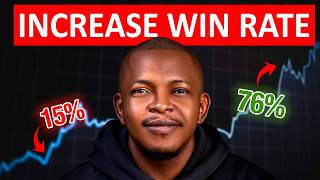
The video reveals that traders with high win rates (80%+) achieve this not through complex strategies but by refining two key behaviors: how they enter trades and how often they trade. The first fix involves waiting for a confirmation entry on a lower timeframe instead of entering immediately at a zone. The second fix is trading less frequently, guided by data from journaling tools like Edgewonk to identify optimal conditions.
Chapters
Traders with high win rates don't rely on complex strategies; they simply use their existing strategies more effectively by fixing two specific behaviors.
Most traders already have a good strategy. The low win rate is due to how they use it, not the strategy itself. This applies to both Forex and cryptocurrency trading.
Instead of entering immediately when price hits a zone, drop to a lower timeframe (e.g., 5-minute) and wait for a confirmation entry defined by a change of character (break of structure).
A trade that would have hit a stop loss if entered immediately at the zone is now profitable when waiting for a break of structure and change of character on the 5-minute timeframe.
Using confirmation entries can improve the risk-reward ratio from 1.9 to 3.57, as demonstrated in the example, by targeting midpoints or order blocks.
Implementing the confirmation entry module significantly increased the win rate, not by winning more trades but by filtering out bad ones that would have hit the stop loss.
The second fix is to take fewer trades. Overtrading is common because traders lack data, and the brain cannot process months of trades into reliable decisions.
The solution is journaling. Edgewonk is a tool that automatically journals trades by connecting to a trading account, eliminating manual entry.
After 6 months to a year, Edgewonk shows which assets, days, and times have the highest win rates. Traders then only trade under these optimal conditions.
Trading less but with better information increases win rates and profits. The edge compounds over time, and the platform Copy Me allows users to copy vetted professional traders.
The key to a high win rate is not a complex strategy but disciplined execution: using confirmation entries and trading less frequently based on data. This approach filters out bad trades and focuses on optimal conditions, leading to improved performance over time.
Mentioned in this Video
Tutorial Checklist
Study Flashcards (7)
What are the two key behaviors of traders with high win rates?
easy
Click to reveal answer
What are the two key behaviors of traders with high win rates?
They use a confirmation entry module and take fewer trades based on data.
00:01
What is the first fix to improve win rate?
medium
Click to reveal answer
What is the first fix to improve win rate?
Instead of entering immediately at a zone, drop to a lower timeframe and wait for a confirmation entry.
00:46
What defines a confirmation entry?
medium
Click to reveal answer
What defines a confirmation entry?
A break of structure and change of character on a lower timeframe.
01:53
What is the second fix to improve win rate?
easy
Click to reveal answer
What is the second fix to improve win rate?
Take fewer trades, using data to trade only under optimal conditions.
04:34
What tool is recommended for journaling?
easy
Click to reveal answer
What tool is recommended for journaling?
Edgewonk, which automatically journals trades by connecting to your account.
05:31
What data does Edgewonk provide after 6 months?
medium
Click to reveal answer
What data does Edgewonk provide after 6 months?
It shows which assets, days, and times have the highest win rates.
06:11
How does the confirmation entry affect the risk-reward ratio?
hard
Click to reveal answer
How does the confirmation entry affect the risk-reward ratio?
It can improve it from 1.9 to 3.57 in the example.
02:24
💡 Key Takeaways
High Win Rate Traders' Secret
Reveals that high win rates come from execution and discipline, not strategy complexity.
00:01Confirmation Entry Module
A practical technique to filter out bad trades and improve win rate.
00:46Trading Less Is Key
Challenges the common belief that more trading leads to more profits.
04:34Journaling with Edgewonk
Introduces a tool that automates the journaling process, making it easier to gather data.
05:31Working with Information
Emphasizes that trading less but with better data leads to more profits.
07:06Full Transcript
[00:01] strategy, and I'll prove that to you in this video. Because traders with high win rates don't do what you think. They are doing just two things differently. And once you see these two things, you cannot unsee it. Now, most
[00:18] traders are already sitting on a very good strategy. The reason their win rate is low is not the strategy itself. It is how [music] they are using it. You just need to fix two things, and this applies whether
[00:33] you're trading Forex or you're trading cryptocurrencies. The first one is your entry module. Now, I'm not asking you to change your strategy. You see your zone, your structure, your biases, just keep all of them exactly the way they are.
[00:46] What I'm talking about is how [music] you enter once price reaches your zone. I made a full video on this, and I'll leave it in the link above here, and also in the description [music] of the video. But, I'll give you a summary of
[01:00] what you need right here, so you don't have to leave this video. Now, this is have to leave this video. Now, this is the problem. You identify a zone, let's say a support or resistance zone, a supply or demand zone, or even an order
[01:13] Price gets there, you enter, [music] then price hits your stop loss, and then price hits your stop loss, and continues exactly as you analyzed. You were right on the direction, but you lost that trade.
[01:27] this is how to fix it. Instead of entering immediately, [music] say the 5-minute time frame or even lower, and wait for a confirmation
[01:39] even lower, and wait for a confirmation entry defined by a change of character. taking this [music] trade once it hits your zone, you drop down to say the 5-minute time frame, and wait for confirmation entry. So, I'm running this
[01:53] forward. This trade went [music] lower. So, this here is a break of structure. I'm going to draw a break of structure. And when it goes above, it forms a change of character. So, this becomes a confirmation that this trade
[02:08] where we're targeting. So, you can do two things. One is to [music] take your entry from this point, target low, and go above like this. Okay. This gives you 1.9, but if you
[02:24] watch my trade, I only take trades if they are up to three risk-reward ratio of three. What I usually do is to from the bottom, and do this. So, I target midway. Okay?
[02:39] it from here, but if your experience more, this is actually the order block this gives us a risk-reward ratio of 3.57. The same trade, but we now have confirmation to take [music] this trade.
[02:55] Yeah, we've got it tapping here. Can go back to the 15-minute time frame So, again, this is my confirmation entry, break of structure, change of character,
[03:08] gives us a confirmation entry to take this trade high. So, that is it. Now, trade we took. I actually did this analysis live on YouTube. You watch my So, it is simple. The same thing happened [music] here.
[03:23] Okay? This is our zone where we expect an entry, [music] and if I scale down to lower time frame, say the 5-minute time frame, you will also see it here. So, in our zone, we have a break of structure,
[03:37] a change of character, and this becomes my entry. Yes, if you took this trade right [music] from here, you're actually good. Your stop loss won't be hit. But, this gives you a confirmation. Another confusion people have is that
[03:51] you see in [music] this zone, we have an entry a zone here. We have another zone here. So, which one do you take? This entry module also just tells you take confirmation. [music] And you can see this trade also went
[04:06] exceptionally well once we tap into this particular zone. This is the confirmation entry. Now, when I started doing this, my win rate went up significantly, and not because I was winning more trades. It's
[04:20] simply because I stopped taking the bad ones. All those trades that would have hit my stop loss, the confirmation entry filtered them out. Not all of them, but a lot of them. So, that is the first thing. Now, let's talk about the second
[04:34] one, and [music] it is probably the one you don't want to hear. You need to take fewer trades. Stay with me because what I'm about to show you will [music] completely change how you think about
[04:48] this. The reason most traders overtrade is The reason most traders overtrade is simple. They don't have data. wins, [music]
[05:00] wins, [music] but the brain cannot process months of trades and turn them into reliable decisions. So, over time, you genuinely >> [music] >> are actually working for you, and which
[05:15] >> [music] >> So, you trade everything all the time, and what this does is that it spreads out your win rate [music] thin. The solution to this is journaling.
[05:31] And yes, I know [music] everybody hates journaling. I myself, I don't like journaling. But, there's a very simple way to [music] do this. You can use a tool called Edgewonk. In Edgewonk, you don't have to manually
[05:45] enter anything. You simply connect your trading account to Edgewonk, and your trades are automatically journaled. All you do is just go to Edgewonk and review it. Edgewonk is the [music] most affordable journaling tool I've seen so
[05:59] far. If you want to use it, I have a code in the description. It gives you code in the description. It gives you 10% off. This is the tool that I myself um for journaling. Now,
[06:11] this is what the data you get from Edgewonk does. So, after using it for [music] like, say, six months going to a year, say, six months going to a year, Edgewonk will show you the assets where
[06:24] your win rate is the highest, the days of the week where you consistently perform better, the time of the day where your setup actually work, the day where your setup actually work, [music] which asset performs best by
[06:37] week and by month. Now, once you have that data, the move becomes simple. You only trade the assets where you win more. You only trade on the days of the week where [music] you win more. You only show up
[06:53] at the time where your edge is actually working. You are not working harder. [music] You are simply working with information. So, you are trading less, but you are making [music] even more money, and your
[07:06] win rate is going up, not because your strategy changed, but because you stopped using it in the wrong condition. That is the whole point of this video.
[07:18] Now, here is something for you to think about. Everything I talked about so far, your entry module, your data, >> this compounds over time. The longer you do them, the sharper
[07:31] do them, the sharper your edge gets. And while that edge is developing, Copy Me, a platform I am building, [music] lets you run alongside traders who already have this edge.
[07:44] You simply connect your trading account, and automatically copy vetted professional traders. These traders only go public after meeting strict performance criteria, and [music] are removed automatically if they fall
[07:58] removed automatically if they fall short. You control your risk and the number of trades. And just like we talked about with journaling, you can choose to copy only the best-performing pairs from each trader. The wait list is
[08:12] open, and the link [music] is in the description of this video.