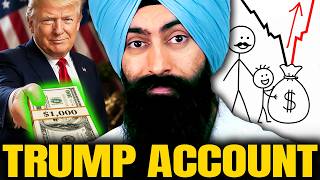

Free $1,000 for Your Baby?
45sThe shocking revelation of government giving $1,000 to newborns sparks curiosity and debate about hidden costs.
▶ Play Clip"The title is somewhat exaggerated; the baby gets $1,000 invested, not instantly rich, but the program could lead to significant growth over time."
The video explains the Trump Account, a government program that deposits $1,000 into investment accounts for U.S. babies born between 2025 and 2028. The money must be invested in broad U.S. index funds, aiming to encourage early investing and build wealth. However, the creator warns that the government funds this by increasing debt and printing money, leading to asset inflation that benefits investors but hurts savers.
The U.S. government gives a one-time $1,000 deposit into investment accounts for babies born between January 1, 2025 and December 31, 2028. No income requirement; must be a U.S. citizen.
Unlike stimulus checks meant to boost consumer spending, Trump accounts require the money to be invested, directly funneling funds into the stock market.
The UK launched a similar program in 2002, investing £250-500 per child. Over 18 years, that grew to about £2,000 (10x), encouraging investing and boosting markets.
The 401k system funnels money to Wall Street for decades, inflating stock prices. Similarly, Trump accounts create a new stream of forced investment, benefiting savvy investors.
Wealth depends on Time, Rate of return, and Money. Starting early with $1,000 can grow to $149,000 by age 65 at 10% annual return.
The government spends $7 trillion but collects only $5 trillion in taxes. To fund Trump accounts, it must borrow more, increasing the $39 trillion debt.
The Federal Reserve prints money to lend to the government, causing inflation. This 'invisible tax' reduces purchasing power and creates asset inflation in stocks.
Trump accounts direct money into stocks, not consumer goods, leading to asset inflation. This benefits investors but makes it harder for non-investors to afford assets.
More money printing increases market volatility. Economic downturns can be opportunities to buy discounted assets.
Asset inflation widens the gap between investors and non-investors. Financial education is crucial to avoid becoming poorer.
The Trump Account offers a $1,000 head start for newborns but is funded by debt and money printing, fueling asset inflation. While it encourages investing, it also risks widening the wealth gap, making financial literacy essential.
What is the Trump Account?
A government program that deposits $1,000 into an investment account for U.S. babies born between 2025 and 2028.
00:01
What are the two catches of the Trump Account?
1) You can't spend the money; it must be invested. 2) The government doesn't have the money to fund it.
00:29
What is the birth date range to qualify for the Trump Account?
Between January 1, 2025 and December 31, 2028.
01:42
How much does the government deposit into the Trump Account?
A one-time $1,000 deposit.
01:42
What was the UK Child Trust Fund?
A program started in 2002 that invested £250-500 per child into broad UK index funds.
03:02
How much did the UK Child Trust Fund grow over 18 years?
From £250 to approximately £2,000 (about 10x).
03:39
What does TRM stand for in the wealth formula?
Time, Return, Money.
07:07
If you invest $1,000 at age 0 and never add more, how much could it grow to by age 65 at 10% annual return?
Approximately $149,000.
08:06
How much does the U.S. government collect in taxes in 2026?
About $5 trillion.
09:27
How much does the U.S. government spend in 2026?
About $7 trillion.
09:54
What are the two costs of government debt mentioned?
1) More tax dollars go to pay interest on debt. 2) Inflation (invisible tax) reduces purchasing power.
12:31
What type of inflation does the Trump Account primarily cause?
Asset inflation, because the money goes directly into the stock market.
13:55
Trump Account Launch
Introduces a new government program that directly invests in newborns, a unique policy.
00:01UK Child Trust Fund Precedent
Provides historical evidence that similar programs can boost investing and market growth.
03:02TRM Wealth Formula
Simplifies wealth building into three key factors, making it actionable for viewers.
07:07Money Printing and Inflation
Explains the hidden cost of free money: inflation that hurts savers and benefits investors.
11:48Asset Inflation vs Consumer Inflation
Highlights a key distinction: Trump accounts inflate asset prices, not consumer goods, widening wealth inequality.
13:55[00:01] officially giving out $1,000 checks to some of your babies. It's called a Trump account and it's the White House's way of encouraging people to have kids and helping those kids build wealth. >> Every US citizen born
[00:14] after December 31st, 2024 before January 1st, 2029, the federal government will make a one-time contribution of $1,000. >> But there's two catches. Catch number one is that you can't spend this money.
[00:29] two is that the government doesn't actually have the money to pay for these checks into your kids' investment accounts considering we're about $40 trillion in debt, which is why I say the most expensive kind of money is free
[00:43] money and if you don't know who's paying the price, well, then it might be you. break down how these Trump accounts work, how your kid could potentially qualify, and then I want to go over the economic side of what is the cost of
[00:56] going to mean for our economy and the stock market. So, make sure you stick as a reminder, I'm coming to Manhattan on July 8th at 5:00 p.m. Eastern Time, I am doing a free meet and greet. So, if you're around, I would love to say hello
[01:10] to you. Come meet me, come hang out with me and my team. It's on July 8th at 5:00 p.m. Eastern Time in downtown Manhattan. If you would be interested in joining, I out. That way we can send you the actual location. The link is for you down in
[01:25] the description. On July 4th, 2026, this Trump account officially went live and the way that it works is in order to qualify, you must be born as a United number. You must be born between January 1st, 2025 and December 31st, 2028.
[01:42] You're going to get a one-time $1,000 deposit. It's not $1,000 a year, it's a one-time $1,000 deposit and there's no income requirement. So, whether you make income requirement. So, whether you make $5,000 a year or $5 million dollars
[01:56] your kids can qualify for this one-time $1,000 payment by the United States government into your kids investment account. Now, the reason why this is States government hand out a lot of free stuff, tax credits, stimulus checks,
[02:10] welfare checks, but we've never seen them hand out investment money to newborn babies. We've seen it happen in other countries, but the reason why I want you to think about this is in the past we've seen stimulus checks. We all
[02:22] remember the pandemic. Stimulus checks went out and people got free money. Now, when you get a stimulus check, you might think it's there to stimulate your wealth, but that's not what it's actually there to do. These stimulus
[02:35] checks are to stimulate the economy. Well, how do you actually stimulate the economy? You're giving people money to spend. So, when you spend money, the person that's getting rich are the investors in the economy. In this
[02:48] instance, it's not stimulating the economy in the same way. It is stimulating investors. And that's going to create an opportunity to build wealth little bit, but I want to start by taking a look at history because while
[03:02] history doesn't exactly repeat itself, it does rhyme. We've seen the United Kingdom do something similar to this in the past, and I want to take a look at how that has changed its economy that we can get an understanding of how it could
[03:15] impact the United States economy. Back in 2002, the UK started something called the UK Child Trust Fund, and what they did was they invested somewhere between did was they invested somewhere between 250 to 500 pounds into your child's
[03:27] investment account depending on your income level. Lower-income people got 500 pounds, higher-income people got 250 pounds into the baby's account, and it had to be invested into broad United Kingdom index funds. So, this is very
[03:39] we saw is that over the course of 18 years, we saw that $250 investment grow to approximately 2,000 pounds, meaning the money grew by
[03:51] approximately 10x. Now, of course, this money by itself didn't make that kid wealthy, but it was a start and it encouraged more people to invest. And do you know what else happened? It also put more money into the stock market. Which
[04:03] means the financially savvy got even richer. Think of it this way. When the 401k was created, do you want to know who really got rich? became richer, and yes, some people did become richer because they used a 401k
[04:16] to build wealth, but what also happened was now money was getting tied up with Wall Street money managers for tens of years. Because if you're starting a 401k at age 25 and you're going to pull your money out at age 65,
[04:31] >> that's 40 years that your money's going to be tied up with a money manager on money out. The Wall Street money manager takes a fee every single year. But more money is going to continue to be going into Wall Street, which helps pump
[04:46] up the stock market. Which means the financially savvy now can use this to their advantage because the stock market, like every other asset, works on supply and demand. When there are more buyers than sellers, the price of stocks
[04:58] go up. When there are more sellers than buyers, the prices of stocks go down. money into the stock market, the stock market goes up, and the 401k guarantees a stream of income into the stock market because it guarantees that people are
[05:11] Employers are putting their money into it. You're getting a tax advantage, and rich as a result of it. Now, sure, but I want you to understand this economic system because now with this
[05:25] Trump account, what's happening it it is going to create millions of new investment accounts for kids. And many of them might not have been And the money that's going in, that $1,000 here that's going into these
[05:38] Trump accounts, this was money that wouldn't have been from the government. Now, the government doesn't have that money. I'm going to talk more about that in just a minute, but this is new money that is going
[05:50] directly into the stock market. So guess who is going to get rich? Yes, there's a very good chance that the markets are going to grow over the next 10-20 years, which means you might be able to see this $1,000 turn into $10,000, $15,000,
[06:03] $20,000, whatever it might be over the next couple of decades. And if you invest more money into this account, it will start your kids wealth journey. That is amazing. But it's also going to pump more money
[06:15] that really understand this will be able to now build wealth as a result of it as into the markets, which means that can help pump up markets for the long term because it
[06:29] to flow in. Now for those of you who want to see how these changes in the economy actually create investment opportunity, I've put together a free through how you can get started as an investor based off of the changes that
[06:42] call it the perfect storm because there right now. And if you want to see how this perfect storm is creating my free investing masterclass I'll walk
[06:54] when you sign up for it, you're also going to get access to Market Briefs, completely free. So if you want to get the investing masterclass and Market is sign up and I have that link for you down in the description below. But this
[07:07] you to understand the three factors that will determine how wealthy you become or your kids become because it's not about what grades you get, what school you go to, or what degree you have. Ultimately comes down to TRM. Time, return, money.
[07:22] How fast does your money grow, the rate of return on your money, and how much let me give you a couple examples here because if you start investing $1,000 right now and you only invest that $1,000 one time with this Trump account,
[07:37] well, if the markets just grow by 10% a year like they've done historically for the last 100 years, well, between now and the age of 18, that $1,000 will only grow to something like $6,000. Now, it's a free $6,000 that you get without doing
[07:53] anything, which is not bad, but take a look at this if you add more time. If now you only invest that $1,000, you never invest another penny, and you keep that $1,000 invested until you turn 65 years old, well, now that $1,000 will
[08:06] years old, well, now that $1,000 will turn into not $6,000, not $50,000, not turn into not $6,000, not $50,000, not $100,000, but about $149,000.
[08:19] investment journey early, and I think this is the biggest value for young people is hopefully this will encourage people to start investing money earlier because if you can start investing money earlier, you now have more time.
[08:32] you don't get a better rate of return that allows your money to compound and grow and hopefully build more wealth over time. Now, ideally, you will be accounts, and you can get better returns, but you get the idea. If your
[08:46] money has more time to grow, it can grow even more and build you more wealth. So, have to be a US citizen, and you understand you have to be born between understand you have to be born between 2025 and 2028. It is a one-time $1,000
[08:58] investment that has to be invested into United States broad funds with low fees, Everybody qualifies for it. Let's talk about now, what does this mean for the economy? Where is the government getting this money, and what is it going to do
[09:13] problem is the government doesn't have the money to fund these Trump accounts because the way that the United States government works is right here, we have the United States government, and the government has one source of revenue.
[09:27] government has one source of revenue. It's tax dollars from taxpayers. And in 2026, the government going to collect something around $5 trillion in taxes from all the taxes that you pay. Now, you might think that the government
[09:41] runs a balanced budget, and because they generate $5 trillion, they should only spend something like $4 trillion. That would be the financially smart thing to do, but that's not what actually happens. The government doesn't spend $4
[09:54] trillion out of the $5 trillion. They don't spend all $5 trillion out the $5 trillion. Instead, in 2026, the government's going to spend something government's going to spend something like $7 trillion out of the $5 trillion
[10:07] that they bring in. The government has a lot of expenses. They spend money on things like our infrastructure, on our health care, social security, on the military, and they have to pay back all the previous debt.
[10:19] government going to get the $2 trillion difference? And this is where the government has to go deeper into debt to borrow that money. video, I showed you that the government has over $39 trillion worth of debt. So,
[10:37] government is doing is they just increased their expenses. They now are going to fund this $1,000 investment into many different kids' accounts, helping kids hopefully build wealth. But now the question is where are they going
[10:52] They're not raising taxes because we know that the government just passed one history of time called the One Big Beautiful Bill Act. So, the money is not coming from taxes, which means the only other source must be here through more
[11:07] borrow more debt, that means now we're going to be growing this number from $39 trillion up to something more because now we have bigger expenses that we need to pay. Now, the idea is good because we want to help kids build wealth, but I'm
[11:20] talking about the economic side that there is a cost to this. Well, where do this money from foreign countries like China, and Japan, and the United people like you and me. We also borrow this money from the central bank, the
[11:34] Federal Reserve Bank. Now, here's the problem. The Federal Reserve Bank is not a bank because you can't go there to deposit money. It's not a reserve reserves, and it's not federal as it says so on their website. So, when the
[11:48] Federal Reserve Bank, which is our central bank here, thin air. The Federal Reserve Bank then prints they lend it to the government, and that money gets spent. Now, everything is
[12:02] money in the economy. People have Trump accounts. People have stimulus checks. People have a whole bunch of free stuff. But now there's a cost because if the didn't have to collect money from taxes, why do we even
[12:17] doesn't the government just print all of the spending money? The reason why is there is a cost and consequence to this free money from the Federal Reserve Bank. There's a cost and consequences to more debt.
[12:31] And that cost and consequence is twofold. Number one is as we have more we have to pay back that debt plus interest, which means now the government expenses go up because now every single
[12:45] time the government collects a dollar, more of the money has to go to pay back this debt plus interest. That's the cost number one. Cost number two is what I call an invisible tax, the inflation tax.
[12:58] Because now as this money is printed, the value of each individual dollar goes down, causing the prices of things to go up. We cannot print more wealth, we can just print the pieces of paper that we use to
[13:12] more dollars, but we're not actually creating more wealth. So, we can now fund these accounts, but the value of each individual dollar in why things get more expensive. So, yes, it is inflationary. But this is where it
[13:28] gets even more interesting because normally when we talk about the government spending money through debt, it is something in the consumer markets. They're funding welfare. They're funding healthcare. They're funding stimulus
[13:41] checks. These things are felt in the consumer markets in the broad economy this time it's not in that consumer market. It is in the investor market. More money going into assets. So, the inflation here
[13:55] will be more in asset prices, asset inflation. Because as more money is going directly into the stock market, there's no indirect path here. The money must be invested. It cannot be spent. So, the money is going directly into the
[14:08] stock market. So, as a result of these Trump accounts, more money is going to go directly into the stock market, which is a fuel to help bump up stock prices, which is good if you are an investor, but it makes stocks more
[14:21] investors. It makes it more difficult for people to get started because now this free money is getting printed and it creates more inflation in asset That's why this is so important for you to understand.
[14:33] happening in our economy. And you have to understand how they impact your assets, how it impacts your money. understand how you can continue building your wealth. Again, that's why I put
[14:46] That link is for you down in the description. But, let's talk about how your kid now. I'm going to link an article for you by Fidelity down in the description that shows you how you can actually claim this $1,000 if your baby
[14:58] qualifies for this Trump account. So, you can just read that article to see much any brokerage that you want. The United States government did announce a partnership with Robinhood. You don't have to use Robinhood, but there is many
[15:11] ways to actually use this money. You're not limited to which brokerage you have to use. If you have more than one baby that qualifies for the Trump account, they each will get $1,000. If you had a baby that was born before 2025, you can
[15:24] you're just not going to get that free $1,000 from the government. You were not required to invest any additional money, and yes, you can lose money. This is investing. Money doesn't always go up. Investing has risks. We're going to see
[15:38] understand that anytime there's more money being printed, we see more volatility in markets. That means bigger swings up and down. Markets go up, markets go down, recessions are part of our economy, market crashes are part of
[15:52] our economy. When you understand that, you will understand how to use economic downturns as an opportunity to build your wealth even faster because they allow you to come in and buy good investments at a discounted price. One
[16:04] is that oftentimes the things you don't pay attention to end up mattering the most. And that's why I want to talk to you about life insurance with our sponsor Policygenius because if you don't have the assets to live off of
[16:16] yet, and something tragically happened to you, spouse and your family trying to struggle to survive financially, and come into play. Now, I'm talking about term life insurance here, not whole life
[16:30] insurance. The whole idea with term life insurance is it's life insurance for a period of time, 10 years, 20 years, 30 years. That way you can work to build your assets. It is a lot cheaper than whole life insurance because the whole
[16:42] idea is you're not here trying to get rich off your life insurance. It's just there as a bridge until you can build your assets. This is one of those things it is because if you're a healthy 30-year-old guy, you could potentially
[16:56] get a half a million-dollar term life insurance policy for less than a dollar you want to learn more about term life insurance, or you want to see how much a actually cost you, I'll put a link to Policygenius' form down in the
[17:10] to complete, and it'll give you an actual quote on how much term life have that link for you down in the description. So, what we talked about in this video is that on July 4th, 2026, Trump accounts went officially live,
[17:24] which means if your child qualifies, they're born between January 1, 2025 and December 31, 2028, they're United States citizen, they will be able to qualify for a one-time $1,000 investment into their account. This is not spending
[17:40] money, it is an investment that must be invested into a broad United States fund like the S&P 500. And now, this is an opportunity to start investing your kids money sooner because what we talked about is there three ways
[17:54] to build your wealth. You can invest for money, you can invest it for more time, or you can get a better rate of return. And if you have more time on your side, your wealth even more. That's the value of starting your investment journey
[18:07] love Trump, you cannot deny the fact investment account sooner rather than later. But now, let's talk about that $1,000 that the government is funding into these accounts because the
[18:20] government doesn't have $1,000 to give anybody, let alone millions of young babies. So, where is this money coming from? And what we talked about is that the government is spending money they don't have, which is why we have 39 some
[18:33] And because the government is not raising taxes, we're actually cutting taxes, the government needs to go deeper into debt to fund that spending. into debt, that means more money has to be printed. If more money has to be
[18:47] printed, that means inflation is going to happen. When inflation happens, the average person gets poorer, while the investors get richer. And this is a unique situation because now this extra money, this free money is going directly
[18:59] into the asset markets. It's going directly into the stock market, which means yes, it is going to create some sort of asset inflation because the market. Well, that asset inflation benefits the investors. Not the average
[19:13] And you need to understand that because this means that the average person is going to become poorer. Because as the dollar loses value, your savings have less buying power. While at the same time there's more money going to into
[19:27] the stock market, which boosts stock prices even higher, which person to get started in the stock market, which makes it even more necessary for the average person to start investing their money. Which means
[19:40] education, period. We know that investing is how you build wealth. We know how important investing is. But now it's up to you to actually go and take action because all these things that are happening are going to help some people.
[19:53] And the people that are financially educated will become even wealthier. But the people that are not will become poorer. It will create a bigger divide and the people that don't. And I want you to be one of the people that
[20:06] value out of this video, the best thank please share this video with a friend, family member, colleague, or fellow spread this type of financial education. Thank you. President Trump's new Fed
[20:19] chair recently finished his first meeting. And his announcements caused money to change overnight. Gold prices crashed to under $4,000 for the first time in months. Silver prices crashed even harder than that. And Bitcoin
[20:32] where everybody is pointing their fingers at Kevin Warsh's new economic fingers at Kevin Warsh's new economic plan as




⚡ Saved you 0h 20m reading this? Transcribe any YouTube video for free — no signup needed.