
Master Card Counting in 60 Seconds
42sThe opening explains the video's training value and betting strategy, hooking viewers interested in learning card counting.
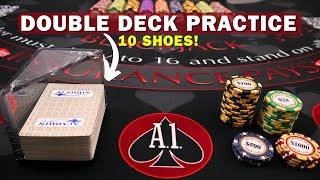
▶ Play Clip"Title accurately describes the content: a practice session with 10 double deck shoes."
This video is a comprehensive card counting practice session using the Hi-Lo system on 10 double deck blackjack shoes. The instructor demonstrates proper bet spreads, deck estimation, and running count verification, emphasizing the importance of long-term play for profitability.
Minimum bet of $50 for true count 0 or below. For each true count above 0 up to 5, bet $100 per true count in two spots (e.g., true 1 = $200, true 5 = $500 in two spots).
Cutting off just over half a deck (about 30 cards) to visualize typical penetration. A camera is set up to help viewers judge deck estimation.
After round 1, the running count is verified to be zero. The instructor explains that since Hi-Lo is balanced, the remaining cards plus burn card should sum to zero.
In round 2, many high cards appear after the cut card, which is unfavorable. The count reaches -9, requiring +9 in the remainder.
A $2500 win occurs after splitting, but the count drops, illustrating the volatility of short-term results.
All counts for the first five rounds are verified correct. The camera overheats, so the instructor pauses.
In round 8, the instructor mistakenly writes 'plus five' as 'minus five' but corrects it, emphasizing the importance of accurate notation.
After 10 shoes, the bankroll is $9,800, a loss of $200. This demonstrates that even 10 shoes are not enough to guarantee profit; long-term play is essential.
Card counting requires practice and patience; short-term results can be negative even with correct play. Long-term profitability comes from hundreds of hours of play to overcome variance.
What is the minimum bet for a true count of 0 or below in this practice session?
$50
00:13
How much is bet in two spots for a true count of 3?
$300 in two spots (i.e., $150 per spot if split equally, but the video says $100 per true count per spot, so $300 total).
00:28
What is the Hi-Lo card counting system?
A balanced card counting system where low cards (2-6) are +1, high cards (10-A) are -1, and neutral cards (7-9) are 0.
04:40
After a round, what should the running count of the remaining cards plus burn card equal?
Zero (since the system is balanced).
04:40
How many cards were cut off in the practice session?
About 30 cards (just over half a deck).
01:10
What was the final bankroll after 10 shoes?
$9,800 (a loss of $200 from the starting $10,000).
43:58
Why is 10 shoes not enough to guarantee profit in card counting?
Because of variance; long-term play (hundreds of hours) is needed to overcome standard deviation.
44:27
Bet Spread Explained
Provides a clear, actionable bet spread strategy for double deck blackjack.
00:13Running Count Verification
Demonstrates the fundamental principle of balanced counting systems.
04:40Big Win and Count Drop
Illustrates the volatility of short-term results even with correct play.
17:10Final Chip Count
Shows that even with perfect counting, short-term losses occur, emphasizing the need for long-term play.
43:58[00:01] because of that, this is probably going to be one of those videos you want to come back and watch again as it's a great [music] training video. So, if you want, you can maybe go down and save that down below this video. And while
[00:13] button for me as that is very helpful. All right, we're going to play with this betre. If we got $50 minimum [music] table and so, uh, any true count that's zero or below, we're going to be betting $50. and then um two spots of that many
[00:28] black [music] chips or $100 chips for every true count above that until we get to a true five. So this will be example of a true one. 2002 spots be a true two. All the way up to 500 in two spots would be an example of a true five. Okay,
[00:42] need another player at the table. I'm not going to be paying them out. This is just kind of like a placeholder here as a minimum of $50 because that's what the table min is. Um, if you need to take a screenshot or something of this bet
[00:54] spread, you can. Otherwise, I'm going to get our cards shuffled up for us. And as I do that, here's some other rules that we're playing with um on the screen. All right, we get our cards cut here. And then we're cutting off just over a
[01:10] half deck, probably around 30 cards or so. Um, just to kind of visualize that. That's what it's going to look like most times. Um, here is uh $50 is our table the discard tray. I have a camera set up for you so you can judge your deck
[01:25] estimation correctly. Otherwise, here's round one of 10. Let's count.
[04:40] and then we're going to check that to see if we are right or not. So, this opposite of what we have since we're using highload card counting, which is using highload card counting, which is balanced. We have one 0 one two one two
[04:55] balanced. We have one 0 one two one two 3 two one two one two one two one two one zero one zero and still zero. So, since this was zero, we need to get back to zero. We also needed zero. And yeah, that's what I had
[05:11] as well. All right, I'll get these shuffled up for round two. Burn card. Minimum bet of $50. We'll get out here. All right, round two. Let's
[05:27] out here. All right, round two. Let's count.
[08:42] bunch of big bets out there at the end and there's going to be a lot of little count. All right. This plus the burn card should be opposites of what we have. We have D1, D2, D3,
[08:54] I said that backwards. There's going to be a bunch of high cards in here because be a bunch of high cards in here because of um, yeah, my count is high. All of um, yeah, my count is high. All right. D1, D2, D3, D2, D3, D4, D5, D6,
[09:08] right. D1, D2, D3, D2, D3, D4, D5, D6, D7, D8, D7, D8, D9, D8, D7, D8, D7, D6, D7, D8, D7, D8, D9, D8, D7, D8, D7, D6, D5, D6, D7, D8, D9, and still D9. This was minus 9. We need plus 9. Yeah. And that's what I had. So,
[09:24] uh, a lot of those high cards were after the cut card, which is kind of hard one to swallow, but that's all right. All right, we'll get the shoved up for round right, we'll get the shoved up for round three.
[09:42] All right, got our minimum bat of $50. Burn card. Round three. Let's count.
[12:56] right, let's count it out. We got D1 0 1 0 1 2 3 4 5 4 3 2 1 0 1 2 3 4 5 4 3 2 1 2 3 4 3 2
[13:08] and one. All right, so this was plus one. We needed minus one. And yeah, losing some of those bigger bets, aren't we? But anyway, I'll go shuffle it up we? But anyway, I'll go shuffle it up for round four.
[13:29] All right, got our cut card in there. Minimum bet of $50. Burn card. Ready, Minimum bet of $50. Burn card. Ready, get set. Round four.
[17:10] waiting for. Nice. All right, we split those and then the count dropped and so was too low at that point, but that was a $2500 win, I think. Very nice. Okay, anyway, let's count
[17:26] this up. See if our count was right. Uh, we have 1 2 3 2 1 zero D1 D2 D3 D2 Uh, we have 1 2 3 2 1 zero D1 D2 D3 D2 D1 D2 D1 D2 D3 D2 D3 D4
[17:43] D3. All right, so this was minus three. We needed a plus three. And yeah, that is what I had. All right, so those last few were justified for sure because um of the correct count. All right, get these shuffed up for round five.
[18:05] All right, round five. Got our minimum bet burn card. Let's count.
[21:34] got. We have D1 0 D1 D2 D1 0 D1 0 D1 D2 D1 0
[21:46] and D1. This was minus one. We needed plus one. All right, so that is was all correct for the first five. Um, my camera overheats, so I'm going to be the next five. All right, we're back. So, let me get these shuffled up for
[22:00] So, let me get these shuffled up for round number six. All right, got the cut card in there. Minimum bet of $50. Burn card. Ready,
[22:14] Minimum bet of $50. Burn card. Ready, get set. Round six.
[25:47] right, let's count up. See what we got. We have D1, D2, D3, D2, D1, D2, D3, D2, D3, D2, D1, D2, D1, 0, 1, zero, D1, D2, D1, D2,
[26:00] D1, D2, D1, 0, 1, zero, D1, D2, D1, D2, D3, D4, D5, D4, D3, D4, D5, D4, and D5 or minus five. So, we needed plus five. All right, get shuffled up for round seven.
[26:24] Burn card. Here comes round seven. Let's count.
[29:50] right, let's count it up. We got D1 0 D1 D2 D3 D2 D1 zero one two one two three Look at all those neutral cards. Three, two, three, two,
[30:04] still two and three. So this was plus three. I had us at minus three. I get three. I had us at minus three. I get them shuffled for round number eight.
[30:21] Okay, minimum bet burn card. Round number eight. Let's count.
[33:45] right, let's count it up. We have 1 0 D1 D2 D3 D4 3 D2 D3 D4 D5 D4 D5 D6 D7 D6
[33:59] plus five. Oh, did I write the wrong thing? I'm an idiot. I don't think I'd be off by 10. So yeah, we were betting the
[34:12] right amount there. I just didn't put a plus. Um anyway. Whoops. All right, let me I think that mistake is believable. Let me uh get these shuffled for round Let me uh get these shuffled for round nine. All
[34:31] about half a deck or so cut off here. If you don't believe me, remember the bet spread that we're using. Of course, we were um betting according to that in the last shoe there. So, I promise I meant plus five. All right, this is going to
[34:46] be session number nine. This one and then one more. Get a burn card over here. minimum bet of 50 bucks. Looks like we are up on our 500s, down on our our thousands yet. Now, we started with 10,000. So, we'll count that up at the
[35:02] appreciating this or liking it so far, please hit the thumbs up button for me. Otherwise, here comes session number nine. Let's count.
[38:57] All right, let's count it up. We have 0 1 0 D1 0 1 2 3 2 3 2 1 0 D1 D2 D1 0 D1 D2 D1 This was minus one. We needed plus
[39:12] one. That time I did write it the right way. All right, we got one last round coming up. I'll get these shuffled for us.
[39:29] All right, $50 minimum burn card. Last round. Let's count.
[43:13] round, but that's okay. We'll count this up, see if we're right, and then I'll get our chips counted. See if we won or lost. Today we have 0 D1 D2 D1 0 D1 D2 D1 0 D1 0 1 2 1 2 3 2 1
[43:33] and two. This was plus two. So we should have finished with minus two. All right. I think all of my counts were correct for all 10 of those shoes. will get our chips counted up and see if we're above or below 10,000 today.
[43:58] We still have 5,000 in these yellow chips. And then these are in piles of chips. And then these are in piles of two. And so for our $500 chips, we have 1 2 3 4. So that's 9,000. Then 100 200 3 4 5 6 7 800. So 9,800. We
[44:14] Then 100 200 3 4 5 6 7 800. So 9,800. We actually lost $200 in these 10 shoes. So, not terrible, but that goes to show that, you know, it's about the long run. Even with 10 shoes, it seems like it should be enough. It's not. All right.
[44:27] should be enough. It's not. All right. You do need to be playing this for um you know, several sometimes hundreds of hours in order to become profitable and meet kind of that sort of n0ero time or the be above one standard deviation to
[44:41] Anyway, that's not what you care about, but hopefully you got these right for your counts. Uh, let me know how you did down below. I'd love to hear from you in thumbs up before you head out. Remember, until next time, this is A1 Blackjack.
⚡ Saved you 0h 45m reading this? Transcribe any YouTube video for free — no signup needed.