
The True Count Explained: Pro vs Beginner
45sThis segment sets up a clear contrast between basic and advanced card counting, hooking viewers who want to level up their blackjack strategy.
▶ Play Clip"Title accurately promises teaching true count, and video delivers with examples and strategy."
This video explains the difference between running count and true count in blackjack card counting, demonstrating how to calculate true count by dividing running count by decks remaining. It covers betting strategies based on true count, including a 1-to-10 bet spread, and introduces deviations from basic strategy using the Illustrious 18. The video also advises on handling negative counts.
Running count tracks ratio of high to low cards remaining. Low cards (2-6) = +1, neutrals (7-9) = 0, high cards (10-A) = -1.
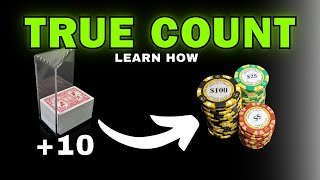
True count = running count divided by number of decks remaining in the shoe.
Running count +10 with 5 decks left gives true count of +2. With 2 decks left, true count becomes +5.
Bet minimum when count is 0 or negative; increase bets as true count rises. Example: 1-to-10 bet spread from $25 to $250.
Player gains advantage around true count +1. Bet minimum at zero or negative counts to avoid 'paying rent'.
Running count +3 with half deck played gives true count +2. Bet two units in two spots accordingly.
True count can indicate when to deviate from basic strategy, e.g., standing on 12 vs dealer 2 at true count +3 or higher.
Running count +7 with one deck played in double deck gives true count +7, max bet of $500 per spot. Splitting 4s vs dealer 6 and doubling down on 9 leads to win.
Avoid playing during negative counts; step away from table if possible. For double deck, need large bankroll ($30k+), play heads-up, and ensure good penetration.
Mastering true count is essential for effective card counting, enabling optimal betting and playing decisions. Always calculate true count before acting, and avoid negative counts to preserve bankroll.
What is the running count?
The running count tracks the ratio of high cards to low cards remaining in the deck.
What values are assigned to low cards (2-6) in Hi-Lo?
+1
00:39
What values are assigned to high cards (10-A) in Hi-Lo?
-1
00:51
How do you calculate true count?
Divide the running count by the number of decks remaining in the shoe.
01:22
In a six-deck game with running count +10 and 5 decks left, what is the true count?
+2
01:48
What is the recommended bet spread mentioned in the video?
1 to 10 bet spread (e.g., $25 to $250).
03:45
At what true count does the player typically gain the advantage?
Around true count +1.
05:40
What is the deviation for 12 vs dealer 2 at true count +3 or higher?
Stand instead of hit.
09:52
What are the Illustrious 18?
The 18 most profitable deviations from basic strategy based on true count.
10:16
What should you do during negative counts?
Avoid playing; step away from the table or make excuses to skip hands.
13:25
What three conditions are needed to play through negative counts in double deck?
Large bankroll ($30k+), play heads-up, and good deck penetration.
14:24
True Count Formula
Core concept that adjusts running count for number of decks remaining, enabling accurate advantage assessment.
01:22Betting Strategy Based on True Count
Practical application of true count to maximize profits and minimize losses.
03:29Deviations from Basic Strategy
True count allows strategic deviations that improve win rate beyond basic strategy.
08:09Avoid Negative Counts
Critical advice to preserve bankroll by not playing when expected value is negative.
13:25[00:00] today we're going to be diving into a fundamental yet often misunderstood concept that separates the one of B counters from the pros that is the true Count you may already have a good grasp on the running count but if you
[00:14] you're going to take the knowledge of card counting be able to actually apply it to your game in both playing and betting decisions let's start by breaking down the basics all right the running count serves as our Compass it
[00:26] guides us through the shifting tides of the deck composition with each card dealt before we get into the true Count we must have a firm grasp on the running right let me remind you that the running count keeps track of the ratio of high
[00:39] cards to low cards that are remaining in the deck and to do this we assign each the deck and to do this we assign each card a value our cards 2 through six 2 3 4 five and six are going to be our low cards those are going to be worth plus
[00:51] cards those are going to be worth plus one as we count cards 7 8 9 are neutrals that's going to be worth zero and then the high cards 10 queen king and Ace we're going to assign the value of a minus one for those okay so most of you
[01:06] are pretty good at counting I have a lot of videos on my channel on that already but here's the twist that not all blackj games are created equal the true Count remaining in the shoe providing us with a more accurate measure of our advantage
[01:22] to calculate the true Count we must divide the running count by the number of decks left in the shoe let's put this the to practice with an example all right imagine that our running count is pretty high let's say plus 10 all right
[01:35] can pause the video and count to make sure that it is a plus 10 here okay now that sounds pretty good but if you remember that the true Count the way we
[01:48] find that is by dividing our running count by the number of decks remaining if we are playing a six deck game let's say one deck has been played here then that + 10 is going to be divided by five decks left to be played that only gives
[02:03] us 10 divided 5 that only gives us a true Count of plus two so suddenly that picture isn't as rosy remind us to tread cautiously in our betting strategy better when there's only two decks remaining so let's say that I have a
[02:21] little card here to help me out if I were to take these cards let's say we're all the way through playing with these and a lot of times what we do to check our uh true Count is we look at our discard tray okay here I can tell that
[02:35] there is exactly four decks that have been played which means if this is a six deck shoe there are two Decks that have yet to be played and it doesn't even matter where the cut card is some people get a little bit caught up on that but
[02:48] we take into account all the rest of the cards that are in the the shoe remaining okay so that's why you only have to pay attention to the discard tray you can train your eye I have videos on how to do that how how much is remaining that's
[03:01] going to be the amount of decks that are left in the shoe okay so that same plus 10 if there are two decks remaining now 10 / two is a plus five which means we could bet even more it's going to be a lot more than when there was just one
[03:16] deck played and it was 10 divided by five decks remaining earlier now I about wondering why does this true Count thing matter why can't I just learn the running count well my friends it's the key that unlocks the door to strategic
[03:29] knowledge we can tailor our betting strategy to maximize profits and minimize losses the whole idea of card counting is to bet as little as possible when the casino has a favorable count and to bet increasingly more the higher
[03:45] and to bet increasingly more the higher the count gets as we gain the advantage in recent videos I've discussed how I personally use a 1 to 10 BET spread when I go play all right what I do is I bet one spot of
[03:57] one spot of $25 at any true Count that is zero or lower okay and once the counts once the count gets to one or higher I start betting more and more okay at a true one I don't just bet one spot of 25 I bet
[04:13] little tricks that you can do to kind of there's tons and tons of different betting strategies and bet spreads is what we call those right what I like to do is again at a true one I'm still
[04:27] betting one chip one green chip right you can do this with $5 tables as well um things that might help you you know to kind of help keep that in mind I like to correlate this with my true Count uh for example at a i maxed this out at a
[04:43] true five so I'm going to be betting two spots of five green chips Right add a true five embedding five green chips here here and five green chips there so that's why
[04:57] I call this a one to 10 BET spread if you were to count these up well five green that's $125 this is also another 125 together that is $250 so my minimum bet $25 that's my one
[05:12] and then I multiply that times 10 to get that 250 Mark at my Max bet okay at that count of plus five you can go higher if you want but that's about where you
[05:26] probably want to stop at a true five or true six that's probably you want to cap your bets so again we usually gain the advantage around a true one so that's every game is the same some it's a little bit more some it's a little bit
[05:40] less than a true one and of course at zero and negative anything less than that you want to bet the table minimum or your minimum bet whatever your bet or your minimum bet whatever your bet spread is allowing for so that you don't
[05:52] kind of pay rent if you will at the table during those negative [Music] counts so let's put this strategy to the test using my personal bet spread here all right I'm going to take these out of
[06:05] the discard tray because we're going to shift to be playing some double deck all right and I have this kind of set up for us let's say I have another cut card to help us out here let's say that half a deck has been played all right that's
[06:17] going to go over here in uh the discard tray and currently let's say that the count just to show you is at a plus three if you want to count that out you three if you want to count that out you can I think it's at a plus three now of
[06:30] course that is our running count all right if you think that one that half a deck has been played that makes our true Count going to be a well 3 divid 1.5
[06:42] that is a true Count of two therefore using my bet spread I would bet two units or two greens in two spots all right two green here and two green here
[06:54] let's play out the hands and see what happens all right in this first hand we get a 17 versus a dealers 4 of course basic strategy tells us that we have to stand on that however on the second hand a 9ine versus a dealers 4 that is going
[07:10] to be a double down all right when I double I get 19 dealer see what happens here has 11 and 18 all right so before I you know
[07:22] get excited about the win and you know maybe uh grieve the loss let's first true Count that should always be happening first in your head remember it was at a three when we started this hand this would drop it to two right those
[07:38] back to three neutral neutral and this is a plus one so now we're at a four all right so it is out of four let me pay you out here so we got double down win and then I think I have to take that one cuz
[07:54] remember dealer had 18 all right there's still probably just maybe right around half a deck still in the discard tray all right so we're going to remember that here in a little bit but here's where the plot thickens a
[08:09] little bit all right the true Count not only guides our betting decisions like we just saw there but also empowers us to make deviations from basic strategy as you know basic strategy is based off of hundreds of millions of computer
[08:23] simulated hands we hit We Stand we double down we split based off of what is most the most likely outcome over these millions and millions of hands however people way smarter than me realize that you can also while you run
[08:38] these simulations you can also uh kind of take a snapshot of what the true Count was during those different hands and decide is it better when the count is higher or lower to maybe deviate or change your decision based off of what
[08:54] the count was during those hands in other words we might not always do what basic strategy say says because the count is really high or we might also not do what basic strategy says because the count is really low let's take a
[09:07] [Music] that so if you remember that last scenario that we just had we finished at a running count of plus four making our true Count a plus two all right four divided by 1 and A2 decks left to be
[09:21] played that's not quite enough for a true three yet so we're still going to be at a true two so for the sake of this one let's just play one hand uh for Simplicity sake right what if I say that we are dealt A2 okay A2
[09:36] versus a dealers 2 first off let's update the running count it was at a plus4 now it's at a plus five which means 5 ided 1 and a half well now that is going to be a plus three and it turns out that this hand calls for a deviation
[09:52] all right it is shown that when you have a 12 versus a dealers 2 at a plus three or higher it is mathematically advantageous to stand on this hand
[10:04] going to do we're going to stand on this hand let's see what happens with the hand let's see what happens with the dealer they have a 12 and then they bust okay so again you won a little bit of money
[10:16] money there because of that deviation in fact that 12 versus a dealers 2 that's part of What's called the illustrious 18 of What's called the illustrious 18 which are the most famous 18 deviations
[10:28] or maybe what I should say is the most profitable 18 deviations right I'm actually going to link uh to that at the end of this video uh but before I do here so brace yourselves as we embark on a journey where the stakes are high and
[10:42] [Music] greater pict sure that we have a high running count of plus seven all right after only one deck has been played so you can maybe pause the video and double check that is a plus s indeed
[10:58] double check that is a plus s indeed okay but whether it is or not um we are going to be maxing out our bets at a true Count of plus five so because there is just one deck remaining right plain double deck that means that I am going
[11:12] that I've been waiting for and we're not playing our measly little uh bet spread from earlier here we're going to be playing some high stakes blackjack right you can see on my big chips over here let's say we're playing $100 for every
[11:27] true Count from that is above a one all the way up to like I said a plus five so this is the moment we've been waiting for we your max bets are out we have for we your max bets are out we have $500 on the table um watch what happens
[11:41] with this hand okay so let's say we have a humble pair of fours here facing off against the dealers formidable six splitting is our only option but it comes at a high cost okay and that cost is another $500 out
[11:59] there there on the table but along with that high cost table but along with that high cost comes a good chance a very calculated risk that we're willing to take and that is we think we can win both of these
[12:12] hands all right let's see if we can right on this first hand we get a nine a nine versus a dealer six of course we're going to double down there again this is going to double down there again this is $500 so we can just put a $500 chip out
[12:27] there and on that double we get an ace which gives us a 20 all right on the second four we get a 14 so we're going to stand on that that is a pretty good their six all right dealer has a 13
[12:44] and they bust all right again because our count was very high there uh there are a lot the deck you might say is rich in high cards and so they are again
[12:56] likely to bust whether it was a seven king or a queen king 10 King whatever um likely going to bust on that hand and so because of that let's pay you out you because of that let's pay you out you have $500 there and $1,000 there and
[13:12] that is why we raise our bets along with the true Count because we are likely to [Music] win now I want to give you a word of warning as we end a situation that too
[13:25] many card counters play incorrectly and that is negative count suppose that we are starting at a daunting -4 many players play right on through these negative counts betting the minimum amount until the count Rises
[13:39] or a new shoe begins but your expected value during any negative count is negative right this means that you are just throwing away your money or uh what Colin from Blackjack apprenticeship likes to say you are paying rent at the
[13:54] table I'd suggest that if the count is negative you kind of put push back from the table maybe count your stack of chips make some excuse not to play that hand try to use the bathroom or something like that go get a drink um
[14:09] yet maybe if you do push them back in your C your chips all the while you know you are not missing a single card that comes out of the shoe and that way you can jump right back in as the count allows now I will say that if you are
[14:24] playing double deck most double deck games are what's called no mid shoe entry which means you can't come back in until after the shuffle all right if you are to play through all these negatives I'd suggest three things one you're
[14:40] going to need quite the bank roll to allow for these negative counts and definitely these negative swings in your winnings right probably at least $30,000 or more okay obviously the more the better two you'll probably be wanting to
[14:55] play heads up with the dealer this makes the game go faster and the rounds per hour that you will get will kind of make up that long run faster and you'll get to that long run faster which kind of makes up for some of those negatives all
[15:09] right and lastly be sure that the deck penetration is very good if any of those three things are not true you probably do not want to be playing through those negative counts you want to make up any excuse you can to leave the table or
[15:23] kind of push your chips back like I said and you know take a break while the sucker at the table play through those negative counts however despite dealing with the negatives this battle rages on but in the end Victory Is Ours thanks to
[15:37] the abute betting strategy informed by the true Count the true Count [Music]
⚡ Saved you 0h 15m reading this? Transcribe any YouTube video for free — no signup needed.