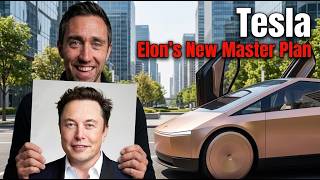

Tesla Will Destroy Uber?
45sControversial claim about Tesla dominating Uber immediately grabs attention due to the strong rivalry between the two companies.
▶ Play Clip"The title promises a bold claim about Tesla wrecking Uber, and the video delivers a detailed, data-backed thesis, though it's padded with personal anecdotes and self-promotion."
The video argues that Tesla is poised to disrupt Uber's dominance in the ride-hailing market, not through its own robotaxi service, but by selling Cybercabs to fleet operators who can leverage tax benefits for massive write-offs. The creator revises his earlier thesis that Uber would aggregate all autonomous vehicles, citing Waymo's departure from Uber's app as evidence that users prefer direct, high-quality robotaxi apps. He concludes that Tesla's real profit engine will be vehicle sales with high margins, not per-mile ride revenue.
The creator believes Tesla will 'completely wreck' Uber, despite Uber's low PEG ratio (~1), because Tesla is about to dominate the robotaxi market.
Tesla's advantage isn't charging for robotaxi rides but making money from selling Cybercabs to fleet operators, leveraging tax benefits.
The creator originally thought the first app users are conditioned to use (Uber) would win, but this thesis was proven wrong.
Waymo ended its three-year contract with Uber in Phoenix (announced June 29, 2026) and is also leaving Dallas and Austin by January 2028, indicating a shift to direct-to-consumer robotaxi apps.
Users are going directly to the Waymo app (rated 5 stars with 245,000 reviews) instead of using Uber, proving that a superior product can displace the incumbent.
The hardest part of robotaxi fleets is cleaning and charging infrastructure, which Tesla avoids by selling vehicles to fleet operators who handle these tasks.
Tesla can sell Cybercabs to fleet operators with contracts requiring a 4.7 star rating, incentivizing cleanliness, and allowing operators to write off 100% of the vehicle cost due to Trump's tax policies.
A dentist with $1M income could buy 30 Cybercabs (~$32,500 each) to write off taxes, paying zero taxes, while Tesla gains financing upside and pricing power.
Tesla's strength is mass manufacturing at low cost, not operating a low-margin mileage business; they should be valued on vehicle sales with high margins.
Tesla's Full Self-Driving subscription has a 99% margin, and Tesla is far ahead of competitors like NVIDIA's Thor platform, which has been 'coming' for years.
Tesla trades at a ~5 PEG, considered pricey, but the creator's 2030 price target is $605 (with Optimus and Semi), or $542 without them, based on 4 million cars sold.
By adding $1B to FSD subscription revenue and boosting sales margin to 30%, the price target jumps to $775, implying $11.48 EPS (10x current), though this is above Wall Street's $7.58 estimate.
Even if the thesis plays out a year and a half later, the return is still attractive (~14.8%). Risks include interest rate hikes and market volatility.
Profits from Cybercab sales will be reinvested into the Optimus robot program, which is a 2035-2040 play, similar to the creator's own Reinvest company model.
Tesla's future value lies in selling Cybercabs to fleet operators who can exploit tax write-offs, not in operating robotaxi services. This strategy could lead to a 30% gross margin on vehicles and a 99% margin on FSD subscriptions, potentially driving the stock to $775 by 2030.
Waymo-Uber Split
This is a concrete example of a major player leaving Uber's platform, supporting the thesis that direct robotaxi apps are winning.
03:23Fleet Operator Model
This is a novel business model for Tesla that leverages tax benefits to create high-margin vehicle sales.
09:29FSD Subscription Margin
The 99% margin on FSD subscriptions is a key profit driver that is often overlooked.
13:32Revised Financial Model
The model shows how small changes in margins can dramatically increase the price target, highlighting the power of operating leverage.
16:51[00:00] I think Tesla is about to completely wreck Uber. I hate to say it, a lot of people are really bullish on Uber because the valuation is pretty low. I think the peg ratio for Uber right now, we'll go look at our course numbers top tab,
[00:12] but I want to say it's close to like a one peg, which is very low for the company. And that is really the market pricing and some uncertainty for, you know, how its growth is really going to play out at this business.
[00:24] That's another reason why, you know, like Broadcom trades for a one peg, and Nvidia trades for a 1-peg because people are like, can this boom really keep going? But I mean, if I had to pick between a 1.09-peg on Uber
[00:36] or a 1 on Nvidia or Broadcom, then I'd go all in on Nvidia or Broadcom all day long before Uber. And I think that is because Tesla is, in my opinion, about to dominate Uber.
[00:50] And there's something that happened this year with Uber and Waymo that really makes me think Tesla is onto something. And no, it's not charging for robo-taxi rides.
[01:03] It's making money from something else related to the cyber-tab. So, you'll see in just a moment. We'll go through this. Okay, so, look. Tesla's down like 19% year-to-date. It's been pretty volatile.
[01:16] And, you know, I'm not here to say this thing's going to go straight up to the moon. And, you know, it's not going to be resilient against if the AI bubble pops when we go into some deep, dark recession. You're going to obviously have problems.
[01:28] But I think there's something that people aren't underwriting for Tesla that should be part of Tesla's valuation. And so that's what we're going to talk about here. In order to understand this component and sort of the change and how this goes back to what Tesla has already proven in the past,
[01:42] you have to kind of know my original thesis on RoboTaxi. My original thesis on RoboTaxi was actually, in my opinion, currently proven wrong. And so here's my original thesis on RoboTaxi.
[01:55] People will hail a cab on whatever app they are conditioned to use first. So they'll open up their phone, all right, I need a ride, honey, we got to go, we're going out, you know, whatever. We're pulling up the Uber app, boom, we're putting in that order for a car, done.
[02:10] And I think that first, or I thought, that first draw app would always end up being the app that wins. because you just use Uber 90, 95% of the time, and you only go to Lyft if, like, the prices seem ridiculous
[02:24] or the availability is too slow on the Uber. But otherwise, it's like Uber, Uber, Uber. Now, I thought this would be the case with RoboTaxi as well. And so I thought it was pretty smart of Uber to say, you know, we're going to partner with other self-driving firms like Waymo or others,
[02:43] and so people can just experience whatever vehicle they want in Uber. you just pick. Oh, I want an EV. I want the XL. I want the XXL. I don't even know what the difference between those two things is anymore. But anyway, you know, I thought this would be true of RoboTax.
[02:57] You would just sort of like have your MLS for real estate, except it's actually the MLS for cars, the different sort of menu of options. That's the app you go to, and so Uber gets their margin.
[03:09] They've got the systems and infrastructure in place to handle it, and they've got the distribution. So that was my thought. Not only do they have distribution, but they also have this sort of first mover advantage. The problem with all of this is what happened between Waymo and Uber this year.
[03:23] So, Waymo told Uber, we're done. Our contract, three-year contract in Phoenix is over. And they just made that announcement in, I think it was June 29th of 2026.
[03:36] Quiet killing. A lot of people didn't even pay attention to that. I talked about it then, but I'm talking about it even more clearly now, after the cyber cab event because it's worth bringing up again. But it's not just Phoenix. Uber's also getting ready to give the middle finger to Dallas and Austin,
[03:54] or sorry, Waymo, if I didn't say that right. Waymo is getting ready to give the middle finger to Uber in Dallas and Austin. And they'll be out of their contract there by January of 2028. And in new areas that they're rolling out, it seems to all just be direct Waymo,
[04:07] which is how it is in, let's say, San Francisco or some of the other parts of the country they're in. and initially I thought, I don't know man, like, it makes more sense Waymo is just going to be in the Uber app and then you just click, I want the Waymo, I want self-driving, and then the Waymo shows up
[04:20] or a Tesla Robo Taxi shows up, and so when I first heard about the partnership I'm like, aha, that's exactly what I thought would happen confirmation bias never felt so good
[04:35] and then, turns out I was wrong See, what's actually happening is people are more and more realizing that when you use the Uber app,
[04:47] you're like 95, probably 99% of the time, getting a human-driven car, and people are freaking tired of it. And so when people want a robo-taxi, they're not going to Uber to get their robo-taxi.
[05:01] They are going direct to the five-star app that they can get their hands on. And so when people want a robo taxi, they just open up the Rainbow app and look at that frickin' ass! Number five in travel?
[05:13] Five review on 245 ratings Holy smokes Why would you bother using Uber when you could just use this This has a perfect reputation it got a great app Waymo has proven my thesis wrong
[05:34] And that actually matters when it comes to Tesla, because it means the Tesla Robotaxi app can also function to this style or this competitiveness, which is actually really
[05:49] bullish, in my opinion, for Tesla. Now, I want you to see a particular chart, and we're going to talk more about Tesla in just a moment. But I want you to see this chart. And just ignore the dates for a moment. But what you can see here is this green section, which is Waymo.
[06:02] And the percentages don't matter because Waymo is coming off of a smaller, you know, scope. But what you can see is Lyft and Uber are seeing a decline in estimated downloads. That may be because you kind of already hit, like, saturation.
[06:16] You know, it's like, how many times do I have to download the Uber app? You know, I already got it. But you're seeing Waymo come in and start eating some of this for Lyft and Uber. Now, the reason I said it go in the day promo is because you might think that this chart is too late.
[06:31] But the most recent chart I could get from this was actually with data going through February of 2025. So it's old. But my thesis is that this trend has likely continued and accelerated,
[06:46] especially with, I mean, when we look at this, 245,000 five-star reviews, man, that feels like it's 100,000 more reviews than where it was the last time I looked, and it still has a five-star review. Holy smokes! can we get a five-star review on the Meet Kevin app, please?
[07:01] I mean, we used to be five-star for a long time. We've come out with so many new features for it. We are at 4.9. Come on. We're going to fix that. We're going to make it better.
[07:14] But anyway, so what's really interesting about this is this trend proves to me that my initial opinion was wrong, that when people find a better product or service, they're going to dump Uber like the hot potato brick deserves to be dumped at.
[07:30] And I'm not saying that I have anything wrong or to say anything about Uber as a company. It has to do with the drivers, the subcontractors. So I'm not here trying to bag on Uber stock.
[07:42] If you own Uber stock, it's not the purpose of the video. It's the fact of the matter that Waymo knows what people want. They want consistent cleanliness. They don't want a driver where they have to listen to them
[07:54] sing their phone calls. They want to have their own phone calls. They want their own climate control, their own music. They don't want to listen to, you know, whatever the heck it is you listen to. And I have had to listen to some crazy songs on Ubers or even
[08:06] a driver singing or they drive like maniacs or they drive really slow or they're just really old and it takes them like a seven second latency to realize the light is green.
[08:18] There's a lot. And maybe that's not related to age. Maybe that person just shouldn't have been driving anymore, right? Or the worst one, of course, is when they just have the windows down because they want to save on gas for not running their air conditioning, yet the drag they are
[08:31] probably creating, that aerodynamic inefficiency they are creating, is probably slowing their car down more than if they just ran the air conditioning. But honestly, that's for the engineers to debate. That's not for me to debate. My point is, all of this points back to Tesla. Tesla can get all of
[08:47] these benefits plus one thing. Fleet operations. See, the hardest part, in my opinion, of these robotized fleet operations, and literally the hardest part, is having the cleaning and
[09:02] charging infrastructure. You literally need commercial space, you need commercial charging equipment, likely DC charging equipment, direct voltage, you need some form of clean infrastructure
[09:17] where these things can get cleaned up when there's a problem. And ultimately, that is a lot. Now, Tesla could scale it. But why? That's going to be the lowest margin portion of this business.
[09:29] Why do you want that? When you could literally just sell the vehicle to fleet operators and make them a gradual contract. If your star rating falls below a 4.7, you're done.
[09:42] we'll buy the cars back from you at a you know 75% discount or some depreciated value but you're done you're out of fleet and somebody else is going in that incentivizes the contractors
[09:55] to actually keep the products clean it also gives the contractors the benefit of being able to launch a business especially if they have the land to launch this business and the infrastructure to launch it it's another potential source of revenue
[10:08] obviously they have to work for it it's not free money but then they also get to buy equipment that they're going to be able to write off 100% because of Donald Trump's tax benefits. So now you actually have a buyer who is buying an electric vehicle
[10:20] not for your $7,500 EV credit, but for literally a 100% tax write-off on a depreciable asset thanks to Donald Trump's policies. This as a business has actually become a potentially massive margin product for Tesla And Tesla has proven in the past that we can get with tax benefits to a 30 margin on these vehicles growth margin I think with the fact that people can
[10:49] upfront depreciate the crap out of these. In other words, let me give you an example, okay? Let's say you're a dentist and you've got, I don't know, a really big commercial facility. You own the whole frickin' strip mall, okay? And you're your own anchor tenant.
[11:01] A dentist isn't an anchor tenant, but you know what I mean. And whatever, okay? You've invested well, you've done well. And you've got a big year coming up. You're going to have a million bucks of income because, you know, you do great with your dentist practice. Fantastic. Okay, we want to write some of this off.
[11:14] Well, why don't we just go buy a crap load of equipment as part of our business? And, you know, I'm not a tax guy, okay? But let's just say I now go, I've got, you know, operating income of a million bucks in my dental business.
[11:27] And this other portion of my business is now going to be renting out tax laws. And I'm going to buy a million dollars worth of cybercabs. I'm going to guess and this is going to be an FSD subscription as part of it
[11:40] so this will be without full self driving you've got to add inflation to the $25,000 car okay, everybody wants the $25,000 car but let's be real, we need to add like 30% inflation to this and honestly that's still in fairness
[11:52] the $25,000 car that Elon then promised I know, I don't want that to sound like cope I just think that's reasonable so that's $32,500 divided by $32,500 I go in, buy 30 robo-taxis, boom.
[12:06] I just instantly wrote off what I would have otherwise had to pay 500 grand in taxes on. I just paid zero in taxes. And then you finance these Teslas as well, and then you're carrying over even more tax benefits if you want,
[12:19] or just put half down, you know, whatever you want. Tesla gets the benefit of financing upside. Tesla gets the benefit of pricing power because you're giving people a massive tax write-off. Tesla gets the benefit of not having to deal with the cleaning and charging.
[12:33] Tesla gets the benefit of selling the damn car up front and collecting the fat margin up front, which, holy smokes, what is Tesla good at?
[12:48] Mass manufacturing in a creative way to bring costs down. That's what the cyber cap is. This is not stop valuing this company on how much money they could make running and operating this low-margin mileage business
[13:05] that's going to commoditize. Oh, they're going to make a dollar a mile. They're not going to make a dollar a mile. They're going to print money taking advantage of the tax benefits that allow them to have pricing power on the vehicles,
[13:18] which actually allow them to sell the cars maybe for even more. Maybe they sell them for $40 and they take 30%, 40%, 35% gross profits. Who cares? plus the 99% margin on the RoboTaxi FSD,
[13:32] full-touch driving subscription. That is where the money is. They're the only ones still yet who have this. We think, oh, NVIDIA's got the Thor platform. They're coming!
[13:45] Dude, that's been said now for like, I don't know how long, at least four years. I still only see brand new rental cars with adaptive cruise control. Like, that's the most I seem to be getting in Europe or America is adaptive cruise control.
[14:01] And maybe I'm missing something, but Tesla's so fracking far ahead, it's insane. And that's why they're aiming at fleet. That's why they've got a fleet sign-up. That's why the plug is a DC plug.
[14:14] And then Tesla can take those profits and reinvest them into Optimus Robot. I think that is a real thesis for this company. Now, the company is based on current estimates.
[14:28] On the pricey side, if we look at the peg ratio for Tesla right now, it is unfortunately high. And I am not here to tell you it is down in the dumps in dirt cheap right now.
[14:40] Right now, based on its earnings expected, it's trading for about a 5 peg. I can buy AI cybersecurity stocks for a 5 peg right now. And, you know, maybe that has already played out. But the point is, there's a lot of optimism around Tesla in charging per mile and optimists or whatever.
[14:59] I don't know when my thesis is going to play out, how quickly they can get to manufacturing. Right now, we've got about 125,000 vehicles that we could produce cyber-cap-wise with the unbox strategy. We don't know what the margins are going to be yet for this.
[15:11] But I wouldn't be surprised that by the end of the decade, maybe, okay, maybe by the end of the decade, they're booming on robo-taxi sales. And now what you're really doing is instead of worrying about revenue per mile on Robotaxi,
[15:26] you're actually coming to my number and you're saying, Kevin, it is back to vehicle manufacturing. Number of vehicles we can sell. Except rather than running it at an 18% margin, we're going to jack up the whole fleet to a 30% margin
[15:40] because we're going to assume we could sell these cybercap businesses who could write it off at a 35% margin, average it with the rest of the business that's 18% now, 18% now maybe it goes up to 22 or whatever and so now what we can do is we
[15:54] can actually jerk around these price targets so right now we have this 2030 end of 2030 for four price targets I honestly it like three and a half now Three and a half price target of 605 That does include we got revenue from the Tesla
[16:12] bot. This could be aggressive. Let me just remove the Tesla bot here, okay? Because I'm just going to be conservative. We'll add it back in in a moment. We're going to put the Tesla bot at zero. And semi-truck, operating income 3.5. You know what? Let's just be mean.
[16:26] Let's just set that to zero, too. Okay, we'll come back. We'll add those back in. So if I set those to zero, I'm still at $542 at 4 million cars. Okay, that still is twice as many vehicles as we're selling right now.
[16:39] But now what we're going to do is we're going to take that FSD revenue. Where do we got it? Sales, leases, services, energy, operating income from FSD subscription.
[16:51] We're going to add another billion bucks to FSD subscription right here because you're going to charge more to those fleet operators because they can write it off. Remember, businesses charge businesses more, okay? It's that simple.
[17:03] Operating income, I'm now going to change this on sales to 30% blended, and I just want you to see how this changes, okay? Just adding a bill to FSD at high, high margin to boosting the biggest line at the top to 30%.
[17:18] Mind you, I literally set Optimus and SemiTruck to zero on purpose, and I haven't even pre-calculated this. I just have a feeling it's going to be big because this top line drives this business.
[17:31] Oh, $7.75. Holy moly. See, that kind of rate of return, I like. Now, what does that take? That takes $11.48 of EPS.
[17:45] That's 10x where we are now. Now, obviously, markets do not expect, analysts do not expect Tesla to 10x earnings per share right now. I will tell you what markets do not expect.
[17:58] Editing 10x. And so who knows? Maybe I'm bulking up the wrong tree here. And I don't think this catalyst needs to be soon. There can be plenty of other poopy-doopy catalysts.
[18:10] You know, people could get nervous before or after midterms. Or, you know, maybe the Fed makes a mistake and starts rapidly hiking. I don't know. Stupid things can happen. Tesla is interest rate sensitive, so if they hike rates, you know, it's going to suck.
[18:24] $1.66 is the current Wall Street estimate. We're at 34.7, 34.7 plus 40.7 plus 63.4 plus 47.6.
[18:36] 186% growth, that's like almost a 3x. Okay, so average growth rate about 46%. Actually, by the end of 2030, it gets to about, oh, that's what I did. It is actually, it's closer to four and a half years because it's the end of 2030 is how I run this.
[18:53] So it's actually more like 4.25. There we go. So they have EPS at $7.58. I'm at $11.48. So, you know, I'm still a bit above.
[19:07] $11.48 divided by, what is this, $7.58. That's 50% away. I might only be a year and a half ahead. My schedule might actually only be a year and a half ahead.
[19:19] So even if I'm a year and a half early, who cares? If I have to set this to 5.75, it's still a good return on my investment. 14.8%, right? And you all know I'm a big fan of reinvesting profits from one part of the business to another business.
[19:33] But that would be the end of, I mean, that's after all what we named our company after, Reinvest, right? People are going, well, what are you reinvesting? What's Reinvest? It's HouseHack. We just renamed it Reinvest because we opened a software division, and we've got, you know, a team of like, I don't know, 10 or 12 developers now or whatever, and we are just cranking on real estate AI and changing real estate AI where nobody has done it before.
[19:54] I'm not trying to pitch you on it. I'm just trying to say the point is revenues we make from software, memberships to that AI or whatever, that's just going to go get reinvested into real estate, you know, our sort of core business.
[20:07] And so I think what they'll actually do with robo-taxis is the money they make selling those vehicles, those cybercabs, they turn around and dump that into the Optimus program.
[20:20] 18% move to 30%. Now, the Optimus program, I think, is like a 2035 to 2040 play. Okay. If cybercaps are scaling to 2 million units or whatever by 2030, now you've got capital and cash for your own baby to reinvest in Optimus.
[20:38] And then, you know, getting the little arm and the servos for the arms worked out. You know, we'll have figured it out by then. That's my take. Honestly, like, you know, between you and me, maybe it'd be a good thing if Tesla goes down just a little bit more.
[20:58] and we get a little bit more of an attractive entry here. But even where it sits now at $350, you know, if we'll write about the strategy with the cybercab, there's something to this. I don't even know how to advertise these things each other here.
[21:11] I feel like nobody else knows about this. We'll try a little advertising and see how it goes. Congratulations, man. You have done so much. People love you. People look up to you. Kevin, top left-hand finance analyst. And YouTube up, meet Kevin. Always great to get your say.


⚡ Saved you 0h 21m reading this? Transcribe any YouTube video for free — no signup needed.