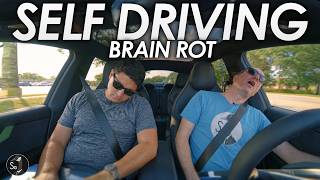

Tesla FSD vs 70% of Drivers
45sThe bold claim that AI is better than most human drivers sparks debate and curiosity.
▶ Play Clip"The title promises a discussion of self-driving and brain rot, which the video delivers, though it's more of a conversational debate than a deep dive."
This video features a discussion about self-driving cars, specifically Tesla's Full Self-Driving (FSD) technology, and its broader societal and philosophical implications. The hosts test the latest version of Tesla's FSD, highlighting its capabilities and limitations, and debate whether such technology enhances accessibility or erodes human accountability and driving skills.
The video begins with a discussion about driverless cars, focusing on the Tesla Model 3, the cons of the technology, and its philosophical implications for society and people's ability to drive.
The hosts are in a Tesla with the latest hardware and software, planning to let the car drive them to a coffee shop without touching the controls.
Level 1 and 2 are described as 'glorified highway' driving with steering assist and speed management. Level 2.5 (e.g., Toyota, Super Cruise, Blue Cruise, BMW Driver Assist Pro) allows hands-off driving on designated highways. True Level 3, like Tesla's supervised driving, can take you from driveway to destination, including rural areas.
The systems use eye-tracking or camera systems to ensure driver attention. Some people spoof the eye-tracking with pictures, which is deemed extraordinarily dangerous. The hosts suggest that those who spoof the system and cause a wreck should go to jail.
The host believes the technology is better than about 70% of the population driving currently. It can navigate obstacles, park itself, and opens doors for people with disabilities, low driving aptitude, or those who are tired.
The hosts clarify that this is not full unsupervised driving. The driver must watch the system because it can make mistakes, and the responsibility ultimately lies with the driver.
The car's capabilities at a price point of $40,000-$50,000 plus a $100/month subscription are considered crazy. The host notes that this is the result of many years of iterations and dedication from the brand, which is hard to replicate.
The host raises the philosophical question of when technology becomes an enabler for removing accountability from people, and where the middle ground is between technology and learning.
The other host argues that buying this car is a conscious choice. If you want the technology, you pay for it. The benefit is for older people, those with disabilities, or those who are tired and want their drive to be less busy.
A con of the technology is that it can make you a worse driver over time because you aren't driving all the time. Your skills dull, and when you need to drive manually, you become a more dangerous driver.
The host reflects on how driving has become a burden for many, due to traffic, insurance, fuel costs, and accessibility. The idyllic idea of car ownership has turned into a nightmare for most people.
The technology provides accessibility for older people, like the host's parents, who would be unable to get around without a car. It helps them get to places they need to go.
The host believes the ship has long sailed on making people better drivers in the country, citing infrastructure, DMV, driver training, and the attitude towards driving as the reasons.
The host argues that the technology is amazing and the Pandora's box is already open. For people who are maxed out and find driving a punishment, this technology provides a huge reprieve, even if they still have to pay attention.
The host describes the 'survival loop' people get into, where they are so busy paying bills and surviving that they have no time for leisure activities like a Sunday drive. This technology offers a reprieve for such families.
The host is excited about where the technology will be in another five to ten years, expecting it to get 'frighteningly good' based on the improvements seen since the previous version.
The hosts ask viewers what they think about autonomous driving, whether they would want it, and whether technology is dumbing us down to the lowest common denominator.
The hosts conclude that self-driving technology is a significant and irreversible advancement that offers substantial benefits for accessibility and convenience, but it also raises serious questions about human accountability, skill deterioration, and the potential for society to become overly reliant on technology.
What are the characteristics of Level 2.5 self-driving?
It allows hands-off control on designated highways, as seen in Toyota, Super Cruise, Blue Cruise, and BMW Driver Assist Pro.
01:47
What is the main difference between Level 2.5 and Level 3 self-driving?
Level 3 takes you from driveway to destination, including rural areas, not just highways.
02:01
What is the estimated percentage of the population that the Tesla FSD is better than?
About 70% of the population driving currently.
03:21
What is a major con of using self-driving technology?
It can make you a worse driver over time because your skills dull, making you more dangerous when you need to drive manually.
06:47
What is the 'survival loop' described in the video?
A loop where people are so busy paying bills and surviving that they have no time for leisure activities like a Sunday drive.
11:29
FSD Better than 70% of Drivers
Provides a concrete, quantifiable claim about the technology's current capability, sparking debate on its readiness.
03:21Technology and Accountability
Raises a core philosophical question about whether technology removes personal accountability and learning.
05:00Skill Deterioration
Highlights a practical downside of self-driving: the potential for drivers to become less skilled and more dangerous when manual driving is needed.
06:47Accessibility for the Elderly
Shows a positive social impact of the technology, providing mobility for those who cannot drive.
08:11The Survival Loop
Explains why many people see driving as a burden and how self-driving can offer a reprieve from the daily grind.
11:29[00:11] discuss driverless cars or self-driving vehicles starring the Tesla Model 3. the cons of the technology and the philosophical implementation of it and what it does to our society and people's ability to drive.
[00:39] We're in a Tesla. Latest version of hardware and software. It's going to take us to the coffee shop. I'm not going to touch it. >> how many lattes are you going to get? >> At least three. I think that's going to
[00:52] keep me balanced and energized at at 4:30 in the afternoon. [laughter] self-driving for a while, and now that we have that we're in this Tesla, and about this, there's been some radical changes in
[01:07] compared to the last time that we've driven it. And people are absolutely phobic of this technology and others that own this car and have experienced it, it's very hard for them to go back to a regular car. And I think our
[01:21] experience so far with it and the other vehicles that are trying to emulate at least different self-driving functions have a lot of catching up to do. But let's just give people a background of the the the layers of self-driving.
[01:33] Currently, you have level one and two, which is just essentially glorified uh highway, you know, there's some steering assist. It can manage its speed and slow it down for you. When you get to level 2.5, what we're seeing from like the
[01:47] Toyotas, Super Cruise, Blue Cruise, BMWs, like Driver Assist Pro, it actually will take control. You don't have to have your hands on the wheel on designated highways. But when you get to level true level three like this
[02:01] supervised driving, it will take you from driveway to your destination. That's not just highways, it's rural areas as well. Um, and the only mitigate eyetracking or in this case camera systems that are looking at you to make
[02:15] >> That big brother is always watching you. >> Yes. 100%. And you have to watch these systems, right? That we're not at the place where you can just sit and screw >> Now, there are people that are spoofing this by putting up like pictures of
[02:27] the eye tracking, faking the eye tracking, so they don't have to pay attention, but that's extraordinarily dangerous. None of these brands support spoof the cameras to sit in the back seat and you get in a wreck, I think you
[02:39] should be going to jail for doing something like that. So, that's where >> Of course, you have the Whimos and everything above this, which are its own >> which those are kind of commercial and they're typically geoenced, right? Like
[02:52] right? Like they're in a geoence zone. So, it's not true like full level five. >> Yes. >> So, let's talk about the pros and cons >> So, let's talk about the pros and cons of this technology first. Um,
[03:07] >> It squirrel lived and the car stopped itself before it hit it, too. So, there's a perfect example of I think after utilizing this specific version, in my view, I think it's better than about 70% of the population driving
[03:21] currently. It's able to get around obstacles. It's able to see certain things if the cameras can actually see. It's able to navigate through difficult situations, park itself, and this opens up. And I always say technology, the
[03:36] things more accessible to the common person that wasn't there before. So if you can't drive very well, if you have a disability, you're super tired, um your driving aptitude's low, this opens the door for more people to get a bad day.
[03:51] >> Yeah. Yeah. Absolutely. >> This is much much much better now than where it was when we first drove a Model Yodel 3 like 5 years ago at this point. >> Right. And ju just to clarify that this is not full unsupervised. Like you have
[04:07] have to watch it and make sure it doesn't make a mistake because at the end of the day it's on you. You could really hurt somebody or hurt yourself if and if this thing makes a mistake. >> And it does make mistakes.
[04:19] happen. And we've seen it happen not just little ways, big ways. >> But to get to that full like level five where there's no steering wheel or brake or pedal. Yeah. That that's just not we're we're nowhere near that. And so
[04:31] what this car is able to do for that price point of like 50 $40 $50,000 and a $100 a month subscription, which I'm sure will be like 500 sooner or later. Uh it's crazy what it's able to do, but this is so many years of
[04:45] iterations. This brand has been dedicated to this, so it's really hard to to replicate it. So the philosoph philosophical question Jack is, you know, at what point does technology become an enabler for people to remove
[05:00] accountability from people? Not just this, but learning and growing as a as a society and people. What point do we stop constantly buying into this, allowing like big companies, engineers to kind of dictate our future because we
[05:15] like everything easy? And where where is that middle ground of technology everything and we us learning? >> See, I I I view this entirely different than you. If you're buying this car, this is what you want. And the whole
[05:27] capitalism thing is if you want it, you'll buy it. Most other cars don't have this technology. And either in the enthusiast car space or a lot of the regular vehicles, there is no sign of that stuff coming for a long time. And I
[05:40] think people's willingness to to pay for it. they are you are taking that step to because you want this stuff. I think the benefit for people candidly if you want
[05:52] self-driving cars where you're willing to pay for it is if you're older, you have a disability, you're tired, you always say you're maxed the out you you you can't deal with life, you want your drive to not be busy. I have a f a
[06:05] friend of ours used to go to Indiana every single day for his practice for allowed him just to turn his brain off which isn't necessarily a good thing but turn his brain off for an hour and a half both ways on his way to work that
[06:19] is the the benefit of this to me the con of that for those who opt into this already whether it be Super Cruise the Model Y the Model 3 the full self-driving you are making a conscious effort to pay for this it's a
[06:33] subscription So, you are saying you want to do this, but I think if you overly Yes, she's the Korean lady that drives around on the 911 on the way to golf, this deep down is what she really wants. She just wants to be driven there. This
[06:47] would make her a worse driver in the next month or two of doing this because you aren't driving all the time. You become a worse driver. Your skills dull and when you need to actually drive, you are then a more dangerous driver. I
[07:00] >> Yeah. And I think this is what really bothers me and I I I think what you're saying makes more more sense. And what I'm really trying to get at with this is the drivers on the road. And I think it's a really sad state. It really
[07:15] bothers me. It just it bothers me emotionally too because I I do feel like from the enthusiast part of me that loves the freedom of driving that that loves the freedom of driving that that that idea of we should all be able to be
[07:29] all be able to have a high aptitude with whatever we set our mind to. But I think the the world has changed so much in terms of driving. When I was young, it and feel the freedom. I can enjoy driving." Now driving is a burden. I
[07:45] really do think it's become a burden more so than ever. It's not just the daily drive and dealing with all these cars on the road. It's the accessibility to owning a car, keeping it on the road, the insurance, the fuel, or the energy
[07:58] costs. It's not like it used to be. So that idea idyllic thing of like, oh, car ownership is like it's the it's the peak. It's turned into an absolute nightmare for most people. If you're an older person, I think about my parents,
[08:11] older person, I think about my parents, they they would be absolutely if they could not get somewhere in a car. They have no way to get anywhere. If you took like in my mom's case, if you took her license away,
[08:23] >> she would probably die of depression in her house, right? Like, so this gives her or people like her the ability to get around, maybe help them get to places they need to go that they couldn't have access to before. So, it's
[08:38] because I just feel like it's it's taking everything all this tech that's being made to make things accessible is taking away the human condition of accountability and the things that people used to maybe enjoy doing. So,
[08:52] they have more time to deal with other and stack up 20 different things in their life that don't matter. And I I know that's coming from a bothers me so much. >> Yeah. I think the ship is long sailed in
[09:05] this country to make people better drivers. Long sailed. >> Like that. And that is no fault of the manufacturers. That is no fault of uh of like self-driving. That is just you know the the infrastructure that we have in
[09:21] place, the DMV, the the the driver training available in this country and the attitude towards driving in this country has and the lack of public transport transportation has turned driving while it is not a legal right
[09:34] into a view of a right for most people and as is nobody wants to invest in the DMV or driver training or blah blah blah. If you told the average person it go >> but I think that's what's changed right
[09:49] there was a lot of enthusiast argument is to raise the bar make people something like if you want a license have better driver training not just for that? >> No. Exactly. And that that's where we're
[10:04] at what they're doing now we have all this technology and engineering to be like well you know what you don't have time to do that Jack. So, we're going to donuts that you're going to gorge yourself on so you can go to your have
[10:17] appointment for your diabetes that you're going to have to deal with. You know what I mean? Like, it's it's really strange that it's changed so much in s I'm grateful for all this engineering and the proof that it actually does
[10:31] work, I'm just I'm it makes me worried for for people's ability to do stuff and just so overly reliant on this. Like, you have no control over this. But if you don't simp the joy of the society we live in for better or for worse is you
[10:45] >> Yeah. No, that's true. And that's where we're at today. So that's why I'm saying discussion. I can't believe where we're at now and it's only going to get >> I think it's a technology play though. Candidly, this stuff's amazing where it
[10:59] currently sits. Like the the Pandora's box is already open. This stuff ain't going away. The fact that for the kind of people you're talking about who are maxed out point where they are miserable and driving is like a a punishment to
[11:13] them. The fact that this gives them yes they have to pay attention but I'd say attention. This is a huge reprieve for most people. thing I'm going to say is and I was thinking about this before is the the
[11:29] loop the the world loop that people get in survival loop, right? like you have so much to pay your bills and even own a car now is insanely expensive. You get caught up in this loop of you get up, you you have to get ready, you have to
[11:43] period of time. You come home, you're maxed out when you're home. There's there's no time to do anything else for most families that are trying again in the survival loop. The idea of like going out and having a Sunday drive or
[11:56] enjoying learning how to drive or learning a new skill, that's that's a faintest dream for a lot of families, especially if you have multiple kids, environment or maybe you're a single parent with like a really taxing job.
[12:10] think this technology really does offer a reprieve for people. I I mean, I think it does. I think there's some benefit to it if they can market it responsibly, if they can be honest about what it is and also bring some level of peace to people
[12:23] knowing that there's some liability like it's not just all on you. Like you feel like that has to be more defined for people to really trust this too. where this stuff goes in another five years. Just seeing where this technology
[12:37] in Tesla's case has improved since we last drove the preface variants of this car is mindboggling. um you know the LAR versus cameras and all that. I'm I'm not going to get into that. But I I I have to imagine the next
[12:51] like five ten years this stuff is going to get frighteningly good where we're which is my dream. I want a little plastic man to sit on the front with a >> Yeah. And have him drive into a building and blow up. [laughter]
[13:06] >> I mean, sure. Um so I guess I'd be curious in the comment side of things Like anything, this is probably going to break into a political issue, but what viewers think about autonomous driving, the full self-driving from Tesla, and
[13:23] not, and whether it's something they would actually want to do, accountability part, right? Like, is is technology just really going to dumb us down into the lowest common denominator? Like, that that's the big question. I
[13:37] right? There's no no black and white, but it sure seems like the tech space today is pushing it towards that, right? Like I feel like that's the endgame. I know people say idiocracy all the time, like where you're just like a, you know,
[13:50] like when Wall-E where you're just sitting there eating your donuts. to just sit in a chair. But yeah, I'll be curious. Autopilot. >> Yeah, autopilot. Yep. Just just sit there in the pool.
[14:02] >> Um, is this what this is turning into? >> Uh, yes. >> Uh, yes. Deep [music]
[14:24] around Heads up.
⚡ Saved you 0h 14m reading this? Transcribe any YouTube video for free — no signup needed.