
Can You See Gravity?
40sThe opening question immediately hooks viewers with a counterintuitive premise, and the explanation of the classic experiment is visually compelling.
▶ Play Clip"Title promises a demonstration of gravity, and the video delivers exactly that—a clear, honest look at the Cavendish experiment."
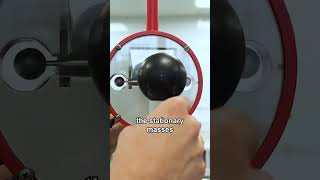
The video explores whether it's possible to observe gravitational attraction between two objects in a room, not involving Earth. It showcases a lab bench version of the Cavendish experiment at Imperial College London, demonstrating the effect with a torsion pendulum and laser.
The creator initially assumes the Cavendish experiment is too fiddly to recreate, but finds a beautiful lab bench example at Imperial College London.
The apparatus includes a long wire thread, hanging masses, and movable stationary masses. The procedure involves placing masses, waiting for settling, then switching sides.
A laser points at a mirror on the pendulum, reflecting onto a wall. The reflection moves as the torsion pendulum oscillates, allowing measurement of angular changes.
The experiment takes a long time; the creator marks the equilibrium position in green, then switches masses and shows a time-lapse of settling.
The new equilibrium position is visibly different from the old one, proving gravitational attraction between the masses.
What does the Cavendish experiment demonstrate?
The Cavendish experiment demonstrates gravitational attraction between two masses in a room.
What apparatus is used in the Cavendish experiment?
A torsion pendulum with a long wire suspending hanging masses, and stationary masses that can be moved.
00:25
How is the change in angle measured?
A laser reflects off a mirror on the pendulum, amplifying small angular changes into visible movements on a wall.
00:53
What is the procedure after the initial settling?
The stationary masses are moved to the opposite side, and the pendulum is allowed to settle to a new equilibrium.
01:09
What is the final result of the experiment?
The new equilibrium position is different from the old one, proving gravitational attraction.
01:24
Gravity Between Objects
Challenges the common assumption that gravity is only observable with Earth.
Laser Amplification
Shows a clever method to measure tiny angular changes.
00:53Visible Result
Provides direct evidence of gravitational attraction in a lab setting.
01:24[00:03] сближение двух объектов под действием силы тяжести? И прежде чем вы начнете комментировать, да, очевидно, что на Земле легко наблюдать сближение двух объектов под действием силы тяжести, если одним из этих объектов является Земля. А что, если
[00:16] в комнате всего два предмета? Я предполагал, что эксперимент Кавендиша мне просто не удастся воспроизвести в своей студии. Это кажется невероятно сложным в исполнении. Благодаря Саймону Фостеру из Имперского колледжа Лондона, у них как раз есть
[00:29] этот прекрасный лабораторный образец эксперимента Кавендиша. эксперимента Кавендиша. Здесь у вас тянется длинная проволочная нить. А самом деле подвижны. Итак, сначала вы располагаете грузы в этом положении и
[00:43] осядут. Затем вы поворачиваете неподвижные грузы на другую сторону, а затем позволяете подвешенным грузам снова стабилизироваться. Как измерить изменение угла наклона подвешенных грузов, вызванное их перемещением из одной стороны в другую под действием
[00:56] неподвижных грузов? А здесь вы видите еще и лазер. отражение на стене. И, конечно же, отражение движется взад и вперед, поскольку этот крутильный маятник, то есть висящие массы, колеблется из стороны в
[01:10] сторону. Это также означает, что всё это займёт чертовски много времени. Поэтому я надеюсь, вы простите меня за то, что на данном этапе я решил, что положение равновесия находится примерно здесь, отмечено зеленым цветом. Затем мы перекладываем неподвижные массы на
[01:22] другую сторону, и вот снова происходит стабилизация во времени. И в конце концов вы увидите, что новое положение равновесия отличается от equilibrium position is different to the old one.

⚡ Saved you 0h 01m reading this? Transcribe any YouTube video for free — no signup needed.