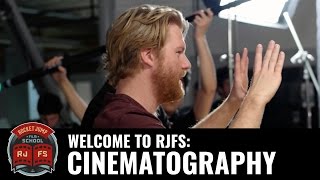

Cinematic Lighting Secrets for One-Take Shots
51sReveals how to hide lights in one-take shoots, a common challenge for filmmakers.
▶ Play Clip"The title promises a behind-the-scenes look, but the content is a bit thin and self-congratulatory, with more fluff than actionable insight."
Cinematographer John Salmon discusses the creative and technical challenges of shooting a one-take film for Rocket Jump Film School, emphasizing the importance of practical lighting and the collaborative 'ballet' of the crew. He explains how mapping the shot like a play allowed him to hide lights and how the Moby camera system enabled a complex balcony stunt sequence.
The goal was to make Rocket Jump feel cinematic, fitting for a film school, with a presentational vibe.
John and Lauren walked through the beats of the shoot, mapping it like a play to know where Lauren would look and point the camera, which helped John hide his lights.
One-take shots with lots of movement often have compromised lighting—either flat or falling off—making it hard to achieve a cinematic look, but it helps a DP grow.
John turned off fluorescents and used soft ambient light plus practicals (lights that make sense in frame), which are smart for one-takes because if the camera catches a light, it looks intentional.
The first successful take where Lauren and Freddie hit their marks and the lighting switched to noir and zombie styles felt magical, even though 15 people were working the cues.
The biggest challenge was a shot where the camera flew over a balcony, watched a stunt performer jump, and then followed him down to a crash pad.
The Moby, a relatively new technology, was attached to a crane with carabiners to achieve the balcony shot, but the real work was the manpower mastering the tech.
After the camera came down, a story beat was added, and PAs and grips practiced unhooking the carabiners so an operator could take the camera and walk around—like a ballet.
John is excited to share what he's learned to help filmmakers find their voice and make their own stuff, and he loves the idea of a free resource for learning filmmaking.
The one-take shoot was a masterclass in collaboration and creative problem-solving, proving that with careful planning and teamwork, even the most complex shots can feel effortless.
Lighting Compromise in One-Takes
Explains a key technical challenge and how it pushes a DP to grow.
00:38Practical Lights as a Solution
A practical technique for hiding lights in moving shots.
01:04Crew Synergy as Magic
Highlights the collaborative effort behind seamless shots.
01:18Moby Technology for Complex Shots
Introduces a relatively new tool and emphasizes that manpower matters more than tech.
02:05[00:00] One of the things I wanted to do when we were going to Rocket Jump was try to make it feel like a very cinematic space. After all, it's a film school, so you want it to inherently feel somewhat cinematic, and we're having this very presentational vibe as we shoot this.
[00:12] I'm John Salmon, I'm a cinematographer, and I shot the RJFS one-take shoot. So in order to prepare for the one-take, Lauren and I walked through the beats of all the different things we had to do,
[00:25] and we kind of mapped it out as if it was a play. and knowing that and where Lauren wanted to look especially, where she wanted to be pointing the camera, helped me to know where I was going to be able to hide my lights throughout the whole piece. Essentially, these one-take shots that move around a lot,
[00:38] they're known for having very compromised lighting. They're either going to be very flat or they're going to let things fall off and it's difficult to create something that's as cinematic as when you're controlling it and you're boxing it in. But I think you get to grow as a DP if you have to figure out how to make that work
[00:51] and still hide the lighting. So one of the things I did is I turned off all these fluorescents that we have in the room here and instead we created just a soft ambient light and then we filled it with practicals, which I love practicals. I love being able to see the lights in frame.
[01:04] So practicals are when you have a light in frame that makes sense to be in frame. It's not a cinema light and especially for one things like this, it's often very smart to use lights that make sense in frame so that if your steady cam operator pans off and catches a light, you can see where the light was coming from in frame.
[01:18] So that's sort of the magic of practicals and why we use them. For me, the first time that we got it where Lauren and Freddie walked up to their marks and then we switched and it was boom, noir lighting, and then it was boom, zombie lighting.
[01:31] The idea is to make it feel very easy, and I know in the back of my head that there's like 15 people working on getting all those cues to work. That a really good feeling It like we all synced up like the soccer team is finally you know all on the same page The moment when a crew syncs up and one elaborate technical move just feels like it happening from one person is really magical
[01:51] Okay. Well done, everybody. Oh, nice job. So the biggest challenge of the one-take video was we had a shot where we wanted the camera to fly back over a balcony and watch a stunt performer jump off, and then come down and follow him down into a crash pad.
[02:05] and then we wanted the camera to continue following him. Figuring out how to do that meant that we had to use a technology that's only existed for a few years now called the Moby. The Moby we attached to a crane. We had a couple of carabiners attached to that crane.
[02:17] But really, as with most amazing technical shots, it wasn't as much about the technology as it was about the manpower mastering that technology. So it involved when the camera came down, we added a story beat where Freddy came up and he said a few lines,
[02:29] maybe just one sentence. In the meantime, we had practiced and practiced and practiced with a few PAs and grips to unhook the carabiners and get the camera free so an operator could take it and then walk all the way around.
[02:41] I can think of no other word than it was like a ballet, where everyone was working together. And that's what I love about these things and why I keep on wanting to use the analogy of a play, is it involves everyone working together. No one person is allowed to drop the ball. You really have to be a supportive role.
[02:55] I'm excited just to share everything I've learned and hopefully to help more filmmakers to find their voice and get out there and make their own stuff. It's something I think now that it exists, I feel like it always should have existed.
[03:10] I love the idea of a resource that people can go to for free and just learn as much as they want to about filmmaking.

⚡ Saved you 0h 03m reading this? Transcribe any YouTube video for free — no signup needed.